
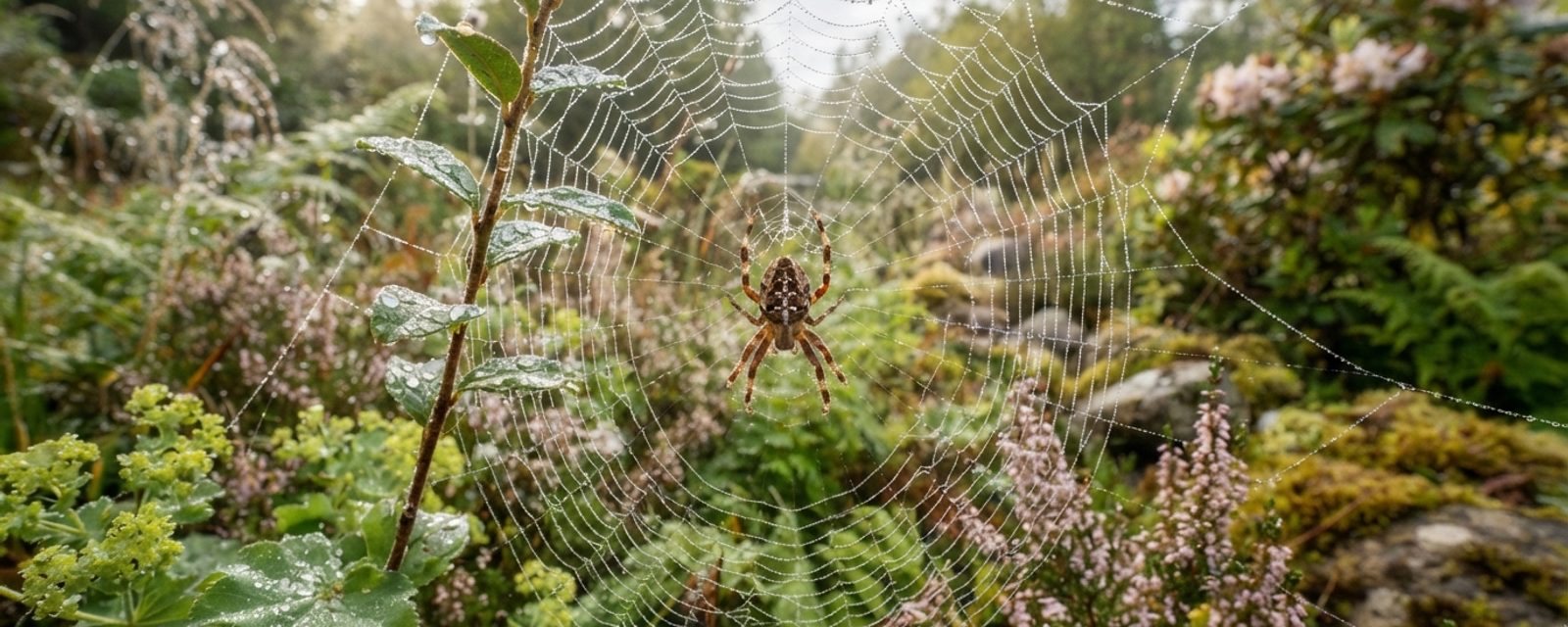
Every year around late August and into September, the same question turns up: why are there suddenly so many spiders around the house and garden? The answer isn't an infestation. It's mating season. Male house spiders (Tegenaria species) reach maturity in late summer and set off in search of females, wandering across floors, up walls, and through gaps under doors as they search every room for a mate. Their size and speed make them far more noticeable than usual, not because there are more spiders than there were in July, but because the males that were previously tucked away in undisturbed corners are now on the move.
Females, by contrast, tend to stay put in their webs. A male that finds one will often stay with her for weeks, mating repeatedly before he dies, at which point she typically eats him. It eases off again once the mating period ends.
The same autumn shift shows up outdoors. This is also when the UK's most recognisable web-builder, the garden cross spider (Araneus diadematus), is at its most visible, its large orb webs strung across paths and between shrubs and catching the low autumn light. It's the most common orb-web spider in the UK and is sighted from June through November, with its numbers and web size peaking as the year moves toward autumn.
The species you're likely to meet in a Scottish garden
A single garden can host as many as 100 different spider species, spread across lawns, flower beds, shrubs, ponds and compost heaps. Three types account for most of what actually gets noticed and identified.
| Species | How it hunts | Typical habitat | Most active |
|---|---|---|---|
| Garden cross spider (Araneus diadematus) | Builds a spiral orb web and waits at the centre for vibrations | Grassland, hedgerows, gardens, woodland edges | June-November |
| House spider / giant house spider (Tegenaria species) | Spins sheet-like cobwebs in dark corners, then ambushes trapped prey | Sheds, garages, dark corners of houses, behind furniture | Most visible in late summer/early autumn when males roam |
| Wolf spider (Lycosidae) | Active ground hunter, chases and pounces on prey, no web | Grassland, gravel beds, garden borders | March-July |
The garden cross spider is grey-brown or reddish-brown with a distinctive pale cross on its abdomen; females are roughly twice the size of males. Giant house spiders have long legs, a dark hairy body, and can run at speeds of up to half a metre per second, roughly a third of an adult's walking pace, on eight legs across a carpet, which is usually what makes an indoor sighting feel alarming even though the spider itself is harmless. Wolf spiders don't build webs at all: they hunt on foot during the day, and females are recognisable by the round egg sac carried on their spinnerets (the silk-spinning organs at the tip of the abdomen), then by the cluster of spiderlings they carry on their backs after hatching.
Not everything that looks like a spider is one
Two other regular garden and house visitors get mistaken for spiders, or blamed for spider-related fears that don't actually belong to them, including the popular myth that "daddy long-legs" is the world's most venomous spider, which mixes up two different, harmless creatures.
| Creature | Actually a spider? | Venom / silk | Where found |
|---|---|---|---|
| Harvestman ("daddy long-legs") | No, a related but different arachnid, with a small round body and no waist | No venom, no silk, catches prey with hooks on its legs instead | Leaf litter, foliage, grass, gardens and houses; around 25 UK species |
| Cellar spider (also called "daddy long-legs") | Yes, a true spider, with an extremely long, thin, tubular body | Harmless to humans; builds loose, messy webs | Almost always indoors, in the corners of rooms |
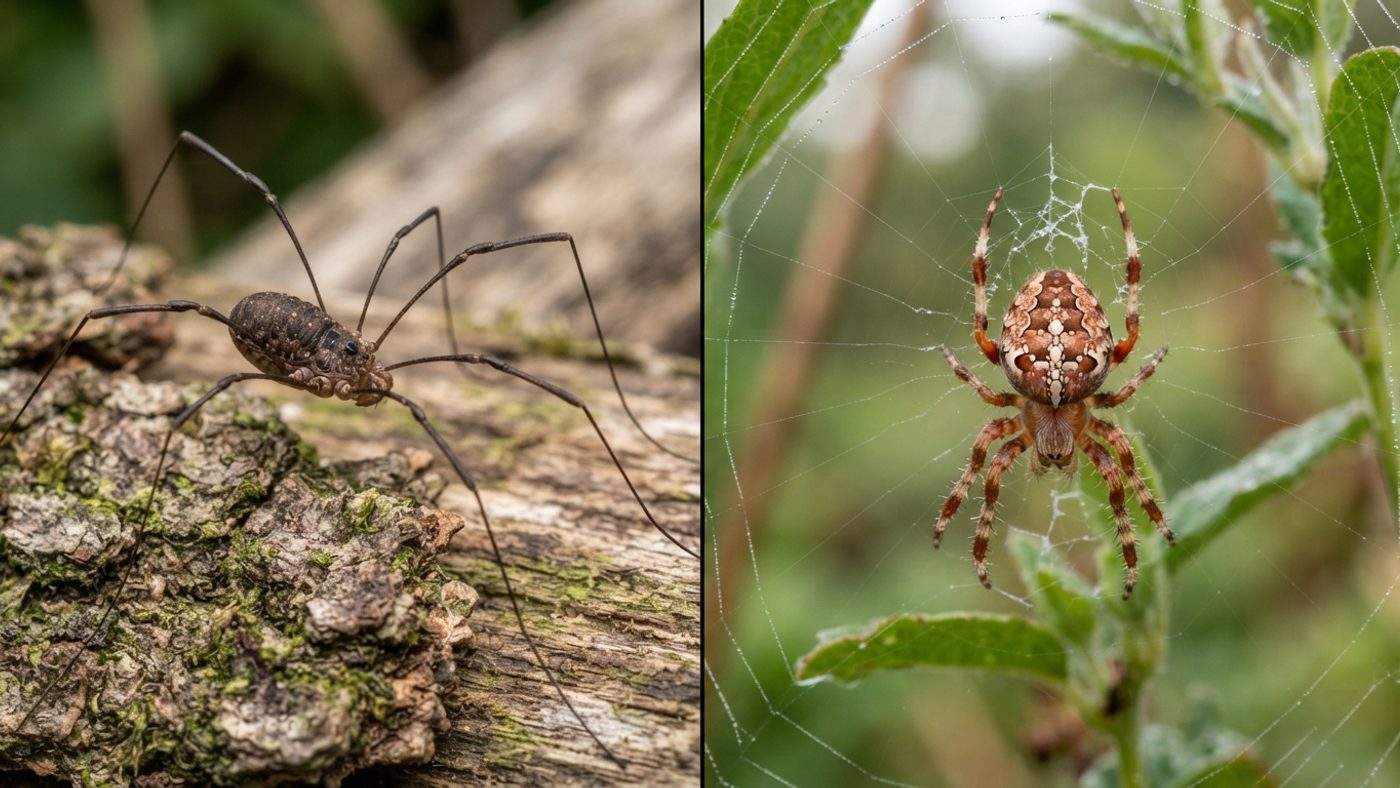
The name overlap is where the "most venomous spider" myth comes from: the harvestman isn't a spider and has no venom at all, and the cellar spider that shares its nickname is a harmless, ordinary house spider.
Should you actually be worried about a bite?
No UK spider is considered dangerous to humans in any meaningful sense. Most British spiders' fangs are too small or weak to break human skin at all, and there are no confirmed cases of serious injury resulting directly from the bite of a native spider in Britain. Very few UK spiders are even capable of biting a person, and the small number that can do so rarely does.
Even the false widow, the species most often blamed for headline-grabbing bite stories, is unlikely to bite humans, and confirmed bites are rare, and its stronghold has traditionally been further south in England, though its range has been creeping northward in recent years. The two spiders an ordinary Scottish garden actually turns up are milder still: the garden cross spider, described as completely harmless, and the giant house spider, whose speed across a carpet is the only thing about it that's actually alarming.
What spiders are actually doing in the garden
Spiders are predators, and in a garden that means insects. Web-building species catch flying insects directly in silk up to 40cm across, while wolf spiders hunt on foot; between them, spiders take large numbers of the aphids and flies that gardeners consider pests of food crops and garden plants. That predation is one part of a much broader network of natural pest control alongside ladybirds, hoverfly larvae, lacewings, ground beetles and parasitoid wasps (wasps that lay their eggs inside other insects, killing them as the larvae develop), spiders aren't a replacement for that network, but a genuine part of it, and one that works around the clock rather than only when a specific prey insect is abundant. Midges and other small flies are among the insects caught this way, alongside the timing and wind-based tactics covered in gardening around the midge.
Encouraging spiders instead of clearing them out
Because spiders are predators rather than pests, the ways to encourage them in a garden are mostly about leaving things alone rather than adding anything new.
Leave an undisturbed corner. A patch left for long grass, nettles, decaying leaves or a stack of logs gives spiders, along with the insects they hunt, somewhere to shelter through the year. Damp conditions behind peeling bark or in a log pile are inviting for spiders and beetles, which in turn provide food for hedgehogs, frogs and birds further up the chain.
Keep some bare or gravelled ground. In gravel gardens, the open space between plants gives ground-hunting spiders room to catch prey, and piles of rocks or rubble tend to get colonised by spiders looking for shelter.
Cut back on pesticides. Synthetic pesticides are toxic to more than their intended target, and using them sparingly, as a last resort rather than routinely, helps keep populations of spiders and other predatory invertebrates intact, along with everything further up the food chain that depends on them.
Go easy on outdoor lighting. Artificial light left on at dawn and dusk disrupts spiders' hunting behaviour, so keeping outdoor lights off, or on a timer or motion sensor, is a small change that helps rather than hinders them.
None of this requires special equipment or a redesign of the garden. A log pile tucked into a corner, a gravel bed left unmanicured, and pesticide use kept to a minimum will do more for the garden's spider population, and its pest control, than anything bought from a shop.
Common questions
I'd still rather not have one in the house — what's the safest way to move it?
A glass placed over the spider and a piece of card slid gently underneath, then carried outside and released, moves it without harming it or you. It works on any of the species covered here, none of which will bite defensively just from being disturbed this way.
Are any spiders found in Scottish gardens dangerous?
No UK spider is considered dangerous to humans. Most can't bite through human skin at all, and there are no confirmed cases of serious injury from a native spider's bite in Britain.
What do garden spiders actually eat?
Garden spiders catch insects in their webs, wrapping and subduing prey with a bite before feeding. Across species, spiders eat large numbers of insects considered pests of garden plants and food crops, making them part of a garden’s natural pest control alongside ladybirds, hoverflies and ground beetles.
How can I encourage more spiders in my garden?
Leave an undisturbed corner with long grass, log piles or leaf litter, keep a gravelled or bare-ground area for ground-hunting species, and reduce pesticide use so populations of spiders and their prey aren’t disrupted.
Is the "daddy long-legs" spider the most venomous spider in the world?
No, and it isn’t even one creature. "Daddy long-legs" is used for both the harvestman, which produces no venom at all, and the cellar spider, which is a genuine but harmless spider. Neither is a danger to people.
Curious about other wildlife your garden might be overlooking? See earthworms, dragonflies and damselflies and lacewings.
Sources
12 sources, recorded with what each was used for
- The Wildlife Trusts: Garden spider: Garden cross spider appearance, diet, habitat, seasonal activity (June-November) and the statement that it is completely harmless to humans
- The Wildlife Trusts: Wolf spider: Wolf spider appearance, hunting method, habitat and seasonal activity (March-July)
- The Wildlife Trusts: Giant house spider: Giant house spider appearance, habitat, running speed, and autumn mating/wandering behaviour
- The Wildlife Trusts: False widow spider: The statement that false widows are unlikely to bite humans and confirmed bites are rare
- The Wildlife Trusts: Common harvestman: Harvestman identification, no venom/no silk, diet and habitat, the ~25 UK species figure
- The Wildlife Trusts: Cellar spider: Cellar spider appearance, its almost-exclusively-indoor habitat, web-building behaviour, shared "daddy long-legs" name with the harvestman
- Buglife: Spider Bites: Most British spiders' fangs being too weak to penetrate human skin, no confirmed cases of serious injury from a native British spider's bite
- Buglife: At Home with Spiders: Male house spiders (Tegenaria species) wandering indoors in autumn searching for mates
- Garden Organic: Support your garden spiders: The ~100-species-per-garden figure, spiders catching flying insects in webs up to 40cm across, log piles/leaf litter as habitat, reduced outdoor lighting
- RHS: Dead Wood and Compost Heap Habitats: Log piles and damp/decaying wood as spider habitat benefiting the wider food chain
- RHS: Stone and Coast Habitats: Ground-hunting spiders in gravel gardens and spiders colonising rock/rubble piles
- RHS: Ideas on attracting wildlife to your garden: Using synthetic pesticides only as a last resort to protect garden predators