
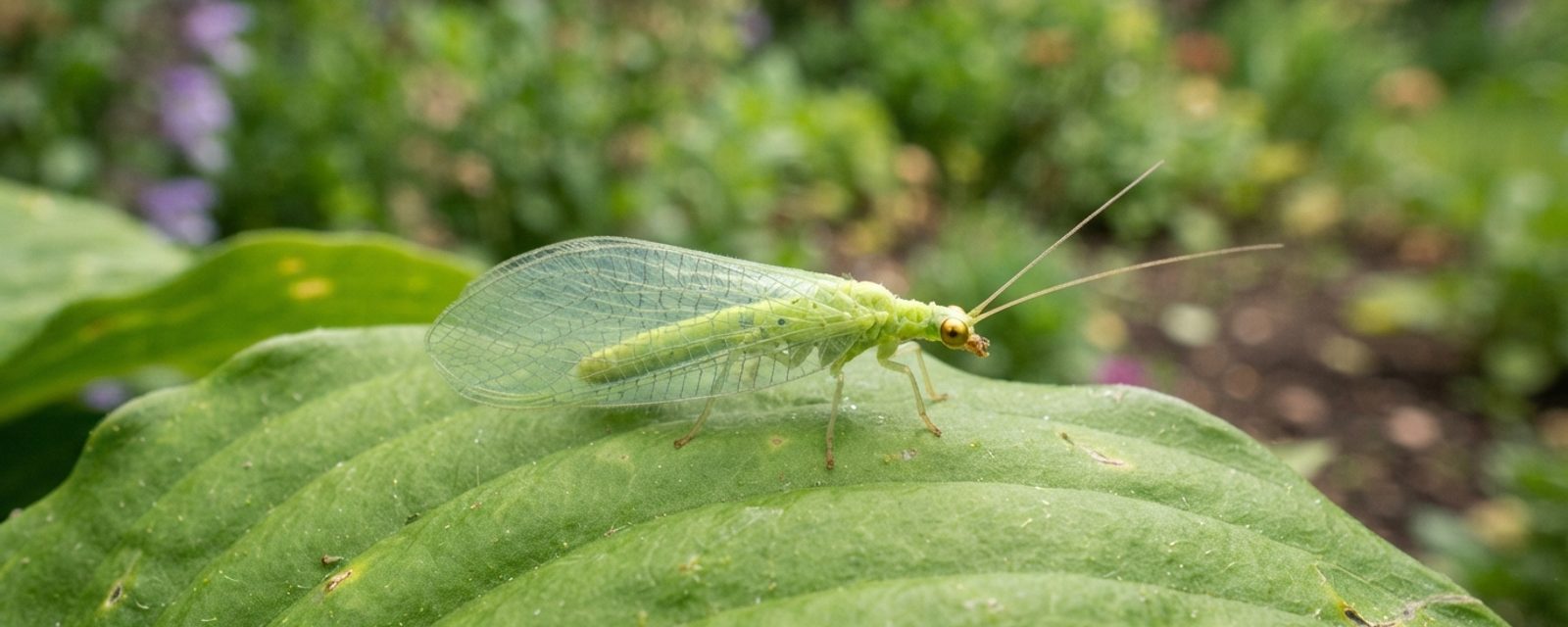
A lacewing larva does not chew its prey. It grabs an aphid with a pair of long, sickle-shaped, hollow jaws, pierces the body wall, and uses those same jaws to inject digestive fluid and draw out the liquefied contents, the aphid is, in effect, drunk rather than eaten. A single larva of the common green lacewing gets through more than 200 aphids and other small, soft-bodied prey a week during its larval stage, which is where the nickname "aphid lion" comes from. Some larvae then stick the sucked-out husks of their victims onto bristles on their own backs, wearing a coat of aphid skins as camouflage against predators and parasitic wasps while they keep hunting.
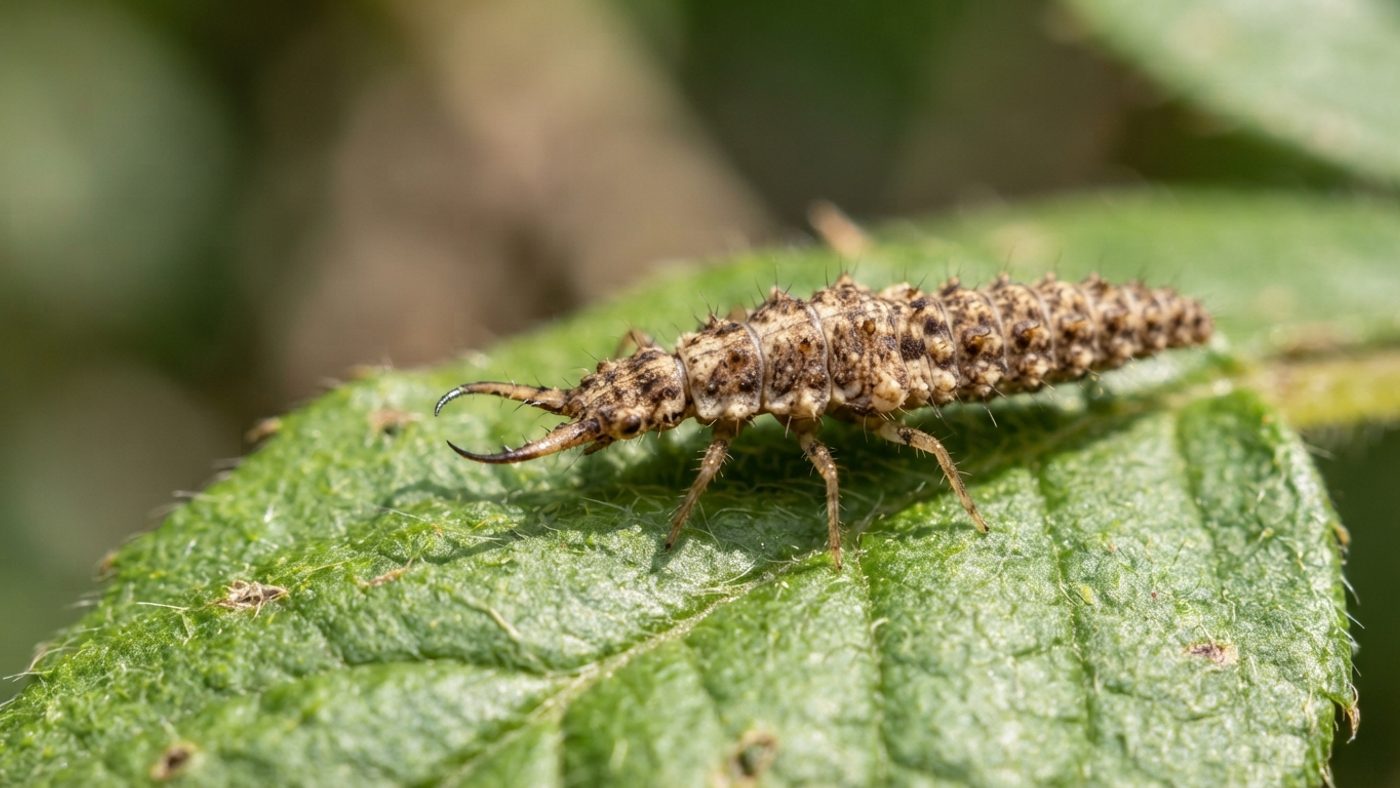
The larva itself looks nothing like the adult, which is worth knowing before pulling one off a plant by mistake: small enough to miss at a glance, elongated, tapered, alligator-shaped, mottled brown or grey, with visible pincer-like jaws at the front and no wings at all. A ladybird larva is a similar shape and also eats aphids, but is shinier, boldly spotted in black-and-orange or black-and-blue, and lacks the lacewing larva's long curved jaws. Both are predators worth leaving in place on any plant they're found on.
Once a larva has eaten its fill through several weeks of active feeding, it spins a small round silk cocoon, often tucked under a leaf, and pupates inside it before emerging as a winged adult. A cocoon on the underside of a leaf is easy to mistake for a pest egg case or a spider's egg sac, it's neither, and it's worth leaving undisturbed too.
That single behaviour, grab, pierce, drain, is the reason lacewings matter in a garden far more than their fragile, papery appearance suggests.
Green lacewings and brown lacewings
Two families turn up in UK gardens under the name "lacewing," and they're worth telling apart because their life histories differ.
| Green lacewings (Chrysopidae) | Brown lacewings (Hemerobiidae) | |
|---|---|---|
| Appearance | Lime-green body, copper or golden eyes, two pairs of large translucent wings roughly twice the length of the abdomen | Brown body, patterned brown-and-translucent wings, generally smaller and less conspicuous than green lacewings |
| UK species | At least 18 species recorded in Britain | Widespread across UK gardens; one Scottish species, the Bordered Brown Lacewing, is found nowhere else in the UK |
| Larval diet | Aphids and other soft-bodied insects, pierced and drained | Aphids and other soft-bodied insects |
| Adult diet | Nectar, pollen and honeydew, not prey | The Bordered Brown Lacewing preys on aphids and other soft-bodied insects as an adult too |
The most common species by far is the common green lacewing (Chrysoperla carnea), found in gardens, hedges, woodland edges and fields across the UK. Adults are most active from May to September, laying the eggs that hatch into hunting larvae across that same stretch of the season, and in autumn adult colouring shifts from green (sometimes blue) to a yellowish-brown with red spots as it prepares to overwinterKeeping a plant alive and intact through the cold months, whether left outdoors, moved under cover, or stored dormant. Full definition → as an adult, often inside buildings and outbuildings, which is why lacewings sometimes turn up clustered at a window or in a shed in autumn as they look for somewhere to spend the winter. Lacewings are also drawn to light after dark, which adds to why they turn up clustered at a lit window on an autumn evening, quite apart from the shelter-seeking behaviour just described. Brown lacewings generally are common UK-wide garden insects, including in Scotland; the Bordered Brown Lacewing is a separate, much rarer coastal specialist confined to a few Scottish sites, not the ordinary brown lacewing found on garden plants.
Larvae hunt; most green lacewing adults don't
Once a green lacewing reaches adulthood, its mouthparts and diet change completely: adults feed on nectar, pollen and honeydew, the same diet as adult hoverflies, and don't hunt aphids at all. A garden benefits from green lacewings in two separate ways that don't overlap: the larvae for pest control, and the adults as pollinators and pollen feeders, both worth providing for, but for different reasons.
Why broad-spectrum pesticides undo the whole point
Lacewing larvae and eggs are just as vulnerable to a broad-spectrum insecticide as the aphids the spray is aimed at. A treated plant loses its aphids and its aphid predators in the same pass, and because lacewings take longer to re-establish than aphids do to reinfest, spraying tends to leave a garden worse off against the next aphid generation, not better. Avoiding pesticide use is the single most consistently repeated piece of advice for keeping lacewings, and the other aphid predators, hoverflies, ladybirds, parasitic wasps, present and active in a garden.
Ants are worth watching for too: they farm aphids for the honeydew the aphids excrete, and will actively defend an aphid colony against a hunting lacewing larva. An ant trail running up a plant stem to an aphid cluster is a sign the aphids have a bodyguard, and a lacewing larva working that same plant may struggle to get through them, a heavy ant presence on an aphid-infested plant is a reason to look for a barrier that keeps ants off the stem, rather than expecting a lacewing larva to clear that plant on its own.
Beyond pesticide avoidance, the advice is unglamorous but real: shallow, open flowers such as alyssum, poached-egg plant and calendula give adult lacewings easy access to nectar and pollen, since their mouthparts aren't built for deep, tubular flowers, the same flower shape that works for hoverflies and parasitic wasps. Structural diversity, long grass, hedges, shrubs, a mix of heights, gives both larvae and adults places to hunt, feed and shelter.
Do lacewing hotels actually earn their keep?
Purpose-built lacewing and ladybird "hotels" are widely sold, but the strongest, most concrete practice for overwintering lacewings is much simpler: leaving winter habitat undisturbed. Adult green lacewings overwinter in sheltered, unheated spaces, commonly described as buildings, sheds and outbuildings, alongside leaf litter, log piles and dense, uncut vegetation in more naturalistic settings. Leaving stems, leaf litter and log piles undisturbed through winter, rather than tidying them away, is already the standard advice for encouraging most overwintering garden invertebrates, and it holds for lacewings too.
A commercially made hotel doesn't contradict that; at best it adds a controlled version of the same thing, a dry, structured cavity sited exactly where a gardener wants overwintering predators concentrated, for instance near a crop that struggles with aphids every spring. A log pile or a patch of leaf litter left alone does the same job for free. If a hotel is already in the garden or appeals as a feature, there's no reason to remove it, but undisturbed plant debris and log piles remain the baseline, not an inferior substitute.
Scotland's own lacewing
There is one genuinely Scotland-specific lacewing story, and it isn't about climate tolerance. Ordinary green and brown lacewings turn up in Scottish gardens on the same terms as everywhere else in the UK, with the same activity and overwintering pattern.
What is real is the Bordered Brown Lacewing (Megalomus hirtus), a small brown-bodied lacewing found in the UK only in Scotland. It isn't a garden species in the way the common green lacewing is, it's confined to a handful of exposed coastal and cliff sites, associated with wood sage on rocky, nutrient-poor, south-easterly slopes, but it's a reminder that Scotland has invertebrate wildlife found nowhere else in the UK, sitting quietly on cliffs most gardeners will never visit.
| Bordered Brown Lacewing | |
|---|---|
| Known sites | Holyrood Park, Edinburgh; the Aberdeenshire coast between Stonehaven and St Cyrus; one 2021 record from Sutherland |
| Habitat | Wood sage on rocky, nutrient-poor, south-easterly slopes |
| Active season | Late May to mid-August |
| Diet | Aphids and other soft-bodied insects |
| Status | Scottish Biodiversity List; part of the Species on the Edge conservation programme (8 individuals recorded across four sites in 2024, 13 in 2025) |
Common questions
Do lacewing larvae bite people?
No. Their mouthparts are built to pierce small, soft-bodied insects like aphids; they aren't a hazard to handle and have no interest in human skin.
What do lacewing eggs look like, and should I leave them alone?
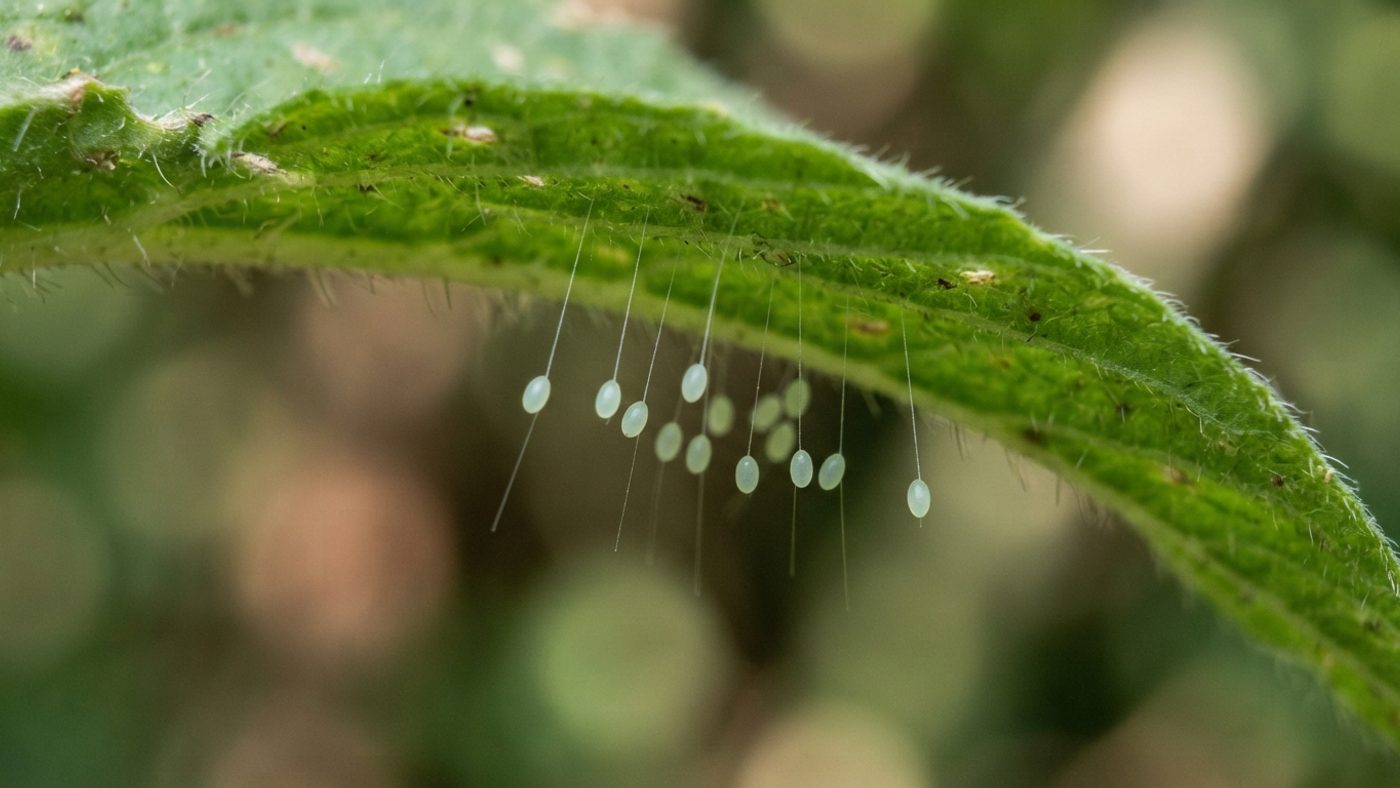
Lacewing eggs are laid singly on the end of a fine, hardened silk-like stalk attached to a leaf, holding each egg up off the surface. They're easy to overlook and worth leaving in place, each one is a larva-to-be that will start hunting aphids as soon as it hatches.
Is it worth buying lacewing larvae for a bad aphid problem?
Lacewing larvae are sold by biological-control suppliers and can be introduced directly onto heavily infested plants, typically from around June when temperatures average roughly 14°C. They won't give the instant knockdown of a spray, expect pest numbers to fall over about a week, and bought-in larvae don't establish a resident population on their own; pairing them with pesticide-free, habitat-rich conditions is what keeps lacewings around for the following year.
Are lacewing hotels worth buying?
There's no strong evidence that a purpose-built hotel outperforms leaving leaf litter, log piles and uncut plant stems undisturbed over winter, which is where lacewings are already known to shelter. A hotel can add value by concentrating overwintering predators in a chosen spot near a problem crop, but it's an addition to undisturbed habitat, not a substitute for it.
What should I plant to attract lacewings?
Shallow, open flowers such as alyssum, poached-egg plant and calendula give adult lacewings easy access to nectar and pollen. A wide mix of flowering plants alongside long grass, hedges and shrubs of different heights supports both the nectar-feeding adults and the aphid-hunting larvae.
Does Scotland's climate affect lacewings differently than the rest of the UK?
No, ordinary green and brown lacewings behave the same way in Scottish gardens as everywhere else in the UK. What is genuinely Scottish is the Bordered Brown Lacewing, a species found in the UK only on a small number of Scottish coastal sites.
Curious about other wildlife your garden might be overlooking? See earthworms, garden spiders and dragonflies and damselflies.
Sources
7 sources, recorded with what each was used for
- RHS: Aphid Predators, Natural Pest Control: Larval predation mechanism (curved jaws, camouflage with aphid skins), adult diet (nectar/honeydew/pollen, similar to hoverflies), pesticide avoidance advice, biological-control availability
- RHS: Aphid predators profile: Corroborating detail on larval size and diet
- Buglife: Common Green Lacewing: Identification, 18 species of green lacewings in Britain, larval predation detail and weekly aphid count, adult diet, overwintering colour change
- Buglife: Bordered Brown Lacewing: Identification, Scottish distribution, habitat, diet, conservation status
- Buglife: Will you join us for 200 Hours for Lacewings?: Scotland-specific survey data (2024/2025 counts), Species on the Edge programme detail, additional Scottish site records
- Wildlife Trusts: Common green lacewing: Identification, habitat range, UK distribution, overwintering-in-buildings behaviour
- Garden Organic: How to use biological controls: Lacewing larvae as a purchased biocontrol, introduction timing/temperature, habitat provision to retain adults over winter, general biocontrol limitations