
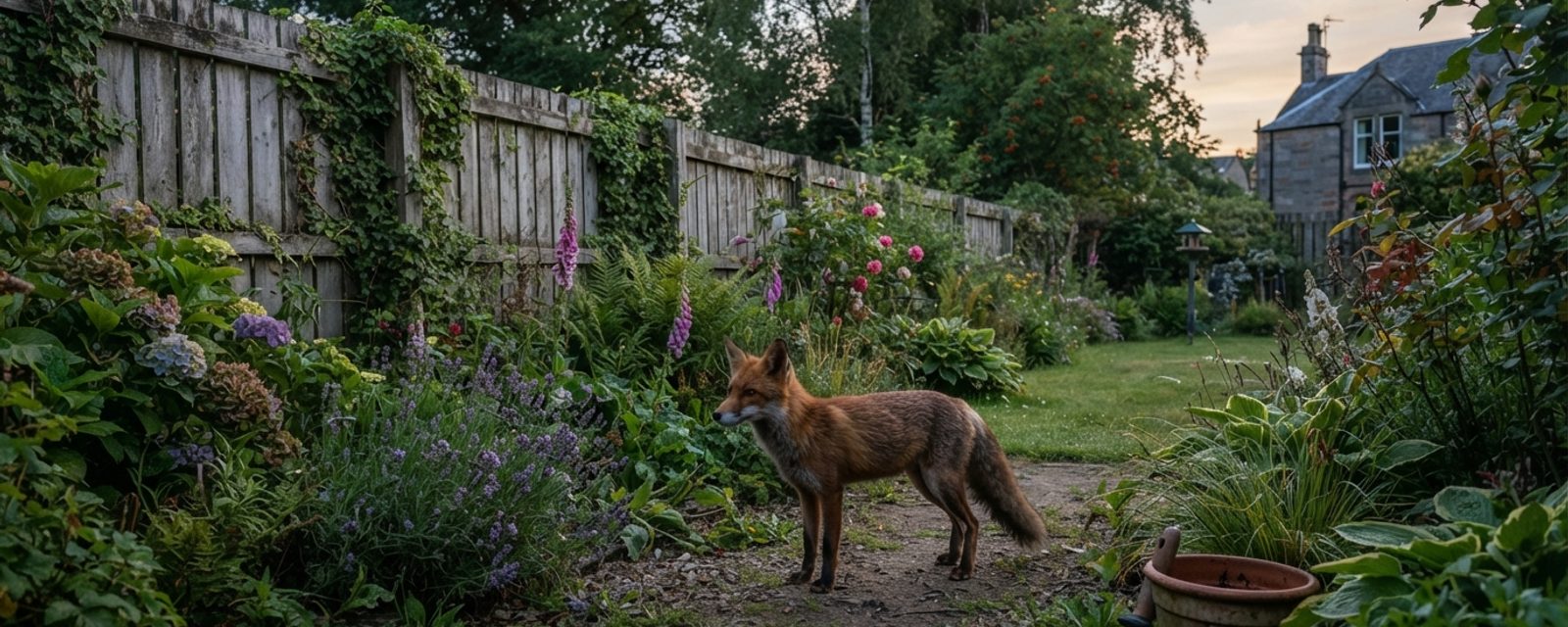
You go out in the morning and the lawn looks like it's been through a rotavator. Or there's a neat row of conical holes punched through the border overnight, and the bin's been knocked over and gone through for the second time this week. The first question most gardeners ask isn't "how do I stop this", it's "what did this." That matters more than it sounds like it should, because a fox and a badger cause different damage, respond to different deterrents, and, critically, one of them you're allowed to discourage fairly freely, and the other is protected by name in UK law in a way that changes what you're legally allowed to do about it.
Working out who's been in the garden
Both animals turn up for the same reason: earthworms, leatherjackets (cranefly larvae) and chafer grubs living just under the turf, plus whatever's accessible in the way of fruit, vegetables, compost and bins. But they dig differently, and the pattern left behind is usually enough to tell them apart without ever seeing the animal itself.
| Sign | Badger | Fox |
|---|---|---|
| Typical hole | Small, cone-shaped "snuffle holes," often in clusters across a lawn | Single, more scattered holes, sometimes with food scraps pushed in |
| Turf damage | Can roll whole strips of turf back like peeling carpet in a bad infestation | Digs individual holes rather than lifting turf wholesale |
| Droppings | Deposited in shallow open pits ("latrines"), badgers are the only common UK mammal that does this | Scattered, often left prominently to mark territory, with a strong musky smell |
| Sett/den entrance | Large entrance with a substantial spoil heap and old bedding outside | May den under sheds or decking; entrance is smaller and less excavated |
| Footprint | Broad, robust print around 6.5cm wide, five toe pads and long claw marks | Narrower, four-toed, more dog-like, without the same heavy claw drag |
A useful rule of thumb: if the lawn looks like someone's peeled sections of it back like carpet, or you find a large sett entrance with a spoil heap and bedding, that's a badger. If you're finding scattered smaller holes, buried food caches, or damage to bins and compost, that points to a fox. Both will happily visit the same garden on different nights, so don't assume it's one or the other just because you've had trouble with that animal before.
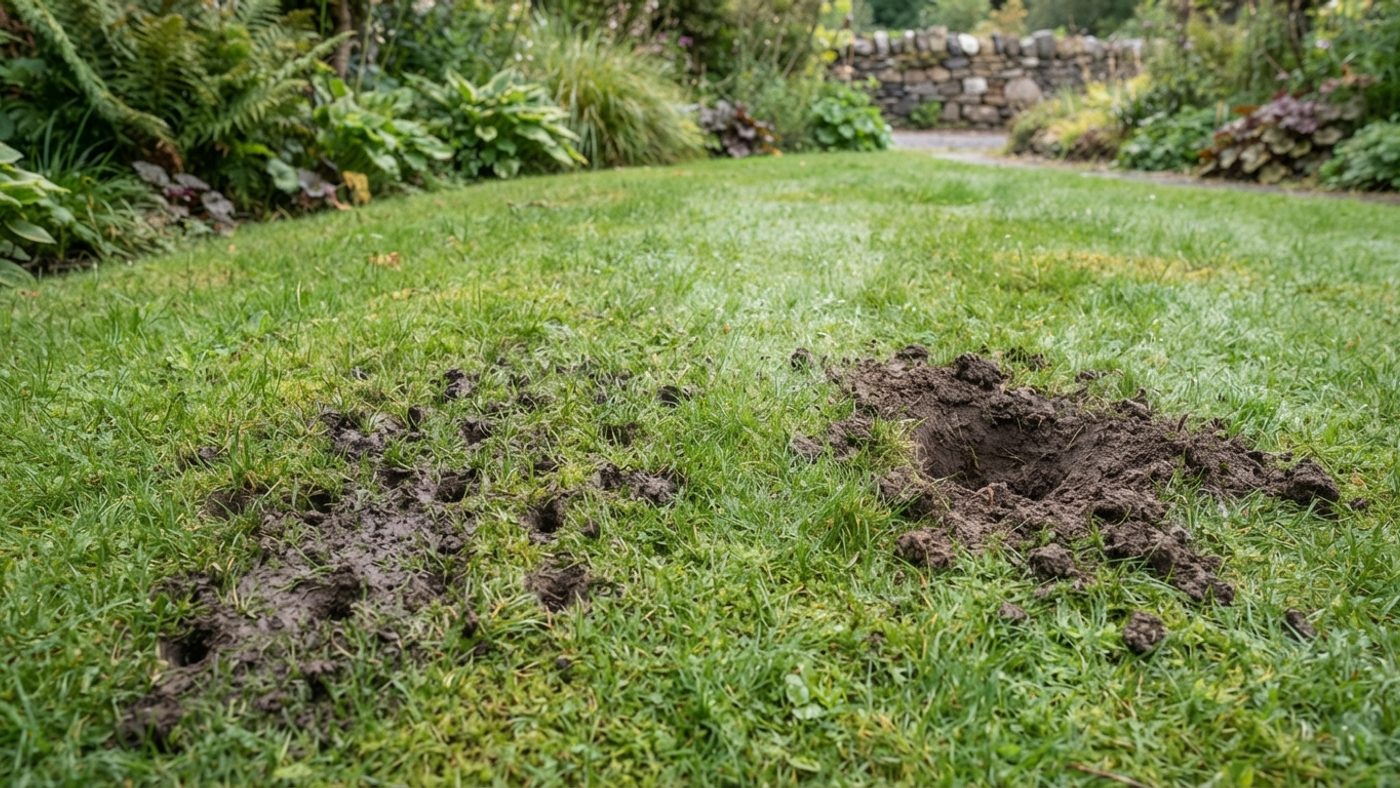
One other common culprit is worth ruling out first: small, volcano-shaped mole hills of loose soil pushed up from underground tunnelling look nothing like a fox's dug holes once you know what to look for, but can be mistaken for badger snuffling by anyone who hasn't seen either before. A mole hill is a neat cone of soil sitting on top of the grass with no visible hole in the middle; a badger's snuffle hole is a small pit dug into the turf itself.
Scottish SPCA's badger guidance describes badgers as scarcer in Scotland than further south, and notes that badgers turning up in gardens is more typically a rural problem than an urban one, in contrast to foxes, which are established in towns and cities right across the country. That's a real difference in how often each animal is likely to show up in a given garden, but not a difference in the law or in how you'd identify or manage either one once it does.
What actually works, and what's folklore
Search "fox deterrent" and you'll find the same shortlist repeated everywhere: mothballs, human hair, chilli or pepper spray, predator urine granules, even lion dung from zoos. It's worth being blunt about the evidence for these before spending money or, in one case, breaking the law.
The weak-to-worthless tier
Mothballs are the one to actively avoid, not just doubt. Their active ingredient, naphthalene, has been banned as a pesticide across the UK and EU since 2008 on toxicity and carcinogenicity grounds, and using them outdoors as an animal repellent is a misuse of a banned substance, not a legal grey area. The UK government's own product safety reports on naphthalene mothballs describe them as containing "a banned, carcinogenic substance" and confirm that authorities have been seizing and destroying stock found on sale. Scattering them in a border to keep foxes off isn't a folk remedy with no evidence, it's putting a banned toxic substance into soil where pets, children and wildlife can reach it.
Human hair, chilli/pepper sprays, and predator urine granules (fox, coyote or similar) sit in a different category: not dangerous, just unproven. There's no controlled evidence that any of them reliably deter foxes or badgers over more than a few days, and both animals quickly habituate, that is, they learn the smell doesn't actually predict any real danger, and stop reacting to it. RHS's own guidance on foxes is candid about this, noting that repellent products need frequent reapplication and "in some cases appear to be ignored" by the animals they're meant to repel.
Lion or tiger dung (sold or sourced from zoos) trades on the idea that prey animals instinctively avoid apex predator scent. It's a nice theory with essentially no controlled UK garden trial evidence behind it, and it needs constant, unpleasant reapplication to have any chance of working even short-term.
Genuine physical exclusion
This is the tier with real evidence, but fox-proofing and badger-proofing are not the same job, because the two animals have very different physical capabilities.
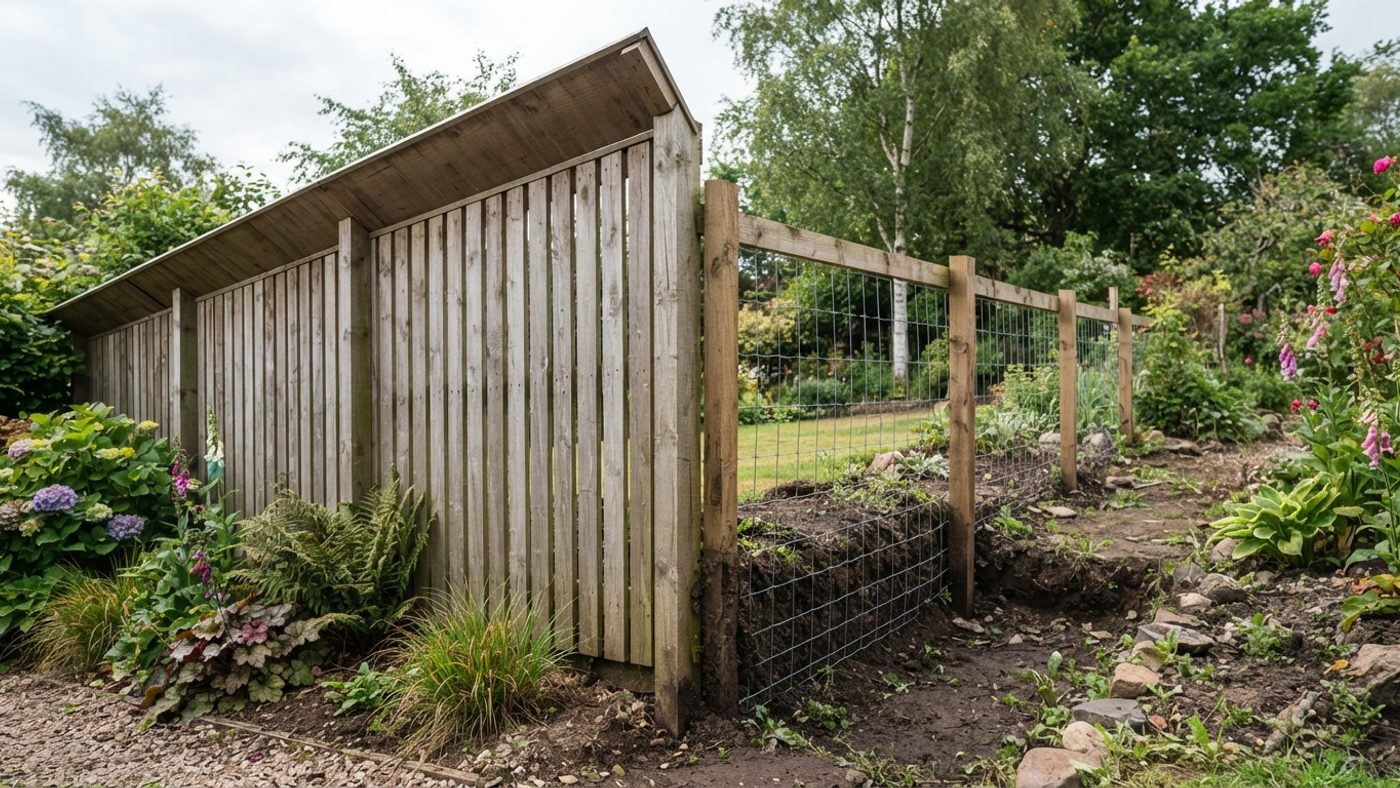
Foxes are far more athletic than most gardeners expect. They can scale a fence around 2 metres high without much trouble, and their flexible skeletons let them squeeze through gaps as small as roughly 10cm (about 4 inches) in diameter, smaller than most people would guess an animal that size could fit through. RHS advice is explicit that "standard netting or fencing is unlikely to provide an effective barrier, as foxes are able to scramble over or dig underneath."
Badgers don't climb or squeeze, they dig, and they're strong enough to dig through or under most garden boundaries that aren't specifically built to resist them. RHS's badger guidance recommends metal mesh fencing buried at least 50cm deep as a realistic barrier, and cautions against electric fencing on safety grounds.
The two jobs need genuinely different fences, so it's worth checking an existing boundary against both specifications rather than one:
| Fox exclusion | Badger exclusion | |
|---|---|---|
| Height | 1.8-2m | Height matters less than depth |
| Top | Inward-leaning or overhanging, so it can't be scaled | Not usually needed, badgers don't climb |
| Mesh gap | No larger than about 8cm | Standard mesh is fine above ground |
| Base | Buried 30cm, or an outward apron of mesh | Buried at least 50cm, this is the critical measurement |
A mesh gap tight enough to stop foxes (8cm or under) also shuts out hedgehogs, which need a roughly 13cm square hole to move between gardens and are already short of through-routes because of fencing generally. If hedgehogs use the garden, or the neighbours' does, it's worth deciding fox exclusion and hedgehog access as one decision, a dedicated hedgehog hole at ground level elsewhere in the same fence, for instance, rather than sealing the boundary completely and only noticing the trade-off afterwards.
The other approach RHS suggests for badgers is addressing what's drawing them in the first place, a nematode-based biological treatment for chafer grubs, applied in late summer or early autumn while the soil is still relatively warm, since the nematodes need reasonably warm soil to stay active. RHS doesn't give a Scotland-specific month for this, but the general principle carries over directly: apply as early in that late-summer window as possible rather than leaving it to late autumn, since soil in Scotland cools sooner in the year than further south. RHS also notes that badgers digging for chafer grubs "tend to be stubborn animals that follow the same routes every night," so exclusion without also cutting off the food supply is an uphill fight.
The practical upshot: a fence built to keep foxes out (tall, overhung, narrow mesh) does very little against a badger, and a fence built to keep badgers out (buried deep, low profile) does nothing to stop a fox jumping straight over it. If you have both, you need both approaches, not one compromise fence.
Motion-activated sprinklers and lights
These have more going for them than the scent-based folklore, but with a well-documented catch. The startle combination of sudden movement, noise and a jet of water genuinely works as a deterrent in the short-to-medium term, RHS's own guidance lists motion-activated water sprays as a legitimate option, alongside noting that ultrasonic devices "may be effective in the short term" but that "foxes may become accustomed to the sound and lose their fear." That habituation problem is the recurring theme with these devices generally: an animal that discovers the spray is startling but harmless learns to tolerate or route around it, often within one to a few seasons of repeated exposure. The practical fix is the same one used for any static deterrent: move the sprinkler or light to a different spot every couple of weeks so the animal can't simply learn the fixed danger zone and avoid it, or walk straight past it.
The unglamorous basics that actually matter most
Secure bins (wheelie bins rather than bags left out), don't leave pet food or bird food accessible overnight, keep compost properly contained rather than in an open heap, and fill in holes and check for access gaps under sheds and decking promptly, before a fox decides it's a good denning spot. None of the scent or noise deterrents above matter much if there's an easy meal sitting out every night.
If digging is audibly happening right now, in the dark, there's nothing useful to do about it that night, going out to intervene risks startling an animal at close range for no real benefit. The basics above are about tomorrow onward: securing whatever drew it in, and starting on exclusion once you know which animal you're dealing with.
The legal angle most gardeners don't know about, and it only applies to one of these animals
This is the part of the picture that changes what you're actually allowed to do, and it applies specifically to badgers, not foxes.
Badgers and their setts are protected under the Protection of Badgers Act 1992, which applies across England, Wales and Scotland. Section 1 of the Act makes it an offence to wilfully kill, injure or take a badger, or to possess a dead badger or anything derived from one, entirely separately from anything to do with a sett. Section 3 covers the sett itself: it's a criminal offence to damage or destroy a badger sett, obstruct access to it, cause a dog to enter it, or disturb a badger occupying it, and the offence covers doing this recklessly, not just deliberately. In Scotland the Act has been amended twice to strengthen it further: the Nature Conservation (Scotland) Act 2004 extended the offence to cover knowingly causing or permitting someone else to interfere with a sett, and the Animals and Wildlife (Penalties, Protections and Powers) (Scotland) Act 2020 increased the maximum penalties, up to 12 months' imprisonment and a £40,000 fine for summary conviction, with higher penalties available on indictment for the most serious cases. Scottish SPCA's guidance for a homeowner who finds a sett has appeared on their property is blunt: don't remove it. The recommended response is to stop whatever is attracting badgers to that specific spot, fencing off a vegetable patch, for instance, and, if the sett itself is a genuine problem, to contact NatureScot rather than dealing with it directly. Filling in an entrance, blocking it, or disturbing it yourself, even on your own land and even with good intentions, risks being exactly the offence the Act describes, not something a landowner gets to judge for themselves case by case; if in doubt, ask NatureScot before acting rather than after.
Where sett interference genuinely can't be avoided, such as building work close to a sett, the legal route is a licence, not self-help. In Scotland, NatureScot is the licensing authority, and it issues licences for development, land management (forestry, agricultural or drainage work near a sett), survey and research work, and, relevantly for a garden, to prevent serious damage by badgers to land, crops or other property. Badgers are treated as most sensitive to disturbance during their breeding season, which NatureScot defines as running from 1 December to 30 June, and licences for works near a sett aren't usually granted during that window. That period also covers when fox cubs are around: RHS notes fox cubs are born in late March to April and stay in the den for about four weeks before starting to explore outside, so activity around an active fox den tends to rise noticeably through spring, exactly the same stretch of the calendar when badger setts are least likely to get licensed disturbance. Anyone planning garden work near a suspected sett or den over spring is better off waiting a season than risking either the offence or an unnecessary disturbance to young animals. Before any building or landscaping work that might come within a few metres of a suspected sett, it's worth checking with NatureScot first rather than assuming the sett is old or disused. If it's an injured or clearly distressed animal rather than a work project, that's a Scottish SPCA matter, not a NatureScot one.
Foxes have no equivalent protected-species status. There's no law that stops you fencing them out, using a genuine startle deterrent, or otherwise making your garden unwelcoming to them. What does still apply is ordinary animal welfare law: the Wild Mammals (Protection) Act 1996 makes it an offence to inflict unnecessary suffering on a wild mammal, foxes included, through acts such as beating, stabbing, crushing or drowning, done with that intent. In practice that rules out cruel methods of getting rid of a fox, not the deterrent methods covered above.
Scotland has also gone further than the rest of the UK on trapping methods generally, in a way that's worth knowing even though it targets rural pest control more than back-garden problems: the Wildlife Management and Muirburn (Scotland) Act 2024 makes it a criminal offence, from 1 July 2026, to use, supply or possess a glue trap, and restricts snares to hand-operated designs used only for specific licensed purposes. Neither is a tool most gardeners would reach for against a fox or badger in the first place, but the ban closes that route in Scotland specifically, with the same penalty range as the badger offences: up to 12 months' imprisonment or a £40,000 fine.
Common questions
Is it illegal to block up a badger hole in my garden even if I didn't know it was a sett?
The offence under the Protection of Badgers Act 1992 covers reckless as well as deliberate interference, so "I didn't realise" is a weaker defence than it might feel like. If you find a large hole with a spoil heap and bedding outside it, treat it as a sett and get advice before doing anything to it.
Can I use predator urine granules or chilli spray to keep foxes off my vegetable patch?
You can, and they're not illegal, but be realistic about the results, there's no strong evidence they work reliably beyond a few days, and both are more expensive over a season than a properly built exclusion fence would be.
Are mothballs actually illegal to use in the garden, or just old-fashioned advice?
Genuinely illegal, not just outdated. Naphthalene, the active ingredient in traditional mothballs, has been banned as a pesticide in the UK and EU since 2008, and UK product safety authorities have been seizing naphthalene mothball products from sale as recently as the past couple of years. Using them outdoors as a repellent is a misuse of a banned toxic substance.
Will a fence that keeps foxes out also keep badgers out, or vice versa?
No, treat them as separate jobs. Fox exclusion depends on height (around 1.8-2m) and an overhang or narrow mesh so they can't climb or squeeze through; badger exclusion depends on the fence being buried roughly 50cm deep, because badgers go under rather than over or through. Bear in mind a narrow fox-proof mesh also blocks hedgehogs, so it's worth deciding on that trade-off deliberately rather than by accident.
Do motion-activated sprinklers actually work, or is that just marketing?
There's real evidence behind the startle effect working, at least initially, but habituation is a well-documented limitation, animals that learn the spray is startling but harmless will eventually walk through it. Moving the sprinkler to a new position every couple of weeks is the standard way to keep it effective for longer.
When is the worst time to disturb a badger sett or fox den in the garden?
Spring through early summer. NatureScot treats badgers as most sensitive to disturbance from 1 December to 30 June and doesn't usually licence works near a sett in that window, and fox cubs, born late March to April, keep activity high around a den for weeks afterwards. If work near either can wait until later in the year, it's worth waiting.
Sources
13 sources, recorded with what each was used for
- RHS: Foxes in the Garden: Damage caused by foxes, deterrent effectiveness (repellents "appear to be ignored", ultrasonic devices habituate), fox exclusion fencing specification, cub birth timing (late March-April) and den activity
- RHS: Badgers in Your Garden: Badger digging/snuffle-hole patterns, fencing depth (50cm), nematode treatment timing and soil-warmth requirement, legal protection statement
- The Wildlife Trusts: Identify tracks: Badger footprint detail (five toe pads, 6.5cm width, claw marks)
- Protection of Badgers Act 1992, Section 1: The separate offence of wilfully killing, injuring or taking a badger, and possessing a dead badger or anything derived from one
- Protection of Badgers Act 1992, Section 3: Full text of the sett-interference offence (damaging, destroying, obstructing, disturbing a sett; recklessness covered)
- Wild Mammals (Protection) Act 1996, Section 1: The offence of intentionally inflicting unnecessary suffering on a wild mammal through named violent acts
- Protection of Badgers Act 1992 as it applies to Scotland: Scotland-specific amendments via the Nature Conservation (Scotland) Act 2004 and the Animals and Wildlife (Penalties, Protections and Powers) (Scotland) Act 2020, including increased penalties (12 months/£40,000)
- gov.uk: Badgers, protection, surveys and licences: Confirms sett interference is a criminal offence and that a licence is required where interference cannot be avoided
- NatureScot: Badgers and licensing: Licence categories, the 1 December-30 June breeding-season sensitivity window, licensing contact details
- Scottish SPCA: Badger Sett advice page: Confirms the offence under the 1992 Act, advises against removing a sett, recommends addressing the attraction or contacting NatureScot, describes badgers as scarcer and more rural in Scotland
- Wildlife Management and Muirburn (Scotland) Act 2024, glue trap ban announcement: Confirms the glue trap ban takes effect 1 July 2026, penalties up to 12 months/£40,000, and background on snare restrictions
- gov.uk Product Safety Report: FUXUE Mothballs: Confirms naphthalene is "a banned, carcinogenic substance" under UK REACH regulations and that products have been seized and destroyed
- Hedgehog Street (People's Trust for Endangered Species and British Hedgehog Preservation Society): The 13cm x 13cm hedgehog-hole gap size, used to flag the fox-mesh/hedgehog-access trade-off