
If you've just found a plant in your garden, allotment, or the field behind your house that looks like giant hogweed, Japanese knotweed, ragwort, or rhododendron, the questions you actually have are narrow: is it going to hurt me or my animals, am I breaking the law by leaving it there, and what happens if I don't act. The honest answer is different for each of the four plants covered here, one can burn your skin within the hour, one is a legal and financial headache with zero health risk, one kills horses but is also a vital food source for pollinators, and one is doing serious ecological damage across the Highlands without posing any danger to a person standing next to it. Work out which one you're looking at first, because the right response for each is completely different.
Giant hogweed (Heracleum mantegazzianum)
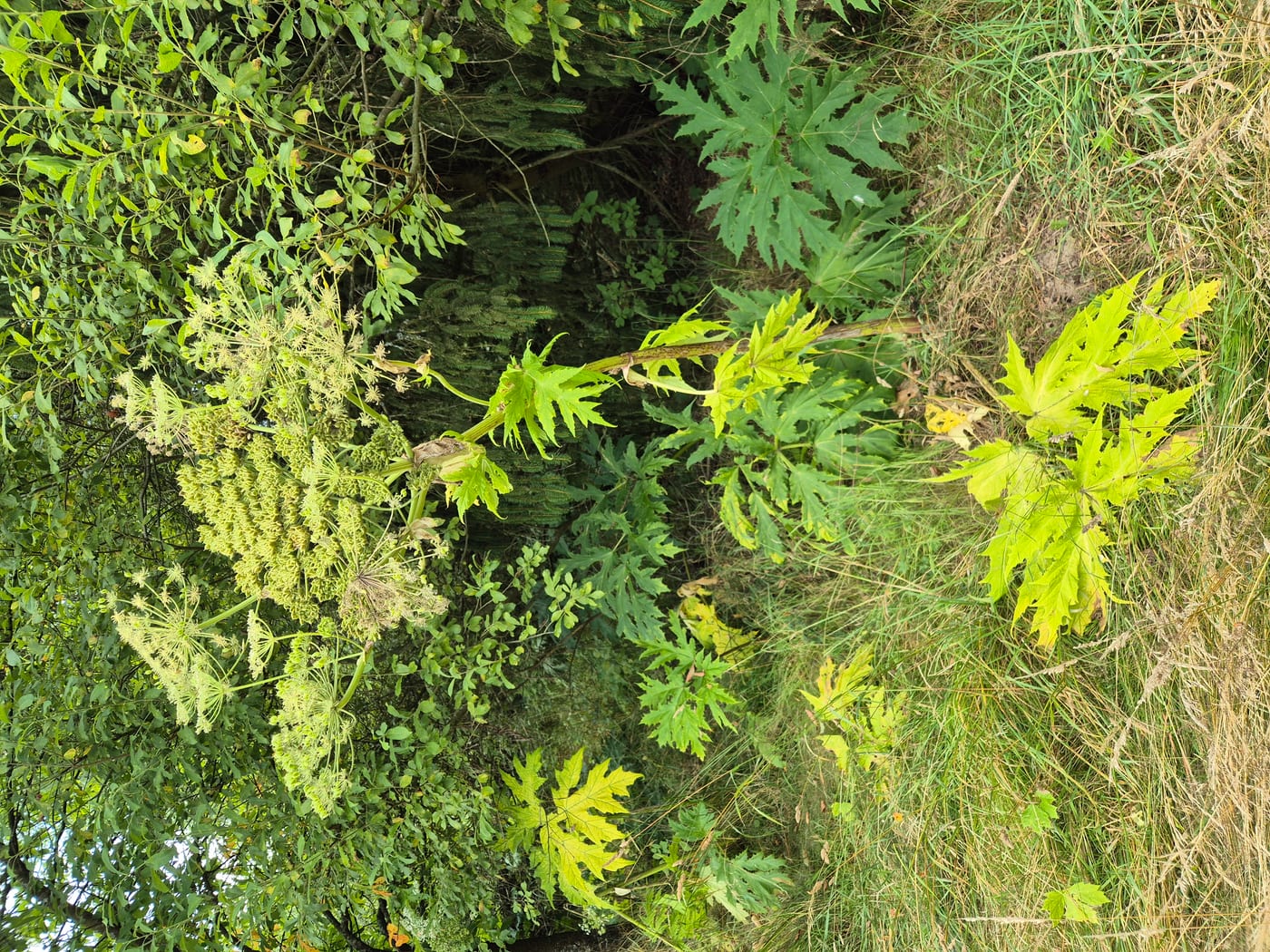
Photo: Stefan.lefnaer, CC BY-SA 4.0
Why it's dangerous
Giant hogweed's sap contains furanocoumarin compounds that make skin extremely sensitive to sunlight. Contact with the sap, followed by exposure to UV light, causes phytophotodermatitis, a chemical burn that can produce severe blistering, long-lasting pigmentation, and scarring. A reaction can start within about 15 minutes of contact, with sensitivity to light peaking between 30 minutes and two hours afterwards, and it can last for several days. Cut or bruised plant material stays dangerous for hours after cutting, so strimming or mowing through it is a real hazard, not just brushing against the standing plant.
What to do if sap gets on your skin
- Cover the affected area and wash it with soap and water as soon as possible.
- Keep the area out of sunlight for at least 48 hours, including on overcast days, since cloud cover doesn't reliably block the UV that triggers the burn. That matters in Scotland specifically, where a grey summer day is the norm rather than the exception, and "it wasn't even sunny" is exactly the reasoning that leads people to skip this step.
- See a doctor if you feel unwell after contact.
- Protect the area with sunscreen for the following months, since it can stay light-sensitive.
Identification, and where people get it wrong
Giant hogweed is a genuinely enormous plant, and size alone rules out most lookalikes. Check it against the three plants people most often confuse it with:
| Feature | Giant hogweed | Cow parsley | Angelica | Common (native) hogweed |
|---|---|---|---|---|
| Height | 5m+ | Under 1.5m | Up to 2.5m | Under 2m |
| Stem | 5–10cm, hollow, bristly, purple-blotched with raised nodules | Thin, fine hairs, no blotching | Smooth, waxy, sometimes purple-tinged, no bristles or nodules | No purple blotching |
| Leaves | Deeply dividedPropagating a clump-forming perennial by digging it up and splitting it into several smaller pieces, each with roots and shoots attached. Full definition →, coarsely serrated, up to 1.5m wide and 3m long | Soft, fern-like, finely divided | Divided into leaflets that are themselves divided again | More rounded than giant hogweed's |
| Flower head | Up to 60cm across | A fraction of hogweed's size; flowers earlier in the year | Smaller, rounder umbels | Smaller than giant hogweed's |
The purple-blotched, bristly stem is the single most reliable check, none of the three lookalikes have it.
Giant hogweed favours riverbanks, waste ground, and roadside verges. A single plant can produce tens of thousands of seeds, which is why it spreads so readily along watercourses and via contaminated soil, footwear, and vehicles, and it's also why roadside verges matter here specifically: they're routinely cut by council or contractor strimmers, and cut hogweed stays hazardous for hours after cutting, so verge-cutting crews working near a known stand are at real risk, not just anyone brushing past the standing plant.
The law
Giant hogweed is listed in Schedule 9 to the Wildlife and Countryside Act 1981, but Schedule 9 itself was repealed for Scotland with effect from 2 July 2012, under the Wildlife and Natural Environment (Scotland) Act 2011. Scotland now runs on its own version of section 14 of the 1981 Act, which makes it an offence to plant or otherwise cause any plant to grow in the wild "outwith its native range," a broader test than England and Wales's approach of listing specific named species. Since giant hogweed is not native to Scotland, causing it to grow in the wild here is still an offence under this broader Scottish provision, even though the specific Schedule 9 listing no longer applies. Having it growing on your own land is not itself an offence, but you can be liable if you cause it to spread into the wild, for the full clause-by-clause detail on how Scotland's version of section 14 works, see the Himalayan balsam identification and removal law article.
If you're treating hogweed with herbicide near a burn or river, which is exactly where it tends to grow, pesticide applied within a metre of the water's edge to control an invasive non-native species like this can go ahead under SEPA's general binding rule GBR 23g without contacting SEPA first, provided the product is approved for aquatic use and none of it enters the water. Spraying further from the bank, or spraying anything that isn't an invasive non-native species, needs SEPA contacted in advance.
Cut hogweed material and any soil that might contain its roots or seed counts as controlled waste too, the same as knotweed below, it can't go in the compost, council green bin, or general household waste. If the plant has already gone to seed, bag the seed heads before cutting to stop them scattering, and treat the bags the same way. For anything beyond a plant or two, hiring a specialist removal company is the realistic option: they carry the right protective equipment and are usually registered waste carriers already.
Japanese knotweed (Reynoutria japonica / Fallopia japonica)
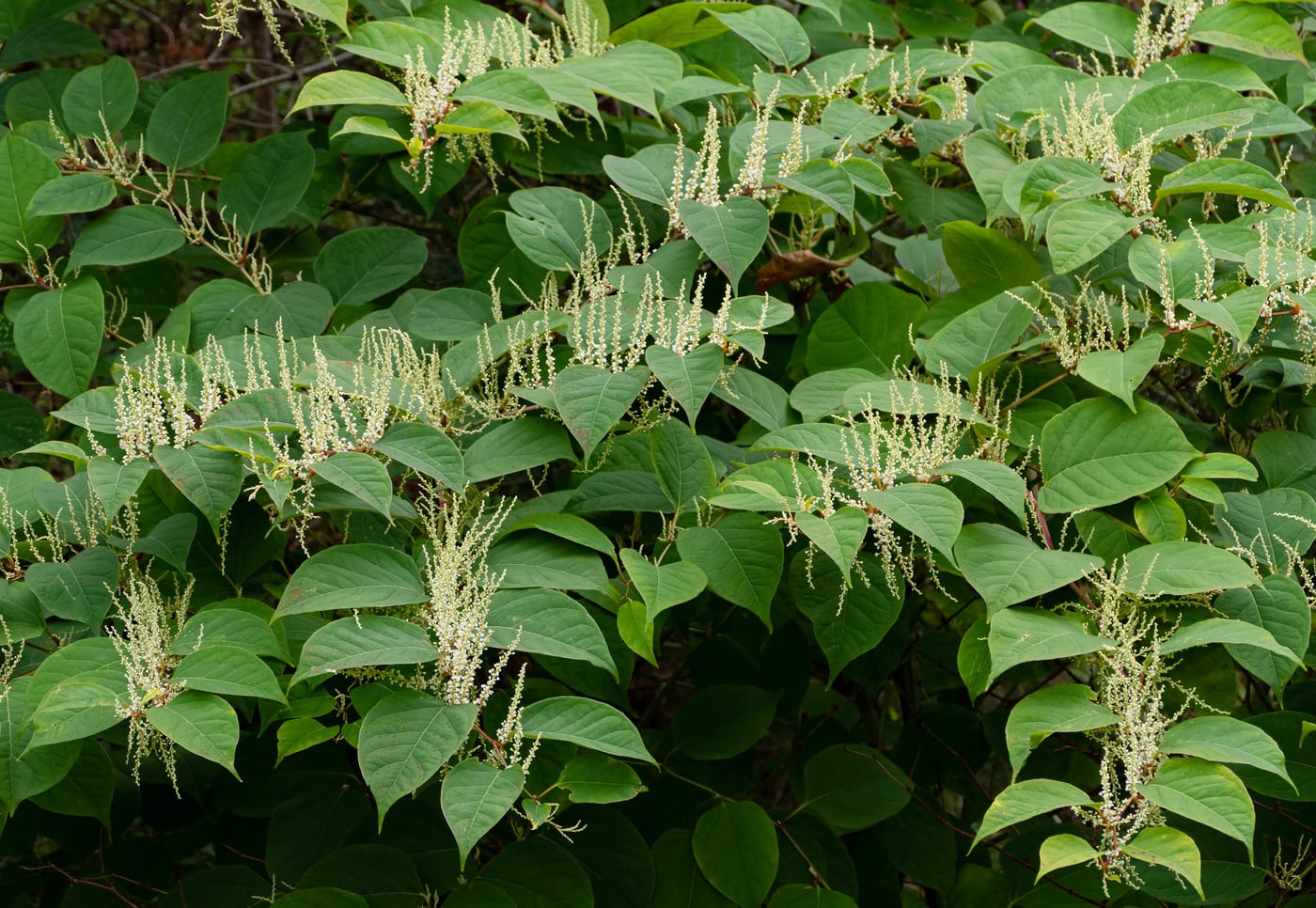
Knotweed doesn't belong in the same danger category as hogweed at all: there's no first-aid concern here. What it costs you is money and legal exposure instead.
Identification
Japanese knotweed has spade- or shovel-shaped leaves with a flat base, growing to around 14cm long, arranged in a distinctive zigzag pattern that alternates left-right along the stem, this zigzag habit is one of the most reliable identifying features. The stems are hollow and bamboo-like, with reddish-purple speckling and conspicuous nodes, typically reaching around 2m and often arching over at the top by late summer. Below ground, the rhizomes, the thick, woody, root-like stems the plant spreads and regrows from, are dark brown on the outside with a distinctive orange interior, and can extend more than a metre deep and several metres horizontally from the visible stand.
What it's commonly confused with
- Russian vine (Fallopia baldschuanica) — a genuinely close relative, sharing the same genus and a similarly fast growth rate, but it's a climbing, twining vine that wraps around structures and other plants rather than growing as an upright cane, and its leaves are smaller and not flat-shovel-shaped. Unlike knotweed, Russian vine isn't Schedule 9-listed and carries none of the legal exposure covered below, see the Russian vine article for that fuller comparison.
- Bindweed — a climbing plant with genuinely heart-shaped leaves (knotweed's have a flat base, not a heart-shaped notch) and large pink-and-white trumpet flowers, versus knotweed's small creamy-white flower sprays. Bindweed has no woody stem at all.
- Dogwood (Cornus) — can look similar in winter thanks to its red stems, but the leaves grow in opposite pairs directly across from each other, while knotweed's leaves alternate up the stem, this is the fastest way to rule dogwood in or out.
Legal status
Japanese knotweed is listed in Schedule 9 to the Wildlife and Countryside Act 1981, making it an offence to plant it or cause it to grow in the wild, though, as with giant hogweed, Schedule 9 was repealed in Scotland from 2 July 2012 and Scotland instead runs on the broader "outwith its native range" test under its own version of section 14. The actual penalty figures under section 21 for that Scotland/England split are set out in the Gunnera tinctoria article.
Separately, and this applies UK-wide including Scotland: knotweed plant material and any soil containing its rhizome is classed as controlled waste under the Environmental Protection Act 1990. Section 34 of that Act places a duty of care on anyone who produces, carries, or disposes of it, and Scotland runs its own amended version of that duty of care through Scottish waste-management regulations. In practice this means you cannot put knotweed material in a normal garden waste bin or bonfire it and walk away, removal off-site has to go through a registered waste carrier to a licensed facility, with the movement recorded on a waste transfer note (the paperwork the carrier is legally required to give you as proof it's gone somewhere licensed to take it). Rhizome fragments as small as 1cm can regrow, and rhizomes can lie dormant in soil for years, which is why herbicide treatment (typically glyphosate over multiple growing seasons) or professional excavation are the realistic options rather than DIY digging-out. The same SEPA watercourse rule described for hogweed above applies here too.
Costs vary hugely depending on the treatment chosen and how established the stand is, a multi-year herbicide programme costs a lot less than full excavation and removal of contaminated soil, and site access, depth, and area all move the price. Get more than one quote from a specialist before committing to either route, rather than assuming a figure from a single source.
Buying, selling, and mortgages
England has a well-established process here: the Seller's Property Information Form (TA6) asks sellers to disclose knotweed within the property boundary or within 3 metres of it, and RICS has published professional guidance for valuers and surveyors on assessing risk. Scotland's conveyancing system works differently, property is sold via Home Reports and solicitors' missives rather than TA6 forms, and standard missives clauses (the Scottish Standard Clauses) typically have the seller declare the property is free of "infestation" beyond what's disclosed in the Home Report.
That clause has already been tested in a Scottish court. Buyers John Busby and Marie Donnelly, who found a substantial stand of Japanese knotweed on a property they'd bought in Auchendinny, were allowed to proceed with a claim against the sellers, who had known about the knotweed and tried and failed to treat it before selling. Sheriff Christopher Dickson, at Edinburgh Sheriff Court, accepted the buyers' argument that knotweed counted as "infestation" under the missives' clause 2.1.3, a reading supported by a RICS information paper stating that any amount of Japanese knotweed on a site can count as an infestation.
What Scotland doesn't have is a published equivalent to England's TA6/RICS four-tier mortgage risk framework, a Law Society of Scotland or RICS Scotland practice note setting out exact buffer distances or lender risk categories for Scottish mortgage lending. If you're buying or selling a property with knotweed nearby in Scotland, that gap means it's worth asking your solicitor directly what standard they'll apply, rather than assuming the English process carries over unchanged.
Ragwort (Senecio jacobaea)
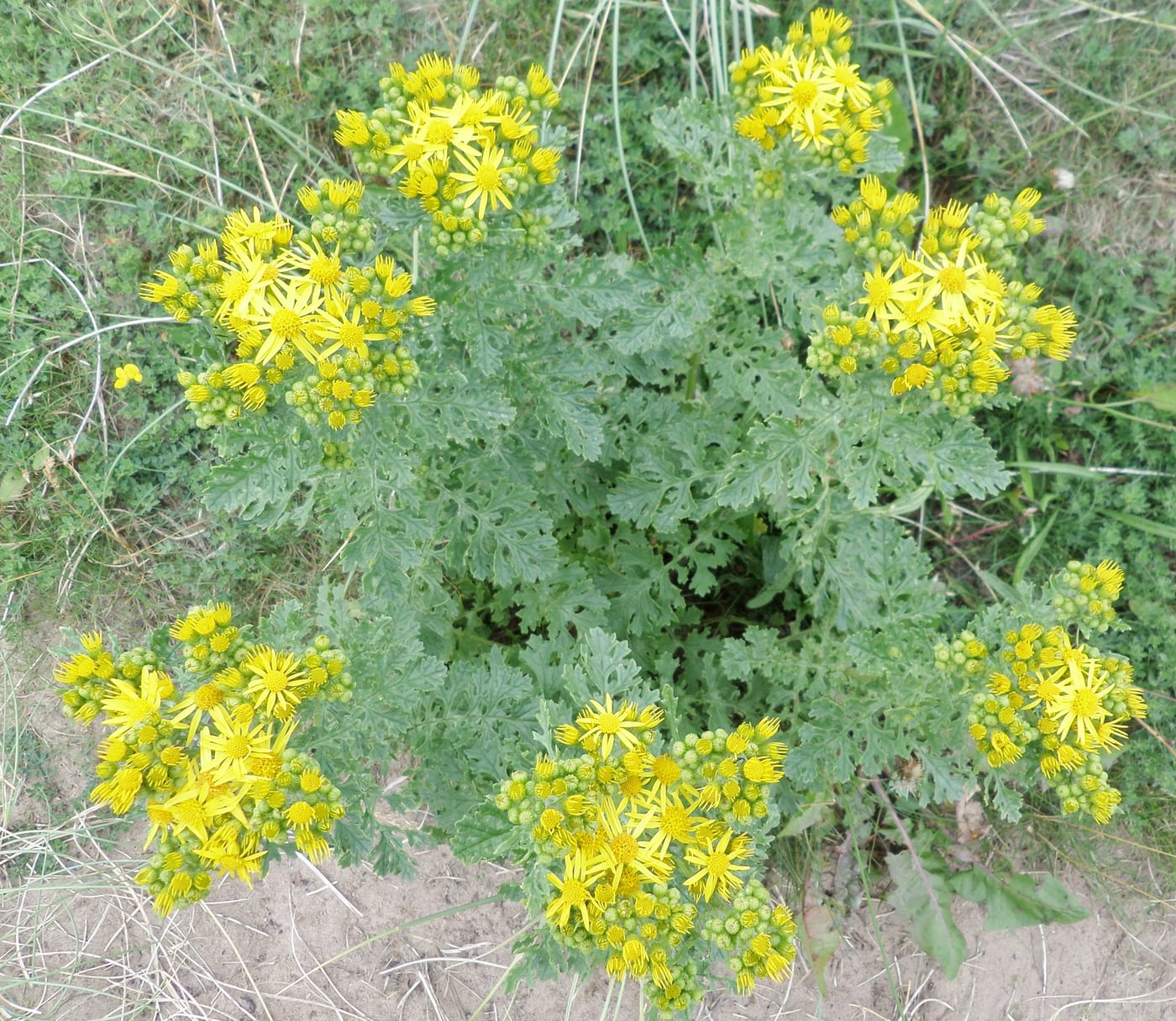
Photo: Rosser1954, CC BY-SA 4.0
Identification
Ragwort is normally biennialA plant that completes its life cycle over two years: growth in year one, then flowering, seeding and dying in year two. Full definition →: in its first year it's a low rosette of deeply lobed, jagged, dark green leaves with no flowers, which is when it's most easily overlooked. In its second year it sends up a stiff stem, usually 30–90cm but occasionally taller, topped with a dense, flat-topped head of small, bright yellow daisy-like flowers from around June through October. It's often confused with tansy, which has similar flat-topped yellow clusters but finely feathery, almost fern-like leaves rather than ragwort's coarser, jagged lobes, the leaf shape is the more reliable check between the two.
Why it matters
Common ragwort is poisonous to grazing animals, and horses are particularly at risk. It contains pyrrolizidine alkaloids that cause cumulative, irreversible liver damage, there is no antidote, and the damage doesn't reverse once the liver is compromised. If you're pulling ragwort yourself, guidance is specific: wear sturdy, waterproof gardening gloves, cover arms and legs, and wear a facemask to avoid breathing in pollen or plant particles. Wash any skin that does contact the plant in warm soapy water straight away.
Ragwort is unpalatable and usually avoided by grazing animals when growing fresh, which is actually part of the risk: animals are far more likely to eat it once it's cut, wilted, and mixed into hay or silage, where the bitter taste that would normally put them off is masked but the toxins remain. That matters more in wetter parts of Scotland, where unreliable drying weather makes silage or haylage a more practical choice than hay for many livestock keepers, exactly the forage form that hides ragwort's bitter taste while keeping the toxins intact.
The legal framework, and how Scotland's actually differs
Ragwort is one of five injurious weeds named in the Weeds Act 1959 (the others are spear thistle, creeping/field thistle, curled dock, and broad-leaved dock), and, importantly, it's the only one of the five that's actually harmful to grazing animals rather than just a nuisance to farmers. The Act applies across England, Wales, and Scotland (not Northern Ireland). Under section 1, a notice can be served on the occupier of land requiring them to take action to stop injurious weeds spreading; failing to comply without reasonable excuse is an offence.
Here's where Scotland's arrangement genuinely differs from England's, and it's worth being precise about it: in England, Weeds Act enforcement runs through Natural England, which has no jurisdiction north of the border. The Weeds Act 1959 itself provides for this, section 9 substitutes "Secretary of State" for "Minister" in relation to Scotland, meaning enforcement authority sits with Scottish Ministers rather than with any dedicated agency. There is no Scottish equivalent body to Natural England that administers ragwort enforcement; it functions as a complaint-and-notice system administered directly by Scottish Ministers, rather than through a standing enforcement organisation.
The Ragwort Control Act 2003, which created the well-known Code of Practice on how to prevent the spread of ragwort, extends to England and Wales only, it does not apply in Scotland. Scotland instead has its own Scottish Government guidance document, "How to prevent the spread of ragwort," issued under a different legal basis: section 38 of the Animal Health and Welfare (Scotland) Act 2006, which gives Scottish Ministers the power to issue animal welfare guidance. This is genuinely separate legislation from England's Ragwort Control Act, not just a rebadged version of it. Scotland's guidance takes a risk-based approach rather than a fixed-distance rule: it asks landowners to assess whether ragwort poses a "high risk" to grazing animals or forage production, high- risk contexts include grazing land, forage production areas, and roadside verges adjacent to grazing land, versus low-risk contexts like intensively managed amenity grassland or woodland, where no action is required. Like England's Code of Practice, none of this makes growing ragwort itself a criminal offence; the obligation only bites if a formal notice is served and then ignored.
The wildlife-value caveat
Ragwort is a genuinely important native nectar and pollen source, supporting a wide range of pollinators, and it is the principal foodplant of the cinnabar moth, whose black-and-orange-striped caterpillars feed almost exclusively on it, typically through mid to late summer. This creates a real tension rather than a simple "eradicate on sight" instruction: the guidance from Scottish Ministers is explicitly about controlling ragwort where it's a genuine risk to grazing animals or forage, not about removing it everywhere it grows. Where control is genuinely necessary near grazing land, pulling plants before they flower and set seed avoids the worst of that conflict; ragwort well away from grazing land or forage production has real biodiversity value and doesn't need to be treated as a problem at all.
Rhododendron ponticum
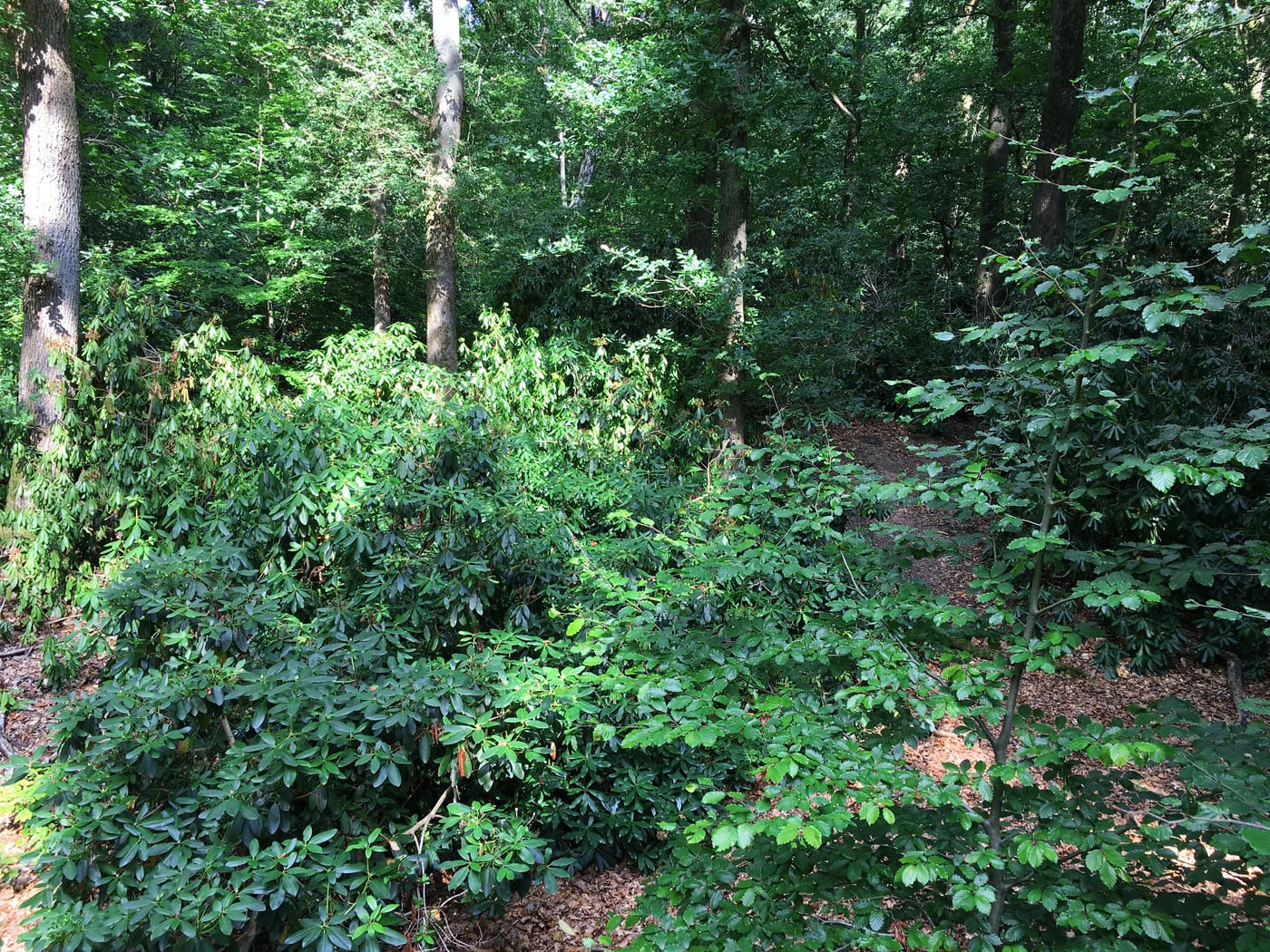
Photo: Cultureel Gelderland, CC0 1.0
Identifying it, and not confusing it with a garden rhododendron
Most rhododendrons in Scottish gardens are hybrids, bred by crossing R. ponticum with North American and Asian species, and they're not the problem, the invasive species itself is what you're checking for. R. ponticum has large, glossy, lance-shaped evergreen leaves up to 18cm long, dark green above and paler beneath, and light purple to mauve flowers (occasionally reddish-purple) in trussesThe flowering, then fruiting, stem cluster on a tomato plant; each truss ripens its fruit together. Full definition → of 10–15 blooms in early summer. Garden hybrids come in a much wider range of flower colours, white, pink, red, spotted, so a rhododendron thicket flowering anything other than that purple-to-mauve range is more likely to be a garden escapee or hybrid than the invasive species itself, though it can still spread if left unmanaged near woodland.
Why it's a problem
Rhododendron won't hurt you or your pets, the problem is what it does to a landscape, and in the Scottish Highlands and along the west coast it is a serious one. Rhododendron forms dense, tall thickets that block sunlight from reaching the woodland floor, shading out native ground flora entirely; its leaf litter is toxic to many other plants and slow to break down, altering soil chemistry beneath it. Left unmanaged, it can come to dominate a woodland understorey and exclude almost everything else.
It's also a sporulating host for Phytophthora ramorum, the pathogen behind "sudden oak death," which in Scotland is primarily a serious threat to larch. Rhododendron thickets amplify and spread the pathogen; where infected rhododendron is found near larch, Scottish Forestry can require felling of the infected trees plus a buffer zone around them, with the exact distance set case by case under a Statutory Plant Health Notice rather than a single fixed figure. Rhododendron acting as a disease reservoir near larch woodland is what turns an infestation into a forestry problem, not just an aesthetic one.
The problem is disproportionately concentrated on Scotland's west coast, where the mild, wet climate gives rhododendron ideal growing conditions. Forestry and Land Scotland names areas like Garry Falls and the Kintyre peninsula near Carradale as particularly badly affected, with difficult terrain compounding the challenge of control.
Legal status
Rhododendron ponticum is listed in Schedule 9 to the Wildlife and Countryside Act 1981, but, as with giant hogweed and Japanese knotweed, Schedule 9 was repealed in Scotland from 2 July 2012 under the Wildlife and Natural Environment (Scotland) Act 2011, replaced by Scotland's broader "outwith its native range" offence under its own version of section 14. NatureScot is the lead body for invasive non-native species on land in Scotland, and rhododendron, along with giant hogweed and Japanese knotweed, falls within that remit.
Why it's so hard to actually kill
Rhododendron regrows vigorously from cut stumps, from layeredPropagating a new plant by pinning a low, flexible stem into the soil while still attached to the parent, so it roots before being cut free. Full definition → shoots where branches have rooted where they touch the ground, and from seed, so cutting it back alone achieves very little. Effective control generally means one of two approaches: applying herbicide (typically glyphosate) directly to a freshly cut stump so it's drawn down into the root system, or stem injection, drilling a small reservoir into the woody stem and dosing it with herbicide, a technique that avoids spraying foliage and is well suited to sites near water or other sensitive vegetation. Smaller plants can sometimes be dug out or "grubbed out" by hand or with a mattock, but incomplete root removal risks regrowth. Forestry and Land Scotland describes rhododendron control as a landscape-scale effort requiring repeat visits over many years and coordination with neighbouring landowners, since seed can simply blow back in from adjacent, untreated stands.
Legal status at a glance
| Plant | Skin/health hazard | Schedule 9 (WCA 1981) | Scotland's post-2012 position | Main legal issue |
|---|---|---|---|---|
| Giant hogweed | Yes — phototoxic sap, severe burns | Yes (E&W) | Schedule 9 repealed in Scotland; covered by s.14 "outwith native range" offence | Causing it to grow in the wild |
| Japanese knotweed | No | Yes (E&W) | Schedule 9 repealed in Scotland; covered by s.14 "outwith native range" offence | Controlled waste disposal (EPA 1990); property disclosure |
| Ragwort | No (toxic to grazing animals, not humans) | Not listed | Weeds Act 1959 applies UK-wide; enforced by Scottish Ministers directly, no dedicated agency | Notice-based control if it poses a high risk to grazing/forage |
| Rhododendron ponticum | No | Yes (E&W) | Schedule 9 repealed in Scotland; covered by s.14 "outwith native range" offence | Ecological damage; Phytophthora ramorum host |
Common questions
Is it illegal to have giant hogweed growing in my garden in Scotland?
No, simply having it on your land isn't an offence. What's illegal is planting it or otherwise causing it to grow in the wild, under Scotland's own version of section 14 of the Wildlife and Countryside Act 1981. If it's confined to your garden and not spreading into the wild, you're not required to remove it, though given the burn risk it's sensible to do so, especially if children or pets use the garden.
Can I get in trouble for Japanese knotweed spreading from my garden to next door?
Potentially, yes, if it can be shown you allowed it to spread, that's the kind of dispute that runs through civil nuisance and property-damage law rather than a specific knotweed offence. There's no equivalent in Scotland to an automatic statutory notice process for garden-to-garden spread. The clearest Scottish precedent so far is on the selling side, not neighbour disputes directly: an Edinburgh Sheriff Court case confirmed that failing to disclose known knotweed to a buyer can count as misrepresentation under the Scottish Standard Clauses.
Do I have to report ragwort to anyone in Scotland?
There's no dedicated Scottish enforcement agency to report it to in the way England has Natural England. The Weeds Act 1959 allows Scottish Ministers to serve a notice on an occupier if injurious weeds are causing a problem, but this is a complaint-and-notice process rather than a standing reporting body. In practice, if ragwort on neighbouring land is threatening your grazing animals, the first step is usually to raise it directly with the landowner.
Is it safe to strim or mow giant hogweed myself?
This is one of the more dangerous ways to encounter it, cut or bruised plant material releases sap and stays hazardous for hours afterwards, and strimming throws sap and plant fragments onto skin and clothing. Full protective clothing (waterproof, covering all skin) is the minimum, and for larger stands, using a specialist contractor is the safer option.
Does removing rhododendron require a permit in Scotland?
Removing rhododendron from your own land generally doesn't require a special permit, though if you're clearing it near or within an area affected by Phytophthora ramorum, or within a woodland subject to a Scottish Forestry Statutory Plant Health Notice, you may be operating under specific control requirements set by that notice. Larger-scale clearance, especially involving felling of other trees, may need separate forestry consents.
Who do I actually contact about one of these plants?
It depends what it's doing and where. Giant hogweed or Japanese knotweed on public land, roadside verges, or a riverbank is worth reporting to your local council; NatureScot leads on invasive non-native species more broadly and Scottish Forestry or Forestry and Land Scotland handle rhododendron and Phytophthora ramorum on forestry land specifically. For anything on a neighbour's land affecting you directly, or a property transaction where knotweed has turned up, that's a solicitor's job rather than a government agency's. For ragwort near grazing animals, start with the landowner directly, there's no single Scottish body that takes reports the way Natural England does in England.
Sources
19 sources, recorded with what each was used for
- Wildlife and Countryside Act 1981, Schedule 9: Schedule 9 plant listings (giant hogweed, Japanese knotweed, Rhododendron ponticum) and the textual amendment note confirming Schedule 9's repeal in Scotland from 2 July 2012
- Wildlife and Countryside Act 1981, Section 14 (Scotland version): Exact Scotland-specific offence text on causing a plant to grow in the wild "outwith its native range"
- Wildlife and Natural Environment (Scotland) Act 2011, Section 14: Confirming the 2011 Act's substitution of section 14 of the 1981 Act for Scotland
- Weeds Act 1959 (Scotland extent): The five injurious weeds list including ragwort, and section 9's substitution of Scottish Ministers for "Minister" in Scotland
- Environmental Protection Act 1990, Section 34: Controlled waste duty of care, and confirmation Scotland has its own amended version of section 34
- gov.scot: How to prevent the spread of ragwort — guidance: Legal basis under s.38 Animal Health and Welfare (Scotland) Act 2006, confirmation Scotland has no named enforcement agency for the Weeds Act
- gov.scot: Ragwort guidance, Appendix 4 (particular categories of land): Risk-based (high-risk/low-risk) categories of land and responsibility framework
- RHS: Ragwort: Ragwort identification (rosette first year, flowering stem height and season, leaf and flower description), tansy comparison
- gov.scot: Ragwort guidance, Appendix 2 (biology and identification): Biennial rosette-then-flowering life cycle confirmation
- gov.scot: Ragwort guidance, Appendix 6 (safety guidelines): PPE advice (gloves, covered arms/legs, facemask) for hand-pulling ragwort, and washing skin after contact
- NatureScot: Scots warned of the dangers of giant hogweed: Phototoxicity mechanism, timing of reaction, first-aid steps
- RHS: Giant Hogweed: Identification detail, cow parsley/common hogweed comparison, controlled-waste disposal status, bagging seed heads before cutting
- RHS: Japanese Knotweed: Identification detail (leaf shape, zigzag stem pattern, rhizome description), controlled waste status, 1cm rhizome regrowth fact
- RHS: Rhododendron ponticum: Leaf and flower description distinguishing R. ponticum from garden hybrids
- Scottish Forestry: Ramorum disease: Phytophthora ramorum background in Scotland, larch felling requirements, zone-based management
- Forestry and Land Scotland: Rhododendron Control: Ecological damage description, cut-stump and stem-injection control methods, west-coast/Kintyre scale of the problem
- Animal Health and Welfare (Scotland) Act 2006, Section 38: The legal basis (Scottish Ministers' power to issue animal-welfare guidance) under which the ragwort guidance above is issued
- NetRegs: Spraying invasive plants with herbicide: SEPA's general binding rule (GBR 23g) allowing herbicide use within a metre of a watercourse against invasive non-native species without prior contact
- Scottish Legal News: Buyers of property with Japanese Knotweed problem allowed to proceed with action against sellers: The Busby and Donnelly v sellers case, Edinburgh Sheriff Court, on knotweed as "infestation" under the Scottish Standard Clauses