
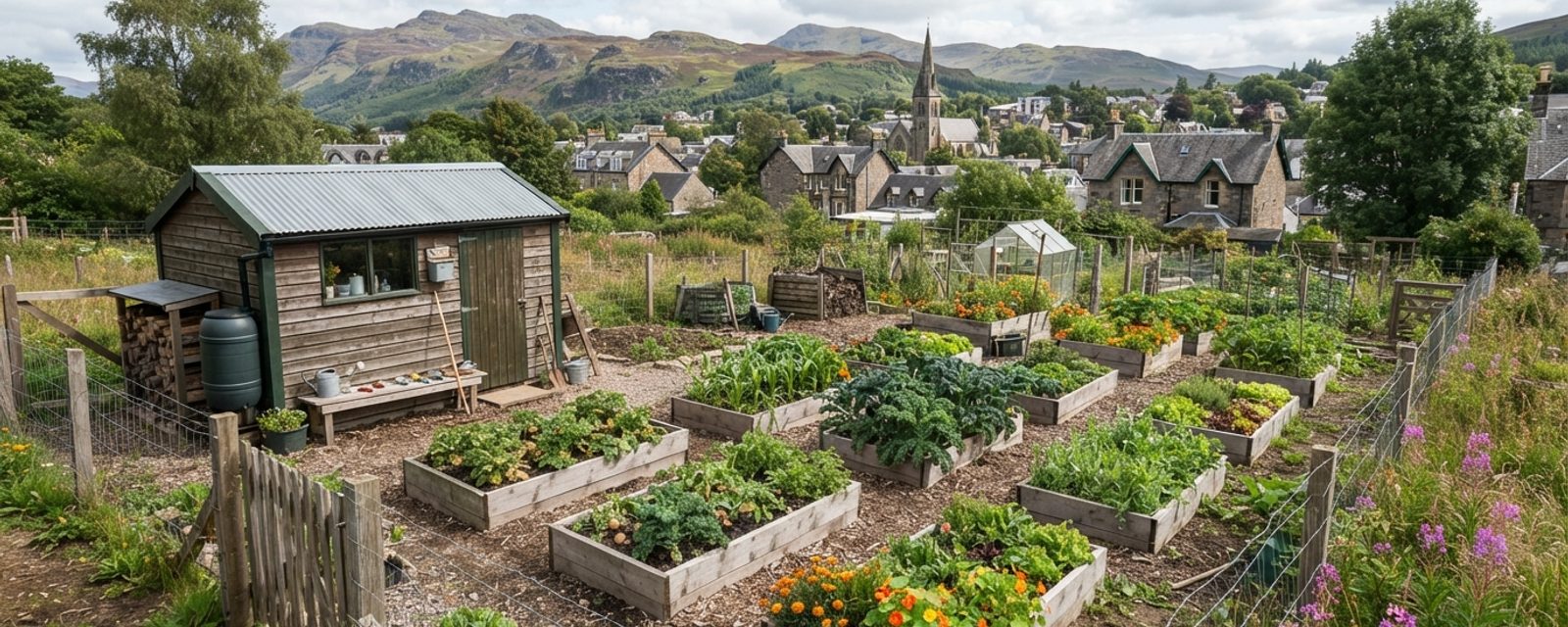
Say a gardening group has spotted it: a fenced-off patch of ground at the end of the street, waist-high in nettles, clearly not being used for anything. Or maybe it's a strip behind the community hall that the council owns but has left to grass over for years. The obvious question follows fast, can we just take this over and turn it into allotments or a community garden?
Quick answer
Sometimes, but not by just turning up with spades. Scotland has three distinct legal mechanisms for a community group to acquire or use land it doesn't own. Two apply to privately owned land and work by registering a right or forcingCovering plants to exclude light and speed early, tender growth in the dark, most associated with rhubarb and sea kale in late winter. Full definition → a sale. The third applies only to publicly owned land and works by requesting a transfer rather than claiming a right. Which one fits depends first on who owns the land, and for private land, on whether the owner is likely to sell at all.
Before any of that, there's a practical first step whichever route ends up being relevant: forming a proper community body, usually a Scottish Charitable Incorporated Organisation (SCIO). See Community Gardens vs Allotments for what that involves, how SCIO governance differs from an informal gardening club, and why liability and insurance questions usually point toward incorporating rather than staying informal.
Two things worth checking early, before committing to any route: who actually owns the land (a private owner narrows things to the two right-to-buy routes below; a public body points to asset transfer), and, if it turns out to be council land, whether it's held as "common good" property, a distinct category with its own extra process on top of anything below.
The three mechanisms, side by side
| Community Right to Buy (Part 2) | Abandoned/Neglected Land (Part 3A) | Community Asset Transfer (Part 5) | |
|---|---|---|---|
| What it is | A registered right of first refusal, triggered when the owner chooses to sell | A power to force a sale even where the owner doesn't want to sell | A request to take on ownership, a lease, or management/use rights |
| Applies to | Private land | Private land | Publicly-owned land or buildings only |
| Can it force an unwilling owner? | No, the owner must decide to sell | Yes, this is the mechanism that can compel a sale | No, it's a request the public body can refuse |
| Key requirement | Around 10% of the defined community must show support via petition, gathered within 6 months of applying | A public interest case, a community ballot, and evidence of having tried to negotiate with the owner first | Authority must agree unless it has reasonable grounds to refuse |
| Typical use case | Rural land coming up for sale | Genuinely derelict or harmful land with an absent or unresponsive owner | Council-owned parcels, including small plots |
Community Right to Buy: registering an interest, not forcing a sale
Part 2 of the Land Reform (Scotland) Act 2003 is the general community right to buy. It lets a community body register an interest in land with the Registers of Scotland's Register of Community Interests in Land. Registration doesn't buy anything on its own, it means that if and when the current owner decides to sell, the registered community body gets first refusal, matching the price rather than being handed the land at a discount.
To register, the community body has to be one of three structures: a company limited by guarantee, a SCIO, or a community benefit society, with its constitution built around community control, a defined geographic community, and a requirement that assets go back to the community on wind-up. Scottish Ministers also need to be satisfied the body's main purpose is consistent with sustainable development.
Registration needs a minimum level of community support, Ministers treat an indication of approval from around one tenth (10%) of the defined community as sufficient, evidenced through a petition of names, addresses, and signatures gathered within the six months before applying. Once registered, the interest lasts five years and can be renewed at five-year intervals.
The key limitation, stated plainly in the legislation and the guidance around it: this is not a forced sale and not a compulsory purchase. A community can't use it to block a development it dislikes or to prevent an owner selling to someone else outright, it only creates the right to be offered first refusal if a sale happens at all. For a group eyeing a specific patch of privately owned derelict ground, that means this route only helps if the owner is likely to sell eventually. If the owner has no intention of selling, registering an interest does nothing.
Once a registered interest is actually triggered, the owner notifying Ministers of an intention to sell, the community body gets a fixed window to confirm it wants to proceed and to raise the funds, and the sale can't complete to anyone else while that window runs. If the community body and the seller can't agree a price, an independent valuer, usually the District Valuer, is brought in to set it, rather than either side simply naming a figure.
The 2003 Act also has a separate crofting community right to buy (Part 3), which applies specifically to crofted land and works differently again, a distinct regime for crofting communities, not a growing-group route in the way the mechanisms in this piece are.
Abandoned, neglected or detrimental land: the compulsory route, and the hard one
Part 3A of the 2003 Act, inserted by the Community Empowerment (Scotland) Act 2015, is a genuinely different and much stronger power. Unlike Part 2, it can force a sale even where the owner has no wish to sell, provided the community body can show the land is wholly or mainly abandoned or neglected, or that its condition is causing harm to the environmental wellbeing of the community.
This is the route that actually matches the "the owner clearly doesn't care about this land" scenario, but it is demanding by design. A community body has to build a public interest case, essentially that community ownership, or another change of ownership, would better serve the public interest than the current owner continuing to hold the land, demonstrate support through a ballot of the whole community, and show it has already tried to negotiate purchase directly with the landowner before applying. Where the case rests on harm caused by the land's condition, the community also needs to show it first approached the relevant regulator. There's no fixed percentage threshold for the ballot the way Part 2 has its roughly-10% petition benchmark, support has to be demonstrated through the vote itself.
Because it's the mechanism that can override an owner's wishes, the final decision to consent to the sale rests with Scottish Ministers, not the community body, and the owner has a route to challenge the outcome, including on price, through the Lands Tribunal for Scotland. It's a real power, but not a unilateral one: a community body building a case still needs Ministers to agree with it at the end of the process.
Some land is excluded outright: occupied homes and the land that goes with them (other than tenanted ones), crofts occupied or worked by the owner or their family, and land held by the CrownThe base of a perennial plant where roots and shoots meet, often sold and planted as a ready-made dormant plant rather than grown from seed. Full definition → via the King's and Lord Treasurer's Remembrancer. Applications go to a separate register, the Register of Applications to Buy Land, rather than the one used for the ordinary community right to buy.
Because it can override a landowner's wishes, this route carries a materially higher bar: a public interest case, a ballot, and documented negotiation attempts, on top of everything the ordinary right to buy requires. Groups drawn to it because "the owner obviously doesn't care" should treat it as a matter of real project planning rather than a quick form to submit, and go in expecting no guarantee of success at the end of it.
Buying the land, under either private-land route, still means paying market value, neither hands land over at a discount, and there are legal and surveying fees on top of the purchase price to budget for. The Scottish Land Fund is the standard funding route community bodies use for both, and despite Highlands and Islands Enterprise being one of its delivery partners alongside the Scottish Government and the National Lottery Community Fund, the fund itself is open Scotland-wide, not restricted to the Highlands and Islands:
| Stage | Grant range | What it's for |
|---|---|---|
| Stage 1 | £2,500–£30,000 | Feasibility study, specialist advice |
| Stage 2 | £10,000–£1,000,000 | The land or building purchase itself |
Overall grants run from £5,000 to £1 million across the two stages.

Community Asset Transfer: the request route, and the one that fits most gardening groups
Part 5 of the Community Empowerment (Scotland) Act 2015 is a different kind of mechanism entirely, and it's the one that applies if the land in question is publicly owned rather than private. It isn't a right to buy at all, it's a request process. A community transfer body can ask a relevant public authority (a local authority, Scottish Ministers, an NHS board, or another body on the Act's list) for ownership, a lease, or other rights to manage, occupy, or use land or buildings.
The authority has to assess the request against a specified set of criteria and must agree to it unless there are reasonable grounds for refusal, considerations include things like economic development, regeneration, public health, and reducing inequality. A transfer can be agreed below market value where the community benefit justifies it. The authority must issue its decision notice within six months of the request being validated (a straightforward request, or one where there's already been substantial discussion beforehand, can move faster), or a longer period if both sides agree. Once that decision notice is issued, the community body then gets at least a further six months to submit its formal offer. If a request is refused, or the terms offered aren't acceptable, there are review and appeal routes: local authority decisions can go to internal review and then to Scottish Ministers on appeal; Ministers' own decisions on requests made directly to them are also reviewable.
Part 5 doesn't name allotments or community growing specifically as an eligible category, it applies generically to any land or buildings a community body wants to make better use of. What's directly relevant to growing space specifically is Part 9 of the same 2015 Act: it requires every local authority to prepare and publish a food-growing strategy, identifying land suitable for allotments and other community growing, and to review it every five years. A council that already has growing space earmarked in its food-growing strategy, or land it isn't actively using, is a realistic asset transfer target, worth checking before assuming a plot needs a full right-to-buy case.
Some council-owned land in Scotland is held as common good property, a distinct category tracing back to former burgh land, which carries extra legal protections. A council generally needs the Court of Session or a sheriff's authorisation to dispose of common good land, and must consult the local community before disposing of it or changing its use. If the plot in question turns out to be common good land, ask the council directly how that affects the process, it doesn't rule out an asset transfer, but it adds a step Part 5 alone doesn't cover.
Which route actually fits a given piece of land
For land in private hands specifically, it comes down to reading the owner rather than just the state of the ground. If there's a realistic chance the owner will sell eventually, registering an interest under Part 2 is the lower-effort option, it just waits for that sale and gives first refusal. If the owner shows no sign of selling and the land is genuinely derelict, neglected, or causing harm, the Abandoned Land power is the only mechanism that can move things forward without the owner's cooperation, but it demands the most, a public interest case, a ballot, and documented negotiation attempts, with no guarantee of success at the end of it.
One route not covered above is worth a mention if the group's real goal is simply an allotment plot rather than acquiring raw land outright: Part 9 of the 2015 Act already gives any resident the right to request an allotment from their local authority, with its own waiting-list and "reasonable steps" duties. See Community Gardens vs Allotments for how that compares with acquiring and running a site independently.
Common questions
Can we just start using derelict land we've found without going through any legal process?
No. Even genuinely abandoned-looking land almost always has a registered owner, whether a private individual, a company, or a public body, and using it without their permission or a legal right of your own isn't something any amount of neglect on their part makes legitimate. All three mechanisms above exist precisely because "nobody seems to be using it" isn't, on its own, a legal basis for taking it over.
Which mechanism should a gardening group try first?
Start by finding out who owns the land, that answer alone rules out two of the three routes before you have to weigh anything else.
Do we need to be a SCIO before we can use any of these routes?
You need a qualifying community body structure, a SCIO, a company limited by guarantee, or a community benefit society, for right-to-buy applications, and a similarly constituted community transfer body for asset transfer requests. An informal gardening group isn't eligible on its own. See Community Gardens vs Allotments for what setting up a SCIO involves.
Can Community Right to Buy or the Abandoned Land power be used on land a council owns?
They aren't restricted to private land by definition, but a request for publicly-owned land is far more naturally handled through a Part 5 asset transfer, since public bodies are already required to assess and justify asset transfer requests. Building a right-to-buy case against a public body would be an unusual and harder route than simply requesting a transfer.
How long does any of this actually take?
Longer than most groups expect, long enough that it isn't something to plan for a single growing season. A Part 5 request alone can run to a year or more once you add the authority's up-to-six-month decision period to the further six-month minimum offer window that follows a decision in the community's favour; the Abandoned Land route adds the time needed to build a public interest case and run a community ballot on top of everything Community Right to Buy requires. Treat the whole thing as a months-not-weeks undertaking.
Can Community Right to Buy be used to stop land being developed?
No. Both the legislation and the practical guidance around it are explicit that it cannot be used to block a development, prevent a sale to a particular buyer, or simply preserve land in its current state. Ministers can refuse registration where an application appears aimed at those purposes rather than genuine community acquisition.
Sources
9 sources, recorded with what each was used for
- Land Reform (Scotland) Act 2003, Part 2 (Community Right to Buy): Community body definitions, the ~10% support threshold, 5-year registration and renewal, confirmation this is a right of first refusal
- Land Reform (Scotland) Act 2003, Part 3A (Abandoned, neglected or detrimental land): The public interest case, ballot, and negotiation-attempt requirements, and land exclusions
- Community Empowerment (Scotland) Act 2015, Part 5 (Asset transfer requests): Community transfer body definition, what can be requested, the authority's duty to agree absent reasonable grounds
- Community Empowerment (Scotland) Act 2015, Part 8 (Common good property): Common good disposal restrictions and the community consultation requirement
- Community Empowerment (Scotland) Act 2015, Part 9 (Allotments): The local authority food-growing strategy requirement
- gov.scot: Community Rights to Buy — overview: The distinct mechanisms and the separate statutory registers
- gov.scot: Asset transfer under the Community Empowerment (Scotland) Act 2015 — guidance for community transfer bodies: What can be requested, below-market-value transfers, refusal and review process
- gov.scot: Asset transfer under the Community Empowerment (Scotland) Act 2015 — guidance for relevant authorities: The six-month decision-notice period and the six-month offer-submission window
- gov.scot: Scottish Land Fund: Grant amounts and the two-stage application structure