
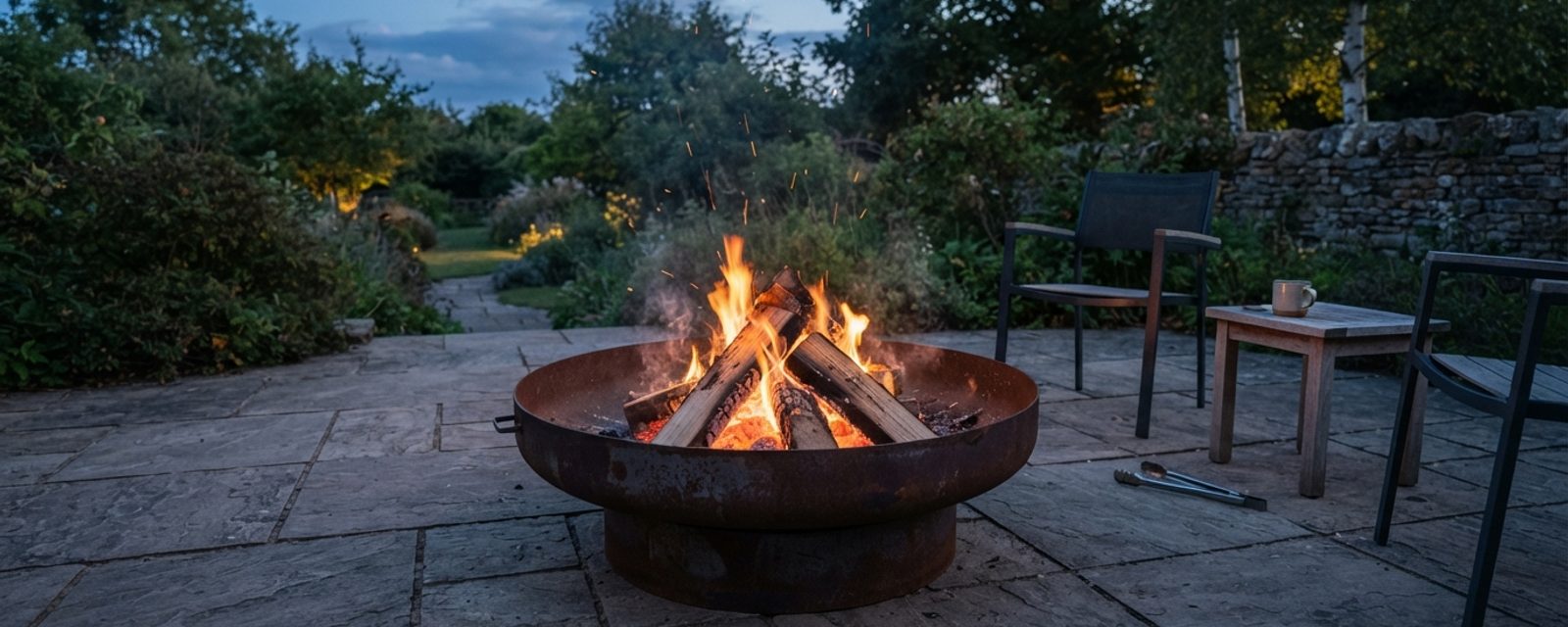
You've settled on the corner by the back fence, decking on one side, the shed on the other, and you're trying to work out whether a fire pit can actually go there, or whether it needs to move six feet closer to the middle of the lawn once you notice how close next door's kitchen window really is. A chimenea feels like it should be simpler, a manufactured, contained thing that surely sidesteps the open-fire questions. And if what you actually want is a proper wood-burning stove built into a garden room, that's a different question again, one that starts sounding like it belongs to planning and building control rather than gardening.
All three questions have real answers, and they're not the same answer. Where a fire pit or chimenea can sit is a safety and nuisance question. Whether you can legally burn wood in it at all depends on where the property sits relative to a smoke control area, a piece of law most people only encounter when installing an indoor stove, if they encounter it at all. And a permanently plumbed-in stove in a garden building brings a separate layer of building control on top of everything else. This piece works through all three.
Siting: how far from anything
This piece covers solid-fuel appliances, wood and coal, throughout. Gas and bioethanol fire pits burn a different fuel entirely and sit outside the Clean Air Act rules covered below, though the siting and safety points in this section apply to any open flame regardless of fuel.
Scottish Fire and Rescue Service's outdoor heating safety guidance sets a real, specific minimum, covering fire bowls, fire pits, chimeneas and braziers together as one group of appliance:
- Keep at least three feet (about a metre) between the appliance and anything combustible: fences, sheds, trees, hedges, or anywhere else that would catch.
- Site it on a stable, non-combustible surface, not decking, dry grass or bark mulchA layer of material spread over the soil around plants to suppress weeds, retain moisture, and improve soil structure as it breaks down. Full definition →.
- Keep it clear of awnings, gazebos, decorative pedestals and any wood finish that won't take the heat.
- Never leave it burning unattended.
- Make sure it's fully out, not just down to embers, before going indoors for the night.
A flat "three metres from any structure" figure circulates widely in fire pit marketing, but it isn't Scottish Fire and Rescue Service's own figure, and no UK fire and rescue service or named insurer publishes that specific number. Three feet is a floor, not a target, and it's the minimum for keeping flame away from something that can catch, not a guarantee against a nuisance complaint: it says nothing about smoke drifting into a neighbour's washing line or open window, which generally wants more distance and more thought about wind direction than the fire-risk figure alone would suggest. Site it, and time it, so smoke is genuinely carried away from neighbouring gardens and open windows rather than settling over a fence line, the same wind-reading habit that matters for any garden fire.
If what you actually want is an open fire rather than a contained appliance, that's a different object with its own established rules, covered fully in the piece on bonfire law on Scottish allotments: the statutory nuisance and dark smoke offences discussed there apply to any garden fire, not just an allotment bonfire pile, but a fire pit or chimenea is a manufactured, elevated, generally smaller-fuel-load appliance with its own separate legal wrinkle, covered next.
Smoke control areas: the part almost nobody checks for a garden appliance
This is the genuinely under-covered part of the picture, and it has nothing to do with distance from a fence.
Local authorities in Scotland can declare all or part of their area a smoke control area under section 18 of the Clean Air Act 1993. Inside a designated area, section 20 of the same Act creates the actual offence: if smoke is emitted on any day from the chimney of a building within a smoke control area, the occupier of that building is guilty of an offence, carrying a fine of up to level 3 on the standard scale on summary conviction, currently £1,000. There's a built-in defence, though, and it turns on two separate tests, not one: the fuel being burned, and the appliance burning it. The defence applies if the emission wasn't caused by burning anything other than an "authorised fuel", the specific fuel test, or if it came from an "exempt appliance", one formally approved to burn an ordinary fuel like wood without producing smoke, the separate appliance test. Section 20 applies across England, Wales and Scotland, and Scottish ministers hold their own duty under it to maintain and publish the list of authorised fuels for Scotland.
In practice this means burning wood or house coal inside a smoke control area isn't automatically illegal. It's illegal in an open fireplace burning an unauthorised fuel, but perfectly legal to burn wood in an appliance on the exempt list, most modern stoves meeting the Ecodesign emissions standard covered below qualify, because the appliance itself has been tested and approved as capable of burning that fuel without emitting smoke.
Checking before you install, or before you buy
The only Scotland-wide public map of smoke control areas is Spatial Hub Scotland, hosted at data.spatialhub.scot, an interactive mapping layer covering every council's designated areas in one place. It's worth checking before installing anything with a flue, and worth checking as part of due diligence before buying a house, since it isn't something a standard property survey flags.
Coverage isn't uniform, and it isn't always narrow pockets either. In Edinburgh, the whole city is a smoke control area, so there's no map lookup needed at all, just the fact itself. Dundee City Council, by contrast, publishes its own overview map showing the 21 individual smoke control areas across the city, since Dundee's designation isn't blanket coverage the way Edinburgh's is. Given that variation, the honest advice is to check the Spatial Hub map first for the Scotland-wide picture, then check the specific council's own pages, since some run their own more detailed local maps or PDFs and some don't, rather than assuming either source alone is complete.
If a property does turn out to sit in a smoke control area, the actual list of authorised fuels isn't published as a standalone Scottish page, Scotland relies on DEFRA's UK-wide database, filtered to show only fuels and appliances authorised in Scotland, searchable at smokecontrol.defra.gov.uk. The legal basis for Scotland's own list sits in the Smoke Control Areas (Authorised Fuels) (Scotland) Regulations 2008, made under the Scottish ministers' duty referred to above.
Reporting a neighbour's smoke
This is a separate legal route from smoke control area status, and it applies regardless of whether the property is inside a designated area or not. Smoke emitted from premises so as to be prejudicial to health or a nuisance is a statutory nuisance under section 79 of the Environmental Protection Act 1990, a provision that has extended to Scotland since 1996. A statutory nuisance complaint goes to the council's Environmental Health team, not the same department that handles smoke control area enforcement, and it works whether or not the source is in a smoke control zone: the test is whether the smoke is genuinely prejudicial to health or a nuisance in fact, not which zone it happened in.
Chimeneas and fire pits: the exempt-appliance question that genuinely has no clean answer
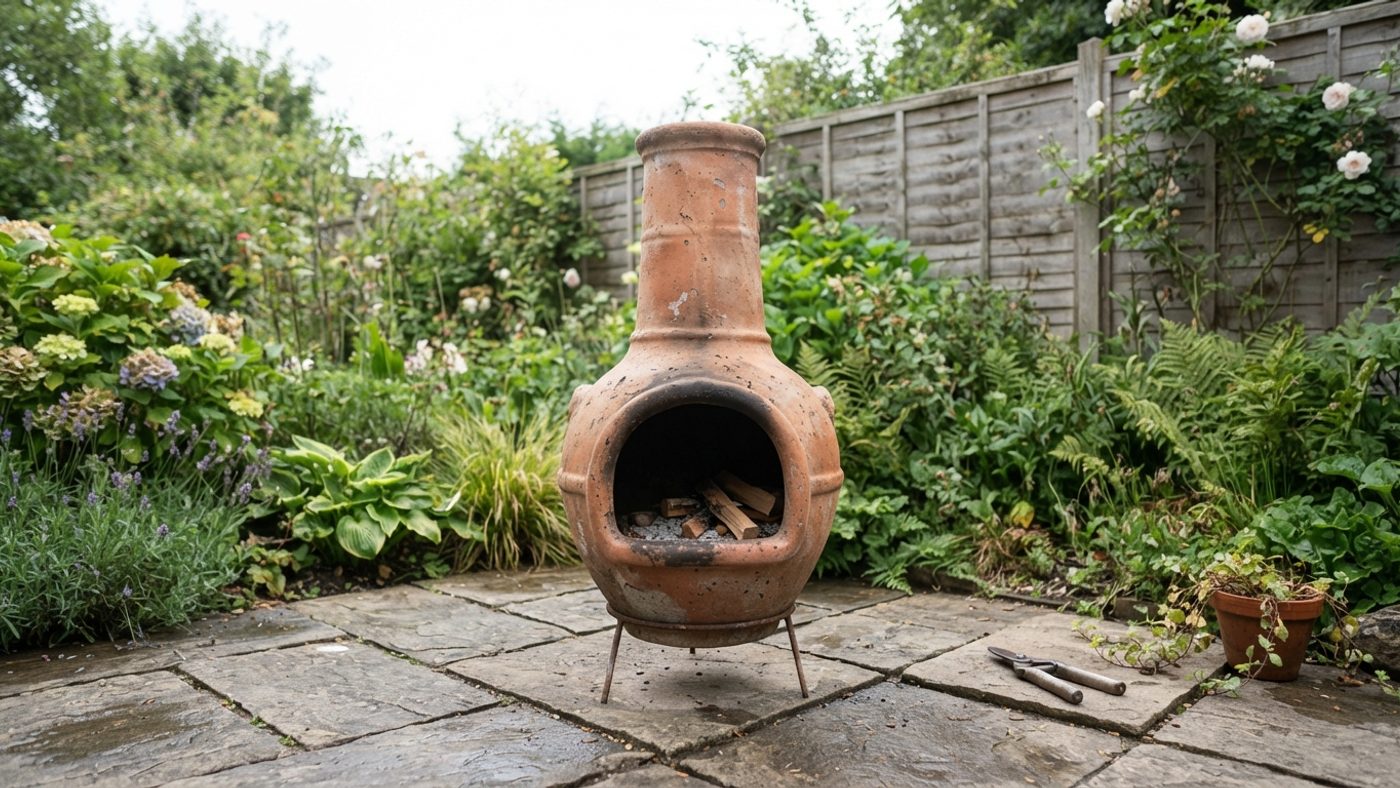
Section 20's offence is built around two specific things: smoke from "the chimney of a building," or smoke from a chimney serving the furnace of a fixed boiler or industrial plant. A chimenea or a garden fire pit is neither. It isn't connected to a building's chimney, and it isn't a fixed boiler or industrial furnace. Read literally, the offence as drafted doesn't appear to reach an unconnected garden appliance the way it reaches a house's wood-burning stove, and it also explains why an open fire pit or chimenea couldn't sit on the exempt-appliance list discussed above even if someone wanted it to: that list exists to certify appliances against the chimney offence in section 20, and a standalone garden appliance was never the kind of thing section 20 was built to catch in the first place. Whether that's a deliberate design choice or simply an area the law hasn't caught up to for modern outdoor products isn't something the statute answers on its own.
That doesn't mean smoke from a chimenea in a smoke control area is consequence-free, it means the consequence runs through a different door. The statutory nuisance route under the Environmental Protection Act 1990 doesn't care what kind of appliance produced the smoke, only whether it's prejudicial to health or a nuisance, so a chimenea or fire pit that's genuinely smoking out a neighbour's garden is exposed there even though section 20 itself doesn't reach it. "My chimenea isn't chimney-connected to a building" is not a free pass on smoke, once a neighbour's nuisance complaint is in front of Environmental Health.
A fixed wood stove in a garden room
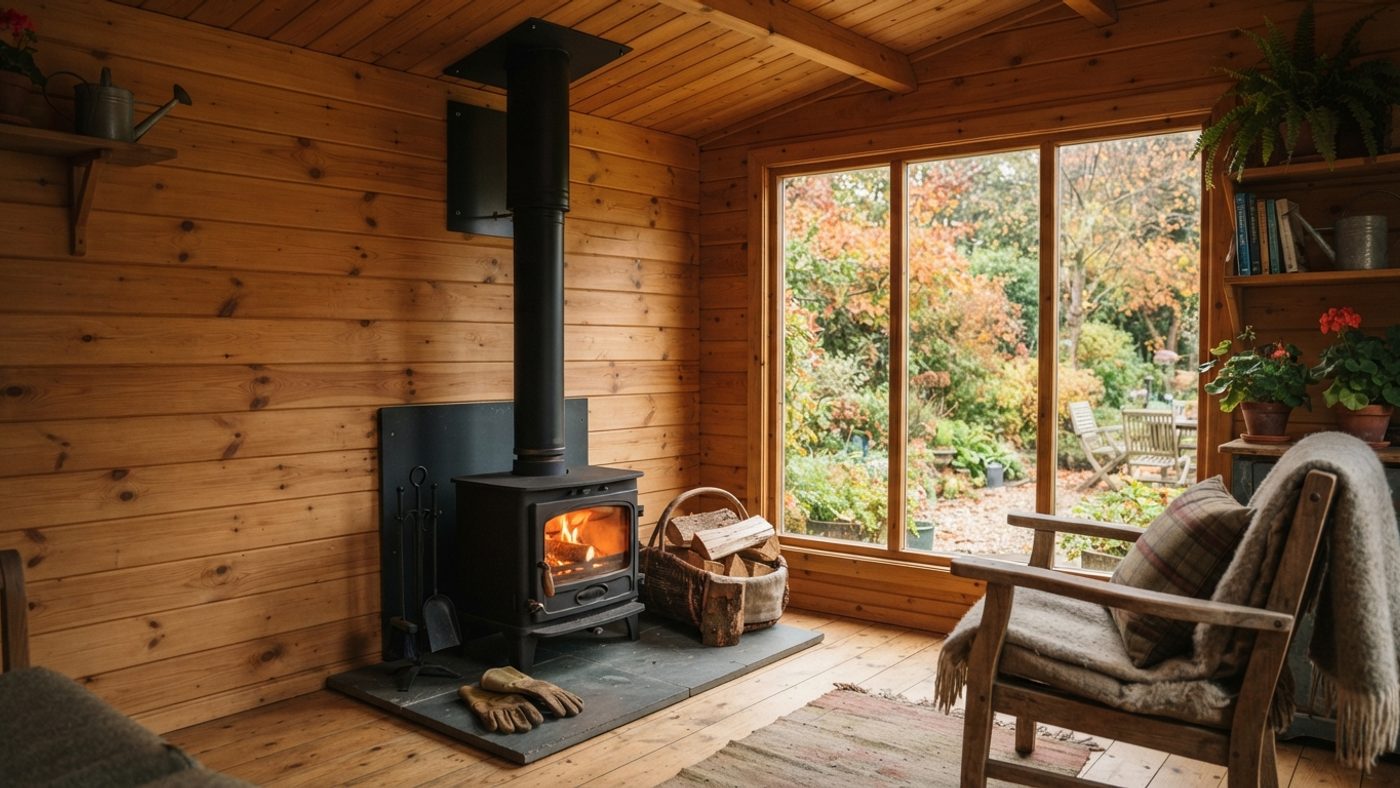
A permanent structure and a permanent flue bring planning and building control into the picture, which none of the standalone appliances above ever touch.
A garden building can often go up under permitted development without planning permission, provided it meets Scotland's specific limits: sited at the back of the house, no higher than 4 metres at its highest point, eaves no higher than 3 metres, any part within a metre of the boundary capped at 2.5 metres, and the building, together with any other garden development, not taking up half or more of the ground behind the house. Meeting all of that covers the shed or garden room itself. It says nothing about what goes inside it. Adding a flue, or converting the space into something regularly heated and occupied, is exactly the kind of change worth raising with the council's building standards service before work starts, since a building warrant turns on the specifics of what's being installed, not on whether the outer shell already qualifies as permitted development.
Those permitted development limits also don't apply everywhere. A conservation area or a listed building can each remove or restrict the normal permitted development rights for a garden building, and a council can go further still with an Article 4 direction, an order removing permitted development rights for a specific area beyond what conservation-area status alone would take away. Any of the three means what would need no planning permission on an ordinary property needs an actual application on that one. Check with the council's planning department directly if the property sits in a conservation area or near a listed building, rather than assuming the standard limits above apply.
Two things statute doesn't cover, but worth checking anyway
Everything above is public law, the same for every property in the same zone. Two further things sit outside statute entirely, decided property by property rather than by any council or Parliament.
A flat in a tenement, or any property with a shared back green, is often governed by title deed conditions and a factor's rules on top of the general law, and it's entirely normal for those to restrict or ban open fires, fire pits or chimeneas on shared ground regardless of what the Clean Air Act or nuisance law would otherwise allow. Check the title deeds or ask the factor before assuming a fire pit is fine just because the general law doesn't forbid it.
Home insurance is the other genuine gap. Policies vary by insurer, and some set conditions around fire pits, chimeneas or wood-burning stoves, a requirement to notify the insurer, an exclusion for damage caused by an unauthorised or badly sited appliance, or specific terms for a fixed stove installation. Check directly with the insurer before installing anything with an open flame or a flue, rather than finding out only after a claim.
Fuel: what you can actually burn
The exempt-appliance question is about the stove or fireplace itself; the authorised-fuel question is about what goes in it, and the two aren't the same test.
Ecodesign requirements for solid fuel local space heaters, the EU-derived standard that sets limits on particulate matter, organic gaseous compounds, carbon monoxide and nitrogen oxide emissions along with efficiency during use, apply in Great Britain to new stoves placed on the market, effective from 1 January 2022. A stove bought after that date should carry a Declaration of Conformity confirming it meets those thresholds; one bought or installed before it isn't retrospectively caught by the requirement. Ecodesign compliance and exempt-appliance status are tested and confirmed separately, but in practice a modern Ecodesign stove is the kind of appliance the exempt list is built around, so the purchase date is worth knowing before assuming an older stove qualifies.
One England-only rule worth flagging so it isn't wrongly assumed to apply here: the retail restriction on selling wet wood or unauthorised coal in small volumes, the "Ready to Burn" moisture-content scheme most wood suppliers now label their product with, comes from the Air Quality (Domestic Solid Fuels Standards) (England) Regulations 2020, which state explicitly that they apply in relation to England only. Scotland has no equivalent regulation restricting what a supplier can sell, though burning genuinely dry, well-seasoned wood remains the sensible choice regardless, both for how cleanly it burns and for staying inside the "authorised fuel" defence discussed above if the property happens to sit in a smoke control area.
Comparing the three
| Fire pit / chimenea | Fixed garden stove | Open bonfire | |
|---|---|---|---|
| Siting guidance | At least three feet from anything combustible | Governed by the garden building's own siting under permitted development limits | Covered separately, see the allotment bonfire law piece |
| Smoke control area (Clean Air Act 1993, s.20) | Genuinely unclear whether it technically applies; not chimney-connected to a building | Applies directly if the flue counts as a building's chimney and the property is in a designated area | Not chimney-based; a different offence (dark smoke) applies instead |
| Statutory nuisance (EPA 1990, s.79) | Applies regardless of zone, if smoke is prejudicial or a nuisance in fact | Applies the same way | Applies the same way |
| Structure/planning | Usually none, a standalone appliance | Garden building limits apply to the structure; a flue can separately trigger a building warrant | None, no structure involved |
| Fuel | No Scotland-wide legal restriction on moisture content; dry wood still sensible | Authorised-fuel defence matters if in a smoke control area | Governed by the dark smoke and nuisance rules in the allotment bonfire piece |
Whatever ends up burning in any of these, what to do with what's left afterwards is its own question, covered in the guide to handling wood ash safely in the garden.
Common questions
Do I need permission to put a fire pit or chimenea in my garden?
No, not for the appliance itself, there's no consent process for buying and placing a standalone fire pit or chimenea. Planning and building control questions only arise if it's built into a permanent structure with its own flue, covered above.
Is my whole garden off-limits if I'm in a smoke control area?
No, and the designation isn't all-or-nothing either: Edinburgh is a single blanket zone covering the whole city, but a smaller authority like Dundee designates individual areas within it, so two houses a mile apart in the same council area can have different answers. Either way, the designation restricts what's burned in a building's chimney without an exempt appliance, not gardens in general.
How do I check if my address is in a smoke control area?
Spatial Hub Scotland's interactive map at data.spatialhub.scot covers every council's designated areas. Some councils, Dundee among them, also publish their own more detailed local maps; others, like Edinburgh, are a single blanket designation covering the whole city, so no address lookup is needed there at all.
My neighbour's chimenea smoke keeps drifting into my garden, what can I actually do?
A conversation is worth trying first, since it's faster than any formal process and often resolves things on its own. If that doesn't work, a statutory nuisance complaint to the council's Environmental Health team under the Environmental Protection Act 1990 is the route that applies regardless of whether the property is in a smoke control area, since the test is whether the smoke is genuinely prejudicial to health or a nuisance, not which zone it's in.
Does an Ecodesign label mean I can burn anything I like in it?
No. Ecodesign compliance is about the appliance's emissions and efficiency performance when tested, it isn't a licence to burn unauthorised fuel. If the property is in a smoke control area, what goes in the appliance still needs to be an authorised fuel, or the appliance needs to be on the exempt list, for the defence under section 20 to apply.
Sources
14 sources, recorded with what each was used for
- Clean Air Act 1993, section 18: The power for a local authority to declare a smoke control area
- Clean Air Act 1993, section 20: The smoke emission offence, the authorised-fuel defence, the penalty, and confirmation the section extends to Scotland with a Scottish-ministers duty to publish the authorised fuels list
- Environmental Protection Act 1990, section 79: Smoke emitted from premises as a category of statutory nuisance, and confirmation of its extension to Scotland from 1996
- Scottish Fire and Rescue Service: Outdoor heating safety: The three-feet clearance figure and general siting/fuel safety advice for fire bowls, fire pits, chimeneas and braziers
- Scottish Air Quality (scottishairquality.scot): Smoke Control Areas guidance: Scotland-wide overview of authorised fuels, exempt appliances, and how to check whether a property is in a smoke control area
- Spatial Hub Scotland: Smoke Control Areas dataset: The Scotland-wide interactive map/dataset of designated smoke control areas
- The City of Edinburgh Council: Smoke control: Confirms the whole of Edinburgh is a single smoke control area
- Dundee City Council: Smoke Control Areas: Confirms Dundee runs its own local map covering 21 designated areas
- gov.uk: Placing energy-related products on the UK market: Confirms solid fuel local space heaters fall under UK Ecodesign product regulation and require a Declaration of Conformity
- Commission Regulation (EU) 2015/1185: The Ecodesign requirements for solid fuel local space heaters (particulate matter, gaseous compounds, carbon monoxide, nitrogen oxide, efficiency)
- The Air Quality (Domestic Solid Fuels Standards) (England) Regulations 2020: Confirms the wet-wood/fuel-sale retail restriction applies in England only, not Scotland
- mygov.scot: Build a shed, garage or greenhouse at your house: The specific permitted development height, boundary-proximity, and garden-coverage limits for a garden building in Scotland
- mygov.scot: Building warrant: General building warrant trigger criteria, used for the point that a flue or heat-source change is worth checking separately from a garden building's permitted development status
- Smoke Control Areas (Authorised Fuels) (Scotland) Regulations 2008: The specific Scottish regulations made under the Clean Air Act 1993 duty to publish an authorised fuels list for Scotland