
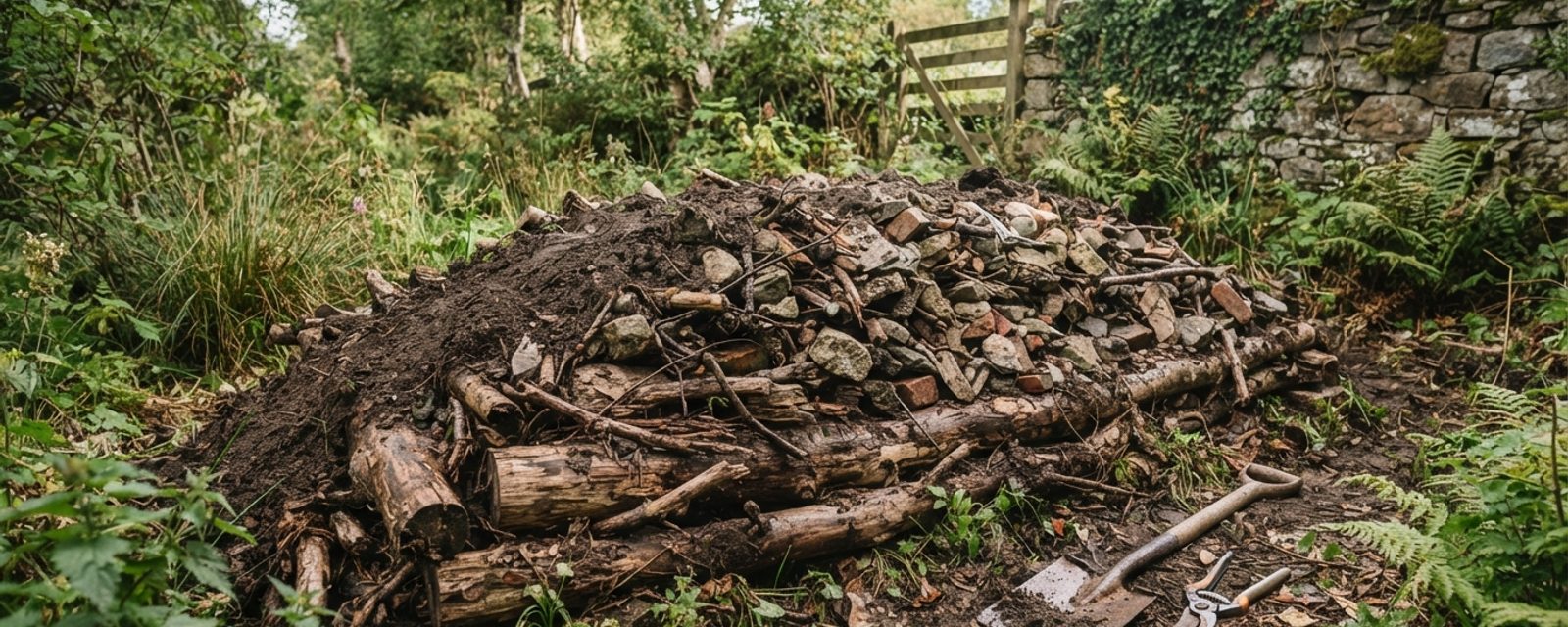
Frogs, toads, newts, slow worms and common lizards are ectotherms: their body temperature tracks whatever is around them, and they cannot generate their own heat to survive a Scottish frost. Left exposed, a hard freeze kills them outright. To get through winter they need to reach a spot below the frost line that stays cool but never freezes, and humid enough that their skin doesn't dry out during the months they spend in torpor, the dormant, barely-active state they pass winter in. A hibernaculum is a garden structure built specifically to provide that refuge, a stack of rubble, logs and soil engineered to hold a frost-free, damp core through the coldest part of the year.
This isn't a hedgehog home, and it isn't a pond guide, for pond design and general advice on attracting frogs, see the frogs page.
What they'd otherwise be looking for
RHS guidance on garden amphibians notes that, in autumn, amphibians seek sheltered places away from ponds, though frogs and newts may instead overwinterKeeping a plant alive and intact through the cold months, whether left outdoors, moved under cover, or stored dormant. Full definition → in the bottom of a pond rather than on land. A hibernaculum is a purpose-built version of the log pile, hedge bottom or rubble heap they'd otherwise have to find for themselves, built properly, rather than left to chance.
Which species will actually use one
Not every animal people picture when they hear "hibernaculum" is a realistic Scottish garden visitor, and the choice of species should shape where and how you build.
| Species | Realistic in a Scottish garden? | Notes |
|---|---|---|
| Common frog | Yes | Standard hibernaculum and log-pile user, especially near a pond |
| Common toad | Yes | Same as above |
| Smooth newt | Yes | Same as above |
| Palmate newt | Yes | Same as above |
| Slow worm | Yes | Commonly found using compost heaps, log piles and rockeries |
| Common (viviparous) lizard | Yes, but habitat-dependent | Needs a sunny, south-facing basking spot near the shelter, not the shelter alone |
| Great crested newt | Not realistic in most of Scotland | Scottish range is scattered populations in the central belt, the Borders and around Inverness |
| Adder | No — don’t build for this species | Prefers heathland, moorland and woodland, and is venomous; not a garden feature to design around |
In practice, a hibernaculum sited near a pond is built for amphibians and slow worms. A sunny bank version, sited away from the pond, is aimed at common lizards. Froglife's guidance on garden lizards notes that whether either group actually turns up depends on whether the species is already present locally, a hibernaculum improves the odds for animals already in the area, it doesn't summon a species that isn't there.
Where to site it
Pick a corner of the garden that won't get dug over, walked on, or cleared out, once built, this feature needs to be left alone through the winter. Froglife's wintering-sites guidance specifies choosing a spot where the soil drains well; a waterlogged hibernaculum defeats the purpose, since the animals need damp air, not standing water.
RHS guidance on dead wood and compost heaps notes that locating a log pile near a pond gives frogs, toads and other amphibians a convenient bolt hole and hibernation site close to where they spend the rest of the year. If more than one pond is involved, use separate tools and nets for each and let anything that touches the water dry out before it goes near another pond, ordinary hygiene that limits the spread of amphibian disease between water bodies.
For lizards, site it differently: Froglife notes that common lizards favour basking on south-facing banks within easy reach of an escape place, so a reptile-focused hibernaculum wants sun exposure and a nearby retreat, not shade, worth taking seriously in Scotland specifically, where a lizard already gets fewer strong sun hours than one further south to warm up in before retreating. Keep either version clear of anywhere due for digging, planting or path repairs, and tuck it away from the middle of the lawn or an open run, a quiet corner behind planting or a shed gives some natural cover from cats and foxes, and letting the surface vegetation establish over the mound adds more once it's grown in.
Step-by-step construction
It can be built as a dug pit or as an above-ground mound, depending on how much digging you want to do, either version is a job for an afternoon rather than a weekend, once the materials are gathered. None of it needs to be bought new: broken bricks, leftover paving rubble, prunings and off-cuts of pipe all work, so it's worth using whatever's already lying around the garden or shed before buying anything.
- Dig the pit (optional). For an in-ground version, dig a hole roughly 50cm deep and about 1.5 metres across, in a sheltered spot with free-drainingSoil that lets water pass through quickly rather than pooling, so roots aren't sitting in wet ground after rain. Full definition → soil. Skip this step for an above-ground pile, simply start stacking on the surface.
- Build the core. Layer in logs, branches, bricks and rocks or brick rubble, leaving air gaps between them rather than packing everything solid.
- Pack the gaps. Fill the spaces loosely with wood-chip so the pile isn't a series of open voids, but keep it loose enough for animals to move through.
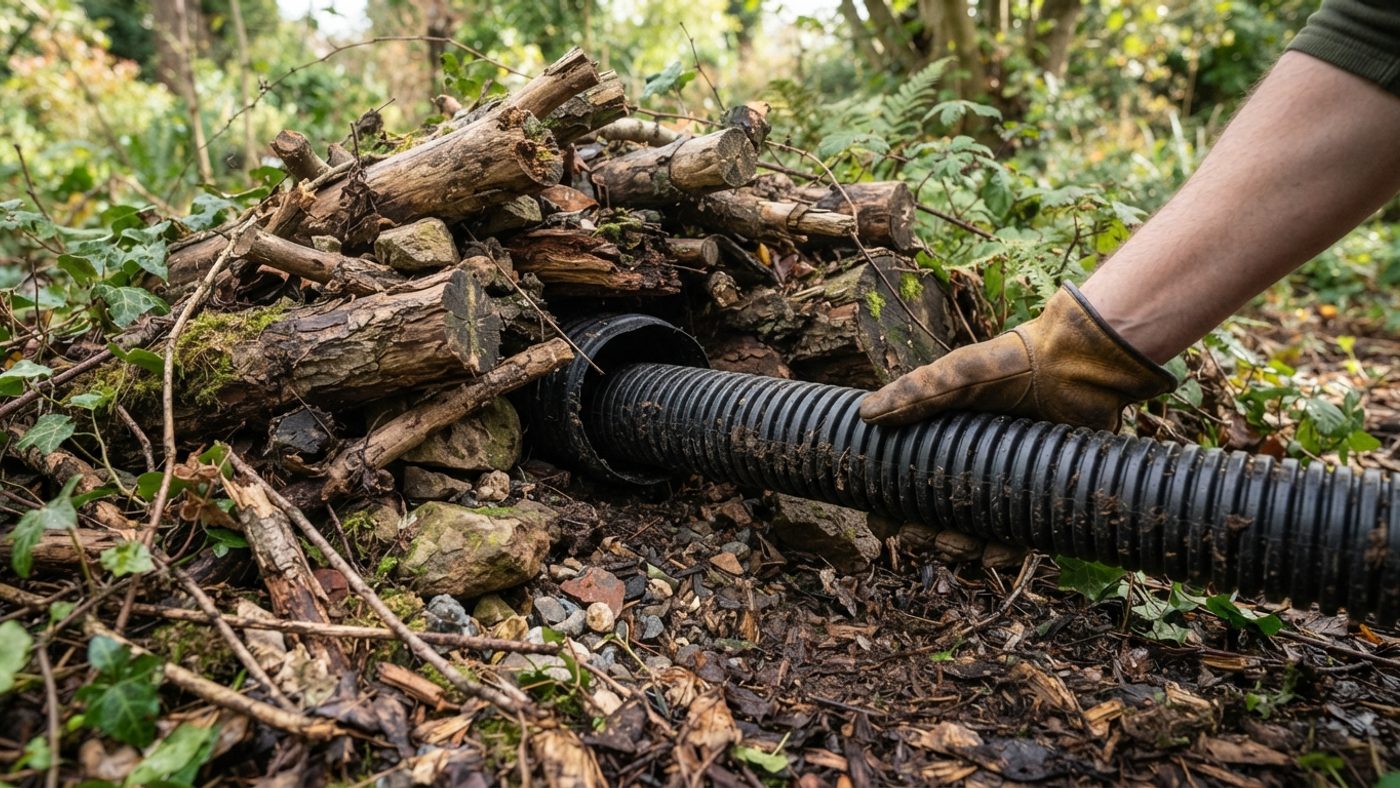
- Add entrance tubes. Insert pipe or drainpipe off-cuts at ground level as you build, so animals have clear access into the core. If the tubes are plastic, roughen the inside with sandpaper first, smooth plastic is too slippery to climb.
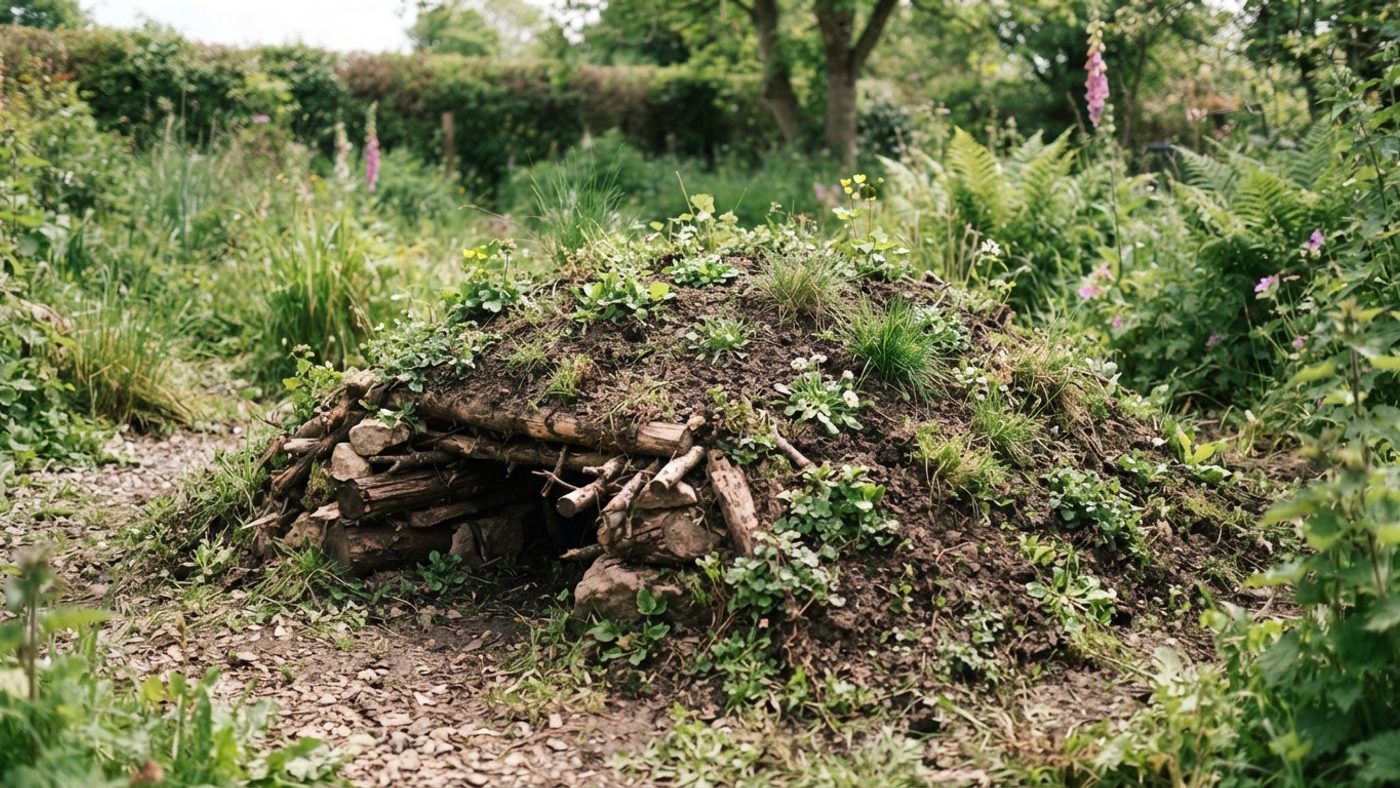
- Cover with soil. Mound excavated soil over the whole structure to a depth of roughly 45 to 50cm, and to about the same height if building above ground. On colder inland and upland ground, staying toward the deeper end of that range is the safer choice.
- Plant it over. Sow a native wildflower or meadow-seed mix, or let long grass establish over the mound. Vegetation cover develops naturally over time and helps the structure blend into the garden.
| Material | Purpose |
|---|---|
| Logs and branches (bark left on) | Core structure and shelter gaps |
| Bricks, rubble or rocks | Core structure, added stability |
| Wood-chip | Loose packing between larger pieces |
| Pipe or drainpipe off-cuts | Entrance tubes at ground level |
| Excavated soil, ~45–50cm | Insulating cover over the whole pile |
| Meadow seed or turf | Surface vegetation once built |
A couple of points are worth carrying into the build: logs that still have their bark on are more useful than stripped ones, treated timber such as old fence posts or tree stakes is less beneficial for wildlife than untreated wood, and it's worth mixing log sizes, too many thin twigs rot and collapse faster than the structure needs.
For a smaller commitment, Froglife's guidance also covers a scaled-down option: an upturned plant pot with a hole knocked in the side as a doorway, or a small wooden structure, with old leaves or grass packed inside for extra insulation, sometimes called a "toad home." It gives an amphibian somewhere to shelter without the dig.
The legal position
Most of the species likely to use a garden hibernaculum, common frog, common toad, palmate newt, smooth newt, slow worm and common lizard, are listed on Schedule 5 of the Wildlife and Countryside Act 1981 as "section 9(5) only." That means it's an offence to sell, offer for sale, or transport any of them for sale, but the Act itself does not make it an offence to kill, injure or disturb these species. Building, moving or dismantling a hibernaculum that shelters any of these animals isn't, on its own, restricted by this Act. Scotland's Nature Conservation (Scotland) Act 2004 extended the Act's disturbance offence to cover reckless as well as intentional acts, which is why that wording carries both.
Great crested newt sits in a different category: alongside its Schedule 5 listing, it's protected as a European Protected Species under the Conservation (Natural Habitats, &c.) Regulations 1994, which does make it an offence to deliberately or recklessly kill, injure, capture or disturb it, or to damage or destroy a breeding or resting place it uses. It isn't a realistic occupant of a garden hibernaculum across most of Scotland, given how restricted its range is. If one ever did turn up in a hibernaculum, the legally relevant point would be disturbing it while it's using the structure, not the act of having built the structure in the first place.
The adder is also Schedule 5 "section 9(5) only," protected from trade, not from disturbance, but as covered above, a garden hibernaculum shouldn't be built with the intention of attracting one.
Common questions
Do I need a pond nearby for a hibernaculum to work?
Not strictly, but it helps for amphibians. RHS guidance on dead wood habitats notes that a log pile located near a pond gives frogs, toads and newts a convenient bolt hole close to their breeding site. A hibernaculum built purely for lizards or slow worms doesn’t need pond proximity, it needs a sunny bank instead.
When should I build it, and when should I leave it alone?
Build it in late summer or early autumn, before animals start looking for winter shelter, then leave it undisturbed from autumn through to spring. Once occupied, digging into it risks exposing hibernating animals to cold and disturbance during the period they’re least able to cope with either.
Can I use treated timber like old fence posts?
Untreated is worth the extra effort of sourcing if you can. The preservatives in treated timber are there specifically to stop the wood breaking down, which is the opposite of what makes an old fence post any good to the invertebrates and fungi that a healthy hibernaculum core relies on lower down the food chain.
Will building one guarantee I get frogs, toads or lizards?
No, and it’s worth setting that expectation before you start digging. A well-built, well-sited hibernaculum gives resident wildlife a better chance of surviving winter where they already live, it isn’t a lure that pulls a new species in from somewhere else entirely.
Is it legal to move or dismantle a hibernaculum if I need to landscape that part of the garden?
For the common species most likely to be using it, frogs, toads, newts, slow worms and common lizards, the Wildlife and Countryside Act 1981 doesn’t make disturbing them an offence, since these species carry only the section 9(5) trade protection. The exception would be a great crested newt, which carries fuller protection under separate regulations, but it isn’t realistic in most Scottish gardens. As a matter of good practice rather than legal requirement, it’s still worth doing this kind of work outside the winter months.
Sources
10 sources, recorded with what each was used for
- RHS: Stone and coast habitats: Hibernaculum construction — cairn method, soil depth, access pipes
- RHS: Amphibians in your garden: Winter shelter-seeking behaviour, log piles, pond overwintering
- RHS: Dead wood and compost heap habitats: Log pile materials, bark/treated-timber guidance, pond proximity
- Froglife: Wintering sites and 'toad homes': Hibernaculum method and the small-garden "toad home" alternative
- Froglife: Lizards in my garden: Reptile basking/shelter needs and the local-presence caveat
- Wiltshire Wildlife Trust: Hibernaculum: Pit dimensions and entrance-tube detail
- Scottish Wildlife Trust: Great Crested Newt: The species' Scottish distribution
- Wildlife and Countryside Act 1981, Schedule 5: Species protection listings
- Wildlife and Countryside Act 1981, Section 9: Offence definitions (9(1), 9(4), 9(5))
- Conservation (Natural Habitats, &c.) Regulations 1994: Great crested newt's European Protected Species status