
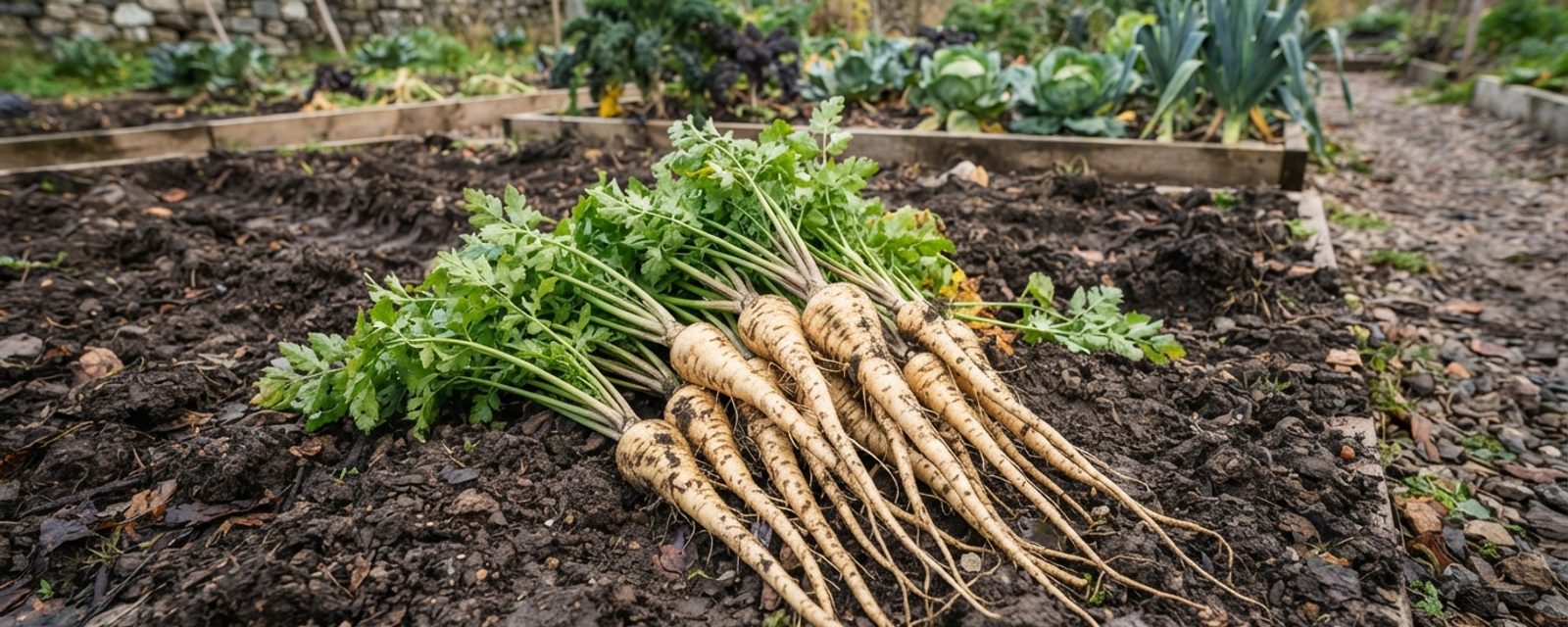
Parsnip canker has no chemical control. Once it takes hold, a reddish-brown to blackish rot spreading across the shoulder and crownThe base of a perennial plant where roots and shoots meet, often sold and planted as a ready-made dormant plant rather than grown from seed. Full definition → of the root, the only response is to cut the damaged part away and eat what's left, or lose the root entirely. That single fact is why variety choice matters more for parsnips than for almost any other root crop: with no spray to fall back on, a resistant variety is doing work that nothing else in the garden can do for it.
Quick answer
Gladiator is the strongest all-round choice: RHS Award of Garden Merit, confirmed canker resistance on its own plant page, and it copes with a wider range of soils than most. Albion and Picador are equally solid canker-resistant alternatives if you want a second variety for succession or seed-saving insurance. Skip Pearl if canker is your main worry, its own page contradicts itself on resistance, and treat Viper as an exhibition variety only, it's potentially susceptible to canker, not resistant to it.
Five varieties carry the Award of Garden Merit for parsnip: Albion, Gladiator, Pearl, Picador and Viper, with Albion, Gladiator and Picador singled out specifically as canker-resistant. That's the starting list. What doesn't show up until you check each variety's own individual plant page rather than stopping at the general summary is that the five don't hold up equally once you look one by one: one has an internal contradiction on canker resistance, and the AGMThe RHS's Award of Garden Merit: a UK-wide trials award for reliable performance, not a Scotland-specific recommendation. Full definition → badge itself doesn't consistently appear where you'd expect it.
The full growing guide covers sowing, station sowing technique, and harvest timing in detail; this page is about choosing between varieties, not how to grow the crop once you've picked one.
The AGM five, checked one by one
The general grow-your-own page states plainly: "It's worth choosing a variety that is canker-resistant and has an RHS Award of Garden Merit (AGM), which means it should grow well and crop reliably." Three of the five, Albion, Gladiator and Picador, are named there as canker-resistant.
Checking each variety's own dedicated plant page turns up real differences the summary page doesn't show. All five carry the same H5 hardiness ratingThe RHS's H1a–H7 scale for how much cold a plant can survive outdoors, H1a being tender indoor-only and H7 hardy anywhere in the UK. Full definition →, hardy throughout the UK even in a severe winter, so hardiness isn't what separates them; canker resistance and AGM confirmation are:
| Variety | AGM badge on own page | Canker resistance (own page) | Root and skin |
|---|---|---|---|
| Albion | Not shown | Yes, "bred for resistance to canker" | Long, smooth, evenly-tapered, white skin slow to discolour, sweet flavour |
| Gladiator | Shown | Yes, "resistant to canker" | Long, slender, pale cream, consistently smooth blemish-free skin, rich sweet and earthy flavour |
| Pearl | Not shown | Contradictory, see below | Long, slender, smooth white skin, pleasant taste, stores well in the ground over winter |
| Picador | Shown | Yes, "good resistance to canker" | Long, tapering, white, "a really vigorous variety" |
| Viper | Not shown | No, "may be susceptible to parsnip canker" | Long, uniform roots with a shallow crown; F1 hybridThe first-generation offspring of two specific, deliberately chosen parent plants, bred for a predictable, uniform result but not worth saving seed from. Full definition → capable of growing very large, "ideal for exhibiting" |
The AGM badge doesn't appear consistently. The general parsnip page lists all five as AGM holders, but only Gladiator's and Picador's own individual plant pages actually display the AGM badge when you visit them. Albion, Pearl and Viper's own pages carry no visible AGM badge at all, despite the summary page including them. This isn't unique to parsnips, it's a pattern that turns up across RHS's variety pages generally, but it means Albion, Pearl and Viper's AGM status is only confirmed by the general page, not by their own listing.
Pearl contradicts itself. Pearl's own plant page opens by describing the variety as one that "stores brilliantly in the ground over winter and has good canker resistance", but its diseases section, further down the same page, states plainly: "May be susceptible to parsnip canker." Both sentences are on the same page. The general summary page sides with the positive claim and doesn't flag the contradiction. Until that's resolved at the source, treat Pearl's canker resistance as unconfirmed rather than relying on it, if canker is the problem you're specifically trying to solve, choose Albion, Gladiator or Picador instead, where both the general page and the variety's own page agree.
Viper is not a canker-resistant choice, despite carrying the AGM on the general list. Its own page states it "may be susceptible to parsnip canker" and says nothing about resistance anywhere. Viper's real strength is size, it's bred to grow large for showing, not to fight off disease.
Two other things worth knowing about Viper specifically: it's an F1 hybrid, so seed saved from your own roots won't grow true to type next year even if you wanted to save it. That's on top of the general parsnip rule that applies to every variety here, F1 or not: parsnip seed loses viability fast, and the growing guide already covers buying fresh seed every year regardless of which variety you grow. And because Viper isn't canker-resistant, it needs the same careful root protection any susceptible variety needs: avoid nicking it while weeding, and keep watering even through dry spells.
Does Scotland's wetter climate actually make canker worse?
The general parsnip page gives no environmental cause for canker at all, no mention of rainfall, soil moisture, or pH in connection with it, only that it's "an orange/brown rot" that can affect roots "especially if already damaged." A Pacific Northwest Extension factsheet on Itersonilia canker, the fungal disease behind parsnip canker, does link cultural practice to canker risk: it recommends hilling soil up over the root shoulders through the season, keeping to a long rotationMoving each crop family to different ground each year, on a multi-year cycle, so pests and diseases that build up in soil don't get a repeat host. Full definition → to reduce the fungus's population in the soil, and choosing well-drained ground while avoiding compaction. That's a real, sourced connection between soil drainage and canker risk, a growing-practice recommendation rather than a direct "wetter regions get more canker" climate claim.
Choosing well-drained ground and avoiding soil compaction is the one canker control with a real source behind it, worth taking seriously on higher-rainfall ground. Treat it as sensible practice, not a proven climate-to-canker link.
One variety is named as maturing faster than the rest: Gladiator's own page describes it as "quick to mature" and able to "produce a crop very early in the season", a real advantage on a short growing season. None of the other four AGM varieties' own pages state a comparable maturity claim, so this isn't a like-for-like comparison across all five, it's the one place a variety's own page volunteers timing information at all.
What every source agrees on, without qualification: roots that are already damaged, by a hoe blade, by carrot fly larvae, or by splitting from erratic watering, are far more vulnerable to canker taking hold. Hand-weed rather than hoe, water evenly through dry spells, and keep carrot fly off the crop with mesh from sowing. Full detail on symptoms and control is on the parsnip canker page.
Soil pH: a figure given on variety pages but not the main guide
The general parsnip grow-your-own page states no soil pH figure for the crop. But the cultivation notes on individual variety pages (Gladiator's and White Gem's both carry the identical wording, standard guidance repeated across parsnip cultivarA plant variety that arose or was bred under cultivation and is kept true by deliberate propagation, rather than a naturally occurring wild species. Full definition → pages rather than a variety-specific figure) do give one: "The ideal soil pH is 6.5–7 so adjust pH where necessary." That's a genuinely useful number missing from the crop's main growing advice.
Beyond the five: two more from a second authority
Gardener's World names five parsnip varieties in its own growing guide, and two are worth adding to the shortlist because they don't appear on the AGM list at all:
White Gem, "a reliable, sweet-flavoured variety with good canker resistance", per Gardener's World, and confirmed independently on its own RHS plant page: "Shows some resistance to parsnip canker." It doesn't carry an AGM badge on its own page or appear on RHS's general AGM list.
Archer, described by Gardener's World as offering "good yields and flavour... a good canker resistant variety" and listed there as RHS AGM. RHS's own current general parsnip page names only Albion, Gladiator, Pearl, Picador and Viper as its five AGM holders, and Archer isn't among them, whether it once held the AGM and was superseded, or Gardener's World's listing is simply out of date, isn't clear. The yield and flavour claims are Gardener's World's own view, not RHS-confirmed.
Gardener's World also names Gladiator as "especially suited to heavy soils", a claim that doesn't appear anywhere on Gladiator's own plant page. It's plausible, Gladiator's own page does separately note it "grows well in most soils", but it's a Gardener's World claim, not an RHS one, so it's presented here as such rather than blended into the RHS description above.
Which one for your situation
Want the safest all-round pick: Gladiator. It's the only variety of the five where AGM status, canker resistance, and broad soil tolerance are all confirmed directly on its own page, with no contradictions to work around.
Growing on heavy or clay soil: possibly Gladiator, per Gardener's World, though that specific claim isn't RHS's own, so treat it as a reasonable lead rather than a confirmed fact. Whatever variety you choose, heavy soil is also where fork-free tap roots matter most, loosen compacted ground and skip fresh manure the season you sow, covered in full in the growing guide.
Want a second variety for succession sowing or seed-saving insurance: Albion or Picador. Both carry confirmed AGM and canker resistance independently of Gladiator, so growing two of the three genuinely spreads risk rather than doubling down on one variety's weaknesses.
Growing for exhibition or maximum root size: Viper, bred specifically to grow large with a shallow crown. Buy fresh seed each year rather than saving your own, and give it the extra root protection covered above.
Considering Pearl: worth growing for its storage qualities if you're not relying on it for canker resistance specifically, but given its own page contradicts itself on that point, don't choose it over Albion, Gladiator or Picador if canker is the problem you're solving for. "Stores well in the ground over winter" is true of any hardy parsnip variety in Scotland, not just Pearl, the practical limit isn't the root's condition, it's whether you can still dig it once the ground's frozen solid, which is why the growing guide recommends marking rows with canes and lifting a few extra in November before the ground locks up.
Common questions
Is Gladiator really better than Albion or Picador, or just more popular?
All three are confirmed AGM with confirmed canker resistance on their own RHS pages, so there's no real gap in reliability between them. Gladiator's edge is broader soil tolerance and being quick to mature; the other two are equally sound choices, and growing two of the three together is a reasonable way to hedge against a single variety underperforming in a given year.
Should I avoid Pearl and Viper altogether?
No, both are still worth growing for what they're actually good at. Pearl stores well in the ground over winter; Viper grows unusually large roots for showing. Neither should be your pick specifically for canker resistance, though.
Does variety choice matter more for parsnips than for other root vegetables?
For canker specifically, yes, because there's no spray or treatment to fall back on if the resistant-variety choice goes wrong. Compare that to carrots, where several other controls exist alongside variety choice against their equivalent pest, carrot fly.
Is it true Scotland's rain makes parsnip canker worse?
Not on any evidence we could independently confirm. RHS gives no environmental cause for canker at all. A US extension source does link canker risk to soil drainage and recommends well-drained ground, a reasonable practice to follow given Scotland's rainfall, but that specific climate connection isn't something any source we checked states directly, so it's worth treating as sensible caution rather than an established fact.
Where do I find sowing dates, spacing and harvest timing for these varieties?
All in the full parsnip growing guide, this page is about choosing between varieties, not the growing calendar. The variety you pick doesn't change the sowing window; all five AGM varieties are sown March to early May once soil reaches about 12°C, often later in the window on cooler ground than the calendar month alone suggests.
Sources
9 sources, recorded with what each was used for
- How to grow Parsnips: General AGM list of five varieties, canker-resistance framing, no environmental cause for canker stated
- Pastinaca sativa 'Albion': Canker resistance, hardiness, root description; confirms no AGM badge on own page
- Pastinaca sativa 'Gladiator': Canker resistance, AGM badge, hardiness, soil pH figure, root description
- Pastinaca sativa 'Pearl': Contradictory canker resistance claims, hardiness, root description; confirms no AGM badge on own page
- Pastinaca sativa 'Picador': Canker resistance, AGM badge, hardiness, root description
- Pastinaca sativa 'Viper': Canker susceptibility, hardiness, exhibition use; confirms no AGM badge on own page
- Pastinaca sativa 'White Gem': Canker resistance, soil pH figure, no AGM badge
- Parsnip (Pastinaca sativa)-Itersonilia Canker: Cultural controls: hilling soil over shoulders, long rotation, well-drained ground, avoiding compaction
- How to Grow Parsnips: White Gem and Archer variety descriptions, Gladiator heavy-soil claim