
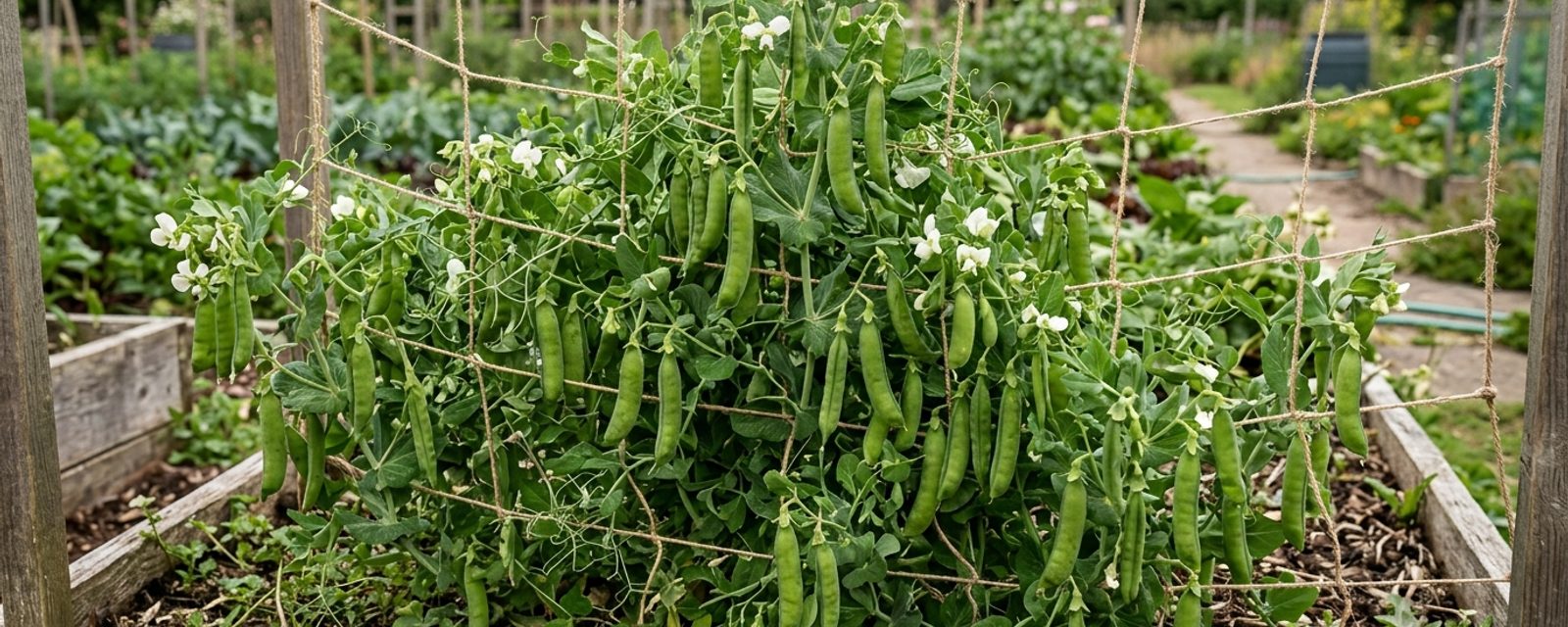
A pea plant's relationship with mildew is a matter of timing as much as weather. Powdery mildew, the disease that eventually shuts down most pea crops, tends to take hold on older, more stressed foliage rather than young growth, which is why it typically shows up late in a plant's life, as lower leaves thin and the canopy has had weeks to build up moisture and shade at ground level. Downy mildew works differently again, favouring damp, cool conditions rather than the dry spells that trigger powdery mildew. The practical result is the same either way: the longer a pea crop stays in the ground, the more likely one or both diseases are to catch up with it. Scotland's cool summers delay pea maturity and stretch the harvest period well past what's typical further south, so that timing question matters more here than it does south of the border, and it's a real reason to look past the same handful of varieties every list recommends.
Quick answer
For most Scottish gardens, Hurst Green Shaft remains the strongest all-rounder: heavy-cropping, well-proven, and carrying documented resistance to downy mildew. But it isn't the right choice in every case. If you want a crop that keeps going latest into the mildew-risk part of the season, Jaguar or Terrain, the only two varieties with resistance to both powdery and downy mildew, are the better bet. If space or shelter is tight, Vivado's compact 60cm habit or Sugar Ann's support-free bushiness will suit a small or exposed plot better than a tall maincropThe main, usually latest-sown and longest-growing type of a crop, grown for bulk and storage rather than an early harvest. Full definition →.
Why mildew resistance is the variety question worth asking in Scotland
Nine pea varieties currently hold the RHS Award of Garden Merit (AGMThe RHS's Award of Garden Merit: a UK-wide trials award for reliable performance, not a Scotland-specific recommendation. Full definition →), the UK-wide mark of a plant judged to have real garden merit. Four carry a specific mildew resistance claim on their own listing rather than just the standard susceptibility list, but only two, Jaguar and Terrain, are documented as resistant to both powdery and downy mildew. That distinction is worth knowing for anyone trying to keep a crop going deep into a Scottish season that already runs later than most growing advice assumes, rather than treating "disease resistant" as an interchangeable label across the group.
Pea moth and pea midge, which trouble crops further south, are not troublesome in Scotland, so a resistance claim aimed at those pests isn't a meaningful selling point here, the mildews are the more relevant risk. Pea wilt, the other disease named on some variety pages, is soil-borne rather than airborne like the mildews, so it isn't tied to how long a crop stays in the ground the same way; slugs, aphids and pigeons round out the pests worth watching regardless of variety.
The varieties worth comparing head-to-head
Delikett, Sugar Ann and Cascadia are all sugarsnap types with overlapping compact habits, and none carries a specific resistance claim on its listing. Sugar Ann stands out from the other two: its bushy habit is the only one described as not needing support, a genuinely distinct practical advantage the other two don't share.
The remaining seven varieties each bring something the others don't, a different pod type, cropping window, height, or a documented resistance claim. All nine share an H2 hardiness ratingThe RHS's H1a–H7 scale for how much cold a plant can survive outdoors, H1a being tender indoor-only and H7 hardy anywhere in the UK. Full definition →, meaning they tolerate cool weather but not a hard frost, and all sow across the same broad window, from early spring once the soil has warmed to early summer; the full growing guide covers Scotland's soil-temperature timing in detail, including why that H2 rating makes the actual sowing date, not the calendar month, the thing to watch here.
| Variety | Pod type | Timing | Height | Mildew resistance |
|---|---|---|---|---|
| Hurst Green Shaft | Shelling | Maincrop, ready from late June | Up to ~1m | Some resistance to downy mildews; may be susceptible to pea wilt and powdery mildews |
| Kelvedon Wonder | Shelling | First early (also usable as maincrop), from June | ~60cm | Some resistance to pea wilt and powdery mildews |
| Jaguar | Shelling | Second early, from June | ~70cm | Some resistance to both downy mildews and powdery mildews |
| Terrain | Shelling | Late/maincrop, extends toward first frost | Up to ~1m | Relatively resistant to powdery mildews and downy mildew |
| Vivado | Shelling | Late maincrop, compact climber, crops May–September | ~60cm | No specific resistance claim on its own listing; the general page separately describes "excellent disease resistance", unconfirmed at the individual level |
| Delikata | Mangetout (dual-purpose, can also be shelled) | Long season, early summer to autumn | Up to ~1.3m, climbing | General page calls it "mildew and fusarium resistant"; not repeated with the same specificity on its own listing, treat as a softer claim |
| Sugar Ann | Sugarsnap | Early | Compact and bushy, shouldn't need support | No specific resistance claim |
| Delikett | Sugarsnap | Pods around 8cm, sweeter (and stringier) with age if left on the plant | Compact | No specific resistance claim |
| Cascadia | Sugarsnap | Quick-maturing, crops early summer into early autumn | Compact | No specific resistance claim |
Best overall pick
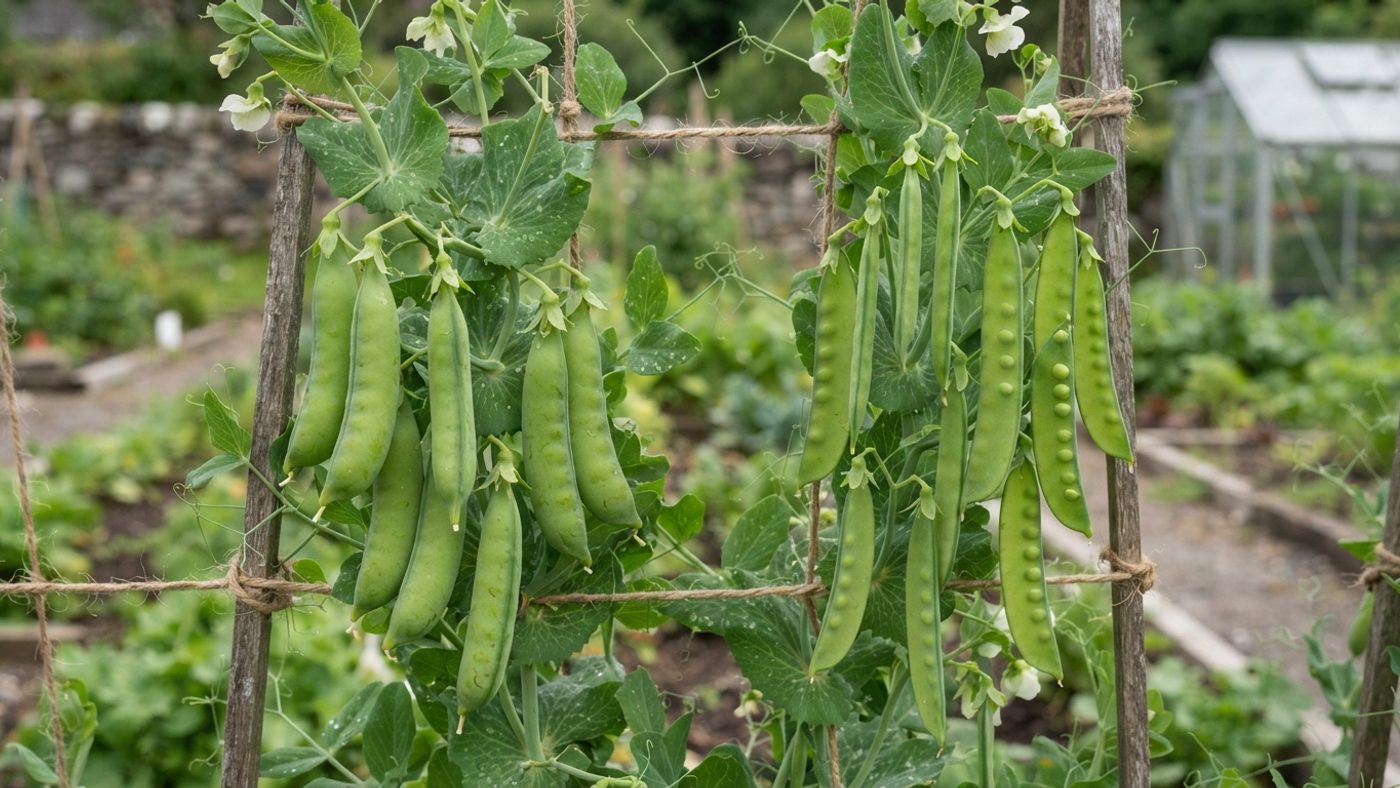
Hurst Green Shaft is the best overall choice for most Scottish gardeners: a heavy-cropping maincrop with documented resistance to downy mildew, pods that run to nine peas each, and a long track record.
It isn't the right call in every situation, though:
- Want the latest possible mildew-resistant harvest? Choose Jaguar or Terrain instead, the only two varieties with resistance claims covering both mildews, and Terrain is specifically positioned as a late-season variety, so it keeps cropping into the window where mildew risk is highest.
- Growing in a small or exposed spot and don't want tall staking? Choose Vivado, a genuinely compact climbing maincrop, without the height (and staking demands) of Hurst Green Shaft.
- Want zero support altogether? Choose Sugar Ann, the only one of the nine described as not needing support at all, a real advantage if staking is the part of growing peas you'd rather skip.
- Want an edible pod rather than a shelling pea? Choose Delikata, the only mangetout among the nine, with a long picking season and the option to leave pods to mature for shelling later.
Two more sugarsnaps worth knowing
Delikett and Cascadia both hold the AGM and sit close to Sugar Ann on pod type and compact habit, without a distinct advantage of their own beyond what's in the table above. Either is a fine second sugarsnap if you want more than one sowing overlapping, but if you're choosing just one sugarsnap variety, Sugar Ann's no-support habit gives it the edge.
Common questions
Does flavour differ enough between these nine to factor into the choice?
No comparable flavour rating exists across all nine, so there's no reliable basis for ranking these on taste specifically. Pod size and texture are the differences actually documented: Kelvedon Wonder's peas are noted as small and sweet, Hurst Green Shaft's pods run larger with more peas each, and the edible-pod types (Delikata, Delikett, Sugar Ann, Cascadia) are eaten whole rather than shelled, which changes the eating experience more than any flavour ranking would.
Can I grow a mangetout or sugarsnap variety instead of a shelling pea and get the same yield?
No comparable yield figures are published across pod types. What is clear from the plant descriptions is that mangetout and sugarsnap varieties are picked and eaten pod-and-all, generally at a smaller pod size than shelling types, so the comparison isn't really about yield per pod, it's about what you're picking peas for.
Does Vivado's "excellent disease resistance" claim mean it's a safe bet for a mildew-prone site?
Be cautious here. That description comes from the general grow-your-own page, but Vivado's own individual listing doesn't repeat a specific resistance claim, it lists the standard susceptibility caveat instead. Its compact habit is well documented and useful; treat the disease resistance claim as unconfirmed rather than a reason to choose it over Jaguar or Terrain specifically for mildew.
Why isn't pea moth resistance a factor in choosing a Scottish variety?
Pea moth isn't considered a significant field problem in Scotland, so a variety bred or marketed with pea moth resistance in mind isn't solving a problem most Scottish growers actually have. It's more relevant for growers further south.
Should I choose an early or a maincrop variety if I only have space for one sowing?
An early variety like Kelvedon Wonder gets you a crop and clears the ground fastest, useful if that space is needed for something else after. A maincrop takes longer but produces for a wider window; if it's the only sowing you're making, Jaguar or Terrain's mildew resistance covers the extra weeks that longer window costs you. Succession sowing several varieties in turn is covered in the full growing guide.
Sources
12 sources, recorded with what each was used for
- Peas: grow your own: General cultivation context, AGM status, and the Vivado and Delikata general-page disease resistance descriptions
- Pisum sativum 'Hurst Green Shaft': Pod size, peas per pod, harvest timing, downy mildew resistance and susceptibility notes, hardiness rating
- Pisum sativum 'Kelvedon Wonder': Pod description, harvest timing, pea wilt and powdery mildew resistance, hardiness rating
- Pisum sativum 'Jaguar': Pod description, harvest timing, downy and powdery mildew resistance, hardiness rating
- Pisum sativum Vivado: Compact climbing habit, height, cropping window, susceptibility list, hardiness rating
- Pisum sativum Terrain: Powdery and downy mildew resistance, foliage description, height, hardiness rating
- Pisum sativum (mangetout) 'Delikata': Mangetout classification, pod description, dual-purpose shelling option, height, sowing window, hardiness rating
- Pisum sativum (sugarsnap) 'Delikett': Sugarsnap classification, pod description, height, sowing window, hardiness rating
- Pisum sativum (sugarsnap) 'Sugar Ann': Sugarsnap classification, pod description, compact no-support habit, hardiness rating
- Pisum sativum (sugarsnap) 'Cascadia': Sugarsnap classification, pod description, height, cropping window, susceptibility notes
- Six of the Best Peas to Grow: Terrain's late-maincrop, high-yield, frost-extending description; Kelvedon Wonder's separate pea wilt and downy mildew resistance and heavy-yielding note; Hurst Green Shaft's freezing suitability and peas-per-pod note
- Organic Vegetable Production in Scotland (SAC/SRUC Technical Note T488): Cool Scottish summers delaying pea maturity and extending the harvest period; pea moth and pea midge not troublesome in Scotland