
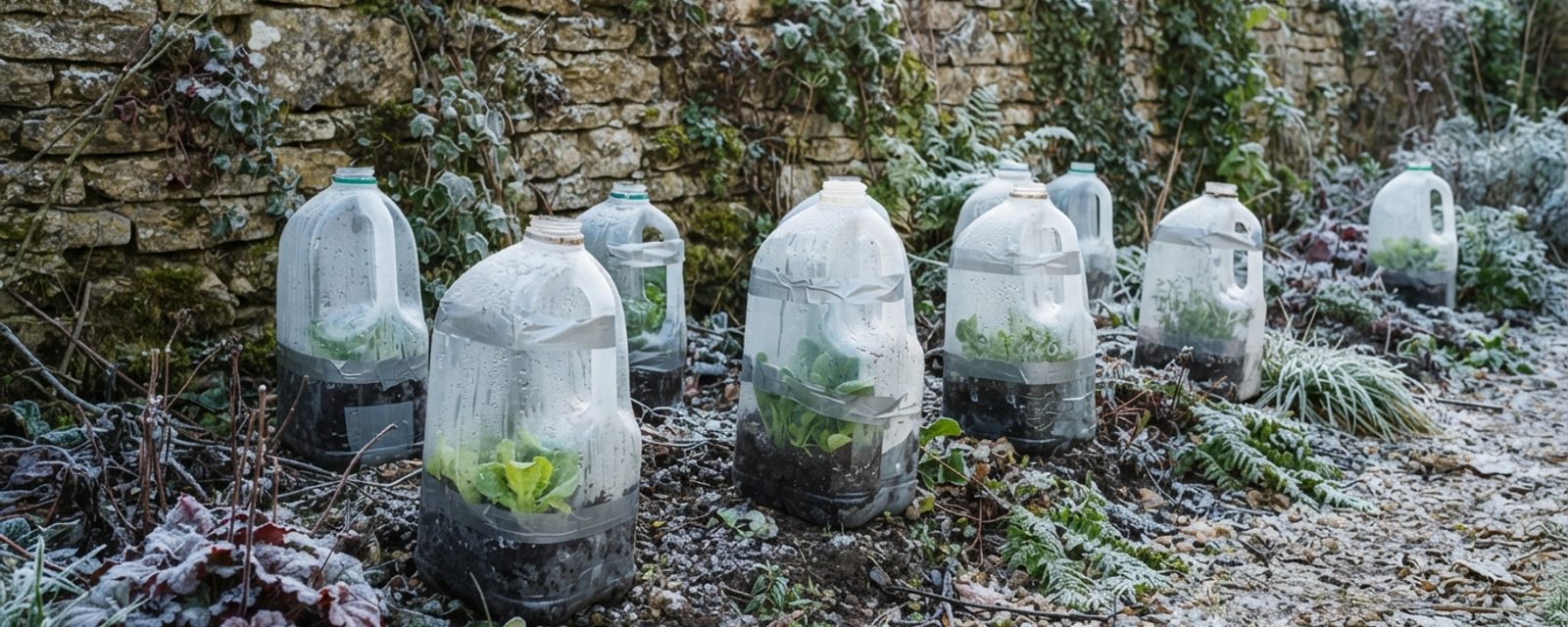
Not to be confused with "winter sowing" in the everyday sense of sowing during the colder months. This article is about a specific propagation technique: sealing seeds and compost inside a cut-open, taped-back-together milk jug or soda bottle, leaving it outdoors all winter with no heat source, and letting the container act as a miniature unheated greenhouse that exposes the seeds to a real, sustained cold period before they germinateA seed sprouting: breaking dormancy and putting out its first root and shoot, given the right warmth and moisture. Full definition → on their own in spring.
The mechanism: why some seeds need winter to happen to them
Many seeds from hardy trees, shrubs and perennials are dormant when they fall, and won't germinate no matter how warm or wet you make them, because dormancy is the plant's way of preventing seeds from sprouting in autumn, only to be killed by the first frost. The seed needs to register that a winter has actually passed before it will break dormancy.
Cold stratification is the technique of supplying that winter artificially: exposing seed to a prolonged period of cold, moist conditions, copying what happens to it naturally in the ground. For seeds that carry this requirement, nothing else substitutes for it, warmth and water alone won't trigger germination until the cold period has been satisfied. The standard cold-stratification method involves chilling seed, sealed in a bag with moist coir, bark or sand, in a refrigerator kept below 5°C (40°F), for anywhere from four to twenty weeks depending on the species. Some species, ash (Fraxinus) is the RHS's example, need multiple dormancy breaks, requiring a period of warmth stratification as well as cold before they'll germinate reliably.
A jug or bottle left outdoors over winter delivers that same cold-moist exposure without a fridge, a chest freezer, or space in it. The plastic keeps rain off the compost surface, while still letting the seed experience real winter cold. A run of days with the compost frozen solid doesn't undo that: stratification is a cold requirement, not a liquid-water one, so a dormant seed sitting through a hard freeze inside the jug isn't being harmed, just held at the temperature it needs. Snow settling on top of the jug is worth leaving in place rather than brushing off, like snow on any bed, it insulates the compost from the harshest of the cold above it while still letting that cold reach the seed underneath. Nothing forces germination, the seed responds to rising spring temperatures in its own time, inside its own miniature greenhouse, typically becoming visible as seedlings from mid-spring once nights stop reliably freezing; the frost dates reference has the regional timing for when that point tends to arrive.
Which seeds actually suit this method
The method suits three overlapping groups: hardy perennials that carry a genuine cold-stratification requirement, hardy annuals that tolerate frost and don't need artificial warmth to germinate, and biennials that are conventionally started in an unheated cold frame anyway. It does not suit anything that needs real warmth to germinate, more on that below. A separate pretreatment, scarification (nicking or softening a hard seed coat so moisture can reach the embryo), solves a different dormancy problem and isn't something a winter jug does on its own; check the seed packet if a species is described as needing it.
Named perennials confirmed as requiring cold, moist stratification before germination include pasqueflower (Pulsatilla vulgaris), blue false indigo (Baptisia australis), pale purple coneflower (Echinacea pallida), Siberian iris (Iris sibirica), Candelabra primulas, English lavender (Lavandula angustifolia) and honesty (Lunaria annua, technically a biennialA plant that completes its life cycle over two years: growth in year one, then flowering, seeding and dying in year two. Full definition →). These are exactly the seeds a jug left outdoors all winter is built for.
Hardy annuals are a separate case: they don't necessarily need cold to germinate, but they tolerate frost as seedlings and are conventionally sown outdoors in autumn precisely because no artificial warmth is required. Cornflower (Centaurea cyanus), pot marigold (Calendula officinalis), larkspur (Consolida) and love-in-a-mist (Nigella damascena) need no frost protection at all. California poppy (Eschscholzia californica), sweet pea (Lathyrus odoratus) and baby blue eyes (Nemophila) benefit from some protection from hard frosts, which is exactly what a taped-up jug provides, without needing to be a heated propagator. Hardy vegetable seed sown outdoors on the same autumn timetable, broad beans among them, tolerates the same frost exposure, but most vegetable seed is bred for faster, warmer germination than this method is built around, so check a crop's own sowing guidance before assuming it belongs in a winter jug rather than a direct autumn sowing outdoors.
| Crop | Type | Why it suits the jug method |
|---|---|---|
| Pasqueflower (Pulsatilla vulgaris) | Hardy perennial | Confirmed cold, moist stratification requirement |
| Blue false indigo (Baptisia australis) | Hardy perennial | Confirmed cold, moist stratification requirement |
| Pale purple coneflower (Echinacea pallida) | Hardy perennial | Confirmed cold, moist stratification requirement |
| Siberian iris (Iris sibirica) | Hardy perennial | Confirmed cold, moist stratification requirement |
| Honesty (Lunaria annua) | Biennial | Confirmed cold, moist stratification requirement |
| Cornflower (Centaurea cyanus) | Hardy annual | Frost-tolerant, no artificial warmth needed |
| Pot marigold (Calendula officinalis) | Hardy annual | Frost-tolerant, no artificial warmth needed |
| Love-in-a-mist (Nigella damascena) | Hardy annual | Frost-tolerant, no artificial warmth needed |
| Sweet pea (Lathyrus odoratus) | Hardy annual | Benefits from frost protection the jug provides |
Building the container
For other household-item reuses in the garden, including simple plastic-bottle mini-clochesA small, portable clear cover placed over an individual plant or short row to trap warmth and keep off wind, rain and pests. Full definition →, see Second Life: Turning Everyday Rubbish Into Free Garden Kit.
Take a translucent plastic container, a 4-pint milk jug or a large soda bottle both work, since light needs to reach the compost. Cut horizontally around the container roughly two-thirds of the way up, leaving a section uncut at the back to act as a hinge. In the base, cut several drainage holes so the compost never sits in standing water. Fill the bottom half with a few centimetres of pre-moistened, peat-freeCompost made without peat, which is harvested from a slow-forming, carbon-storing wetland habitat that peat extraction damages. Full definition → seed or multipurpose compost, not garden soil, which compacts inside a small container and can carry weed seed and pests in with it, sow the seed at the depth stated on the packet, then fold the top back down and tape the seam shut. Leave the original cap off, or cut a few small ventilation holes near the shoulders of the container, so air can move in and out, a fully sealed jug will overheat on sunny days and cook the seedlings once they emerge, and stagnant, sealed-in moisture invites rot. Label each jug on the outside with the species and sowing date in waterproof pen, and again on a marker pushed into the compost inside as backup, since an unmarked jug is hard to tell apart from the next once several are lined up together.
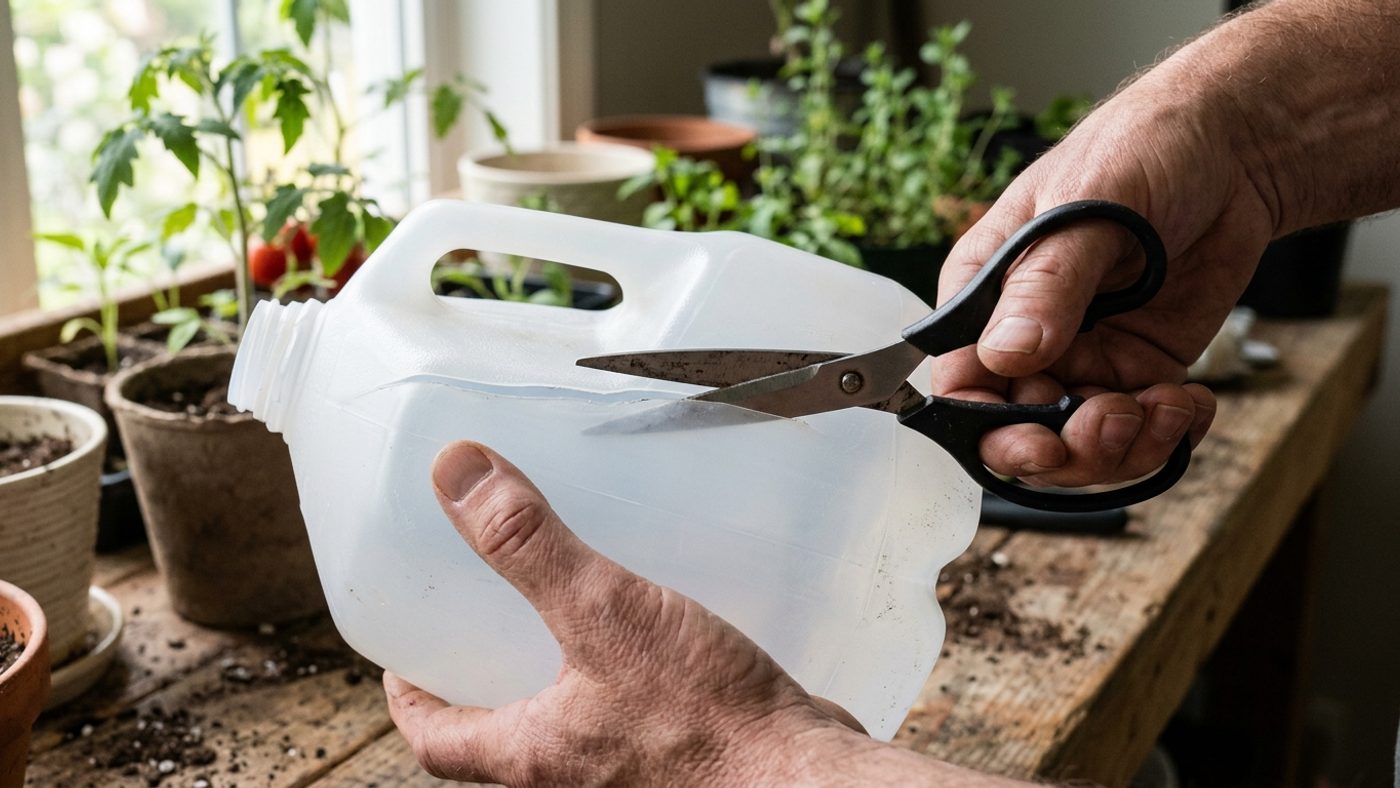
There's no need to rush the build to a fixed date: any time from the depths of winter into early spring gives the seed weeks of cold before longer, warmer days start bringing it out of dormancy. Setting jugs out too late, once spring's already properly under way, cuts that cold exposure short.
Where to place the containers
Site the containers somewhere they'll get some direct sun and are genuinely sheltered from wind, not a spot that bakes them in full sun all day, and not a shaded corner where the compost never warms enough to trigger germination once conditions are right. A spot against a wall or fence, out of the main run of wind, works better than an exposed open bed: wind is the real hazard to a jug specifically, since a container light enough to lift and carry seed and compost in a gust needs a stable spot far more than a fixed cold frame would.
What success looks like
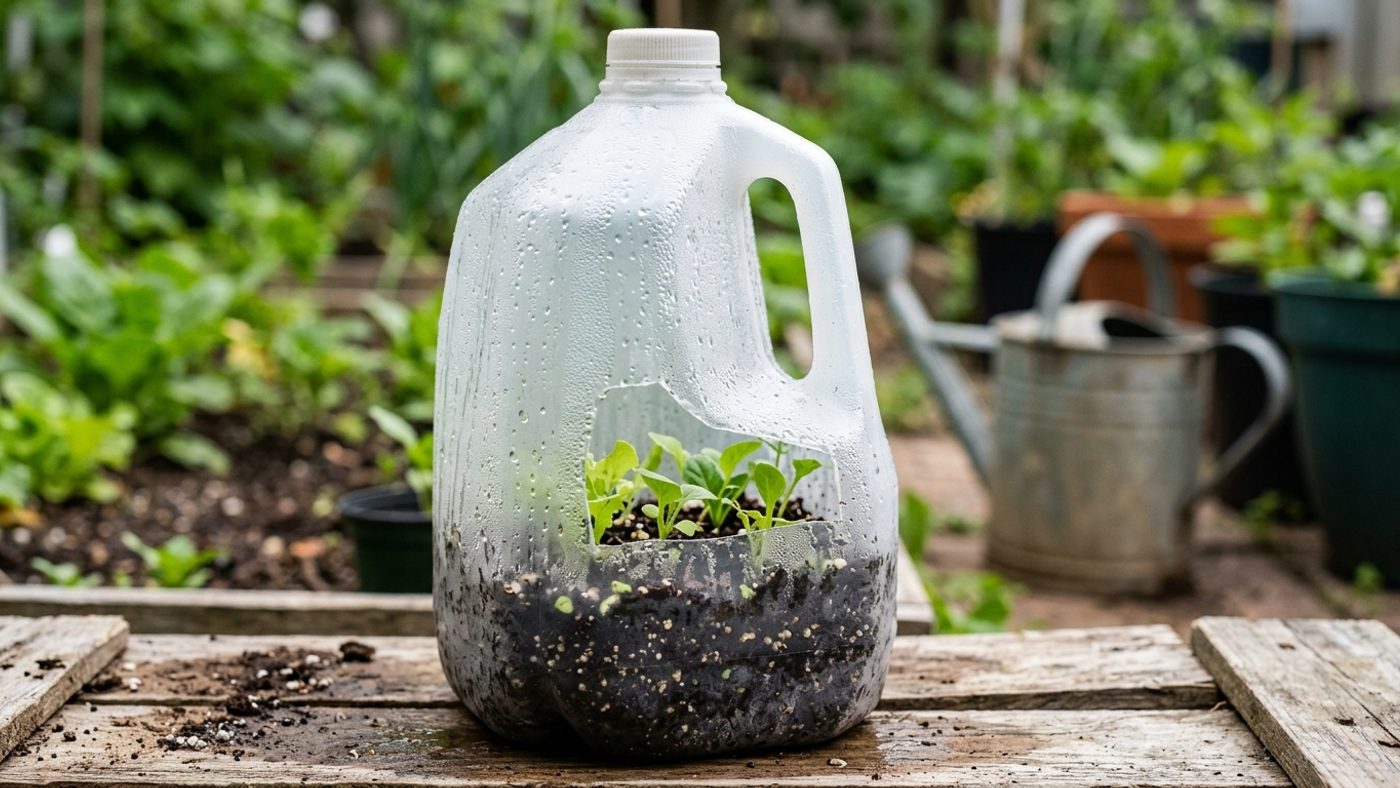
Condensation building up on the inside of the plastic during cold spells, clearing as the weather warms, is a reasonable sign that moisture is cycling correctly inside. As the weather turns and true leaves appear, start easing the container open on mild days rather than opening it all at once, propping the lid or widening the ventilation holes gradually accustoms the seedlings to open air before they're potted onMoving a plant into a larger pot as its roots fill the current one, giving it more room and fresh compost before it becomes pot-bound. Full definition → or planted out. Once they're vented and growing, check them the way you'd check any other seedling tray outdoors: slugs and snails reach a jug as easily as any other container once it's open, and are worth watching for around the vents, see what actually works against slugs if they become a problem. Birds and mice will investigate an open jug too, drawn by loose compost and any seed left sitting on the surface rather than properly covered, so keep the vents modest until seedlings are established.
The Scotland case, and its caveat
Scotland's winters tend to run colder and wetter than the winters much of the crop-specific advice from English gardening sources is written for. The Met Office's general characterisation of UK regional climate is that "places in the east and south of the UK tend to be drier, warmer, sunnier and less windy than those further west and north," which puts Scotland further along that colder, wetter gradient than most of England, though Scotland itself spans a real range, a west Highland winter is a different proposition from one in Aberdeenshire or the Lothians. For a method that depends on seeds getting a sustained, genuine cold period, a longer and more reliably cold Scottish winter is plausibly an advantage over a milder southern English one, where a run of unseasonably mild weeks could under-deliver the chilling some perennials need. In practice, that points toward fewer failed springs from perennial seed simply not getting enough cold, though no study has directly compared outcomes for this specific method between Scotland and England, so treat it as a reasonable inference from the climate difference rather than a tested result.
The same wet, exposed Scottish winter cuts the other way too. A jug sitting on open, windy ground can blow over, and prolonged heavy rain can waterlog the compost inside faster than the drainage holes clear it, especially if they're too few or get blocked. Coneflowers (Echinacea) are a useful illustration of the tension: they're named as needing cold stratification to germinate, yet mature plants are also known to be more prone to rotting off over winter in wet or heavy soil. The same balance applies to a jug of Echinacea seedlings, the cold is doing useful work, but the container still needs to be sited and drained well enough to avoid becoming waterlogged before that benefit means anything. Choosing a sheltered site, weighting the containers with a paving slab or crate, and drilling generous drainage holes are not optional extras in this climate.
The limits
This method is not a universal substitute for indoor seed starting. Tender, frost-sensitive crops, tomatoes, peppers, basil, courgettes and squash, germinate reliably only once soil or compost reaches real warmth, typically nudged by an indoor windowsill or a heated propagator rather than an outdoor container in winter. Putting these seeds in an outdoor jug over winter doesn't stratify them into readiness; it just leaves them sitting cold and inert, at real risk of rotting before spring warmth ever arrives. Reserve the jug method for the hardy annuals, hardy perennials and cold-requiring seed on the list above, and keep tender vegetable and herb seed for an indoor start closer to the last frost.
Common questions
Is this the same as sowing seeds outdoors in winter?
No. Sowing seeds directly into open ground or a normal pot during the winter months is a timing choice, and a different subject from this article. This article is specifically about sealing seed and compost inside a repurposed translucent container, a milk jug or soda bottle, and leaving that sealed mini-greenhouse outdoors through the cold season.
Do I need to water the containers over winter?
Generally no, once the compost is pre-moistened at sowing and the container is properly ventilated, rain gets in through the vents and drains out through the base holes, and the sealed sides keep evaporation low. Check occasionally that the compost hasn't dried out during an unusually dry, cold spell, or become waterlogged after heavy rain.
Which seeds should never go in a winter jug?
Anything that needs real warmth to germinate, tomatoes, peppers, basil, courgettes, squash and other tender crops. These need an indoor or heated start closer to the last frost date, not a cold winter outdoors.
When should I actually set the jugs outside?
Any time from midwinter into early spring works, since the aim is to give the seed as many weeks of cold as possible before the days lengthen and pull it out of dormancy. There's no single correct date the way there is for a printed sowing date on a seed packet.
What temperature and duration does cold stratification actually require?
Guidance for deliberate fridge stratification is below 5°C (40°F) for four to twenty weeks depending on species. A jug left outdoors over a full Scottish winter is intended to supply a comparable cold exposure without needing to measure or control it directly.
Can I reuse the same jug the following year?
Yes, provided the plastic is still sound and the drainage and ventilation holes are clear. Rinse it out between uses and check the tape seam and hinge before resealing it with fresh compost and seed.
Sources
8 sources, recorded with what each was used for
- RHS: Growing Trees and Shrubs from Seed: The definition of cold stratification, the fridge stratification method (below 5°C for 4–20 weeks), and the Fraxinus (ash) example of multiple dormancy
- RHS: Hardy Annuals — Sowing in Autumn: Frost-tolerance of hardy annuals, named species needing no protection versus species benefiting from some frost protection, and autumn sowing timing
- RHS: How to Sow Seeds Indoors: RHS endorsement of recycled food containers for sowing and covering sown containers with clear plastic to hold humidity and warmth
- RHS: Seed List and Germination Guide (Members' Seed Scheme): The list of named perennials and biennials confirmed to require cold, moist stratification
- RHS: How to Sow Seeds Outdoors: Confirmation that hardy seedlings tolerate light frosts and outdoor sowing timing spans spring, summer and autumn
- RHS: Echinacea: The caution that autumn plantings are more prone to rotting off in winter on wet or heavy soils, informing the waterlogging caveat
- RHS: Foxglove: Confirming foxglove seed is conventionally raised in a sheltered spot or unheated cold frame at 10–15°C
- Met Office: UK Regional Climates: The general characterisation that places further north and west in the UK tend to be wetter, cooler and windier than the south and east