
Every hydroponic system has to solve the same problem: roots sitting in water can't breathe. Submerge a root system completely and permanently, and it drowns, plant roots need oxygen just as much as they need water and nutrients.
Active hydroponic systems solve this mechanically. Deep Water Culture and Nutrient Film Technique setups run an air pump continuously, bubbling air through the reservoir or trickling a thin, oxygen-rich film of solution across the roots, keeping them wet and aerated at the same time. It works, but it depends on a pump that has to keep running, day and night, for as long as the plant is in the system, and on mains power staying on to run it, which a storm-hit Scottish winter night can't always promise.
The Kratky method solves the same problem without a pump at all, by using the plant itself.
The mechanism: how a static reservoir aerates its own roots
A Kratky setup is deliberately simple: a net pot holding the seedling in a growing medium, rockwool, clay pebbles, or perlite, sits in the lid or neck of a container, suspended above a reservoir of nutrient solution. At planting, only the lower few centimetres of the net pot and roots touch the liquid. The rest of the container, between the solution surface and the lid, is empty air.
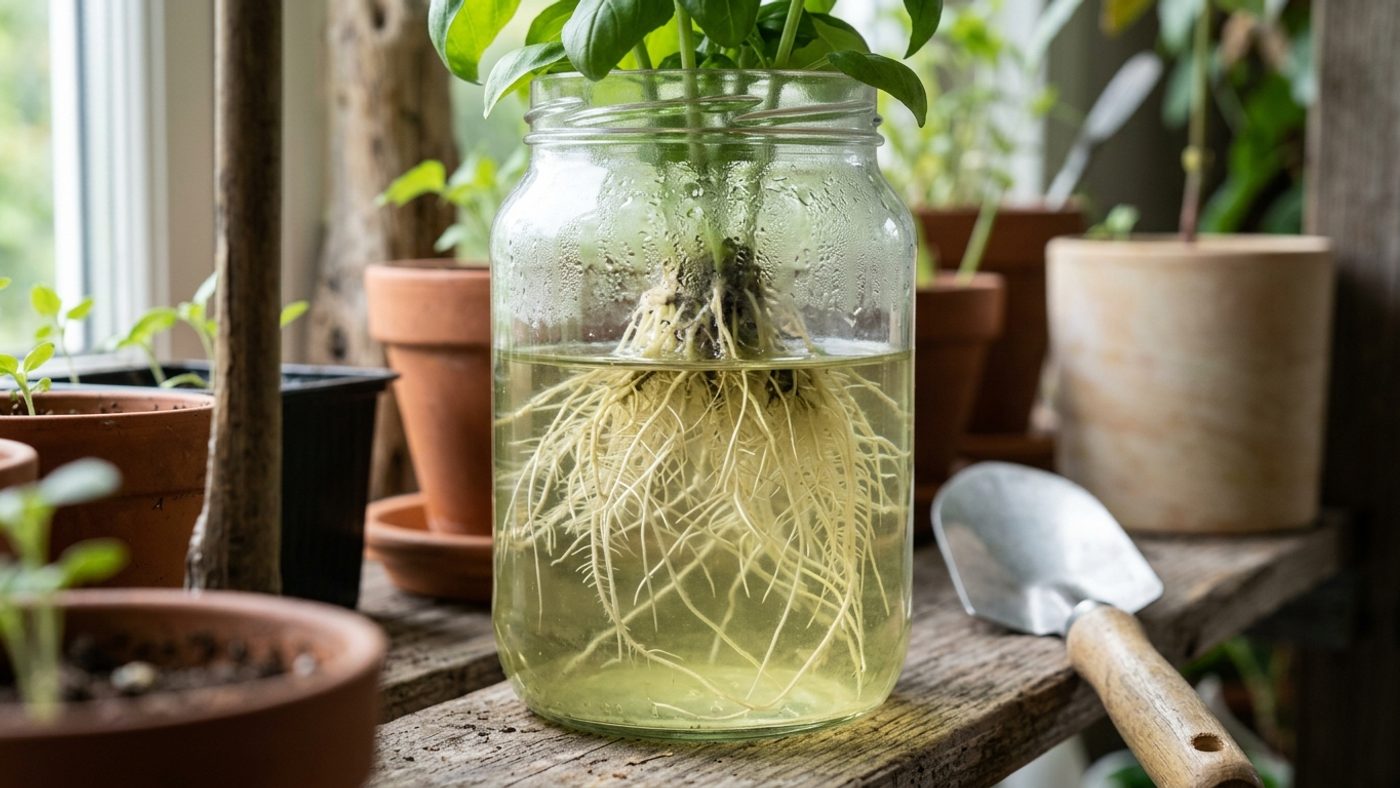
As the plant grows, it draws water and nutrients up through the submerged roots, and the solution level drops. That drop is not something to correct, it's the entire mechanism. As the level falls, it steadily exposes more of the root system to the air gap above the solution, and that gap stays humid, not dry, because it's enclosed and sitting directly above water. This is exactly the oxygen access that an active system provides artificially, by pumping air into the reservoir or misting the roots. In a Kratky setup, the plant's own water consumption does the same job, gradually and for free, with nothing mechanical involved.
The two root zones end up doing different work. Roots that stay down in the solution keep absorbing water and nutrients, but grow relatively slowly, because dissolved oxygen is limited deeper in standing liquid, warmer water holds even less dissolved oxygen than cool water, one reason a jar left in strong midsummer sun can behave differently from the same jar in a cooler spot. Roots in the expanding moist-air zone above the waterline, usually called "oxygen roots", grow fast and branch heavily. Their job isn't feeding the plant; it's aeration. Between the two zones, the plant keeps both water uptake and root respiration going, without a pump doing either.
Cold has the opposite effect to heat: it doesn't oxygen-starve the roots, it just slows the whole plant down, the same as a cold soil-grown plant sitting still through a cold snap rather than dying from it. The real cold-weather risk is the container itself, not the plant, a jar left somewhere that actually freezes can crack as the solution expands, so an unheated shed or porch is fine on a normal Scottish winter night but not somewhere the water itself is likely to freeze solid.
The method is named after Dr. Bernard A. Kratky of the University of Hawaii's College of Tropical Agriculture and Human Resources, who developed and published it as a low-cost, non-circulating hydroponic technique. In his original trials, lettuce grown this way saw the solution level drop 15–25cm below the starting point over a roughly 6–7 week crop, with no water or nutrients added at any point after planting.
The one rule that actually matters: fill once, never top up
A Kratky reservoir is filled a single time, at planting, and left completely alone until harvest. No topping up, no circulating, no daily watering. The entire crop lives on that one fill.
This is also where the method is easiest to get wrong. Adding more liquid partway through, to bring the level back up, re-submerges the oxygen roots that have grown into the air gap, and drowns them. If a reservoir genuinely needs supplementing (evaporation in a hot, dry spell, for instance), whatever is added should not restore the original level. For a basic Kratky setup, the rule is: fill once, don't touch it again, and harvest before the reservoir runs low.
Because nothing is topped up, the solution itself changes as the crop grows: the plant draws out water faster than it draws out dissolved nutrient salts, so the remaining solution gets more concentrated as the level drops. This is measured as EC (electrical conductivity, a simple stand-in for how strong or "salty" a nutrient mix is; a pen-style EC meter or the test strips sold alongside hydroponic nutrients read it in seconds).
| Reservoir stage | Typical EC | What it means |
|---|---|---|
| Starting fill, lettuce | Around 1.5 mS/cm | The concentration Kratky's own commercial-scale trials used as a target |
| Late in the crop, low water quality | Can climb to 2.0 mS/cm or more | Strong enough to scorch leaf edges (tipburn) if the starting mix was already on the strong side |
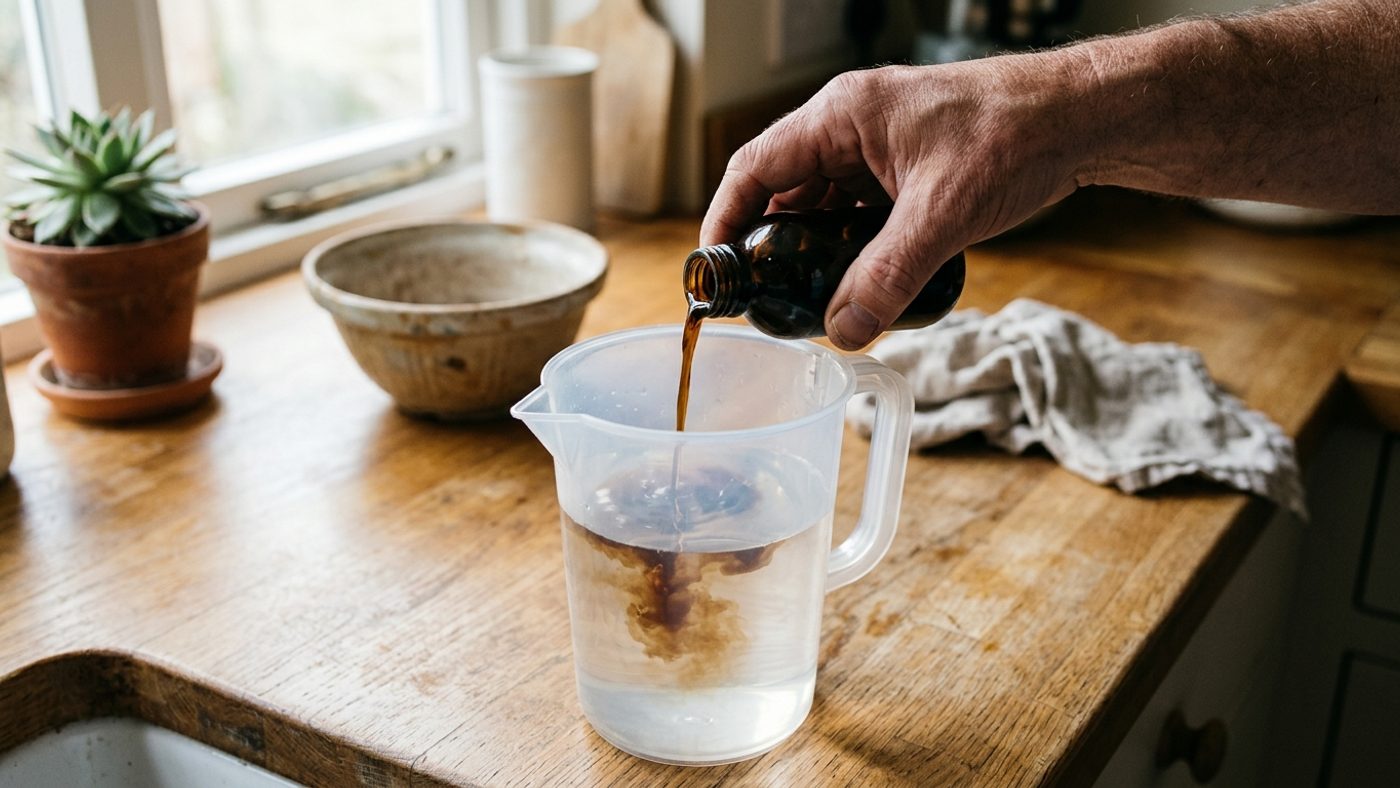
Mixing the initial solution on the weaker side of the nutrient product's instructions, rather than the stronger side, leaves headroom for that natural rise instead of starting close to the tipburn threshold. Rainwater or filtered water helps too, if the tap water is already hard, how much this matters depends on where in Scotland the jar is filled, since mains water hardness varies a good deal regionally (the hydroponics for beginners guide has the regional breakdown). pH can drift over the same weeks-long fill for the same no-circulation reason; a cheap pH testing kit and a small amount of pH-up or pH-down solution, added the same way any other hydroponic grower would use it, corrects it if it strays outside the range the nutrient product's instructions give.
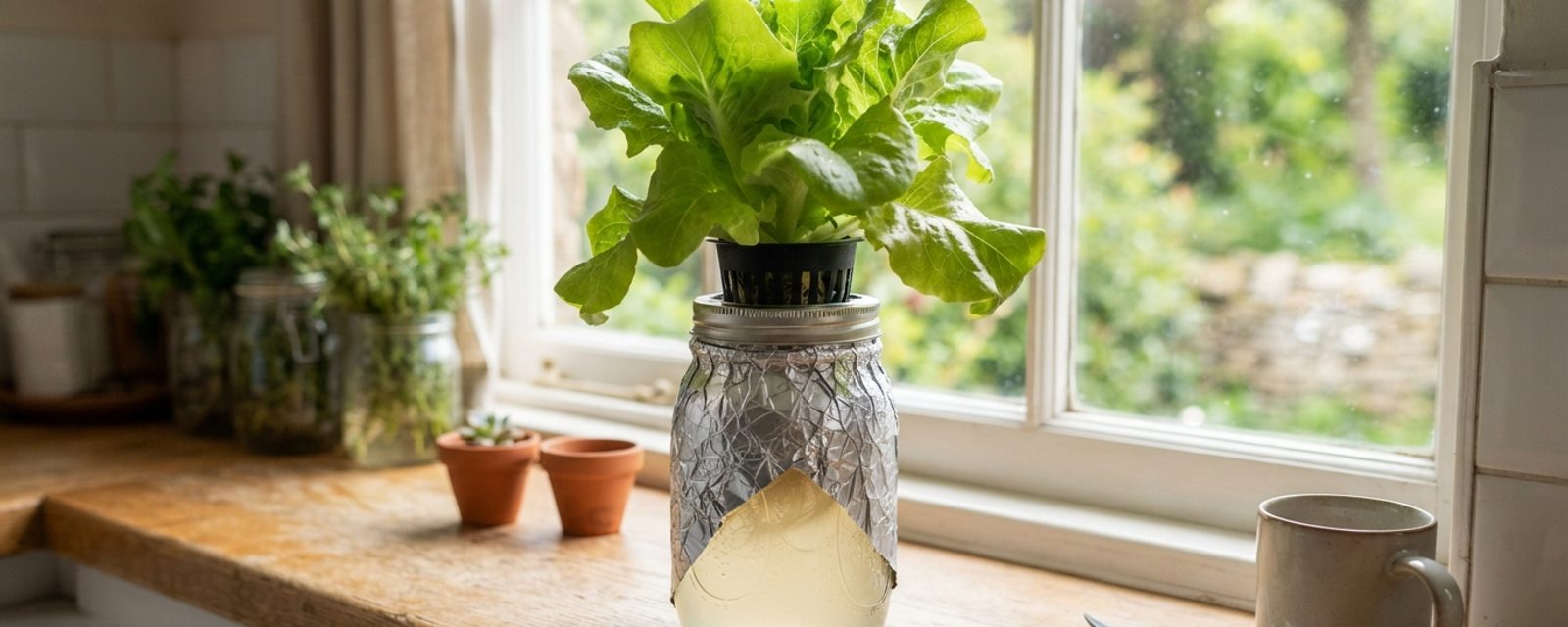
The other non-negotiable rule is light. The container has to be opaque, or covered so no light reaches the solution itself. Kratky's own base setup, a clear plastic bottle, works specifically because it gets darkened or covered; a clear jar left in daylight lets algae establish in the nutrient solution, which competes with the plant and fouls the water. A mason jar wrapped in tin foil or dark paper costs nothing and does the same job as buying an opaque container.
Because the reservoir is static and never circulated, a jar left uncovered outdoors or in a greenhouse can become a place for mosquitoes to breed. A snug-fitting lid around the net pot avoids this, it isn't a reason to avoid growing outdoors, just a reason to keep the container closed.
What grows well in a Kratky jar, and what doesn't
Kratky rewards crops that finish fast, because the whole point is that the plant has to complete its life cycle before a single, unreplenished fill of solution runs out or becomes nutritionally unbalanced.
| Suited to basic Kratky | Why | Not suited to basic Kratky | Why not |
|---|---|---|---|
| Loose-leaf and cut-and-come-again lettuce | Shallow, fibrous roots; harvest in weeks | Tomatoes, peppers, cucumbers | Long season, heavy feeders, need far more water/nutrients than one fill provides |
| Spinach | Fast-growing, shallow roots | Large solid-head lettuce | Outgrows a small container before heading properly |
| Basil, mint, coriander, dill | Short time to usable harvest | Root vegetables (carrots, beetroot etc.) | Need depth and bulk of growing medium the net-pot setup doesn't give |
| Pak choi and small salad greens | Compact, quick-finishing | — | — |
Some hobbyists adapt the method for tomatoes, using much larger reservoirs, five-gallon-bucket scale, with occasional, careful top-offs; that's a different, larger-scale build from the basic jar setup below.
A single jar only produces one batch, so anyone wanting a steady supply of salad leaves rather than one big harvest every six or seven weeks is better off starting a new jar every week or two, staggered, rather than sowing several jars all on the same day. Older jars get harvested while newer ones are still filling out, and there's always something ready. Rinse the jar, net pot and any reusable growing medium out properly between batches, a static reservoir that's already grown one crop is exactly the kind of still water that lets algae film or root-rot organisms carry over into the next fill.
Watch lettuce specifically for boltingA plant switching early into flowering and seed production, usually triggered by stress, after which leaves, roots or bulbs turn bitter or unusable. Full page → (running to seed early) on a bright windowsill through a Scottish summer, Scotland's long midsummer daylight, well past 17 hours in much of the country, is the same daylength/heat trigger that pushes soil-grown lettuce to bolt, and a jar sitting in a sunny window all day gets the same signal.
Building a basic setup
- Container: a wide-mouth mason jar, or any food-safe container with an opaque or light-blocked exterior, wrapped in foil or dark paper if it isn't naturally opaque.
- Net pot: a 2–3 inch net pot sized to fit the jar's neck or a hole cut in the lid, holding the seedling in rockwool, clay pebbles, or perlite. Net pots and rockwool cubes are cheap and widely sold online as small hydroponic starter packs, usually a few pounds for enough to start several jars.
- Starting the seedling: sow the seed directly into a pre-soaked rockwool cube or damp growing medium, kept moist until it germinatesA seed sprouting: breaking dormancy and putting out its first root and shoot, given the right warmth and moisture. Full definition →, then move the whole net pot into the jar once there's a small root system to work with, rather than trying to transplant bare seedlings into dry medium.
- Nutrient solution: an inexpensive hydroponic nutrient concentrate, look for one labelled for leafy greens/vegetative growth rather than a "bloom" or fruiting formula, since a Kratky jar is almost always growing leaves, not fruit. Dilute on the weaker side of the label's range rather than the stronger side, since the solution only concentrates further as the level drops (see the nutrient-strength note above).
- Fill level: solution deep enough that only the lower 2–3cm of the net pot and roots sit submerged at planting.
- Assembly: seat the net pot in the lid, put the lid on, and leave it. No daily watering, no pump, no timer, no maintenance until harvest.
Where Kratky actually saves money, and where it doesn't
Active systems like DWC or NFT need a continuously running air pump and, if pushed into winter growing, potentially a grow light and reservoir heater on top of that. The hydroponics for beginners guide works through the running costs of that at current electricity rates. Kratky avoids the pump/aeration cost entirely, in every season, because there's nothing there to draw power in the first place.
It's specifically the pump and aeration cost that disappears, not electricity costs generally. A grow light added to a Kratky jar over winter is the same optional cost as it would be on any other system, whether the roots underneath are aerated by a pump or by a dropping water level.
Light is the part Kratky doesn't get an exemption from. Per Met Office long-term averages, Edinburgh gets roughly 7% less winter sunshine than Cornwall overall, widening to 10-11% less in December and January specifically, the same regional shortfall the beginners guide works through in full for hydroponic growing generally, and it applies just as much to a windowsill jar as to a powered system, since both need actual daylight, not just power, to grow. A bright windowsill or unheated porch, without supplemental grow lights, is realistically a spring-to-autumn setup. Where Kratky genuinely stands out is as a low-cost, low-effort way to grow herbs and salad leaves indoors when the room already gets decent light, or with a cheap grow light added regardless of season, not as a way around the winter light problem itself.
Common questions
Can I use a mason jar for the Kratky method?
Yes, a wide-mouth mason jar is one of the most common home setups, provided it's made opaque (wrapped in foil or dark paper, or painted) so light can't reach the solution and encourage algae.
Do I need to change or top up the water?
No. The solution is added once at planting and left alone until harvest. Topping the level back up mid-crop re-submerges and drowns the oxygen roots the plant has grown into the air gap, so it should be avoided even if the reservoir looks low.
Why is my Kratky jar turning green?
Light is reaching the nutrient solution and algae is establishing in it. The container needs to be fully opaque or covered, a clear jar, even a lightly tinted one, usually isn't enough on its own.
Can I grow tomatoes this way?
Not in a basic jar setup, tomatoes are long-season, heavy-feeding plants that need far more water and nutrients than a single small fill can sustain. Growers who do grow tomatoes with this method use much larger reservoirs, bucket-scale, with occasional careful top-offs, a different build from the jar setup above.
How long does it take to harvest lettuce grown this way?
In the original University of Hawaii trials, lettuce reached harvest in roughly 6–7 weeks from seeding, with the solution level dropping 15–25cm over that time and no top-ups.
Does the Kratky method work in winter in Scotland?
The setup itself never draws power, so nothing about winter changes that. What does change is daylight: Scotland's winter sunshine is meaningfully lower than further south, which makes an unlit windowsill or porch realistically a spring-to-autumn setup, and a grow light the practical option for winter.
Will a hard frost or a cold shed kill a Kratky jar?
Cold slows growth rather than killing the plant outright, the real risk is the container itself cracking if the solution actually freezes solid, so keep it somewhere that gets cold but not hard-freezing, like most unheated porches and sheds on an ordinary Scottish winter night.
Sources
3 sources, recorded with what each was used for
- Kratky, B.A. (2009), University of Hawaii CTAHR: Three Non-Circulating Hydroponic Methods for Growing Lettuce: The method's origin, the root-zone mechanism, the fill-once/never-top-up rule, the nutrient EC target and concentration/pH drift figures, the opaque-container/algae rule, the mosquito-breeding caution, and general crop-scale figures
- RHS: Hydroponics: General hydroponics oxygenation framing, and confirming RHS's guidance covers only active, pump-dependent systems
- Met Office: Regional Climates: Regional winter sunshine-hour comparison underlying the winter-light discussion