
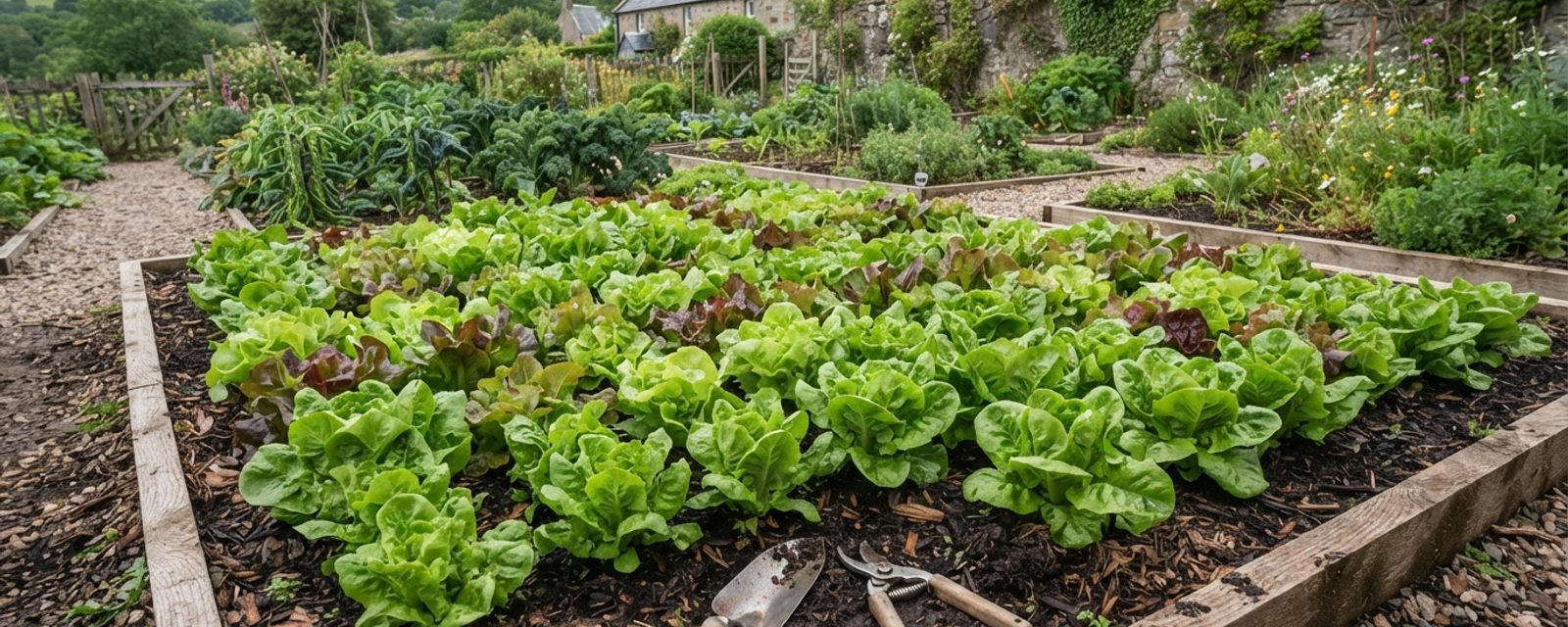
Slugs move on a single muscular foot lubricated by mucus, and that mucus is their whole defence against drying out. Without a moist surface to glide on and damp air around them, a slug dries out and cannot move far or feed for long, which is why slugs are most active at night and after rain, and why they retreat to damp, sheltered spots in dry weather. That single fact is the entire logical basis for most barrier deterrents on this list: if a slug can be forcedCovering plants to exclude light and speed early, tender growth in the dark, most associated with rhubarb and sea kale in late winter. Full definition → across something dry, rough, or sharp, the theory goes, it will turn back rather than cross and dry out its mucus trail.
Copper works on a different claimed mechanism, a mild electrochemical reaction between the metal and a slug's mucus is said to give it a shock or irritation on contact, rather than a purely physical barrier. It's a reasonable hypothesis. Most of what follows is the story of that hypothesis meeting an actual trial, and the short version is that the barriers mostly failed, while two methods that work a different way (nematodes and ferric phosphate pellets) held up.
The RHS barrier trial
The RHS ran a controlled experiment testing five widely recommended barrier materials, crushed eggshells, pine bark mulchA layer of material spread over the soil around plants to suppress weeds, retain moisture, and improve soil structure as it breaks down. Full definition →, copper tape, sharp horticultural grit, and wool pellets, grown around lettuces in nine patio pots and nine raised beds, monitored over six weeks with a leaf area meter to measure damage precisely. The result: no measurable difference in damage between the barrier-protected lettuces and the unprotected control plants. All five materials, tested this way, failed to reduce slug and snail damage.
That result covers barriers laid as a ring around open-ground or pot-grown plants over six weeks. It doesn't mean every possible application of copper is useless, the container exception below is a real one, and it doesn't cover materials the RHS didn't test, like orange peel, coffee grounds, or salt. Those are simply untested, not disproven.
The verdict table
| Method | Verdict | What the evidence actually shows |
|---|---|---|
| Copper tape / copper rings (open beds) | Tested, found ineffective | RHS trial found no reduction in slug damage from copper tape used as an open-bed barrier. |
| Copper tape / copper rings (containers, unbroken ring) | Genuine evidence supports it (qualified) | Garden Organic separately calls copper the most effective barrier for container growing specifically, where a continuous unbroken ring is actually achievable. |
| Crushed eggshells | Tested, found ineffective | Included in the same RHS trial; no reduction in damage. |
| Pine bark mulch | Tested, found ineffective | Same trial; no reduction. Mulches performed poorly since the organic matter itself creates favourable damp cover for slugs. |
| Wool pellets | Tested, found ineffective | Same trial; no reduction. |
| Sharp horticultural grit / sand | Tested, found ineffective | Same trial; no reduction. |
| Beer traps | Untested / folklore | Listed by the RHS as a trapping option with no effectiveness claim attached. They catch slugs, but a full trap is not evidence a bed has fewer. |
| Coffee grounds | Untested / folklore | No RHS or Garden Organic trial data found specifically testing coffee grounds. |
| Orange peel / citrus peel | Untested / folklore | No trial evidence located either way, folk advice with no controlled test behind it. |
| Salt | Not a deterrent, a lethal method, and a damaging one | Kills slugs on contact by drawing water out of their bodies, but also draws water out of soil and plant roots; excluded from serious gardening advice. |
| Nematodes (e.g. Nemaslug) | Genuine evidence supports it | Applied as a soil drench, gave good control on daffodils and intermediate control on lettuce. Needs moist soil at 5-20°C; one application protects roughly six weeks. |
| Ferric phosphate ("organic") slug pellets | Genuine evidence supports it | A two-year RHS study found ferric phosphate performed almost as well as metaldehyde, and outperformed it on hostas. Metaldehyde outdoor use is now illegal in Great Britain. |
| Maintained physical barriers (sealed copper mesh, raised copper-lined containers) | Genuine evidence supports it, conditionally | Not separately trialled, but the failure mode the open-bed trials expose, any gap gets crossed, implies a genuinely unbroken barrier removes that failure mode. |
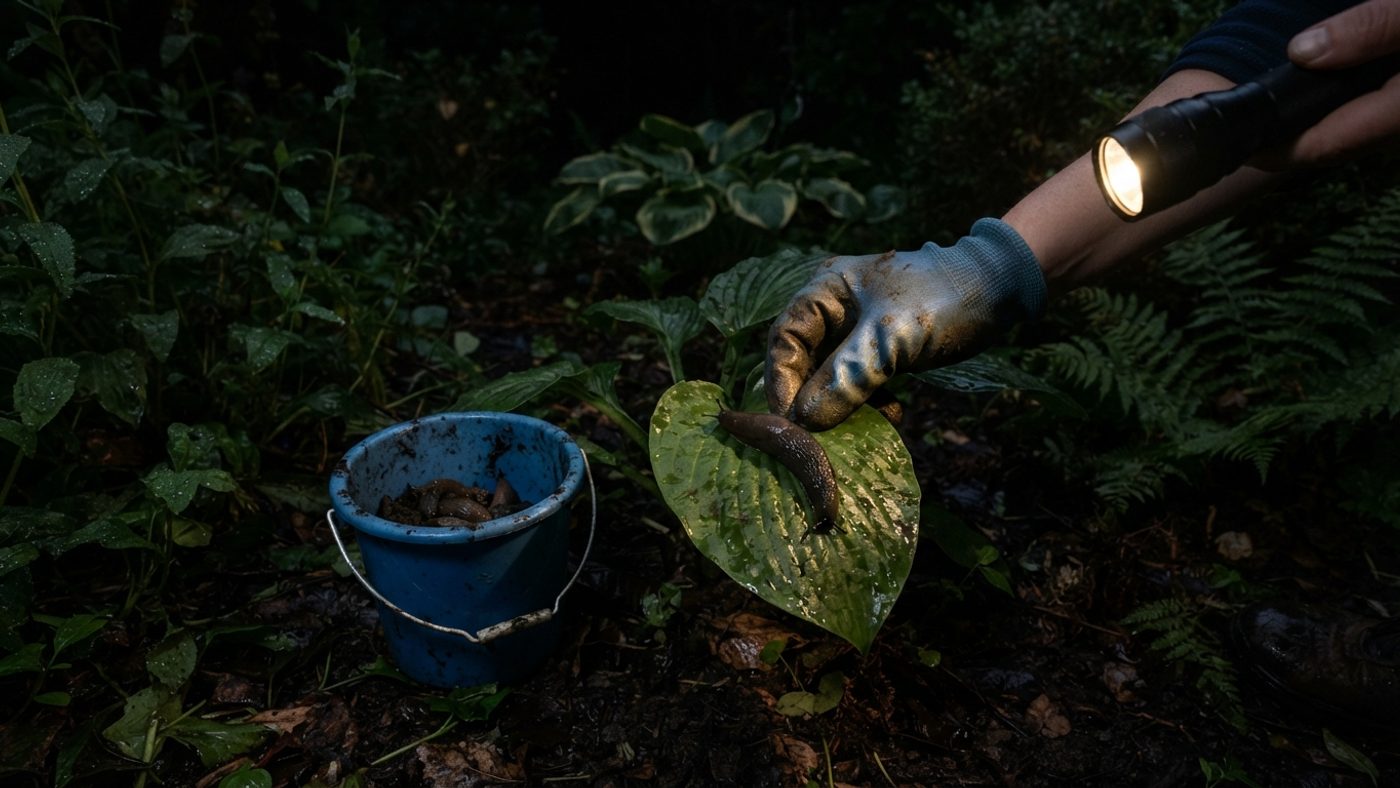
| Torchlight hand-picking | Genuine evidence supports it | Not a barrier at all, direct removal of active slugs after dark removes real slugs rather than hoping they turn back. |
Why the barriers fail and hand-removal doesn't
The pattern across the failed barriers is not that slugs are unusually tough or immune to sharp or dry surfaces, it's that a ring around one plant in an open bed is nearly impossible to keep intact. A single fallen leaf bridges a gap in eggshell or grit. Rain compacts or washes grit into gaps. A stem touching soil beyond the ring gives a slug a route that skips the barrier entirely. Copper tape corrodes, gets buried by soil splash, or simply doesn't extend below ground where a slug can tunnel under it. None of this requires slugs to be clever; it only requires the barrier to have one weak point over six weeks, and in practice it always does.
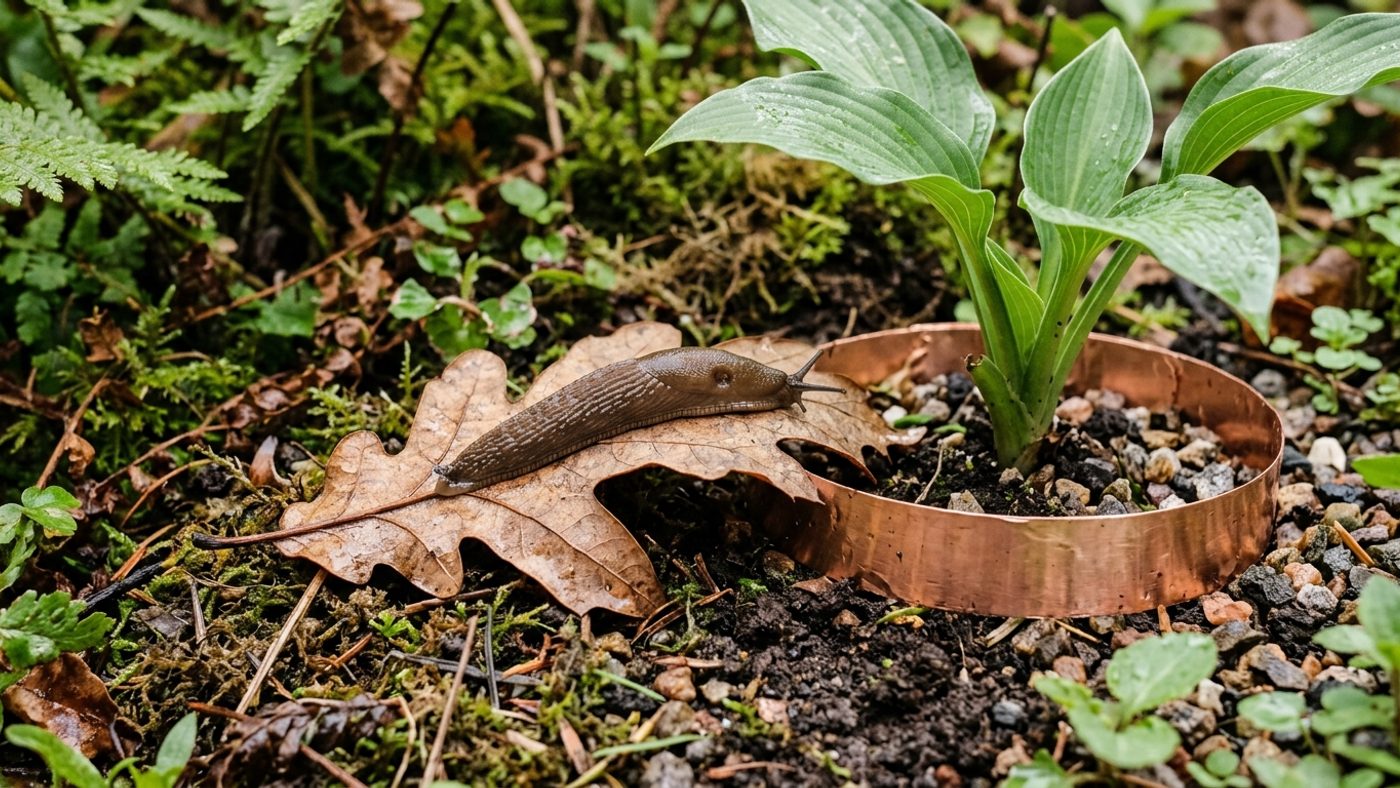
That is also exactly why the container exception for copper holds up: a smooth-sided pot with copper tape running its full circumference, with nothing bridging from soil or an overhanging leaf, is one of the few real-world setups where "unbroken ring" is achievable rather than aspirational.
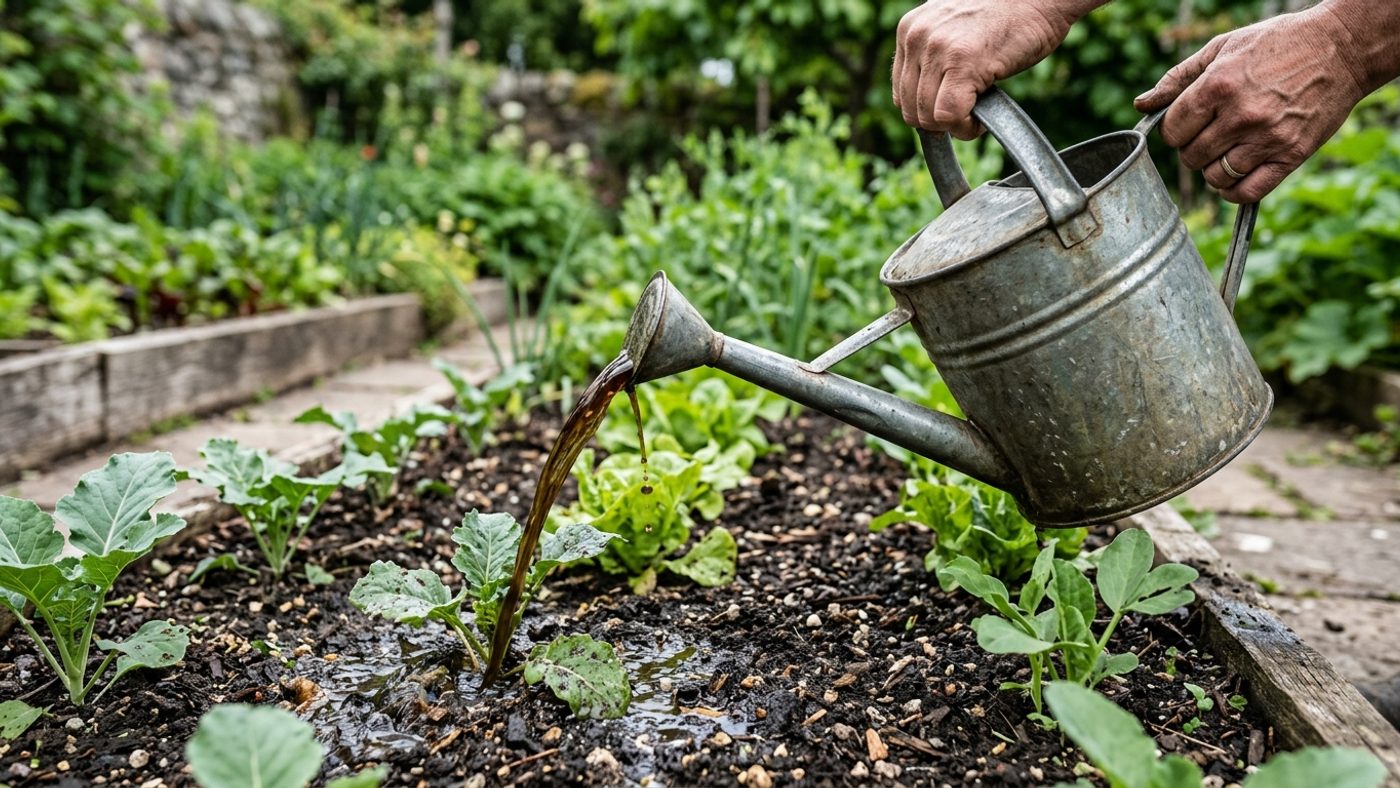
Nematodes and ferric phosphate pellets work by a completely different mechanism, they don't ask a slug to turn back, they act on slugs that are already in the bed. Nematodes are a biological control: microscopic worms, sold as a powder mixed with water and applied through a watering can over damp soil, that infect slugs with a bacterial disease and kill them from within, working below ground where no barrier can reach.
Ferric phosphate is an iron-based pellet that disrupts a slug or snail's calcium processing when eaten, stopping feeding and causing death within three to six days, without the toxicity to birds and mammals that older metaldehyde pellets carried. Both act directly on the animal rather than trying to keep it out, the same principle behind encouraging natural predators. Ground beetles, frogs, toads, hedgehogs and birds all eat slugs and their eggs for free; none of them need buying, but they do need somewhere to live, a log pile, dense planting, or a small pond, or they won't stay around to do the job. One more low-effort habit follows from the same moisture logic that opened this piece: watering beds in the morning rather than the evening lets the soil surface dry out over the day, instead of sitting damp overnight exactly when slugs are most active.
The Scotland angle, honestly
The mechanism is genuine and worth stating plainly: slugs depend on damp conditions to move and feed without drying out, so regions with more rainfall generally support more slug activity. Scotland's own rainfall figures show how large that gradient actually is, from an east-coast climate not far off southern England to a west-coast and Highland climate several times wetter:
| Location | Annual rainfall |
|---|---|
| Drier eastern England | ~500-700mm |
| Camborne, Cornwall (England comparator) | 1,076mm |
| Edinburgh (Royal Botanic Garden) | 728mm |
| Lerwick, Shetland | 1,252mm |
| Tiree, Argyll (west coast) | 1,275mm |
| Dunbartonshire | ~2,067mm |
| Argyllshire | ~2,275mm |
| Scottish Highlands (wettest sites) | 4,000mm+ |
Edinburgh sits close to the English comparator; the west coast, islands and Highlands are a different climate altogether, several times wetter than the driest parts of England. That gradient sits squarely inside the established biology of why slugs need dampness to operate.
What this rainfall data does not do is quantify slug damage. No authority publishes a figure for how much more slug damage Scottish gardens actually suffer compared with English ones, and none should be implied here. What the totals do establish is that the west coast, islands and Highlands get several times more rain across the year than the driest parts of England, and since damp conditions are what slugs need to move and feed, that's a reasonable basis for treating slug pressure as a bigger year-round concern in those areas specifically, rather than assuming the whole of Scotland is uniformly worse than the whole of England, Edinburgh's own rainfall figure barely differs from the English comparator above.
There's also a practical timing catch worth flagging for nematodes specifically: they need soil holding above 5°C to establish, and GrowScotland's own regional frost data shows last spring frosts running from mid-April in the mildest lowland areas to late May or early June further north and at altitude, soil takes time to warm past a frost-risk period, not before it. A gardener following packaging aimed at the UK as a whole risks applying nematodes into soil that's still too cold in the areas where spring runs latest; checking actual soil temperature, rather than a calendar date, is the safer approach. See Scotland frost dates for the regional breakdown.
GrowScotland's Garden Myths tool has the full source-by-source breakdown on copper tape and nematodes, including where RHS and Garden Organic actually disagree with each other.
Keeping Your Crops Safe: Deer, Rabbits, Birds, Slugs and Allotment Theft → covers the other threats a plot faces once the slugs are dealt with, deer and rabbit fence specs, netting for birds, and what to do about theft.
Common questions
Do copper rings work in raised beds, or only in pots?
The RHS trial that found no effect included raised beds as well as pots, so a copper ring around a raised bed section shouldn't be expected to perform differently from an open-ground ring. The container exception specifically concerns individual pots with a smooth, unbroken copper band running the full circumference, a raised bed with soil-to-soil contact at ground level or overhanging foliage reintroduces the same bridging problem that undermines open-bed barriers.
Is it worth combining several deterrents, grit plus eggshells plus copper, to be safe?
Based on the trial evidence, no combination of the tested barrier materials has been shown to reduce damage, since each one individually made no measurable difference on its own. Effort is better spent on nematodes, ferric phosphate pellets, or hand-picking, which have actual measured effects.
Are ferric phosphate pellets safe to use where pets or wildlife might eat them?
Ferric phosphate breaks down into iron and phosphate, both of which plants absorb as nutrients, and it does not carry the toxicity to birds, mammals, and pets associated with older metaldehyde-based pellets. It still isn't intended as food for anything, so following label application rates rather than scattering pellets loosely remains sensible.
When should nematodes be applied in a Scottish garden?
Nematodes need moist soil holding between 5°C and 20°C to work, and one application gives protection for roughly six weeks. Scotland's last spring frosts run from mid-April in the mildest lowland areas to late May or early June further north and at altitude, and soil takes time to warm past that point, so checking actual soil temperature before applying avoids applying nematodes into soil too cold to establish. Nematode products are also living organisms with a short shelf life once delivered, worth planning around for longer parcel transit times to the Highlands and islands.
Does hand-picking at night actually make a difference, or is it just satisfying?
It removes real slugs from the bed rather than relying on them turning back at a barrier. It's labour-intensive and needs repeating, since new slugs move in, but every slug removed after dark is one that didn't get the chance to feed that night.
Sources
10 sources, recorded with what each was used for
- gov.uk: Outdoor use of metaldehyde to be banned to protect wildlife: Metaldehyde slug pellet ban; outdoor use illegal in Great Britain from 31 March 2022
- RHS: How to stop slugs and snails: The barrier trial (copper tape, eggshells, bark mulch, grit, wool pellets, no significant damage reduction)
- RHS: Slugs and snails: Slug biology, moisture/mucus dependence, nematode application detail
- Garden Organic: RHS trials — organic slug pellets perform as well as those with toxic metaldehyde: Ferric phosphate vs metaldehyde trial results; nematode crop-by-crop effectiveness; mulch performance
- Garden Organic: Slugs and snails expert advice: Container copper tape endorsement; nematode timing and cost
- Met Office: How much does it rain in the UK?: Regional rainfall normals (Dunbartonshire, Argyllshire, Scottish Highlands, eastern England)
- Met Office: Edinburgh, Royal Botanic Garden, long-term averages (1991-2020): Edinburgh annual rainfall (728mm)
- Met Office: Tiree, long-term averages (1991-2020): Tiree annual rainfall (1,275mm)
- Met Office: Lerwick, long-term averages (1991-2020): Lerwick annual rainfall (1,252mm)
- Met Office: Camborne, Cornwall, long-term averages (1991-2020): Camborne annual rainfall (1,076mm), England comparator