
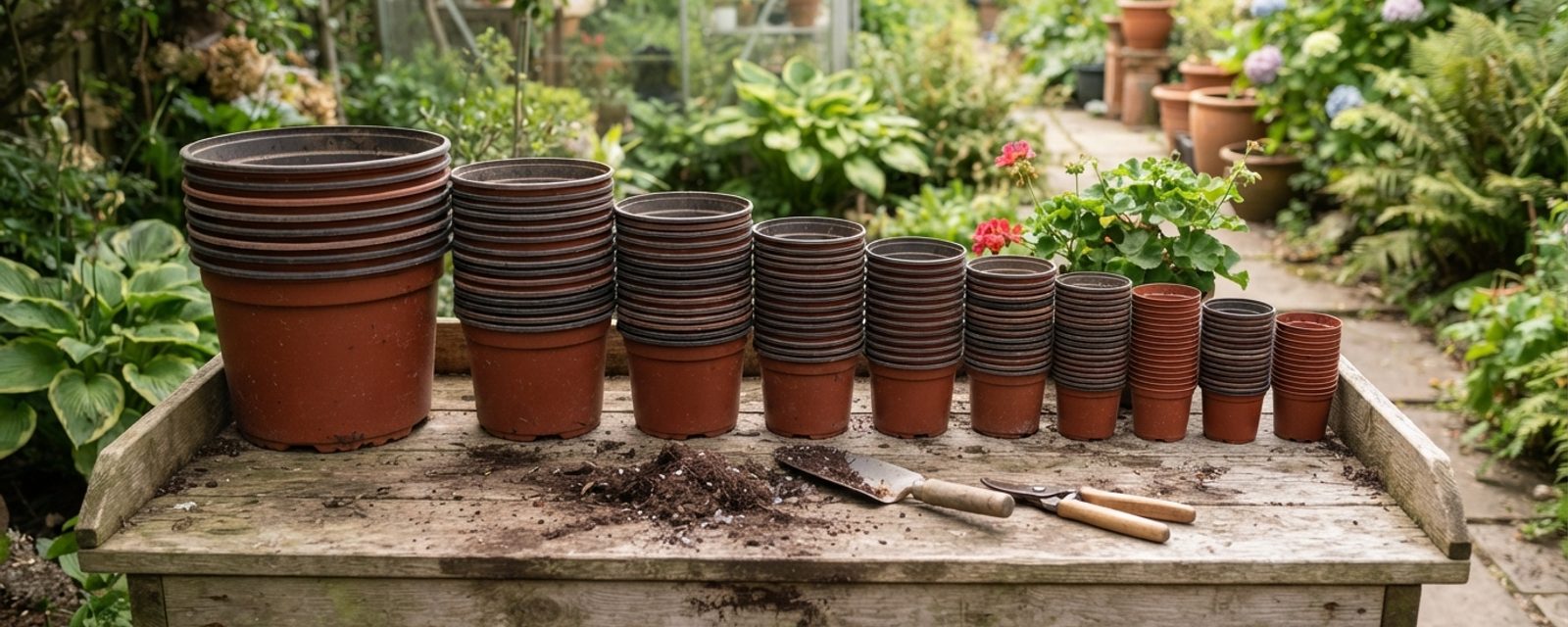
A plant pot is a tapered bucket shape, not a straight-sided cylinder, narrower at the base than at the rim, so empty pots nest and stack for transport without wedging together. That taper is the whole reason litres-to-centimetres conversion isn't a simple lookup you can do in your head.
Pot size lookup
Typical top-diameter figure from a UK trade sizing chart — expect variation of a centimetre or two between manufacturers, more at the larger sizes.
Why a pot's litre size and its diameter don't move together
Volume in a tapered container scales up much faster than diameter does. Double a pot's diameter and you don't double its volume, the increase is far bigger, because you're filling more width, more depth and more of the taper all at once. That's why a 20 litre pot isn't twice the width of a 10 litre one, and why jumps between common sizes (2L to 3L, 5L to 7.5L, 10L to 15L) look uneven when you set them out diameter by diameter, the numbers scale up fast, not in a straight line.
On top of the geometry, there's no single UK or European industry standard fixing exact pot dimensions per litre. Manufacturers set their own depth-to-diameter ratios: one firm's 5 litre pot might be a bit wider and shallower, another's narrower and deeper, and both are correctly labelled "5L" because litre sizing describes volume, not shape. Johnsons Nurseries, a commercial nursery and trade supplier, makes this explicit on its own pot size guide, noting that pot sizes listed may vary due to the different pot manufacturers used. Treat every cm figure below as a close, genuinely useful approximation rather than an exact spec you could machine a shelf to.
One concrete way to see the taper: on the same trade chart, a 20 litre pot measures roughly 35.5cm across the top but only about 27.5cm across the base, nearly 8cm of taper on a single pot. That difference is also why "diameter" on a spec sheet almost always means the top rim, not the widest or narrowest point, unless stated otherwise.
Litres to cm: the conversion table
These figures come from a published trade nursery sizing chart (Johnsons Nurseries Ltd, a UK commercial nursery supplying landscape, garden centre and trade customers) and are top (rim) diameters, since that's the dimension most UK suppliers list and the one you'll usually be matching against a saucer, planter or gap on a windowsill. Treat them as typical values, expect variation of a centimetre or two either way between manufacturers, more at the larger sizes.
| Pot size | Diameter (top) | Diameter (top, inches) | Typical use |
|---|---|---|---|
| 9cm (P9) | 9cm | 3.5" | Young plants, herbs, small herbaceous perennials, an early-stage size before potting onMoving a plant into a larger pot as its roots fill the current one, giving it more room and fresh compost before it becomes pot-bound. Full definition → |
| 1 litre | 13cm | 5" | Herbs and the smallest perennials |
| 2 litre | 17cm | 6.5" | Standard size for one-season herbaceous plants and young shrubs; compact enough to establish quickly |
| 3 litre | 19cm | 7.5" | Most common size for garden centre shrubs and perennials once they've filled out from 2L |
| 4 litre | 20cm | 8" | Between 3L and 5L; used where a plant needs slightly more root room than standard shrub stock |
| 5 litre | 22.5cm | 9" | Larger shrubs and "feature size" plants needing more root volume |
| 7 litre | 25cm | 10" | Bigger shrubs and young trees moving toward specimen size |
| 10 litre | 28cm | 11" | Specimen plants typically grown on for two or more years |
| 15 litre | 33cm | 13" | Semi-mature shrubs and small trees ready, or nearly ready, to plant out |
| 20 litre | 35.5cm | 14" | Mature specimens, established shrubs, conifers, small trees |
| 25 litre | 38.5cm | 15" | Large specimen shrubs and trees |
| 30 litre | 41cm | 16" | Mature trees and large architectural shrubs |
| 40 litre | 50cm | 20" | Large specimen trees, often root-balled or container-grown for years |
Above 40 litres, pots move into semi-mature and mature tree territory (50L, 100L and larger), and diameter figures become less standardised still, at that scale, suppliers typically quote root-ball or container width individually per plant rather than working from a fixed chart, so it's worth confirming the actual dimensions with the seller rather than extrapolating from the table above.
What about depth? The table above only gives top diameter, because that's the figure suppliers actually publish consistently, depth varies more between manufacturers than width does. As a rough shape guide: a small pot (1L-5L) tends to be a little shorter than it is wide, while from around 15L upward, height and diameter run close to equal, a 15 litre pot, for instance, comes out at roughly 33cm across and 30cm deep, close to a squat cube rather than a shallow bowl. Standard round pots aren't the only shape either: "long toms" and deep pots are noticeably taller than wide for the same litre figure (useful for plants with a long taprootA single, thick, dominant root growing straight down from a plant, storing energy and anchoring it, as opposed to a spreading mass of fine roots. Full definition →), while alpine pans and half-pots go the other way, wide and shallow, if you're matching a specific gap, check the individual product listing rather than assume a standard depth from the litre size alone.
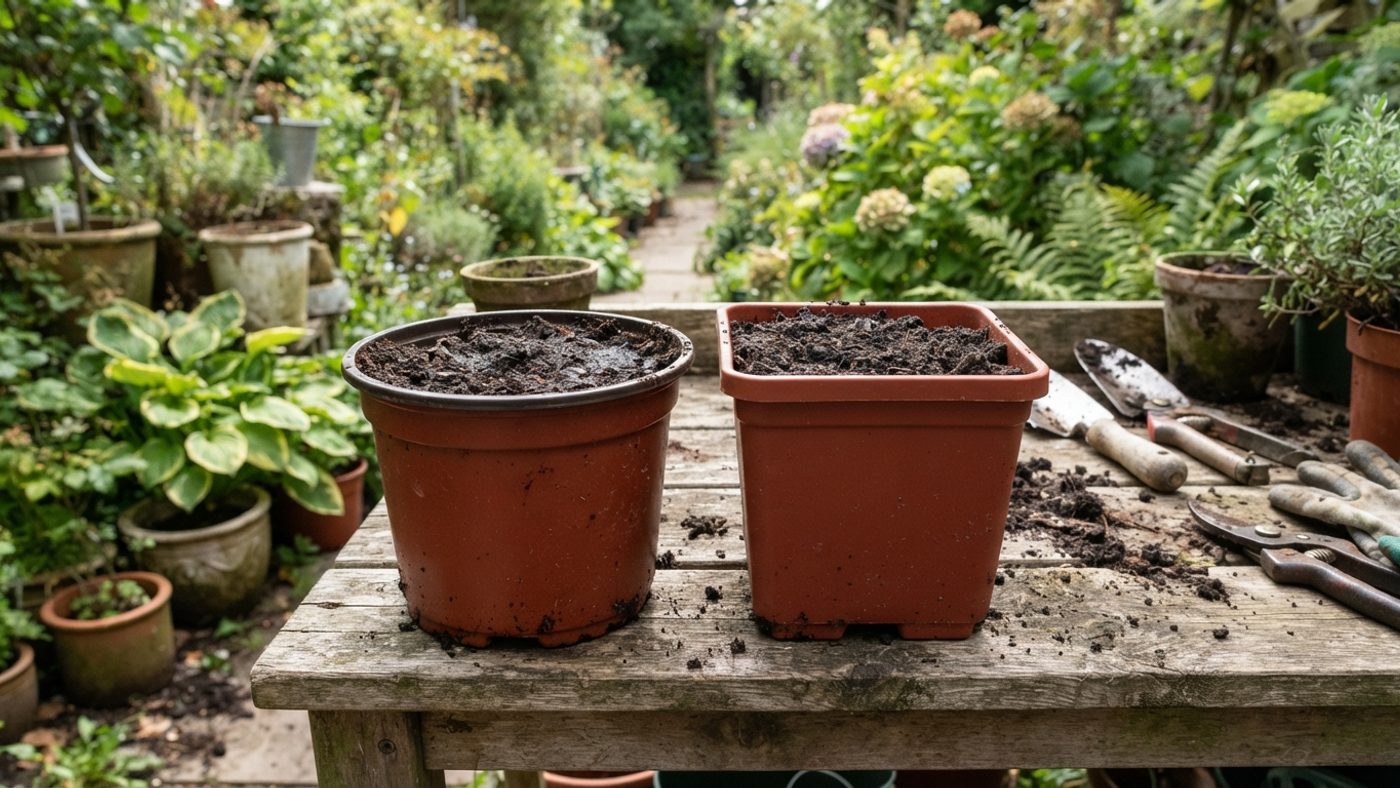
Square and rectangular pots hold more than round ones of the same width. A square pot fills its own corners, so for the same diameter/side measurement it holds noticeably more volume than a round pot, roughly a quarter more, since a circle only covers about three-quarters of the square that contains it. If you're converting a round-pot litre figure to a square trough or planter, don't assume the litre size translates directly across shapes.
Houseplant labels often skip litres altogether. Garden centres and houseplant retailers commonly size indoor pots by centimetre diameter alone (a "12cm pot," a "17cm pot") rather than quoting a litre figure, a different convention from the outdoor/shrub trade sizing this table is built on. The cm figures in the table above are still the right ones to match against a cm-labelled houseplant pot; there just won't always be a litre number given to cross-check it against.
Pot size isn't the same thing as plant size
A litre figure tells you how much compost and root space a container holds. It does not tell you how old, tall, or developed the plant inside it is. The same 3 litre pot might hold a fast-growing shrub that filled it in one season, or a slower species that's spent two years reaching the same point, both correctly labelled 3L, both very different plants to buy.
This matters most when comparing suppliers, or comparing an online listing against a plant label at a garden centre. A "specimen" plant in a 10 litre pot has usually been grown on for two or more seasons specifically to build a fuller root system and more top growth before sale, rather than being a young plant simply dropped into a bigger container. Pot size is a proxy for plant maturity, not a guarantee of it, if maturity matters for your purchase (a hedge you want screening this year, not in three), check the plant's height and habit description as well as its pot size.
Signs it's time to pot up
A plant that's outgrown its current pot usually shows some combination of the following, rather than one dramatic symptom:
- Roots visible at the drainage holes or circling the base. Tip the plant out (or look through the holes), roots that have started spiralling around the bottom and sides of the rootballThe mass of roots and the soil or compost clinging to them, as it comes out of a pot or out of the ground when a plant is lifted. Full definition → are a clear signal, and if left too long can mat so tightly that water struggles to drain through them at all.
- Compost dries out unusually fast. When roots fill most of the pot, there's less actual compost left to hold water, so a pot that used to need watering every few days suddenly needs it daily.
- Growth stalls or slows noticeably, even in the growing season, with no obvious pest, disease or feeding problem.
- Roots visible at the surface, pushing the plant slightly proud of the compost line.
- The plant is physically top-heavy or unstable relative to its pot, tipping over easily in wind.
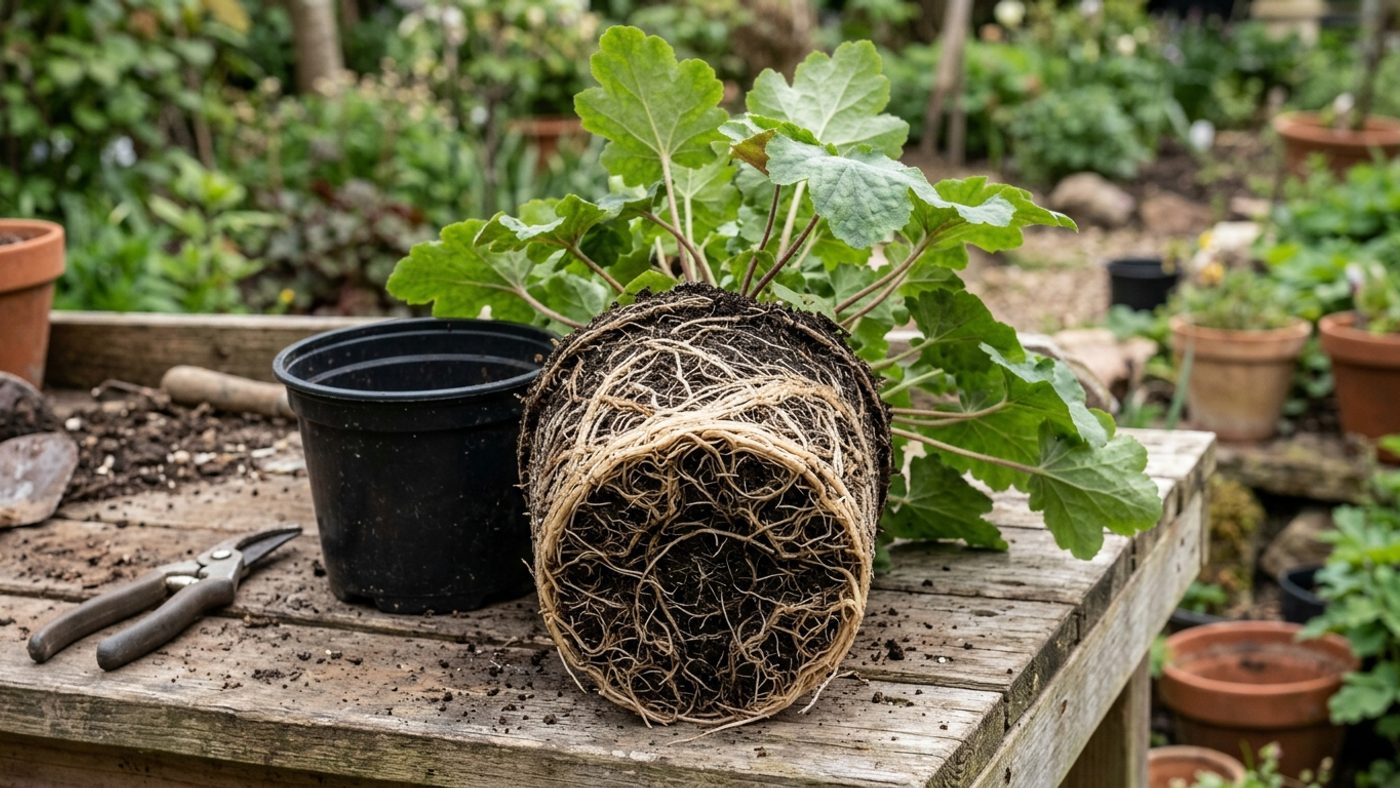
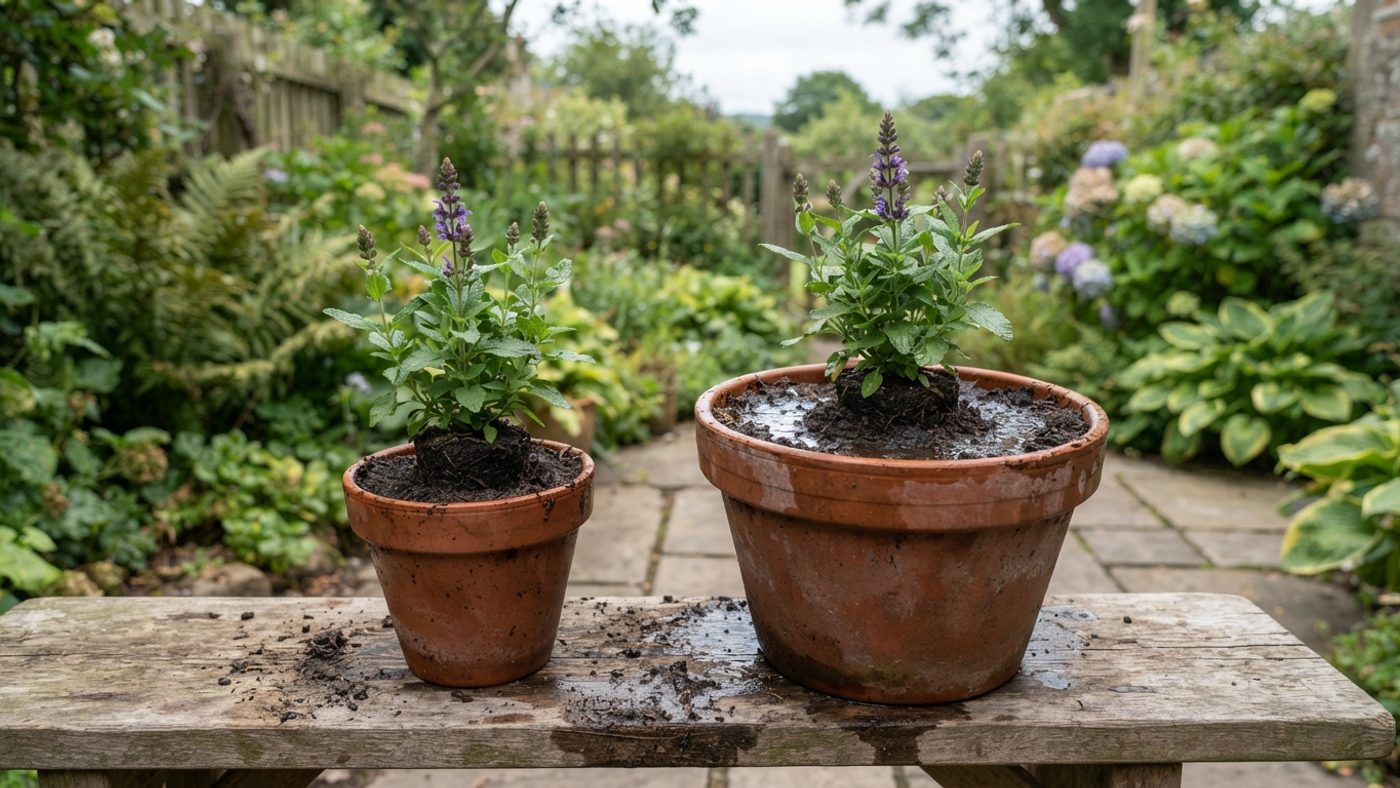
When you do pot up, resist the urge to jump several sizes at once. The general guidance for containers under about 25cm in diameter is to move into a pot only around 2.5-5cm wider and deeper than the current one, going much bigger than that risks "overpotting," where a small rootball sits in a large volume of fresh, slow-draining compost that stays wet for too long, encouraging root rot rather than growth. Signs of overpotting include yellowing or browning leaves, leaf drop, wilting, and compost that stays soggy on the surface long after watering, the opposite problem to being root-bound, but caused by the same instinct to "give it more room" taken too far in one step.
UK litres vs US quarts and gallons
If you're reading US gardening content, or buying from a US-linked retailer, the sizing system changes underneath you. UK and European nurseries size pots in litres; US nurseries commonly size them in "trade gallons" and "quarts" instead, and a US trade gallon is not the same volume as a real (liquid) gallon. The convention dates back to a post-war US nursery habit of growing plants in reused one-gallon cans and continuing to call the resulting pot size "one gallon" even though its actual capacity, by most industry accounts, runs closer to three US quarts than a true four-quart gallon.
| US pot label | What it actually holds | Roughly equivalent to |
|---|---|---|
| 1 quart | About a quarter of a US "trade gallon" | Small UK pot, under 1 litre |
| 1 "trade gallon" | Closer to 3 US quarts than a true 4-quart gallon | Roughly a UK 2-3 litre pot |
| 5 "trade gallons" | Five times the above, same under-fill convention | Roughly a UK 10-13 litre pot |
Exact figures for the "trade gallon" vary between sources, so treat this table as a working approximation, not a precise conversion, the practical takeaway is that a US quart/gallon pot size is a different sizing convention entirely, not a straightforward unit conversion you can do the maths on.
Common questions
What size pot is a "2 litre" plant?
Around 17cm (6.5in) across the top on a typical UK trade pot, though this varies a little by manufacturer. It's the standard size for one-season herbaceous plants and young shrubs, big enough to establish quickly once planted, small enough to be affordable and easy to handle.
Is a bigger pot always better for a plant?
No. Too large a jump in pot size, "overpotting", can leave a small rootball surrounded by a large volume of compost that stays wet too long, which encourages root rot rather than growth. Moving up by roughly 2.5-5cm in diameter at a time is the safer default for pots under about 25cm.
How often should I pot up a container plant?
There's no fixed schedule, it depends on the plant's vigour, the compost, and the container size, but repotting roughly every two to five years, or whenever you see root-bound signs (roots at the drainage holes, fast drying compost, stalled growth), covers most container plants. Spring is generally the best time.
Why do two "5 litre" pots from different suppliers look different sizes?
Litre sizing measures volume, not a fixed shape. In practice: if the exact footprint matters (fitting a specific gap on a windowsill or in a plant stand), check the individual product's stated diameter rather than assuming from the litre size alone.
Is a US "1 gallon" pot the same as a UK litre size?
No, and it's not even the volume you'd expect from a real gallon. US nursery "trade gallons" are their own sizing convention, running noticeably under a true four-quart gallon, in practice a US 1-gallon pot sits closer to a UK 2-3 litre pot. Don't convert it as if it were a plain unit-of-volume swap.
Sources
5 sources, recorded with what each was used for
- Johnsons Nurseries Ltd: Plant Pot Size Guide (trade nursery documentation): Primary source for the litre-to-cm/inch diameter figures in the conversion table and the note that dimensions vary by pot manufacturer
- RHS: How to repot a plant: Root-bound/repotting signs, the 2.5-5cm potting-up sizing rule, and recommended repotting timing
- RHS: Overpotting: The definition of overpotting, its symptoms, and sizing-up guidance
- Hillier: Plant Pot Size Guide (trade nursery documentation): Cross-check on typical plant-type-to-litre-size associations
- Burncoose Nurseries: Pot Sizes (trade nursery documentation): Second trade-nursery cross-check on typical plant-type-to-litre-size associations, particularly larger specimen sizes