
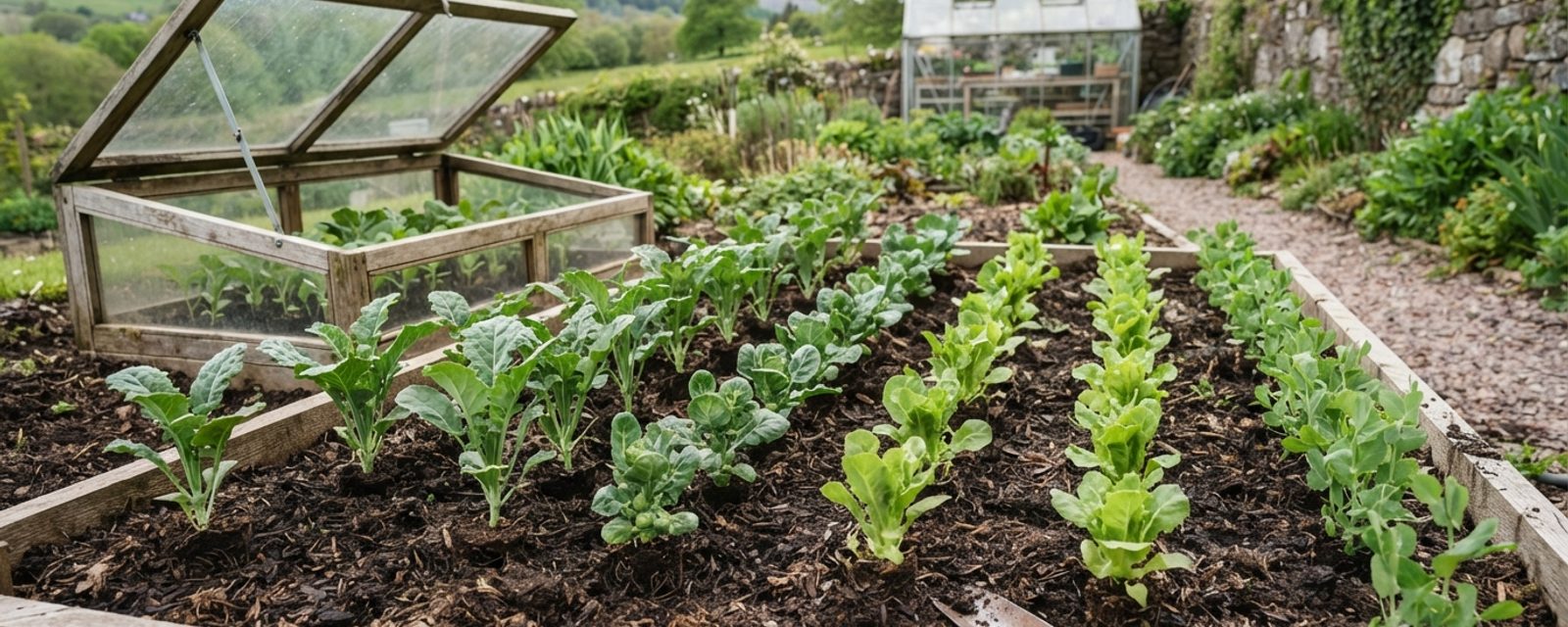
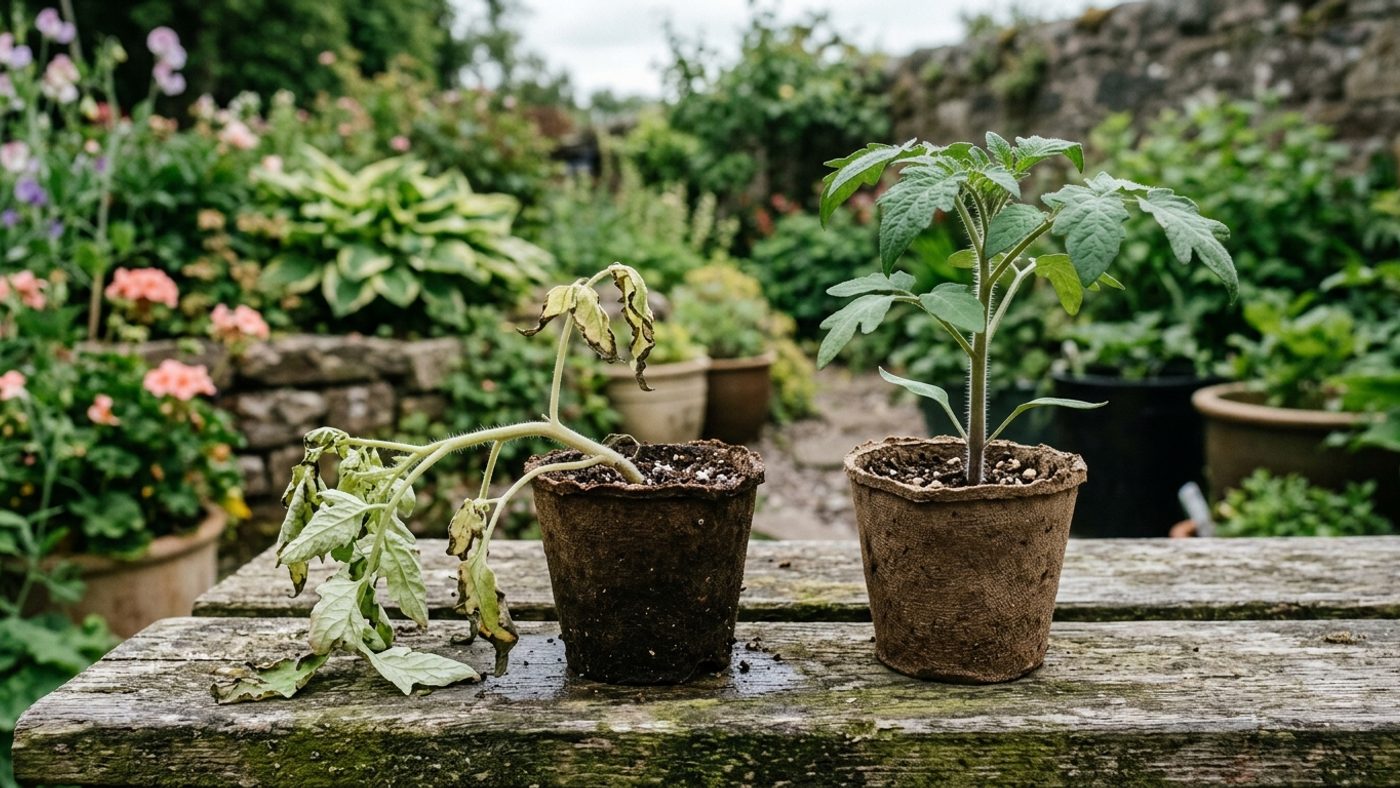
If you're reading this because a tray of tomatoes, courgettes or bedding plants went outside looking fine and came back in a few days later grey, floppy, or with leaves that look sunburnt and papery at the edges, you're not dealing with a disease, a pest, or bad luck. You're dealing with transplant shock, and it has one overwhelmingly common cause: the plants went from a stable, sheltered indoor or greenhouse environment straight into wind, direct sun and cold night air with no acclimatisation period in between.
Symptoms sort themselves fairly cleanly by cause. Leaves that have gone pale, bleached or crisped at the margins, usually on the side facing the sun, are sun scorch; the leaf tissue that formed indoors under diffuse light has no protective wax layer built up for direct UV. Whole plants lying flat, stems bent over at soil level, or a general wilted collapse that doesn't recover overnight even with watering, is usually wind or cold shock; the stem tissue is too soft to stand up to moving air, and the plant is losing water faster through its leaves than its unhardened root system can replace it. A blackened, water-soaked look on the youngest growth after a clear, still night is frost damage, which is a different problem again (the plant went out too early relative to the last frost, not too fast). A fourth possibility, easy to mistake for the others: if whole seedlings have simply vanished overnight, or leaves show ragged holes and a silvery slime trail, that's slugs, not weather. Scotland's characteristically damp climate keeps them active and feeding through more of the year than a drier garden further south, and newly planted-out or still-hardening seedlings are exactly the soft, undefended growth they target. A ring of sharp grit or crushed eggshell round each plant, a beer trap, or an evening check with a torch during the hardening-off weeks will catch most of the damage before it's done.
All three are avoidable, and all three come down to the same fix: hardening offGradually getting young plants raised indoors used to outdoor conditions over 7–14 days before planting out, so cold, wind and direct sun don't shock or damage them. Full definition → properly, for long enough, starting at the right calendar date for where in Scotland you're gardening, which is not the same date as the seed packet or a UK-average gardening guide will tell you.
What hardening off actually does
Hardening off is the deliberate, staged exposure of indoor-raised plants to outdoor light, moving air, temperature swings and (for greenhouse or windowsill stock especially) direct sun, carried out over roughly two to three weeks before the plants go into open ground for good. During this period the plant's leaf structure genuinely changes: cell walls thicken, leaves develop a heavier cuticle (the waxy outer layer that reduces water loss), and new growth comes in shorter and sturdier rather than the soft, stretched growth typical of a warm, sheltered environment. None of this happens instantly, it's a physiological adjustment, not just the plant "getting used to it" psychologically, which is why rushing the process doesn't work no matter how mild the weather looks on a given day.
It is worth being precise about what hardening off does not do: it does not make a frost-tender plant frost-hardy. A tomato, courgette, dahlia or bedding pelargonium that has been hardened off for three weeks will still be killed or badly damaged by a hard frost, hardening off toughens the plant against cold, wind and sun stress in general, it doesn't confer frost tolerance. That distinction matters a lot in Scotland, where a clear, calm night can still produce a ground frost well after the daytime weather has turned reliably warm.
The Scotland-specific timing question: shift, or compress?
Generic UK gardening advice tells you to harden off over two to three weeks and plant out after your last frost date, with the explicit note that the last frost comes later in the north and Scotland than in the south of England. That's correct as far as it goes, but it leaves the actual planning question unanswered: if everything in Scotland happens later, does the whole indoor-growing calendar get squeezed into a shorter window, or does the entire schedule simply slide later on the calendar while keeping the same shape?
The answer is: it shifts, not compresses, the hardening-off period itself is still the same two to three weeks wherever you are in Scotland. What moves is the date you start it, which you work out by counting backwards from your regional safe planting-out date. A courgette hardened off in the Highlands doesn't need a shorter, rushed acclimatisation just because the season started later; it needs the same fortnight of stepped exposure, begun three weeks later on the calendar than it would in Edinburgh.
Where things genuinely get compressed, and this is the trap that catches people out, is the indoor growing period before hardening off starts, if you sow to a generic UK-timed seed packet. Packet instructions are often written around an English last-frost date. Sow tomatoes or bedding plants on that schedule in, say, Aberdeenshire or Perthshire, and by the time your actual regional planting-out date arrives, your plants have already spent an extra two to three weeks sitting indoors past the point they were ready to move on, getting leggyDescribes a plant that's grown tall, thin and sparse rather than bushy, usually from too little light or not being pinched out. Full definition →, root-bound, and stretched for light. The hardening-off process doesn't shorten to compensate; the plants just go into it in worse condition. The fix is to sow later to match your region, not to harden off faster.
Regional dates and what they mean for your start date
Find your region below, then count back two to three weeks from its safe planting-out date to get your hardening-off start date (the "safe" date already carries roughly a two-week margin past the average last frost, the standard horticultural buffer, not a hard guarantee against every late cold snap). Not sure which region matches your exact garden, or gardening somewhere not listed here, such as Orkney? Check the fuller regional frost dates page for station-by-station detail.
| Region | Safe planting-out date | Start hardening off |
|---|---|---|
| Central Belt lowland (Edinburgh area) | Mid May | Late April |
| Highlands lowland/coastal (Inverness/Moray Firth) | Mid May | Late April |
| Islands (Hebrides & Shetland) | Mid May | Late April |
| Northeast lowland (Aberdeen/Dyce) | Late May | Early-to-mid May |
| Upland/inland (Eskdalemuir, Braemar) | Early-to-mid June | Mid-to-late May |
The pattern behind these figures is coastal and low-lying beats inland and high: nearby sea moderates temperature swings, so the mild, low-lying Moray Firth coast and the Hebrides actually match the Central Belt for last frost, while inland and upland ground (Eskdalemuir, Braemar) runs three to four weeks behind on the same table, altitude and distance from the sea, not simple north-south geography, is what's driving the gap.
Wind: the constraint that isn't in the standard advice
Cold and frost dominate most hardening-off guidance, which makes sense for most of England, but on a lot of Scottish sites, particularly west-coast, island and other exposed positions, wind is the factor that actually determines whether hardening off succeeds, independent of temperature. A plant can be perfectly safe from frost on an April afternoon and still be shredded, desiccated or physically flattened by sustained wind that would barely register as "breezy" in a sheltered inland garden. The Hebrides make the point clearly: last frost there is late April, tied with the Central Belt for the earliest safe start in Scotland, but exposure, not cold, is what actually limits how fast you can move plants outdoors, so a milder frost date doesn't translate into an easier hardening-off process.
Wind causes damage through two separate mechanisms, and it's worth treating them separately when you're hardening off. Mechanical damage, snapped stems, torn leaves, plants physically knocked over or uprooted, comes from gusting and turbulence, and is worst around walls, gaps between buildings, and open ground with no windbreak. Desiccation damage, the same crisping, curling leaf-edge symptoms you'd associate with sun scorch, comes from moving air pulling moisture out of leaves faster than an unhardened root system can replace it, and it happens even on cool, overcast, windy days when there's no direct sun involved at all.
If you're gardening somewhere exposed, adapt the standard hardening-off method rather than abandoning it: start the outdoor exposure stage in the most sheltered spot on your plot, against a south- or east-facing wall, behind a hedge, inside a cold frame with the lid providing wind protection even when it's not needed for cold, and only move plants to a fully open position in the final few days before planting out. A simple windbreak (fine mesh netting, an old cold-frame lid propped on its side, even a row of canes with fleeceA lightweight, breathable fabric laid or draped over plants to trap a little warmth and keep off frost, wind and some flying pests. Full definition → stretched between them) knocks the worst of the gusting and drying effect down substantially without blocking light, and is worth setting up before you start rather than after the first batch of plants comes to grief.
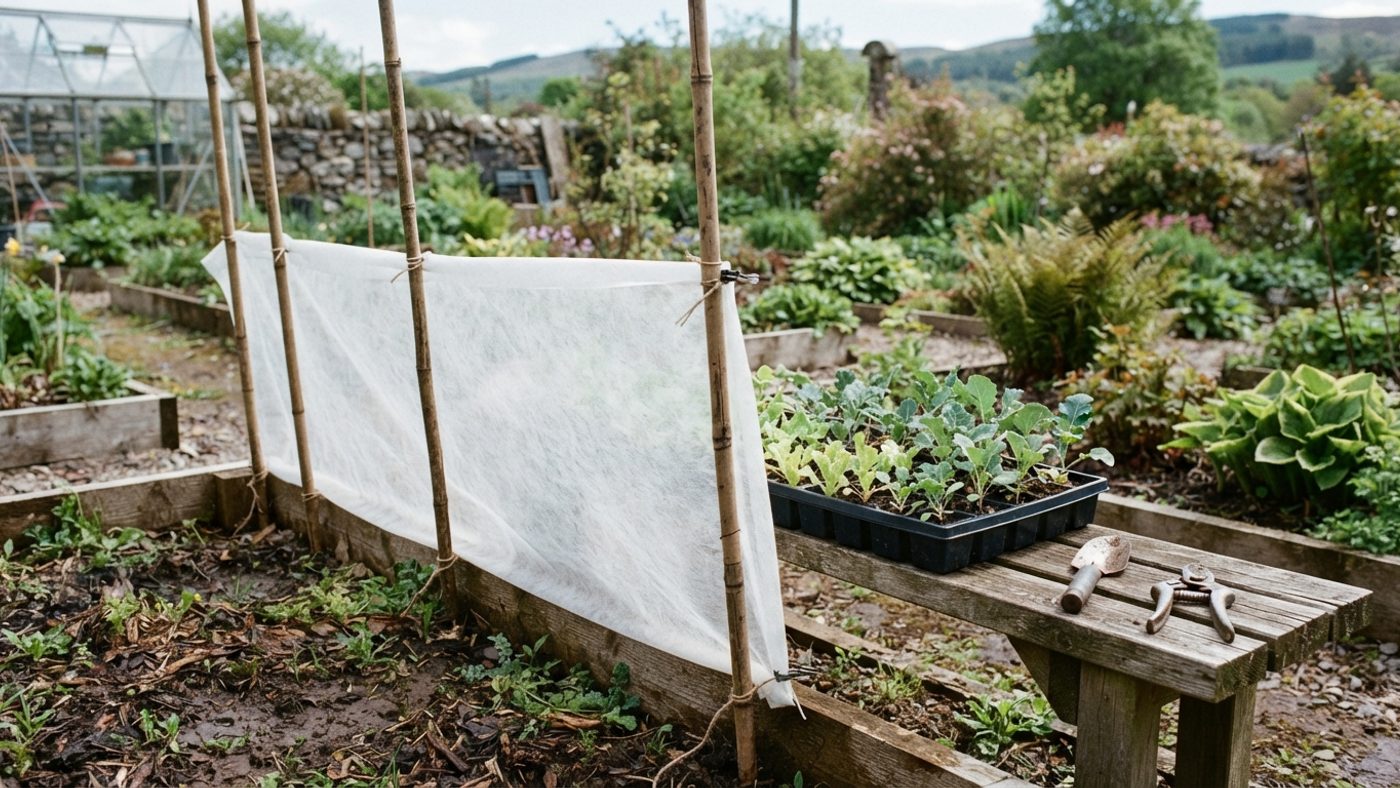
Two further hazards worth watching for alongside wind, both more of a feature of a Scottish spring than further south. Hail showers are common through April and May and can shred leaves and snap stems in minutes, independent of frost or wind, there's no acclimatisation against it, so the only real defence is having fleece or a cold-frame lid ready to throw over plants at short notice when a hail-bearing shower is forecast. On the east coast in particular (Lothians, Fife, Aberdeenshire), haar, the sea fret that rolls in off the North Sea on otherwise fine days, can drop daytime temperatures sharply and cut light levels for hours at a time during exactly the weeks most plants are being hardened off; it's not damaging in the way frost or wind is, but it can stall the toughening-up process on the days it settles in, so don't be surprised if progress looks slower on a haar-prone coast than the calendar alone would suggest.
The method, step by step
Whichever regional start date applies to you, the mechanics of hardening off are the same. Pick the method that matches how your plants were raised.
Greenhouse-raised plants
Move from a heated greenhouse to an unheated one first, if you have the option, this alone removes a lot of the temperature shock before wind and direct sun are even a factor. After about a week, start moving trays outside during the day to a sheltered spot and bringing them back into the cold greenhouse or a porch at night. Extend the outdoor period by roughly an hour a day over the following ten to fourteen days, until they're spending full days and finally full nights outside before planting out.
Windowsill or propagator-raised plants
These are the most vulnerable, since they've had the most sheltered start, no wind exposure at all, and often lower light levels than a greenhouse. Take them out of any propagator lid on an overcast, still day rather than a bright or breezy one, to reduce the initial shock. Start with an hour or two outside in full shade or dappled light, extending gradually; don't put windowsill-raised seedlings into direct sun or open wind in the first few days under any circumstances, even if the weather looks mild. One genuine advantage further north: by late April and May, Scotland's longer daylight hours mean these plants get more hours of usable outdoor light per day during the process than the same schedule would give a grower in the south of England, useful for the light-hardening side of things, though it does nothing to offset the cold or wind side, so don't let it tempt you into rushing either of those.
Cold-frame method
Start with the lid open a crack during the day, closed at night, and gradually raise it further over the fortnight until it's left off entirely except on nights when frost is forecast. This is the most forgiving method for exposed sites, since the frame itself acts as a windbreak throughout the process, you're removing the cold and glass protection in stages rather than removing wind protection at the same time.
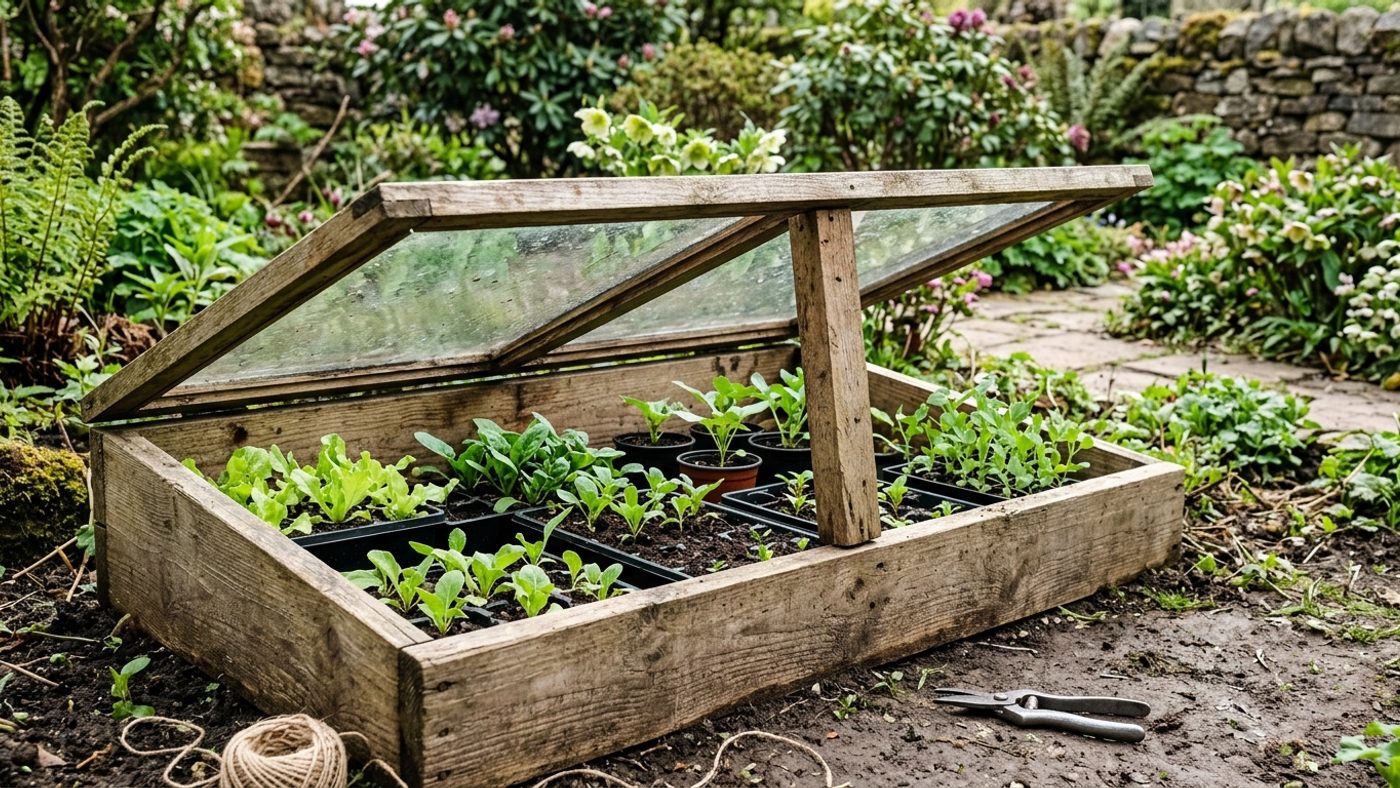
Cold Frames in Scotland → covers building or buying one, siting it, and using it through the rest of the growing season beyond just hardening off.
Fleece method (for plants already in their final position or a nursery bed)
Cover with two layers of horticultural fleece to start. In the first week, remove the fleece during the day and replace it at night. In the second week, drop to a single layer, or none during the day. By the third week, leave uncovered, keeping fleece on hand to throw back over if a late frost is forecast.
Polytunnel-raised plants
Common on Scottish allotments, these sit in an odd middle ground: a polytunnel gives more light and less draught-exclusion than an open cold frame, but far less wind and temperature buffering than a heated greenhouse, since polythene doesn't hold heat the way glass does and tunnels are often less airtight. Plants raised in one are usually partway hardened already if the tunnel isn't heated and gets ventilated on warm days, but they still need the wind- and direct-sun step; a still, humid tunnel interior is nothing like an open, gusty allotment plot. Treat polytunnel stock as roughly a week ahead of windowsill-raised plants on the schedule, not as ready to go straight out.
Watering and feeding during the process
Ease off feeding a week or so before you start hardening off, you want growth to slow down and toughen, not keep pushing soft new growth right as you're trying to acclimatise the plant. A dilute, balanced liquid feed can resume once plants are in their final position and established, but not during the hardening-off fortnight itself.
Watering needs more attention during hardening off than people expect, not less. Outdoor conditions, wind especially, dry out compost much faster than a sheltered indoor spot, and small pots or plug trays have very little reserve. Check pots daily during the hardening-off period rather than sticking to whatever watering schedule worked indoors, and water in the morning so foliage isn't sitting wet going into a cold night, which increases frost and fungal risk, worth taking seriously in Scotland specifically, where damp, humid spells are the rule rather than the exception through spring. Don't let plants dry out to the point of wilting during hardening off, a wilt-recover-wilt cycle at this stage is exactly the kind of stress that produces the floppy, collapsed look people mistake for cold damage.
Plant-by-plant timing notes
Not everything hardens off at the same pace or needs the same care. Hardy annuals and brassicasThe cabbage family: cabbage, kale, broccoli, cauliflower, Brussels sprouts, kohlrabi, swede, turnip and more, sharing the same pests, diseases and rotation rules. Full definition → (calendula, cornflowers, cabbages, kale) tolerate a faster, more casual hardening-off process and can go out slightly ahead of your general planting-out date if conditions allow. Half-hardy bedding, busy Lizzies, begonias, pelargoniums, fuchsias, need the full careful three-week treatment and should not go out until you're confident the last frost has passed, since a late check will show in flowering all season. Heat-loving vegetables, tomatoes, courgettes, squash, sweetcorn, French and runner beans, are the most vulnerable group: as well as frost risk, they stall if soil temperature is too low regardless of air temperature, so even after hardening off is complete it's worth holding off planting these specifically until night air temperatures are reliably above 7C, and ideally above 10C for tomatoes, peppers and basil, rather than planting strictly to the frost date alone. In practice that soil-and-air-temperature threshold is often the real limit in Scotland, not the frost date on the table above, a Central Belt garden can be frost-safe by mid May and still sitting well under 10C at night for another week or two, so treat the regional planting-out date as a floor for heat-loving crops, not a green light on its own.
What to do if damage has already happened
If your plants are showing scorch, wind damage or mild cold check but are still upright and green at the base, don't scrap them, cut back the damaged growth and continue the hardening-off process at a slower pace, with more shelter, before trying again. Plants that have gone fully black, collapsed, or mushy at stem level, particularly after a frost, are unlikely to recover and are better replaced than nursed. Either way, the underlying fix for next time is the same: start hardening off on the date that matches your region, not the date on the seed packet, and don't shorten the two-to-three-week window even if your local last frost is later than everyone else's.
Common questions
I've already sown late and I'm behind schedule. Can I speed up hardening off to catch up?
Don't shorten the process itself; the two to three weeks is doing real physiological work regardless of the calendar, and cutting it to a few days is what causes the scorch, wind damage and collapse this piece opened with, not the late start. If you're genuinely up against it, the two things that actually help are checking a short-range forecast rather than relying on the season's average conditions (a settled, calm stretch lets you push each stage on a day or two faster than a windy, showery one would), and holding your heat-loving crops back specifically, since they're gated by soil and night-air temperature as much as frost, a slightly late tomato or courgette rarely loses much by going out a few days after everything else once conditions allow. Note the timing for next year instead: sow to your own region's dates, not the seed packet's.
Can I start hardening off before my region's last frost date?
Yes, and you should: hardening off needs to finish by your last frost date, so it has to start two to three weeks before it, not after. Keep frost-sensitive plants under cover or fleeced at night throughout the process regardless of how mild the daytime weather is; hardening off doesn't protect against frost, it only builds general toughness against wind, cold air and sun.
My seedlings looked fine one day and were flat on the ground the next. Was that frost?
Not necessarily. A sudden physical collapse with no blackening is more often wind damage than frost: unhardened stems simply aren't strong enough to stay upright in open air, and the plant loses water through its leaves faster than its root system can keep up. Blackened, water-soaked, translucent-looking tissue after a clear, still night is the more typical sign of actual frost damage.
Do plants raised in a polytunnel still need hardening off?
Yes, but from a head start. An unheated, ventilated polytunnel gives more light and airflow than a windowsill or heated greenhouse, so plants raised there are often partway acclimatised already, but a tunnel interior is still far calmer and more humid than an open plot. Treat polytunnel-raised plants as roughly a week ahead of windowsill-raised stock on the schedule, not as ready to plant straight out.
How do I harden off plants on an exposed or coastal site where wind is the main problem?
Start the outdoor stage in the most sheltered spot you have: against a wall, behind a hedge, or inside a cold frame, and only move plants to a fully open position in the last few days before planting out. A simple windbreak (mesh netting, a propped cold-frame lid, fleece strung between canes) reduces both mechanical damage and wind desiccation without blocking light, and is worth setting up before starting the process rather than after plants have already been damaged.
Sources
3 sources, recorded with what each was used for
- RHS: Hardening Off Tender Plants: Baseline hardening-off method, duration (2-3 weeks), the stepped greenhouse/cold-frame/fleece techniques, and the note that hardening off does not confer frost hardiness
- RHS: When to Plant Out Tender Plants to Avoid Late Frosts: The generic UK regional planting-out windows (for comparison against Scotland-specific dates) and the 7C/10C night-temperature thresholds for heat-loving vegetables
- Met Office: Location-specific long-term averages (1991-2020 station normals): The underlying data (via named stations: Edinburgh RBG, Inverness, Dyce/Aberdeen, Stornoway/Tiree/Lerwick, Eskdalemuir/Braemar) behind all Scotland-specific last-frost and safe planting-out dates used in this article