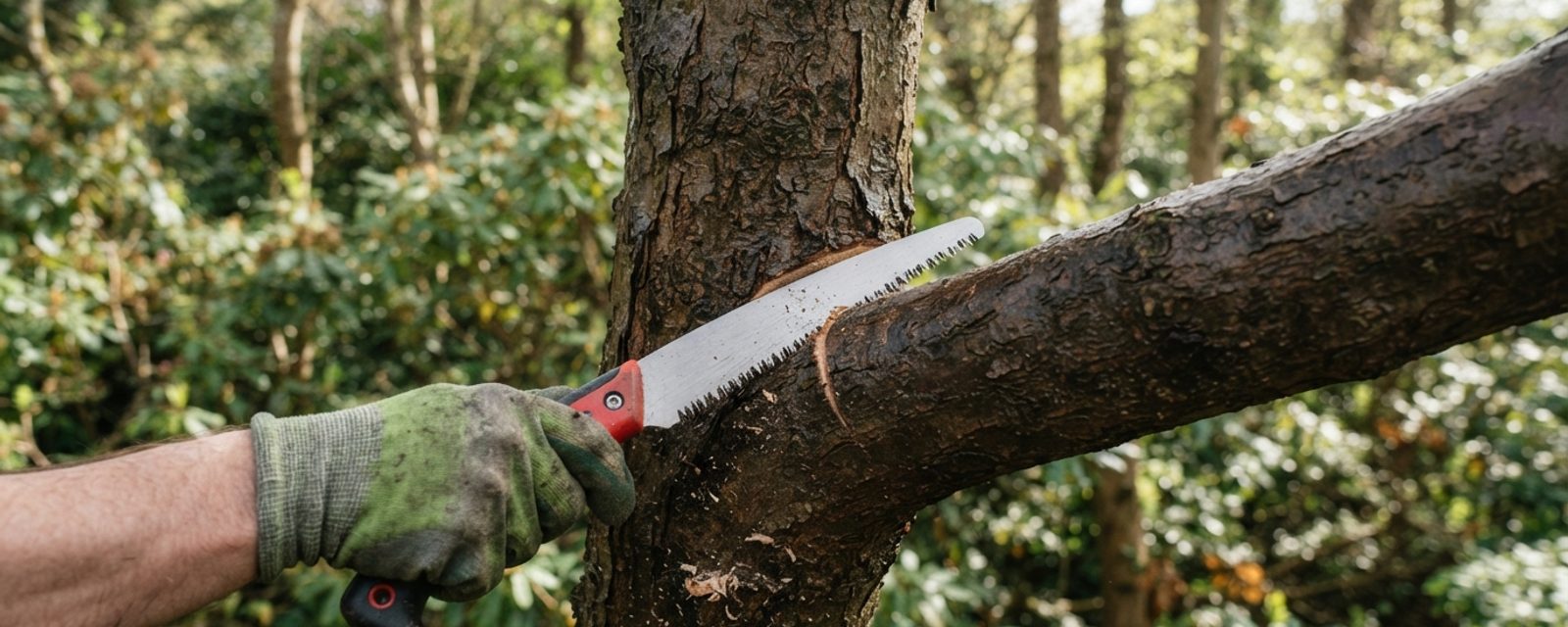
A gale has been through overnight, and there's a branch hanging at an odd angle above the lawn, still attached at one end, cracked through at the other, moving slightly every time the wind gusts. Or maybe nothing dramatic happened at all: a limb has just been getting in the way of the washing line for two summers running, and today's the day you've decided to deal with it. Either way, you're standing there with a saw in your hand, sizing up the job. Is this something you can finish safely before lunch, or is this a job for someone with ropes, a chainsaw and insurance?
That question is worth taking seriously. Branch removal carries real injury risk that most ordinary garden jobs don't, not through some freak accident, but through the entirely predictable combination of gravity, cutting tools and working above ground level. None of what follows is meant to alarm you out of doing legitimate DIY pruning; most branch work on a garden tree is well within a competent gardener's reach. But it's worth being honest about where that reach ends.
Why technique matters: the three-cut method
If you take one thing from this article, take this: never remove a heavy branch with a single cut from the top. A branch of any real size is under enough weight that, as your saw nears the bottom of a single cut, the branch's own weight tears the last inch of wood rather than letting the saw finish it cleanly. That tear doesn't stop at the cut line, it runs down into the bark of the trunk, stripping a long ragged wound that heals badly and gives decay and disease an easy way in. It's also dangerous: an unsupported branch can drop unpredictably in the final moment of the cut, swinging or barrel-rolling with the saw still in it.
The three-cut method solves this by controlling the fall before the branch is fully free.
- The undercut. Starting on the underside of the branch, roughly a foot out from where you intend to make your final cut, saw upward through about a third of the branch's thickness. This does the real safety work: it pre-scores the underside so that when the branch does eventually break away, the bark below the cut can't tear past this point.
- The top cut. A few inches further out from the trunk than the undercut, cut down from the top. As your saw meets the depth of the undercut below, the branch's own weight snaps it off cleanly at that point, the two cuts meet, the branch falls away in a controlled manner, and because the undercut already exists, there's no bark to tear down the trunk. You're left with a stub, not a hazard.
- The final cut. With the weight gone, you can now cut the remaining stub back accurately. This is where the branch collar matters: the slightly swollen, wrinkled ring of tissue where a branch joins the trunk. It's the tree's own healing tissue, and it's what will grow over and seal the wound. Cut just outside it, angled slightly away from the trunk, rather than flush against the trunk itself. A flush cut removes the collar along with the stub and leaves the tree unable to seal the wound properly; a stub left too long, on the other hand, dies back and invites rot. The aim is a clean cut close to, but not into, the collar.
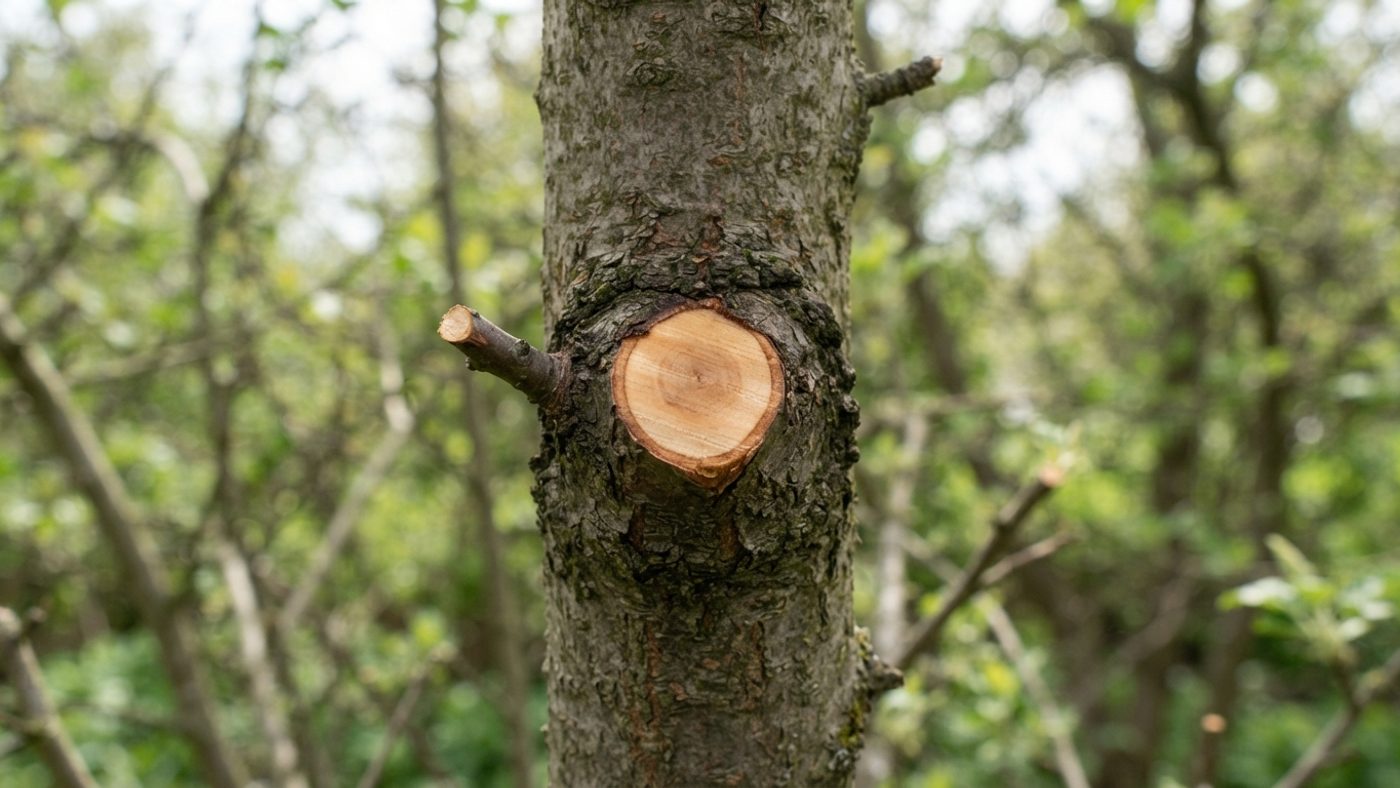
Skip pruning paints or wound sealants on the finished cut, too, they tend to trap moisture against the wound and encourage rot rather than protect it.
What you can safely do yourself, and what you can't
| Situation | Verdict |
|---|---|
| Branch smaller than your wrist, reachable from the ground | DIY, three-cut method |
| Branch larger than your wrist in diameter | Call an arborist |
| Any work requiring a ladder or climbing into the canopy | Call an arborist |
| Branch within reach of, touching, or near power lines | Call the utility, not an arborist |
| Cut requiring a chainsaw used from height or in the tree | Call an arborist |
| Storm-damaged or hanging branch still caught in the canopy | Call an arborist |
Two of these are worth more than a line in a table, get them wrong and the consequences are the ones that actually hurt people.
West-coast and island gardens run considerably windier on average than sheltered inland sites: Stornoway and Lerwick's long-term average wind speeds run to roughly 13.7-17.0 mph, against under 7 mph at a sheltered inland spot like Aviemore. That gradient matters for both of the hazards below, so keep it in mind through this section.
Ladders and climbing. Cutting a branch is a two-handed job that also needs you braced and able to move if the branch behaves unexpectedly. A ladder gives you none of that: one hand is holding a saw, the other is holding the ladder or the tree, and your footing has no give in it if the branch kicks back or the ladder shifts. This is consistently the point at which experienced tree-work guidance draws the line between homeowner and professional, once a job needs a lot of work up ladders, it's time to call someone qualified rather than improvise. A trained arborist works from proper climbing systems or a platform, not a domestic stepladder. On an exposed west-coast or island site, that line arrives sooner than the general guidance implies: a gust that's a minor nuisance standing on solid ground is a genuine hazard on a ladder braced against a moving tree.
Storm damage and widowmakers. A widowmaker is the correct arboricultural term for a broken or partially broken branch that's still caught up in the canopy above, hung on other branches, wedged against the trunk, or held by a last strip of splintered wood, rather than lying safely on the ground. The name is blunt for a reason: these branches can let go without warning, with no sound or visible trigger, and they fall from height with the momentum of everything that's damaged holding them up. If a storm has left a branch cracked, hanging, or lodged above head height, that is exactly the situation to leave alone and hand to a professional with the right rigging and rescue equipment. The same repeated gusting behind the wind figures above is what works weak branch unions and deadwood loose in a tree until they fail, so on an exposed site, treat storm damage as suspect until you've had a proper look from the ground; see securing a greenhouse or polytunnel in wind for the same exposure gradient in more depth.
Branch weight and drop control. The three-cut method above, with hand tools such as loppers or a pruning saw, is for branches at or below wrist thickness reachable from the ground. It isn't a technique to stretch beyond that by adding a chainsaw, a helper, or a rope: once a branch is heavier than that, bringing it down safely stops being about cutting technique and becomes about rigging and controlled lowering, a second person or a rope isn't a substitute for that, it's what a trained arborist adds on top of it. That's exactly the point at which this is an arborist's job rather than a bigger version of the same DIY task.
Before you cut: three legal checks
In Scotland, some trees can't legally be pruned or removed without permission, even on your own property, and there are three separate checks worth making before you pick up a saw.
Tree Preservation Orders and Conservation Areas. Where a Tree Preservation Order (TPO) applies, or the tree stands in a Conservation Area, cutting, lopping, topping or removing it requires the planning authority's consent, and unauthorised work on a protected tree carries a fine of up to £20,000 on summary conviction. A TPO can apply to a single tree in an ordinary back garden, not just an obviously significant one, and it isn't something you can tell just by looking, check with the local council's planning department. See the guide to pollarding and coppicing for the fuller detail on TPO and Conservation Area consent, which applies equally here.
Nesting birds. If you're working between March and August, check the tree for an active nest first. It's an offence to intentionally damage, destroy or disturb a wild bird's nest while it's being built or in use, a fully-fledged empty nest from a previous year is fine, an active one with eggs or chicks isn't something you can legally cut around. The pollarding and coppicing guide covers the same timing considerations in more depth, and they apply to any hard cut on a garden tree, not just a pollard.
Bats. Tree cavities, loose bark and thick ivy can hold a bat roost, which carries separate, stricter protection again, bats and their roosts are protected whether or not the roost is in use at the time. If a mature tree has cavities, splits, loose bark, or woodpecker holes, it's worth a look for droppings or staining before cutting, and if you suspect a roost, that's a job to pause and take advice on rather than push through.
Basic protection, and who you're actually calling
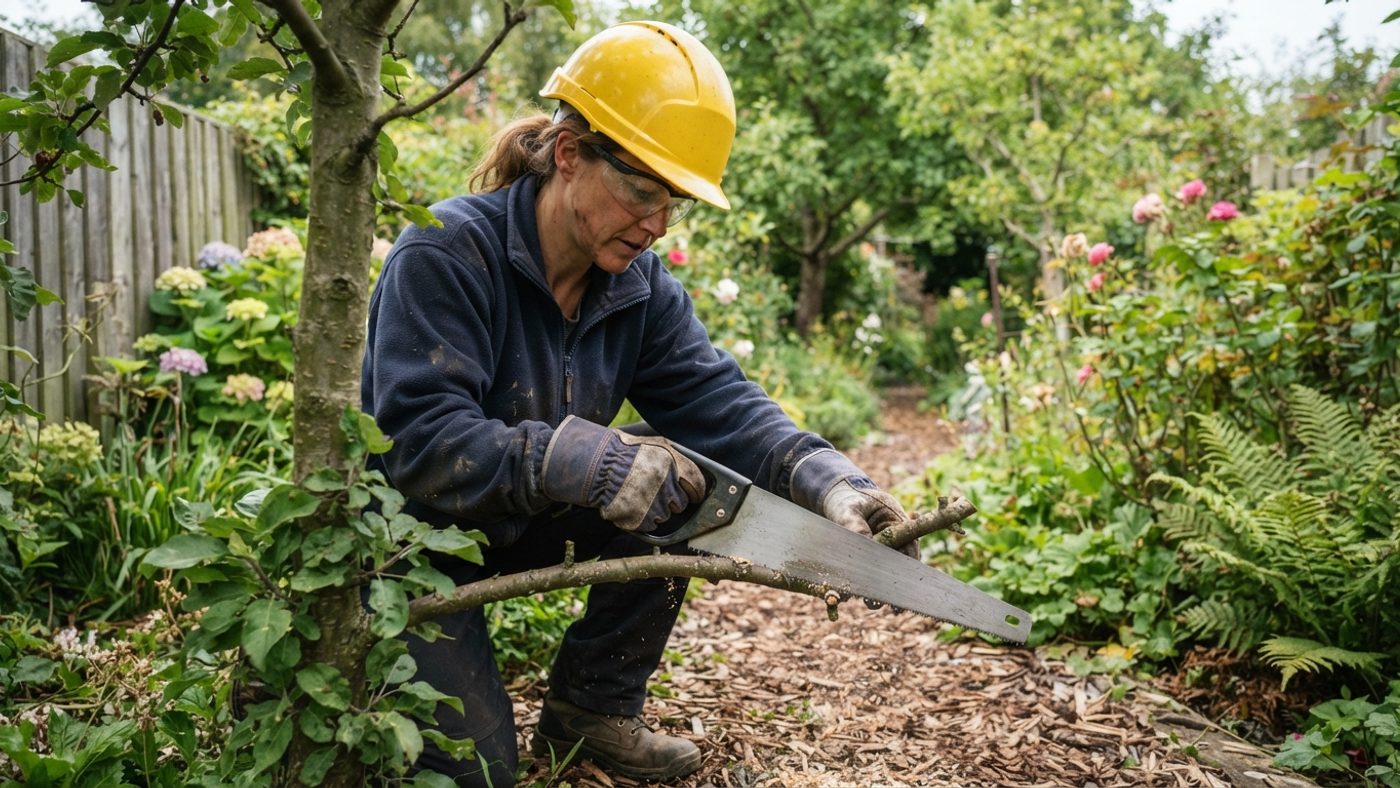
Even a straightforward removal from the ground is worth doing in eye protection, sturdy gloves, and boots with a solid sole rather than garden trainers, standing on offcuts and debris underfoot. Add a hard hat too if there's any deadwood or hung-up material still above you, it's there to protect against exactly that, something breaking free overhead while your attention is on the cut in front of you. If the job needs a chainsaw rather than a hand saw or loppers, that's a separate level of risk again: proper chainsaw-rated leg protection, not ordinary trousers, and training in kickback awareness are the minimum before starting one up, and if you don't already have both, that's reason enough on its own to call a professional instead.
When you do call a professional, "arborist" and "tree surgeon" aren't protected titles in the UK, so it's worth checking before booking: look for membership of the Arboricultural Association's ARB Approved Contractor scheme, ask whether the crew hold NPTC or Lantra chainsaw and climbing certificates for the specific work involved, and ask to see proof of public liability insurance before anything starts. A legitimate contractor expects these questions and answers them without hesitation.
Common questions
What do I do with the branch once it’s down?
Most council garden-waste bins or recycling centres will take the cut branches and brash, though many limit branch diameter or bundle size, so it’s worth checking your local authority’s rules before turning up with a full trunk section. For a bigger job, a hired or contractor-supplied chipper turns it into mulchA layer of material spread over the soil around plants to suppress weeds, retain moisture, and improve soil structure as it breaks down. Full definition → on site, which is often the easiest way to deal with a large prune in one go.
Can I remove a branch that’s touching power lines?
No, never attempt this yourself, even with a long pole saw. Contact your electricity network operator or utility company, not a tree surgeon, since only they can safely make branches near live lines dead-safe to work on.
Is it safe to cut a branch that’s under tension, or that’s already bent or bowed by a storm?
No, not with the ordinary three-cut method described above. A branch under tension, from a lean, a snapped neighbour still resting on it, or its own weight after storm damage, can spring back, whip sideways, or barrel-roll as soon as a cut releases that stored energy, in a direction that’s hard to predict from the ground. That’s a rigging and controlled-release job for a professional, not a straightforward cut.
Do I need permission to remove a damaged branch after a storm, even in an emergency?
Emergency safety works to remove an immediate hazard are treated differently under TPO rules than routine pruning, but if a tree is protected, notify the planning authority. Don’t assume storm damage automatically removes the need for consent.
Do I need to do anything different if the branch I’m removing is diseased or has fungal growth on it?
Clean your saw blade with household disinfectant or diluted bleach before moving on to healthy wood elsewhere on the tree, or on any other tree, so you don’t spread the problem. A branch with significant fungal growth, cavities, or visible decay at the point you’d need to cut is also a sign the wood itself may be weaker and less predictable than it looks, worth getting a professional opinion on rather than assuming it will behave like sound timber.
Sources
8 sources, recorded with what each was used for
- RHS: Trees: Reducing Size Safely: The professional-hire threshold (branches larger than wrist diameter, or significant ladder work), the branch-collar cutting technique, and guidance against pruning/wound paints
- gov.scot: Scottish Planning Series, Planning Circular 1/2011 – Tree Preservation Orders: The TPO consent requirement and the up-to-£20,000 fine on summary conviction for unauthorised work on a protected tree
- legislation.gov.uk: Town and Country Planning (Scotland) Act 1997: Primary legislation underpinning Tree Preservation Orders
- legislation.gov.uk: Wildlife and Countryside Act 1981, Section 1: The offence of intentionally damaging, destroying or disturbing an active wild bird’s nest
- legislation.gov.uk: The Conservation (Natural Habitats, &c.) Regulations 1994, Regulation 39: The protection of bat roosts, including when not currently in use
- Met Office: Location-specific long-term averages, Stornoway Airport (1991-2020): Annual mean wind speed figure (11.90 knots / ~13.7 mph)
- Met Office: Location-specific long-term averages, Lerwick (1991-2020): Annual mean wind speed figure (14.73 knots / ~17.0 mph)
- Met Office: Location-specific long-term averages, Aviemore (1991-2020): Inland sheltered comparator annual mean wind speed figure (5.84 knots / ~6.7 mph)