
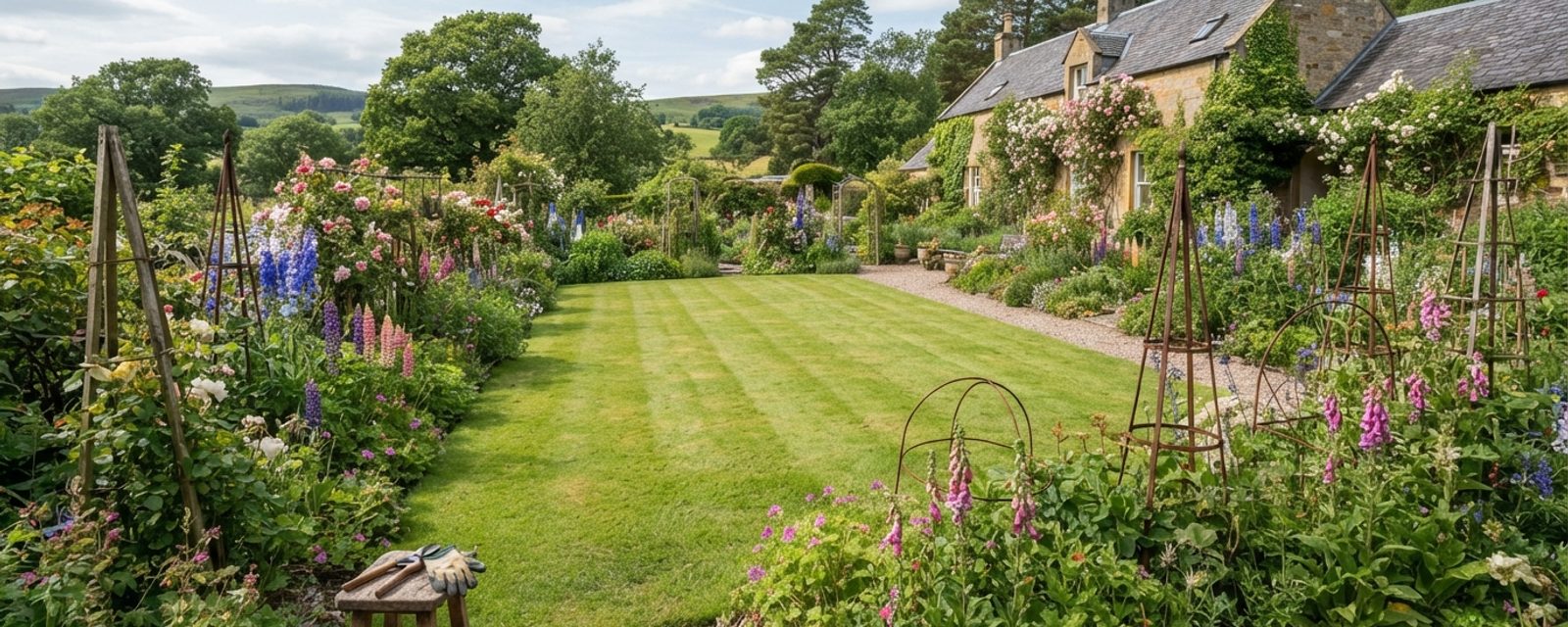
A garden left alone for two weeks doesn't pause, it keeps running whatever process was already in motion when you shut the gate. A courgette that was 8cm on the day you left is still swelling every day you're gone, because the plant has no way of knowing nobody's coming to pick it.
Why a fortnight matters more than it sounds like it should
A greenhouse or polytunnel that's shut up and unshaded doesn't sit at whatever temperature it was when you closed the door, glass and polythene both trap solar heat, and without airflow that heat has nowhere to go, so the internal temperature can climb well past what any of the plants inside can tolerate, long before you're back to open a vent. A lawn cut too short right before you leave doesn't just look scalped, the shorter the blade of grass, the less leaf area it has to fuel root growth and recovery, so a hot, dry week does more damage to a tightly shaved lawn than to one left a little longer. And a tall dahlia or delphinium that's never been staked doesn't fall over gradually, a single gust catches the full weight of the flower head above an unsupported stem and snaps or flattens it in seconds, not over days.
None of this is really about watering. Established beds and borders in open ground usually cope with a fortnight unattended, even through a dry spell, provided the soil itself holds some moisture reserve, anything newly planted or still root-establishing is the exception, and needs a thorough soak before you leave regardless of the weather. It's containers, undercover crops, and anything already close to a tipping point that actually need attention, and that attention is about everything that keeps happening while you're not there to intervene, growth, heat, wind, decay, not just about keeping things wet.
The lawn: mow high, not short, before you leave
The instinct before a holiday is to give the lawn one last short back-and-sides so it doesn't get shaggy while you're gone. That's the wrong call. An ordinary domestic lawn wants keeping at 13–25mm through summer, never removing more than a third of the grass height in a single cut. Scalping it lower than that right before a fortnight away strips away leaf area the plant needs to keep photosynthesising and recovering, precisely when it might also be facing a dry spell with nobody there to water it.
Scotland's summer weather can swing from unremarkable to genuinely hot with only a day or two of warning, so it's worth raising the mower's cutting height a notch higher than your usual summer setting rather than lower, even if nothing hot is forecast the day you leave. A slightly longer lawn shades its own roots and copes with drought stress far better than a short one, and RHS advice on lawn care in spring and summer supports mowing less frequently, dropping to once a fortnight or longer, during periods of drought, which is effectively what a two-week absence forces you into anyway. You're not skipping a job by mowing high before you leave; you're choosing the height that survives your absence best.
Deadhead and harvest anything close to ready
Anything that's ready, or nearly ready, when you leave will not wait for you. DeadheadingRemoving spent flowers before they set seed, which redirects a plant's energy into further flowering rather than seed production. Full definition → spent flowers before departure isn't just tidiness, RHS guidance on deadheading notes that removing faded blooms redirects a plant's energy into further flowering rather than into seed production, so a border deadheaded properly before you go is more likely to still be flowering, rather than setting seed and shutting down, when you're back.
Harvesting is the more urgent half of this. Courgettes are the classic case: RHS growing advice puts the ideal harvest size at 10–12.5cm, picked regularly, because "if left, courgette fruits will quickly grow into marrows," and a plant that isn't picked stops producing at the same pace. The same logic applies to beans, peas, and most cut-and-come-again crops: leave the plant unpicked and it reads that as permission to stop cropping and put its energy into seed instead. Before you go, pick everything that's ready or close to it, even if it means an odd glut the day before you leave. It's better used than wasted, and it buys the plant a head start on producing more while you're away, assuming someone keeps picking (more on that below). Soft fruit needs the same treatment for a different reason: raspberries, strawberries, and currants left unpicked for a fortnight are as likely to end up stripped by birds and wasps as they are to simply overripen, so pick everything that's ripe or close to it, and net what's left if birds are already a problem in your garden.
Stake anything top-heavy before wind gets the chance
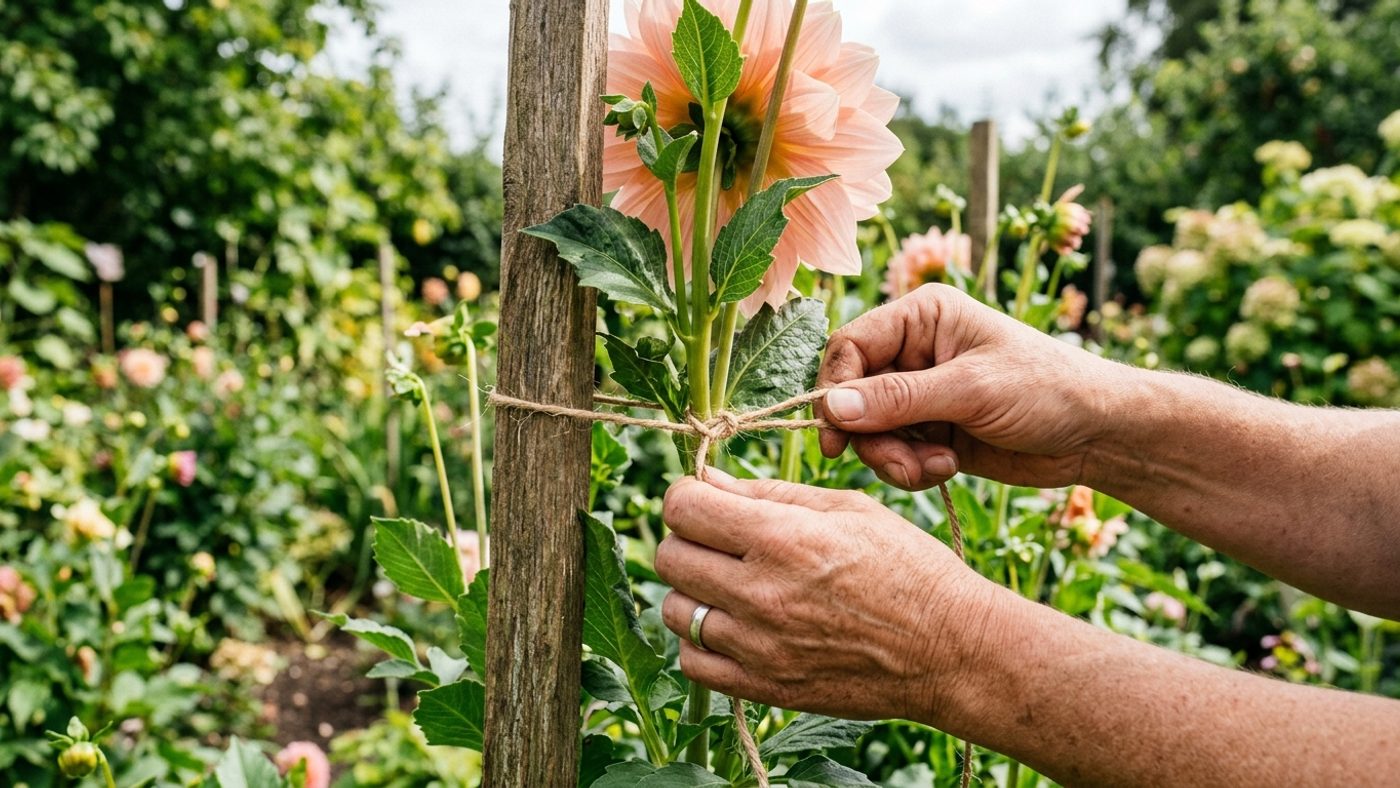
Tall perennials, dahlias, and top-heavy vegetables are at their most vulnerable exactly when nobody's around to prop them back up after a bad night of wind. Support needs to go in early, before the plant has put on most of its growth, so stems can grow up through the framework rather than being tied in after the fact, once they've already reached full height and are harder to support without damage. If that early staking didn't happen, don't skip it because it's late, go round a few days before you leave and get supports in regardless, rather than leaving anything top-heavy unsupported for a fortnight. Delphiniums and other tall, brittle-stemmed perennials, along with peonies and dahlias carrying heavy flower heads, are named as the plants most likely to need it. Y-stakes or circular grid supports suit dahlias and peonies well; canes and soft twine work for upright clump-forming perennials like delphinium.
A fortnight is long enough for a calm week to give way to an unrelated squally one, and nobody's there to react if it happens. If a plant goes over, there's no one to right it before the stem snaps or the crownThe base of a perennial plant where roots and shoots meet, often sold and planted as a ready-made dormant plant rather than grown from seed. Full definition → gets crushed under its own collapsed weight. Stake before you go, not after you notice it's leaning.
Greenhouse and polytunnel ventilation: the real risk in a Scottish summer
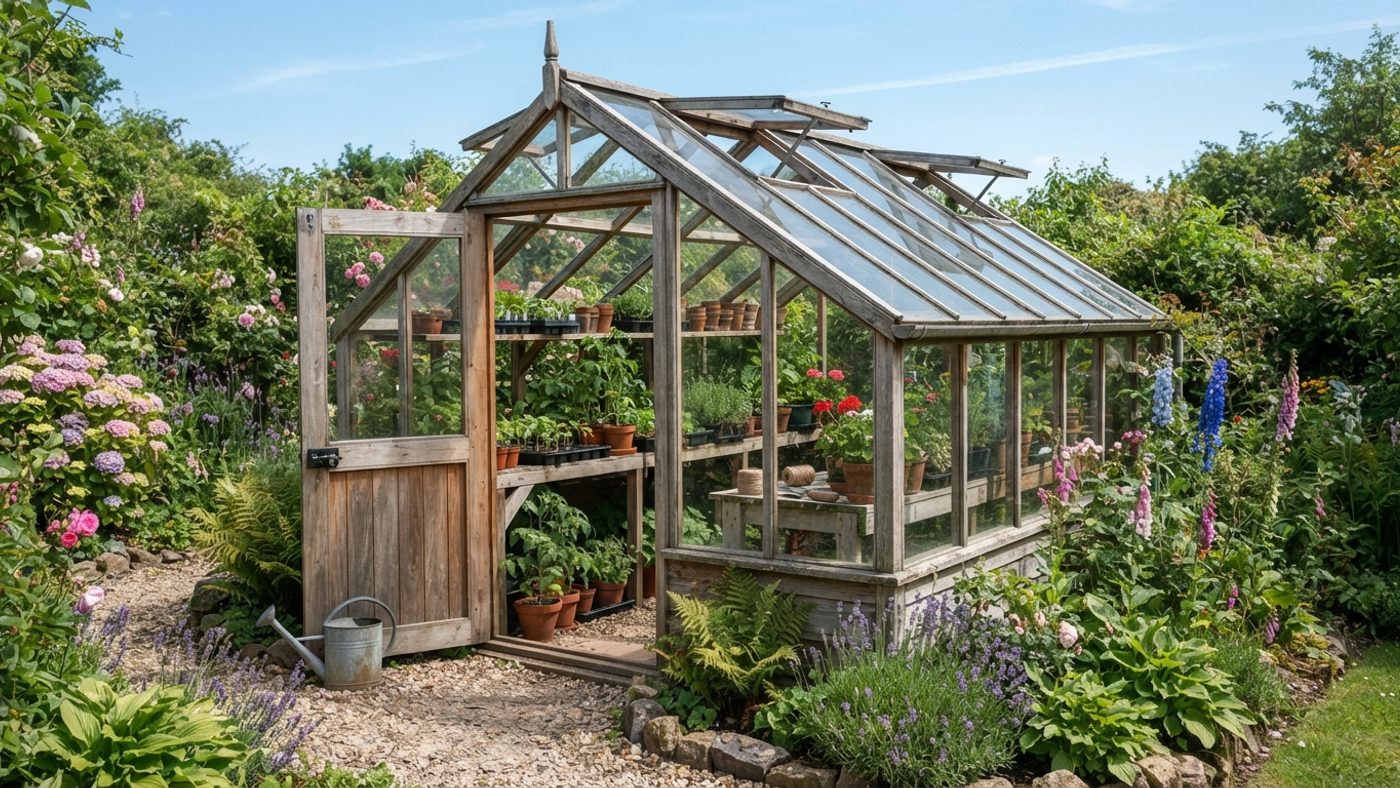
This is the job most likely to be skipped, and the one with the highest cost if it is: it only takes one or two genuinely hot days landing while you're away, with nobody there to open a vent or throw shade over it, to do real damage. RHS guidance on greenhouse ventilation and shading puts the safe upper limit at roughly 25–27°C, above which plants risk sun-scorch and leaf desiccation, wilting so badly the foliage collapses (RHS calls this "sun-flag"). Roof vents are the most effective single fix, RHS advice recommends around one square metre of ridge ventilation for every five square metres of floor area to allow a full air change roughly every two minutes, and shading is expected to be in place from mid-spring through early autumn, reduced only as the season cools into September.
Automatic wax-expansion vent openers are useful but not instant: RHS advice notes they take time to respond as the wax heats and expands, so on a fast-rising hot day they can lag behind the actual temperature spike. If you have one, leave it set to open at a sensible threshold before you go, but don't rely on it alone, leave doors or side vents propped open too, using a hook or latch that holds them ajar rather than fully open and free to bang about, so a squally spell doesn't do its own damage while you're solving for heat. Make sure shading is up rather than folded away for "just in case it's not sunny," and unplug or switch off any heater or propagator mat before you leave, there's no reason to run one through a two-week absence, and it's one less thing that can go wrong unattended. A shut, stuffy structure isn't only a heat risk either: still, humid air sitting on tomato foliage for two weeks is exactly the condition that lets fungal problems like blight take hold, so airflow is doing double duty. Pick any tomatoes and peppers that are ripe or close to it before you go, for the same reason as courgettes and soft fruit, a plant left unpicked in a hot, shut structure is under more stress, not less, and split or sun-scalded fruit is more likely on anything left hanging.
Scotland isn't a country known for heatwaves, which is exactly why gardeners under-prepare for one. A settled warm spell can arrive with only a day or two of warning after a run of unremarkable weather. Met Office regional climate data for Eastern Scotland shows just how wide the gap between a typical July and an extreme one can be:
| Typical July daily max | Recorded extreme | |
|---|---|---|
| Inland low-level sites, Eastern Scotland | ~20°C | 32.9°C, Greycrook, Borders (9 Aug 2003) |
| Edinburgh Airport | ~20°C | 31.4°C (4 Aug 1975) |
That gap between the average anyone plans around and the extreme that actually occurs is the whole risk, a shut, unshaded structure has no defence against the day the average doesn't hold.
Move vulnerable containers into shade
Pots and containers heat up and dry out far faster than open ground, because there's a limited volume of compost around the roots and it's exposed on all sides, not just at the surface. Hanging baskets dry out fastest of all, small volume, full sun exposure, and moving air on every side. Anything in a dark-coloured or thin-walled pot, or already looking stressed, is worth moving into shade, against a north-facing wall, under a tree canopy, or grouped together so the pots shade each other's sides, before you leave, regardless of what the forecast says for the day you set off. For how to keep them actually watered once they're in position, see the holiday watering systems guide (drip kits, capillary matting, self-watering pots).
Brief a neighbour properly: water is only the start
If someone's coming in while you're away, water is the obvious ask, but it's not the only one worth making, and arguably not even the most important.
Ask them to keep picking anything that crops quickly, courgettes, beans, peas, cut-and-come-again salad. A plant that isn't harvested reads that as a signal to stop producing, so a neighbour who only waters and never picks can come back to find the same problem this whole checklist is trying to avoid: boltedA plant switching early into flowering and seed production, usually triggered by stress, after which leaves, roots or bulbs turn bitter or unusable. Full page →, stringy, or oversized produce, and a plant that's shut down for the rest of the season.
It's also worth a quick word about slugs and caterpillars. Two weeks with nobody around to check is exactly when slugs can do the most damage to hostas and soft young growth, and cabbage white caterpillars can strip brassicaThe cabbage family: cabbage, kale, broccoli, cauliflower, Brussels sprouts, kohlrabi, swede, turnip and more, sharing the same pests, diseases and rotation rules. Full definition → leaves to a skeleton in the same window. Ask your neighbour to glance at anything you know is vulnerable, hostas, brassica leaves, seedlings, and, if they're willing, pick off any visible slugs or caterpillars by hand, or scatter a few wildlife-friendly slug pellets round the worst-hit plants. It's a small ask on top of watering and picking, not a separate job.
Ask them to collect post and any parcels from the doorstep too. This isn't strictly a gardening job, but it belongs on the same list: a fortnight of mail and deliveries piling up visibly signals an empty house, which is a security risk as much as an untidy one. Someone already coming round to water and pick produce can take thirty seconds to clear the doormat on the same visit, worth asking for explicitly rather than assuming it's implied.
Before you hand over, double-check your own side of the arrangement too: if you run any watering timer or irrigation system, make sure it's actually working and not about to flood a bed or run a butt dry with nobody there to notice, the holiday watering systems guide covers the actual kit if you haven't set one up yet.
What will still suffer, no matter what you do
None of this is a guarantee that the garden will look untouched when you get back. Two weeks is genuinely long enough that some things will move on without you regardless of preparation, and it's worth being honest about which ones.
Hedges, fast climbers, and anything you'd normally trim weekly will visibly get away from you, and there's no realistic amount of pre-departure pruning that banks two weeks of stillness. Some produce will go past its best even with a neighbour picking on your usual schedule, because picking every three or four days rather than daily still lets the fastest growers, courgettes especially, slip past ideal size occasionally. A few flowers will go over and self-seed rather than get deadheaded in time, even after a thorough pre-holiday round. And weeds will establish a foothold in beds you'd normally keep on top of weekly; a fortnight's growth on weeds you can't see yet the day you leave is not preventable by anything on this list.
What the preparation above actually buys you is protection against the failures that are sudden and severe rather than gradual and cosmetic: a scalped lawn stressed by drought, a greenhouse cooked in an unexpected hot spell, a dahlia snapped by wind, a courgette plant that's stopped cropping entirely because nothing was ever picked. Those are preventable. A slightly shaggier hedge and a few marrows you didn't quite avoid are simply the cost of being away, not a sign the prep failed.
Common questions
How short should I cut my lawn before going on holiday?
Not shorter than your usual summer height, and ideally a notch higher, RHS guidance for ordinary domestic lawns is 13–25mm through summer. Scalping the lawn right before you leave removes leaf area the grass needs to cope with heat or drought while you're away.
Will my lawn be ruined if it doesn't get mown for two weeks?
No, grass tolerates a missed mow far better than it tolerates being cut too short beforehand. The bigger risk is scalping it right before departure, not skipping a cut while you're gone.
How do I stop my greenhouse overheating while I'm on holiday?
Maximise ventilation before you leave, prop roof vents, doors, and side vents open rather than relying on a single automatic opener, and make sure shading is in place. RHS guidance puts the safe upper limit around 25–27°C; a wax-expansion automatic vent opener helps but reacts too slowly on its own for a fast heat spike.
What should I ask a neighbour to do besides watering?
Ask them to keep picking anything that crops quickly, such as courgettes, beans, and salad leaves, so the plants keep producing rather than bolting or overgrowing. It's also worth asking them to clear post and parcels from the doorstep so the house doesn't look empty for two weeks.
Should I stake my dahlias before I go away, or is it too late by midsummer?
Ideally staking happens early in the season, before the plant reaches full height, so it can grow up through the support. If that didn't happen, a Y-stake or grid support added late is still better than none, an unsupported, top-heavy dahlia is genuinely at risk from a single gusty night while nobody's there to prop it back up.
Is it true that Scotland's weather is too mild for greenhouse ventilation to matter?
No, that assumption is exactly what leads to problems. Scotland's summer weather is changeable enough that a short, intense warm spell can follow an unremarkable stretch with little warning, and Met Office data for Eastern Scotland shows recorded temperatures well above 30°C even though the July average sits around 20°C. A shut, unventilated greenhouse has no buffer against that gap.
Sources
6 sources, recorded with what each was used for
- RHS: Lawn Mowing Guide: Summer mowing height (13–25mm for ordinary lawns), never removing more than one-third of grass height per cut, reduced mowing frequency in drought
- RHS: Deadheading Plants — How and Why: Why deadheading redirects plant energy into further flowering rather than seed production
- RHS: Perennials — Staking for Support: Timing of staking (early, before major growth), and which plants (delphinium, peonies, dahlias) need it most
- RHS: Greenhouse — Ventilation and Shading Tips: Safe temperature ceiling (25–27°C), ridge ventilation ratio, automatic vent opener response lag, shading season
- RHS: How to Grow Courgettes: Harvest size (10–12.5cm), regular picking to sustain cropping, courgettes growing into marrows if left
- Met Office: Eastern Scotland Climate: July mean daily maximum temperature versus recorded extremes, supporting the gap between typical and extreme Scottish summer heat