
A tomato that cracks in rings around its shoulders, or develops a sunken, leathery-brown patch on its underside, isn't usually diseased. Both problems trace back to how water arrives at the roots, not how much arrives, but how evenly.
Tomatoes show the fallout most clearly, in a specific, recognisable way, but any thirsty, deep-rooted vegetable grown in a bed, courgettes, squash, runner beans, leafy crops that bolt or wilt when they dry out between waterings, benefits from the same even supply.
Blossom end rot happens because calcium can't move through a tomato plant without a steady flow of water carrying it. The RHS is explicit that this isn't a soil deficiency: the plant needs "a good flow of water through the plant" to get calcium to the fruit, and containers are especially exposed because they're "most at risk of irregular water supply leading to local calcium deficiency in the fruits." Splitting and cracking has a related but distinct cause, fruit skin that has hardened during a dry spell, then can't stretch fast enough when a sudden soak follows. The RHS attributes this "usually" to "variable water supply and/or fluctuating temperatures," noting that outdoors, "periods of heavy rain" after dry weather are a common trigger, and that growing bags and pots make the swings worse.
The RHS's fix for both problems is the same: keep the root zone at a constant moisture level, never fully drying out, and in hot weather water little and often rather than a single flood, "it is better to water twice a day than once with a double volume." That's a demanding standard to hit by hand, especially for anyone who waters in the morning before work and hopes the bed survives until evening. It's also exactly the problem an olla is built to solve.
What an olla actually is
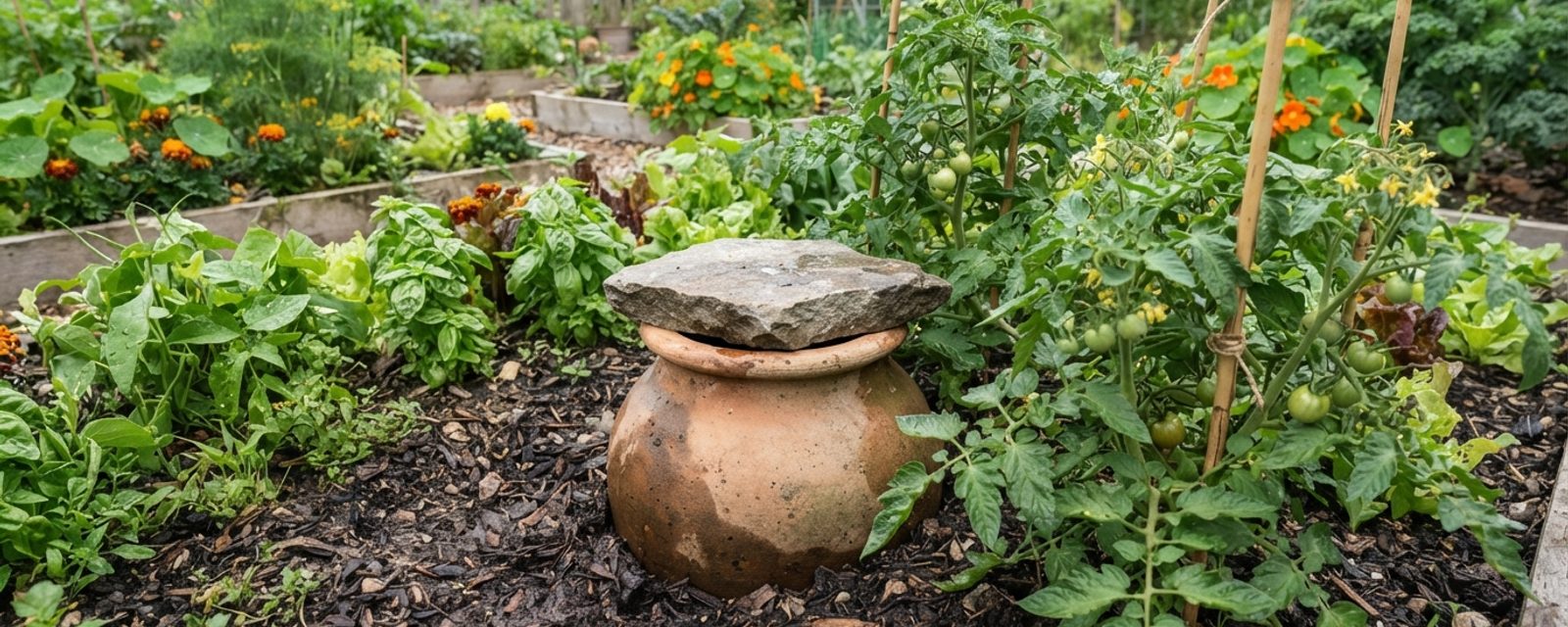
An olla (pronounced "oy-ya") is an unglazed clay or terracotta vessel, buried in the ground near a plant's roots so that only its neck sits above the soil surface, then filled with water. Unlike a drip line or a wicking reservoir, it has no moving parts, no tubing and no mechanism beyond the pot itself. The entire system depends on one physical property: the clay is left unglazed, which means its walls are porous.
Water sitting inside the olla slowly finds its way through those pores and into the surrounding soil. What makes an olla more than a slow leak is that the rate of seepage isn't fixed, it responds to the soil around it. As one horticultural source describing the mechanism puts it, "the plant's roots 'pull' the water out of the olla if the soil is dry," while "if the soil is wet from rainfall or surface watering, the water remains in the olla until the surrounding soil dries." That pulling force is soil moisture tension: dry soil particles hold water tightly and exert a stronger draw across the clay wall, so seepage speeds up; wet soil already holds water and exerts little draw, so seepage all but stops.
The result is a passive feedback loop rather than a schedule. Nobody sets a timer and nobody decides how much to release, the soil's own dryness does that, continuously, for as long as there's water in the pot. That's a genuinely different mechanism from the drip kits, capillary matting and self-watering reservoirs covered in the holiday watering systems guide, all of which move water on a timer, a wick, or a fixed reservoir gradient rather than in direct response to soil moisture tension.
Building or buying one
The DIY version: two terracotta pots
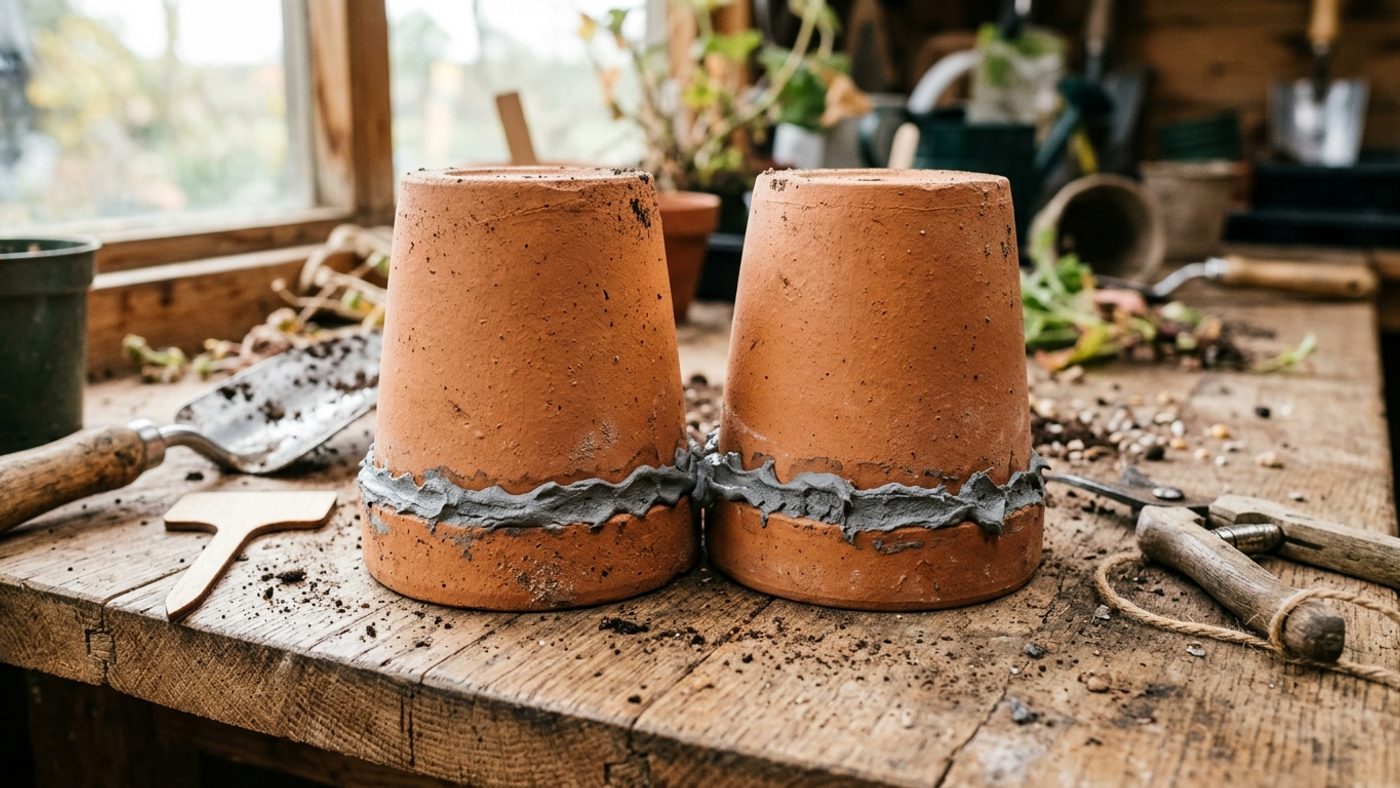
The standard homemade olla uses two ordinary unglazed terracotta plant pots of matching size, glued base-to-base.
- Choose two unglazed terracotta pots of the same diameter. This is the one non-negotiable: they must be plain fired clay with no glaze, paint or sealant on the inside or outside.
- Seal the drainage holes. Every pot has at least one hole in the base, plug it with waterproof silicone sealant, or a similar exterior-grade adhesive/sealant. Apply it only to the hole itself and a narrow ring immediately around it, not smeared across the wider base, the whole point of the pot is to leave every other part of the clay open to the soil, so keep sealant off any surface that isn't the hole or, in the next step, the rim. Let it cure fully.
- Glue the two pots base-to-base, rim to rim, so the two open mouths face outward in opposite directions, one becomes the top opening for filling, the other stays sealed against the soil below. Run a bead of silicone sealant around the rim only and let it cure completely; this is the joint that has to hold water pressure once buried.
- Leave (or create) a small fill opening at the top rim, sized to take a jug spout, or use the pot's own open neck as the fill point.
- Bury the assembled vessel near the plants it will serve, packing soil firmly against the sides to avoid air pockets, leaving roughly the top 1–2 inches of the neck above the soil surface.
- Fill with water and cap the opening loosely, a flat stone, saucer or tile keeps debris, insects and rainfall dilution out while still allowing refilling.
Buying a purpose-made olla
UK terracotta potteries also make and sell unglazed clay vessels purpose-built as ollas, search "olla irrigation pot" or "terracotta irrigation pot" to find them, usually as a single-piece bulb shape with a narrow neck rather than two glued pots. They cost more than a pair of ordinary plant pots and some silicone sealant, since they're a specialist, hand-made piece rather than mass-produced stock, but they skip the gluing and hole-sealing steps entirely and remove the DIY seal as a point of failure. The buried mechanism is identical either way.
Sizing and spacing
There's no single correct size, the right olla for a bed depends on how many plants it needs to serve and how deep the root zone is. As a starting point:
| Olla type | Burial depth (neck exposed) | Spacing between ollas |
|---|---|---|
| Standard-size olla | Bury so 1–2 inches of neck remains above soil | Every 2–3 feet |
| Larger olla (2+ gallon capacity) | Bury so 1–2 inches of neck remains above soil | Every 3–4 feet |
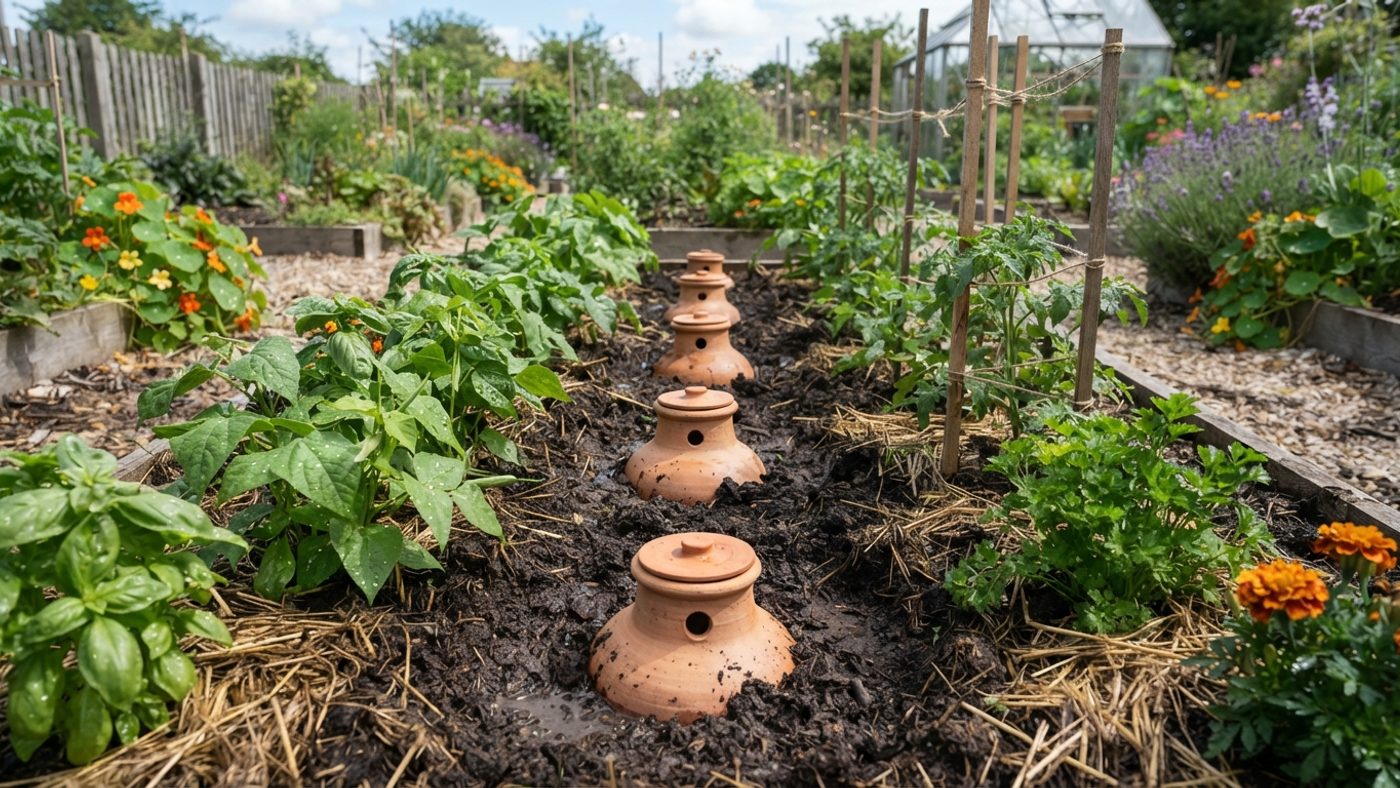
Pack the soil firmly around the buried body to eliminate air gaps, which otherwise create uneven seepage and dry pockets against the clay wall. In loose or deep soil, a saucer or drainage tray placed under the olla stops it from settling or tipping over time.
A standard olla's roughly 2–3 foot spacing above is really describing its coverage radius, so for a single deep-rooted plant like a tomato, one standard olla positioned close to its base sits well within that radius and is usually enough on its own. A row of smaller plants spaced closer together than that radius is better served by spacing ollas through the row at the intervals above and letting each one cover its own patch, rather than trying to reach every plant from a single central pot.
What doesn't work: glazed or sealed pots
An olla only functions because unglazed clay is porous. A glaze is, by design, a fired-on glass coating that seals the surface, that's precisely what makes glazed pots waterproof and suitable for holding compost without leaking. Bury a glazed pot and fill it with water, and it will simply hold water indefinitely with no meaningful seepage, because there are no open pores for soil moisture tension to draw through. The same applies to terracotta that's been painted, varnished or treated with a waterproofing sealant on its outer or inner surface, any coating that blocks the pores defeats the entire mechanism. For an olla to work at all, the clay body itself has to be exposed and unsealed everywhere it contacts soil.
Honest limits: what an olla won't do
An olla delivers water slowly, in a small radius, from a small reservoir. It is not a substitute for planning around a genuine long dry spell, and it is not designed as an unattended holiday watering solution, a buried pot with a few litres of capacity will run dry well before a week or two away ends, especially for thirsty, fruiting plants like tomatoes in a hot spell. For watering while away, the mechanical options, capillary matting, drip kits and self-watering reservoirs, covered in the holiday watering systems guide are built for that specific problem and shouldn't be replaced with ollas for that purpose.
There's also a real soil-type caveat. An olla's ability to spread water out depends on the surrounding soil actually letting water move through it. Ollas are "best suited for coarse-textured and/or sandy soil," and soil with a high clay content "does not dissipate water well", meaning in heavy clay, water can pool close to the pot wall rather than spreading evenly outward to the root zone. This isn't a reason to rule ollas out in clay soil altogether, but it is a reason to expect less even coverage than in a lighter, more free-drainingSoil that lets water pass through quickly rather than pooling, so roots aren't sitting in wet ground after rain. Full definition → bed, and to check the soil around the olla periodically rather than assuming even distribution.
Fired clay left wet and buried through a Scottish winter is also a real frost-crack risk: water held in the pores of a saturated, unglazed pot expands as it freezes, and a hard frost can split the wall the same way it splits an unprotected terracotta plant pot left outdoors over winter. Lift ollas out, empty them, and store them somewhere frost-free once the growing season ends, rather than leaving a full pot buried through winter.
Over a full growing season, the inside of the reservoir can also grow algae in the sun and pick up a chalky mineral film from tap water, both of which are worth an occasional scrub with a stiff brush when refilling, a clogged, scaled interior surface sheds water into the soil less evenly than a clean one.
Watering at soil level rather than over the leaves is a genuine plus alongside all of this: foliage stays dry, which matters for anything prone to fungal disease in a damp climate, since standing moisture on leaves is what most leaf and blight infections need to take hold. The trade-off is that the damp soil directly around an olla is also good slug and snail habitat, the same way any consistently moist ground is, so it's worth checking nearby seedlings and low leaves rather than assuming an olla is risk-free simply because the watering itself is tidier.
The honest Scottish angle: even moisture, not water saving
Ollas were developed for hot, arid climates, and the case usually made for them is water conservation, burying the reservoir cuts evaporation loss compared with surface watering, which matters where water is scarce and summers are long and dry. That's not really Scotland's situation: on the general physics alone, a cooler climate with far less sustained direct sun loses less water to evaporation regardless of watering method, so the pressure to conserve water that drives olla adoption elsewhere doesn't carry over in the same way. An olla marketed to a Scottish gardener primarily as a water-saving device would be overstating its case.
What does carry over is something different: even moisture rather than saved water. An olla's self-regulating seepage, slowing as the soil around it stays wet, speeding up as it dries, releases water continuously in small amounts rather than in the large, occasional doses that both a watering can and rainfall tend to deliver, and that continuous top-up is a close match for the RHS's own prevention advice on blossom end rot and fruit splitting: a consistently moist root zone, without the dry-then-soaked swings. A garden that gets its water from a mix of hand-watering and whatever rain happens to fall is prone to exactly that kind of swing, a dry spell followed by a heavy downpour, or a few missed days followed by a thorough catch-up soak, which is where an olla placed near the root zone can help most, independent of whether it's saving any water.
Tomatoes grown under cover in a greenhouse or polytunnel are a good example of where this applies: there's no rain reaching the soil at all, so every drop comes from hand-watering or a system, and a missed or rushed watering session is a real, ordinary occurrence rather than a rare one. An olla's steady background seepage between waterings smooths over exactly that gap.
Olla pots aren't a fringe idea in the UK, either: they featured among the sustainability measures of the Freedom from Torture Garden at the RHS Chelsea Flower Show 2024, listed as "clay olla pots for tactical in-ground irrigation."
Common questions
Do ollas work in Scotland's climate?
Not for the reason they're usually recommended. The water-saving case for ollas is built around hot, dry climates, and that pressure is much weaker here. What still applies is the even-moisture effect, which is useful for watering-sensitive crops like tomatoes regardless of climate.
Can I use an olla in a raised bed or a large container instead of open ground?
Yes, the mechanism doesn't care whether the surrounding soil is in open ground or contained, a raised bed or a large enough pot works the same way, as long as there's enough depth and volume of soil around the olla for water to actually spread into. It's a poor fit for a small, shallow container, where there's barely any soil mass to regulate against.
Can I use a glazed plant pot as an olla?
No. The mechanism depends entirely on the clay being unglazed and porous so water can seep through the walls. A glaze, paint or waterproof sealant blocks those pores and stops the pot from releasing water into the soil at all.
How often do I need to refill an olla?
There's no fixed interval, it depends on the olla's size, how thirsty the plants around it are, and the weather. Check the water level once a week to begin with, then adjust: a hot spell will drain it faster, a cool damp stretch will barely touch it. Topping up on what you find, rather than a fixed schedule, matches how the pot actually loses water.
Will an olla work in clay soil?
Ollas are best suited to coarse-textured or sandy soil. Soil with high clay content doesn't dissipate water from the olla as well, which can mean water pooling near the pot rather than spreading evenly to the root zone. It's a real limiting factor worth checking for, not a reason clay soil rules ollas out entirely.
Can an olla water my garden while I'm on holiday?
Not reliably for anything beyond a very short absence. An olla holds a small volume of water and releases it slowly and locally, it isn't designed to cover a genuine multi-day or multi-week absence unattended. For that, see the holiday watering systems guide for options built specifically for extended time away.
Do I need to do anything with my olla over winter?
Yes, empty it and lift it out of the ground before the first hard frosts. A saturated, unglazed pot left buried over a Scottish winter is at real risk of cracking as the water held in its walls freezes and expands, the same failure mode as any unprotected terracotta pot left outdoors. Store it somewhere frost-free and rebury it the following spring.
Sources
4 sources, recorded with what each was used for
- RHS: Blossom End Rot: The cause of blossom end rot (calcium transport disrupted by irregular water flow), the container risk factor, and the "keep soil consistently moist" / "water twice a day rather than once" prevention advice
- RHS: Tomatoes — fruit splitting and cracking: The cause of fruit splitting/cracking (variable water supply and fluctuating temperatures), the note on growing bags/pots and heavy rain, and the "constant level of soil moisture" recommendation
- RHS: Freedom from Torture Garden, RHS Chelsea Flower Show 2024: The Chelsea 2024 mention of olla pots as a sustainability feature
- University of California Agriculture and Natural Resources: "The Coastal Gardener" — Olla Irrigation: The porosity/soil-moisture-tension mechanism, burial depth and spacing figures, soil-type/clay limitation, and general DIY/maintenance guidance