
You dug the bed, raked it level, sown your carrots or lettuce, and the next morning there's a shallow scrape in the soil, or worse, an actual deposit sitting where your seedlings should be coming up. If this is why you're here, you're not imagining it and you're not doing anything wrong. Cats are drawn to exactly this kind of soil, and there are specific, tested ways to make your beds far less appealing to them.
If you want the short version: physically covering the bare soil, chicken wire, mesh, or fleeceA lightweight, breathable fabric laid or draped over plants to trap a little warmth and keep off frost, wind and some flying pests. Full definition → laid flat, or twigs pushed in close together, stops a cat digging at all, works on the first day, and costs little or nothing if you've already got any of that lying around. Everything else below (scent, sprinklers, plants) is worth adding on top for the areas a physical cover can't reach, not a substitute for it.
Why cats go for freshly dug soil specifically
It's the same instinct that makes a litter tray work: cats look for loose, dry, diggable ground to toilet in. The RHS notes that cats "dislike wet soil, preferring loose, dry earth and mulchA layer of material spread over the soil around plants to suppress weeds, retain moisture, and improve soil structure as it breaks down. Full definition →," which is why a bed you've just forked over and raked to a fine tilthThe crumbly, fine texture of well-prepared soil, achieved by raking the surface, that small seeds are typically sown into. Full definition → is far more attractive to a passing cat than the same patch of ground once it's planted up.
This matters because it means the vulnerability is temporary, not a permanent feature of that bed. A newly sown row of carrots or a freshly turned patch of soil is at its most tempting in the days and weeks before germinationA seed sprouting: breaking dormancy and putting out its first root and shoot, given the right warmth and moisture. Full definition →, while the surface stays bare and loose. Once seedlings are up and starting to canopy over, or once you've planted out and mulched, the same ground stops looking like an invitation. That tells you where to concentrate effort: the window right after digging or sowing, not the bed forever after.
Physical barriers: the most reliably effective option
Across the sources, physical deterrents come out ahead of anything you spray or sprinkle on, because a cat can't simply wait them out or get used to them.
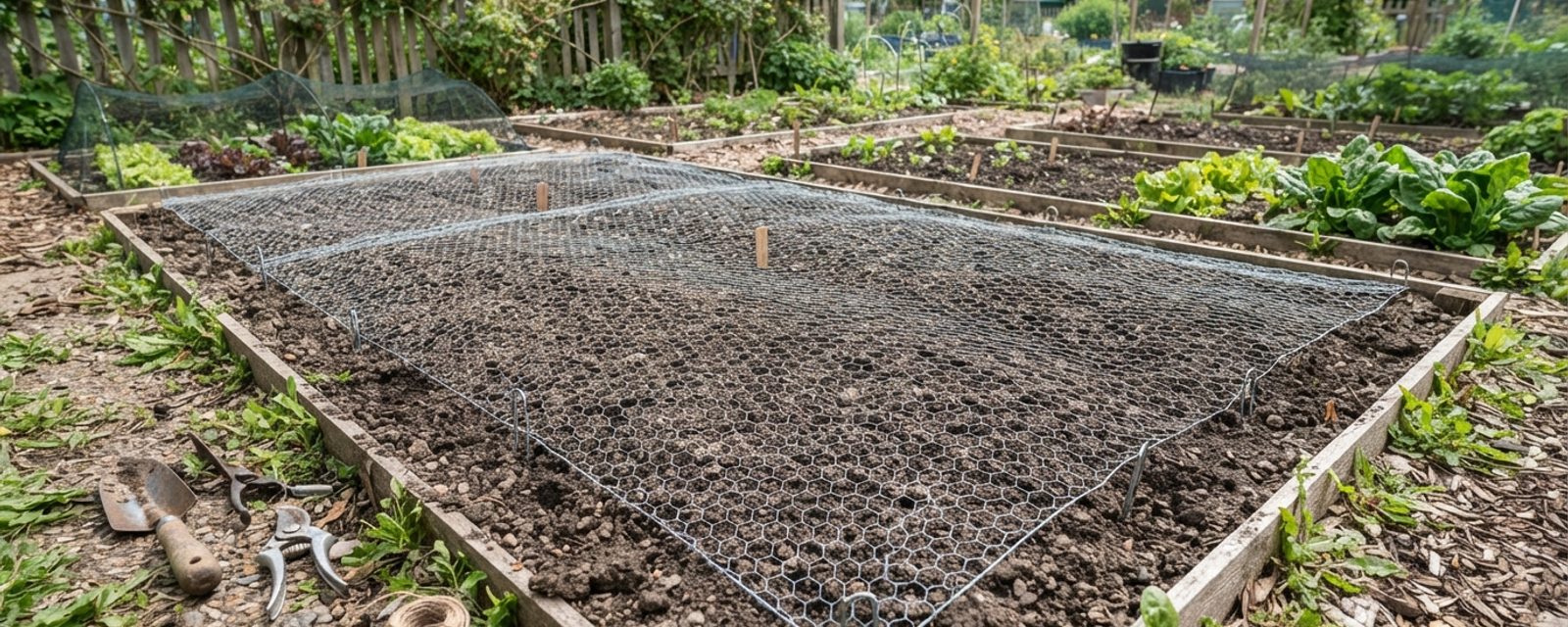
- Chicken wire or mesh laid flat over the soil surface, threaded between and around your plants. Cats dislike the feel of wire underfoot and can't dig through it to get to the soil beneath. Leave it in place until seedlings are established, then lift it away.
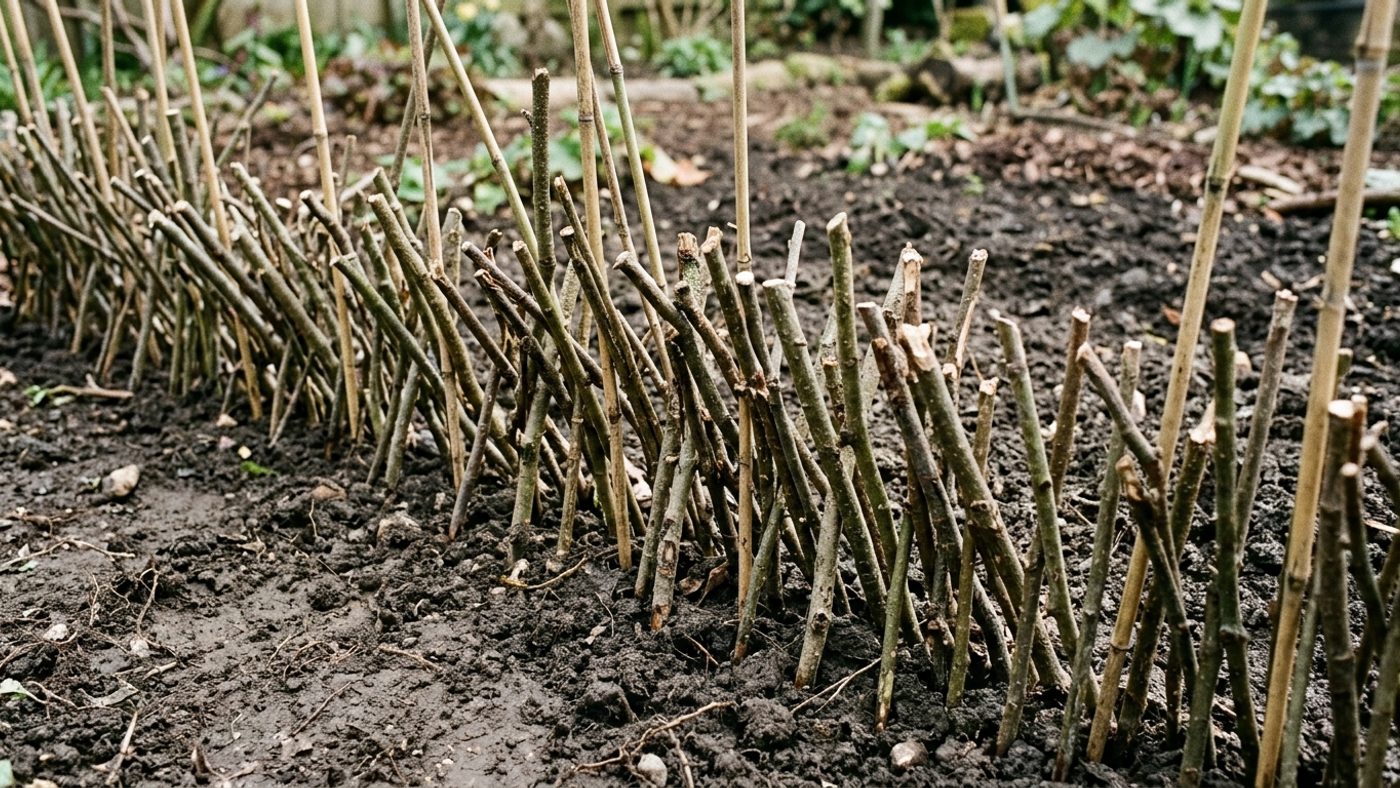
- Twigs or short canes pushed into bare soil, spaced closely enough that there's no clear patch left to dig. Cheap, quick, and works well for smaller sown areas.
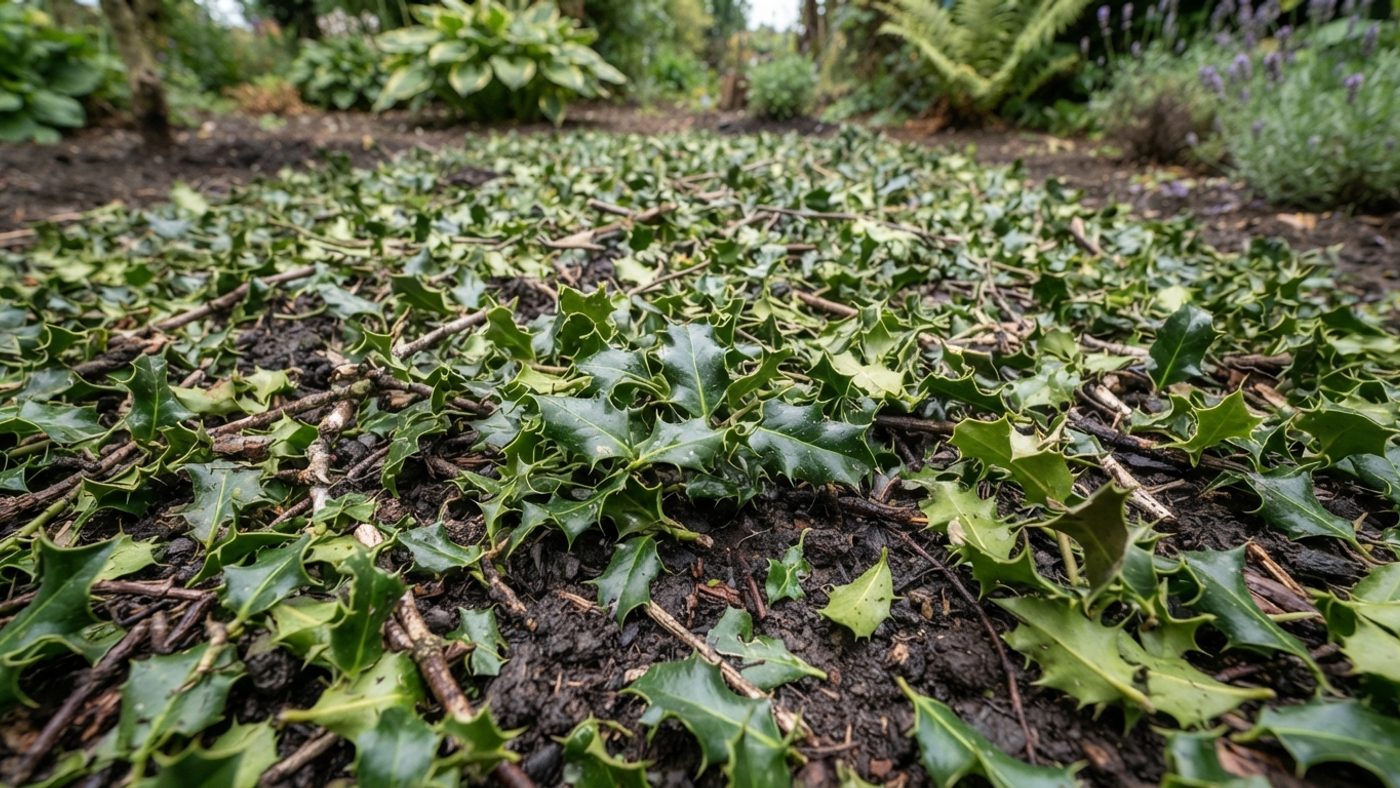
- Prickly mulch, holly clippings, pinecones, or similar spiky material spread over the surface, makes the ground uncomfortable to walk on or dig into.
- Fine mesh or fleece pegged over a bed while seed is germinating does double duty: it's already a common way to keep slugs and early-season cold off young seedlings, and the same cover stops a cat getting to the soil underneath at all.
- Dense planting. The RHS points out that closely planted borders simply remove the bare soil cats are looking for in the first place, as much a long-term prevention strategy as a fix for an existing problem.
The RHS's own guidance on cats as garden pests notes that netting can protect small areas but that "cats' agility limits fencing effectiveness" for anything larger, so barriers work best on beds and rows, not as a boundary around the whole garden.
One thing worth checking before you commit to mesh everywhere: fine mesh and netting can also trap or obstruct hedgehogs and ground-feeding birds if it's pegged loosely or left up long after it's needed. Keep it flat and taut against the soil, and lift it once the bed no longer needs protecting, rather than leaving it as a permanent fixture.
Scent deterrents: honestly, a mixed bag
Scent-based repellents are the most commonly recommended option, and the most overstated. The RHS lists repellent products sold under names like Cat-a-Pult, Vitax Stay Off, and Vapet Get Off, most working on pepper powder, plant oils, or a chemical scent cats find unpleasant, but is blunt about their limits: "repellents can be washed off by rain and often give only short-term protection." Scotland's west and north are among the wettest parts of the UK, with Met Office monthly summaries regularly recording Scotland getting more rain than other UK regions in the same period, so treat any scent deterrent as something you'll be topping up after every wet spell, not a fix-and-forget solution.
| Scent deterrent | Roughly how often to reapply |
|---|---|
| Commercial repellent granules/spray | After every rain, or weekly even if dry |
| Citrus peel | Every 2–3 days, it dries out and loses scent fast |
Citrus peel scattered over soil is a common home remedy cats are said to dislike, but decomposing peel can also attract flies and other pests to a vegetable bed, so it's more upkeep for less certain result than a physical barrier.
Coffee grounds need a specific warning, not a recommendation. Some gardening advice suggests scattering used coffee grounds as a cat deterrent, and cats may well be put off by the smell. But coffee grounds still contain caffeine, and caffeine is genuinely toxic to cats and dogs if ingested, the ASPCA lists coffee among the substances whose danger comes from methylxanthine content, with possible effects including vomiting, diarrhoea, an abnormal heart rhythm, tremors, seizures, and in serious cases death. A cat sniffing around a bed is unlikely to eat a handful of grounds, but a dog in the same garden might, and grounds mixed into soil a child could reach are an unnecessary risk. A bed protected with physical barriers and other scents does the same job without that risk, so coffee grounds aren't worth using here.
Mothballs are worse, and shouldn't be used at all. They turn up in older cat-deterrent advice, but mothballs are a pesticide product containing naphthalene or paradichlorobenzene, both toxic if a cat, dog, or child ingests one or breathes the fumes over time, never scatter them in a garden, and especially not near anything you're growing to eat.
Commercial cat-deterrent sprays sit somewhere in between, some gardeners find them helpful, but like other scent repellents they wash out in rain and need reapplying, and evidence for how well any of them work under real garden conditions is thin.
Motion-activated sprinklers
A sensor-triggered jet of water is one of the more genuinely effective deterrents available, since it startles the cat and creates an unpleasant association with the bed without you having to be there. The RHS lists motion-activated water sprayers connected to a hosepipe as a management option, alongside ultrasonic devices that emit a high-frequency sound cats find unpleasant, though the RHS is notably less confident about ultrasonic units, since some cats simply get used to the sound over time and stop reacting to it, which is a real limitation worth knowing before paying for one.
Sprinklers aren't without drawbacks either. They cost more than mesh or twigs, the spray on cheaper models can be too weak to bother a determined cat, small or fast cats can slip through the trigger zone before the jet fires, and you or anyone else walking past at the wrong moment will get sprayed too. They're worth it for a bed that's under repeated attack, less so as a first thing to try.
Deterrent plants: real plants, debated results
Coleus canina, sold and marketed as the "scaredy cat plant" (now more correctly labelled Plectranthus ornatus by the RHS), is a real plant with a genuine reputation for repelling cats through the unpleasant smell it gives off when touched or brushed against. The RHS is honest that results vary, "some cats ignore this deterrent entirely." It's tender and frost-sensitive, and Scotland's winters are cold and wet enough that it won't survive left out in a bed, grow it in a pot you can bring under glass or indoors from autumn rather than planting it out permanently.
Rue (Ruta graveolens) is sometimes recommended on the same logic, a strongly aromatic plant cats are said to avoid. The RHS's own plant profile for common rue describes its aromatic, blue-grey foliage and doesn't itself make a cat- or pest-repellent claim; that reputation is better treated as garden folklore than an established fact. Rue also carries a real caution of its own: the RHS profile flags it as toxic to skin in sunlight, for people and for dogs, so it needs gloves to handle and shouldn't go somewhere pets or children brush past it regularly.
Treat both plants as a possible extra layer rather than a solution on their own, plant them at the edge of a bed you're already protecting some other way, not instead of it.
Comparing the options
| Method | Cost | Effort | How reliable |
|---|---|---|---|
| Chicken wire / mesh laid flat | Low | Low-medium (lift once seedlings established) | High, cats can't dig through it |
| Twigs/canes in bare soil | Very low | Low | High for small sown areas |
| Prickly mulch (holly, pinecones) | Low | Low | Good, especially combined with barriers |
| Citrus peel | Very low | High (frequent reapplication) | Low, short-lived, can attract pests |
| Commercial scent sprays | Low-medium | Medium (reapply after rain) | Mixed, evidence limited |
| Motion-activated sprinkler | Medium-high | Low once installed | Good, but weak on small cats/cheap units |
| Deterrent plants (Coleus canina, rue) | Low-medium | Low | Debated, some cats ignore them entirely |
Coffee grounds and mothballs don't appear in this table, both carry a real toxicity risk to cats, dogs, or children, so neither is a recommendation here, whatever else you read about them elsewhere.
Why this matters more for vegetable beds specifically
Beyond the annoyance of a dug-up seed row, there's a real food-safety reason to keep cats off ground you're growing food in. Cat faeces can carry Toxoplasma gondii, the parasite that causes toxoplasmosis, and NHS guidance names "the poo of infected cats" and "soil that's been contaminated by cat poo" directly as transmission routes, alongside undercooked meat. You cannot catch it from stroking a cat, the risk is specifically about contact with contaminated soil or produce grown in it.
For most healthy adults toxoplasmosis causes mild or no symptoms. The real concern is for pregnant women, where infection "can cause miscarriage" and, if it spreads to the baby, serious complications, and for anyone with a weakened immune system, where it can cause problems affecting the eyes, brain, heart, or lungs. Advice for anyone gardening or growing food is straightforward: wear gloves while gardening or handling soil, wash your hands thoroughly afterwards, and wash fruit and vegetables thoroughly to remove any trace of soil before eating them, all of which reduces the risk regardless of whether cats have used a particular bed.
This is a genuine reason to be more careful about vegetable beds than ornamental borders, a cat sunbathing in a flower bed is only a nuisance, but the same behaviour on a carrot bed has a real, if generally low, health dimension attached to it, worth factoring into how much effort you put into keeping cats off edible ground specifically.
A neighbour's cat, not your own
On an allotment, or in a garden backing onto several others, the cat digging up your beds often belongs to someone else entirely, sometimes several households' worth of outdoor cats sharing the same patch of ground. Every deterrent above works on the bed itself, not on the animal or the person responsible for it, so none of them need the owner's cooperation or even their knowledge. If you do know whose cat it is, a friendly word is usually enough, most owners would rather know than not, and a covered litter tray or an accessible patch of loose soil in their own garden often solves it from that end too. Whatever you try, keep it to methods that only make the soil unappealing, harming, trapping, or poisoning someone else's cat isn't just unneighbourly, it's against the law.
Give the cat somewhere else to go
A cat determined enough, or hungry enough for a toilet spot, will eventually test a barrier that a less motivated animal would avoid on smell alone, no single method here works on every cat, every time. Where you have the space, the single most effective addition to physical barriers isn't another deterrent at all: it's a decoy patch of loose, dry, welcoming soil somewhere well away from anything you're growing to eat. Redirecting the behaviour tends to outlast blocking it, since the cat still has somewhere it's allowed to do what it was always going to do anyway.
Is this a bigger problem in Scotland?
There's no evidence that Scottish gardens face a fundamentally different scale of this problem than gardens anywhere else in the UK, it's a widespread issue wherever outdoor and semi-feral cats share space with gardeners, not something with clear Scotland-specific data behind it, and it would be dishonest to claim otherwise.
The genuine Scottish angle is the rainfall: any scent deterrent's own reapply guidance is usually written with a UK-wide average in mind, and Scotland's wetter weather means that's a starting point here, not the ceiling. Budget for topping up sooner, and lean more heavily on the physical barriers that don't care about the weather at all.
Common questions
Will cats damage my vegetable bed permanently, or is this just while it's freshly dug?
It's mainly a risk while the soil is bare and loose, right after digging and before germination or canopy closes over. Once plants are established and the ground is no longer soft, open soil, most cats lose interest in it as a toilet spot.
Is chicken wire safe to leave under growing vegetables?
Yes, lay it flat on the surface between and around your plants rather than burying it, and lift it once seedlings are big enough that the bare-soil problem has passed. It doesn't need to stay down permanently.
Should I use coffee grounds to keep cats off my beds?
It's better avoided. Coffee grounds still contain caffeine, which is toxic to cats and dogs if eaten, so scattering it around a garden any pet has access to carries a real risk that physical barriers and other scent deterrents don't.
Can I actually catch anything from a cat using my vegetable bed?
Cat faeces can carry the parasite that causes toxoplasmosis, and it can contaminate soil and produce grown in it. Most healthy adults have mild or no symptoms if infected, but it's a genuine concern for pregnant women and anyone with a weakened immune system, wear gloves while gardening, wash your hands afterwards, and wash all produce thoroughly before eating it.
Do motion-activated sprinklers actually work?
They're one of the more effective options, but not perfect, cheaper models can have a weak spray that doesn't bother a determined cat, small cats can move too fast for the sensor, and you'll get sprayed too if you're not paying attention.
Is Coleus canina ("scaredy cat plant") worth planting?
It's a real plant with a genuine reputation for repelling cats through its smell, but results are inconsistent, some cats avoid it, others ignore it completely. It's also tender and needs winter protection in Scotland, so it's best treated as one extra layer alongside physical barriers rather than a fix on its own.
What if it's not my cat causing the problem?
It usually isn't, especially on an allotment or in a terraced garden. Every deterrent above works on the bed itself, not on a specific animal, so you don't need to know or confront the owner to use them. If you do know whose cat it is, a friendly conversation is often all it takes.
Sources
6 sources, recorded with what each was used for
- RHS: Cats: Why cats target loose, dry soil; physical barriers, netting limitations, repellent products and their rain/short-term limitations, ultrasonic devices and motion-activated sprayers, Plectranthus ornatus as a deterrent plant
- RHS: Plectranthus ornatus: Confirms current botanical name and synonym status for the plant sold as Coleus canina/"Scaredy Cat"
- RHS: Ruta graveolens (common rue): Plant description, growing conditions, and toxicity warning for skin/pets
- NHS: Toxoplasmosis: Transmission via cat faeces and contaminated soil, risk to pregnant women and immunocompromised people, prevention advice (UK-wide NHS guidance, not Scotland-specific)
- ASPCA: People Foods to Avoid Feeding Your Pets: Confirms caffeine/coffee toxicity to cats and dogs and its symptoms (a US veterinary poison-control authority; caffeine's toxicity to cats is basic animal physiology, not a US-specific finding)
- Met Office: Weather and climate summaries: The recurring pattern of Scotland recording higher rainfall than other UK regions in the same period, used for the reapplication-frequency point on scent deterrents