
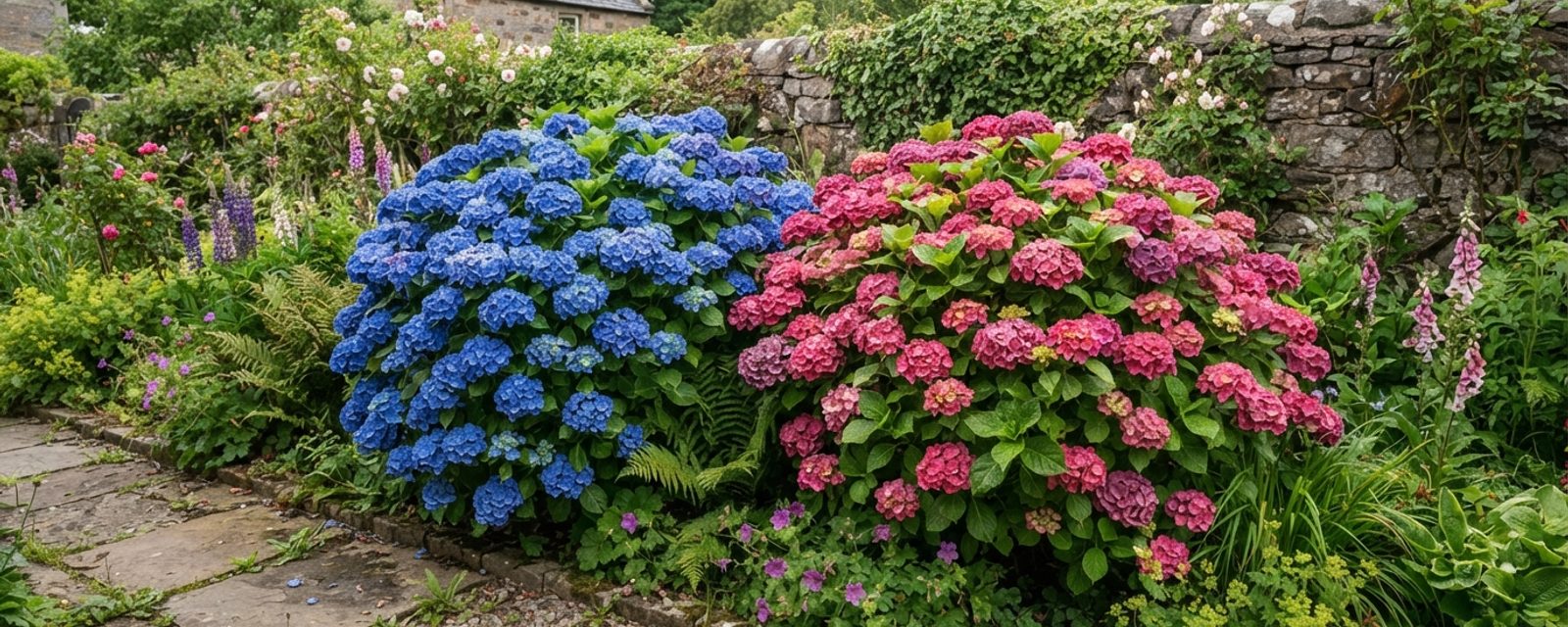
A hydrangea that flowered blue last year and comes up pink this year hasn't been swapped by a mischievous neighbour, and a hydrangea that stubbornly refuses to turn blue no matter how much "blueing" powder gets tipped around its roots isn't being fed wrong. In both cases the answer is almost always soil chemistry, and in the second case it may be that the plant genetically can't change colour at all.
This article covers the mechanism behind hydrangea flower colour, which hydrangeas it applies to, how to actually shift it, and why containers are the most dependable route to a chosen colour, including why Scottish gardens tend to find blue easier than pink. For hydrangea pruning, timing, and old-wood/new-wood technique, see Pruning Hydrangeas in Scotland, worth reading alongside this one, since a mophead that's lost its old-wood flower buds to a late frost has nothing left to show colour on, whatever the soil is doing.
It isn't pH that colours the flower, it's aluminium
The common shorthand, "acid soil makes hydrangeas blue, alkaline soil makes them pink," skips the actual mechanism and leads people to fixate on the wrong number. The pigment involved is an anthocyanin already present in the petal (technically the sepal) tissue of colour-changing hydrangeas. On its own, that pigment reads as pink to reddish-purple. It only shifts to blue when it bonds with aluminium ions taken up from the soil through the roots.
Soil pH doesn't supply that aluminium directly, aluminium is naturally present in most garden soils already. What pH controls is how available that aluminium is for the plant to absorb:
- In acid soil, aluminium is soluble, so plant roots can take it up. That aluminium reaches the flowers and binds to the pigment, and the flower turns blue.
- In neutral to alkaline soil, aluminium locks up into forms the plant cannot absorb. With no aluminium reaching the flower, the underlying pigment shows through unmodified, and the flower is pink.
- In the transitional band between those two states, some aluminium gets through but not consistently, and the result is mauve or a muddy in-between colour rather than a clean blue or pink.
The working pH bands, per RHS guidance, run roughly pH 4.5-5 for reliable blue, lightly acid to neutral soil for mauve, and alkaline soil for pink. Blue doesn't hold reliably much above pH 5.5, because that's roughly where aluminium starts locking out of solution.
| Soil pH | Aluminium availability | Resulting flower colour | What to add to get there |
|---|---|---|---|
| ~4.5-5.0 | High, freely available to roots | Blue | Aluminium sulphate (or ericaceous compost in containers) |
| ~5.0-6.0 | Partial, inconsistent | Mauve / muddy purple | Often the natural resting state of untreated soil; hard to hold a clean colour here |
| Above ~6.0, alkaline | Low, locked up, unavailable | Pink | Garden lime (calcium carbonate) to raise pH and keep aluminium locked away |
Treat these as bands, not switches. A reading of 5.3 doesn't guarantee mauve any more than 4.9 guarantees postcard blue, other factors (how much aluminium is actually present in the soil in the first place, plant age, individual cultivarA plant variety that arose or was bred under cultivation and is kept true by deliberate propagation, rather than a naturally occurring wild species. Full definition →) all affect how strongly a given pH translates into colour.
Which hydrangeas this even applies to
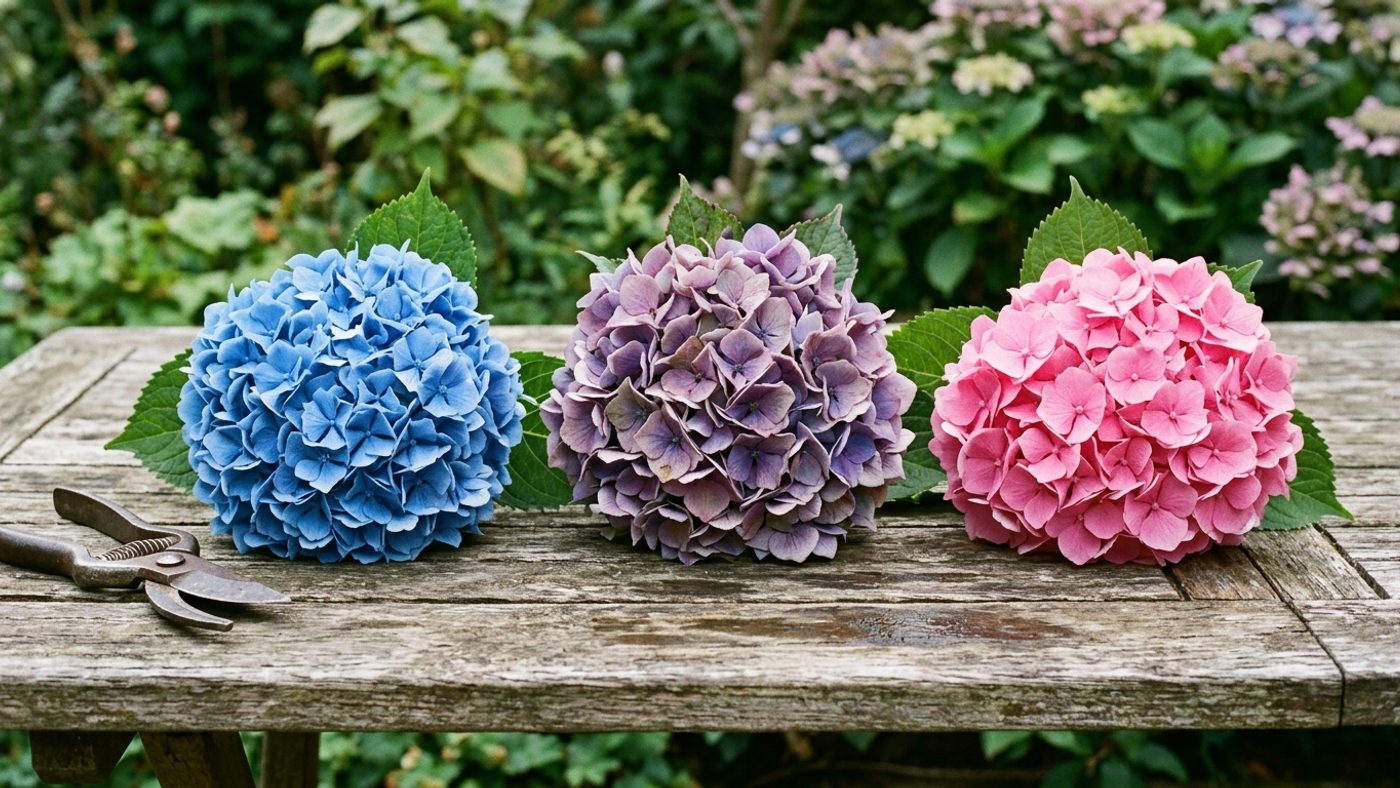
This entire mechanism only works on mophead and lacecap Hydrangea macrophylla cultivars, and on Hydrangea serrata. These are the varieties with the big round "mophead" flowerheads or the flat lacecap flowerheads, most commonly seen in Scottish gardens, well-known examples that do respond to soil chemistry include 'Nikko Blue' and 'Endless Summer'. If yours doesn't match that description, check the label before assuming the same rules apply.
It does not apply to:
- White-flowered hydrangeas, such as 'Annabelle' (a Hydrangea arborescens cultivar) and most Hydrangea paniculata varieties (the cone-shaped panicle types, including 'Limelight'). These don't carry the anthocyanin pigment that aluminium binds to, so there's nothing for the aluminium to act on. No amount of soil amendment will turn a white hydrangea blue or pink, the flowers stay white (sometimes ageing to a papery pink or tan late in the season, which is an ageing effect, not a pH effect).
- Red-flowered cultivars, per RHS guidance, which also stay their own colour regardless of soil.
- Some modern mophead cultivars bred for a fixed flower colour regardless of soil chemistry. Plant labels and breeder descriptions sometimes flag this explicitly, and no amount of aluminium sulphate or lime will override a genuine fixed-colour breeding trait.
Before spending a season adjusting soil, it's worth confirming which type is actually being grown. Trying to force colour change on a plant that's genetically fixed, whether that's a white paniculata or a fixed-colour mophead cultivar, wastes time and, in the case of aluminium sulphate, risks unnecessary root stress for no result.
Testing soil before doing anything
A home soil pH test kit is the starting point, and it's worth doing before applying anything, not after a flower comes up the "wrong" colour. For testing method, kit types, and how to read results, see Soil pH Testing and Adjustment.
One caveat matters more here than almost anywhere else in the garden: soil pH varies significantly even within a single plot. A bed next to a concrete path, an old wall, or buried mortar rubble can run noticeably more alkaline than soil ten feet away, because lime leaches out of masonry and concrete over years, the same leaching mechanism that Scotland's higher rainfall drives on a larger scale across whole gardens (see the Scottish tilt below), just concentrated here into one corner of a bed. A hydrangea planted near a driveway or foundation may sit in different soil chemistry than one in an open bed nearby, which is one of the more common reasons two hydrangeas of the same cultivar, planted a short distance apart, come up different colours. Test near the actual root zone of the specific plant, not a general reading for "the garden."
A newly bought plant can also mislead: garden centres commonly grow mophead hydrangeas in aluminium-dosed or ericaceous compost specifically to sell them blue. Planted out into ordinary garden soil, that colour can fade or shift toward pink or mauve within a season or two as the roots move into different soil chemistry, not a sign anything's gone wrong, just the plant settling into its new soil's actual pH.
Going blue: aluminium sulphate
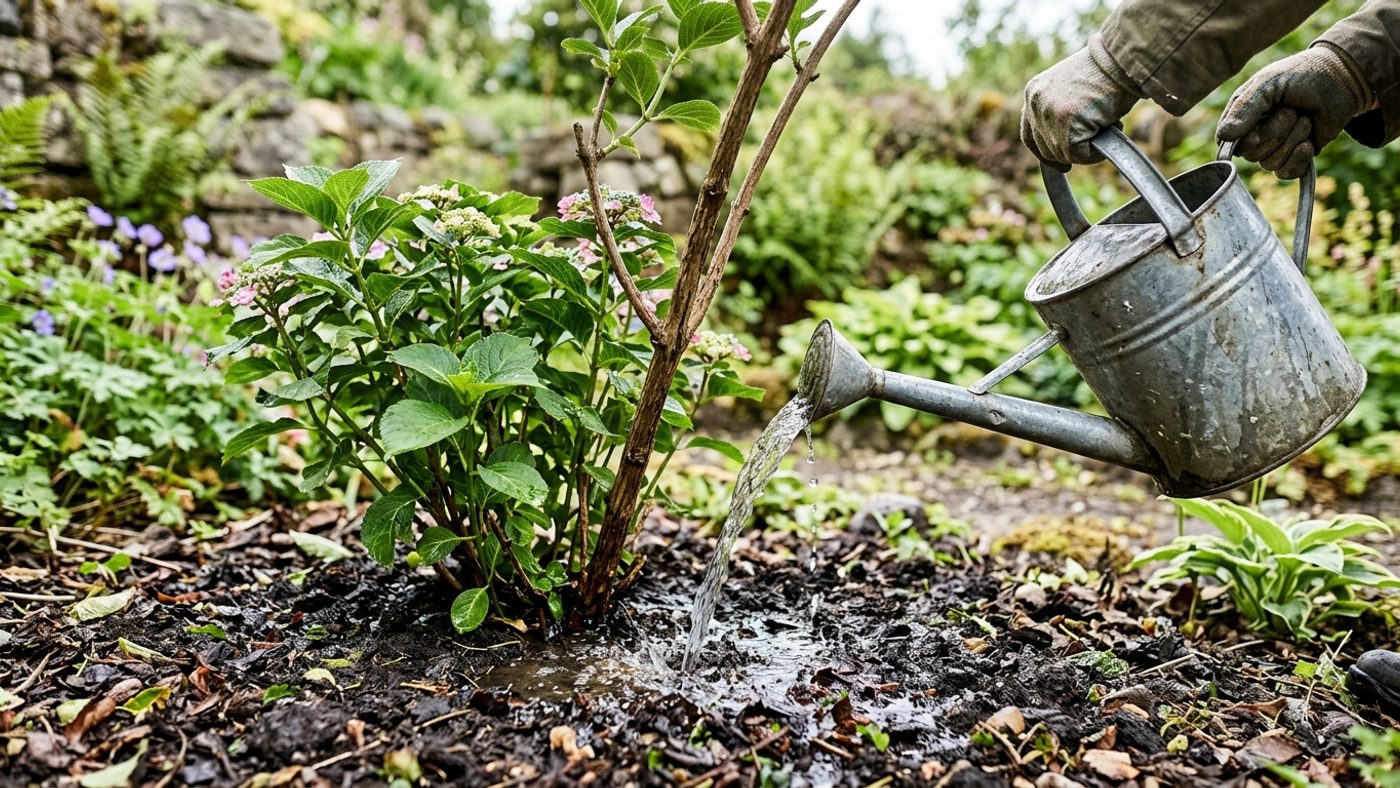
Where soil isn't already acidic enough to hold blue reliably, aluminium sulphate ("hydrangea blueing compound," sold under that description at garden centres) supplies aluminium in a form the plant can take up once the soil is acidic enough to keep it soluble. Dissolve it in water and apply around the root zone (not directly against the stem), or scatter and water in well, at whatever concentration the product's own label states rather than a generic figure, unlike garden lime, which is a standard material with a settled application rate, aluminium sulphate products vary in strength between brands, so the label is the only reliable number. Apply it as a series of smaller doses spread across the growing season rather than one large dose.
A few things worth being honest about:
- This does not work on very alkaline soil or soil with visible chalk. If the soil is heavily alkaline, aluminium sulphate on its own generally can't push it acidic enough to hold blue, a container is the more reliable route in that situation (see below).
- Overdoing it causes damage. Aluminium sulphate applied too heavily or too often can scorch roots and damage the plant rather than deepening the colour. More is not better past a certain point, and it's a real risk on already-acid Scottish soil specifically: a garden that's naturally close to the pH blue needs anyway requires far less aluminium sulphate to get there than the packet's generic dose assumes, so start with a soil test rather than the full label rate on ground that may already be halfway there.
- A high-phosphorus feed works against it. Bone meal, a common feed for roses and bulbs in Scottish gardens, and other high-phosphate fertilisers interfere with the plant's aluminium uptake, which can hold a hydrangea pink even in properly acidic soil. If blue isn't developing despite a low enough pH, check what's been fed nearby as well as what's been added to the soil.
- Handle it with care. Aluminium sulphate is not something to apply casually near other plants, pets, or a pond: it can scorch neighbouring plants, and manufacturers warn against ingestion and runoff into water. Wear gloves, keep it off foliage and away from watercourses, and wash hands after use.
- It is not instant. The soil test number can shift within weeks of applying lime or aluminium sulphate, but the flower colour doesn't follow that fast. Colour is set by aluminium uptake into new growth over a growing season, so a treatment applied this spring is unlikely to fully show in this year's flowers, expect the fuller effect the following season, sometimes over two seasons for an established plant to shift completely.
Going pink: garden lime
To push toward pink, the goal is the opposite: raise soil pH so aluminium locks up and stops reaching the plant. Ground limestone or chalk, applied at a rate of roughly 75-100g per square metre (2-3oz per square yard) in winter, is the standard approach for intensifying pink or red colouring on soil that's naturally on the acid side.
This is the harder direction to hold in much of Scotland specifically: naturally acidic ground and heavy rainfall (see the Scottish tilt below) both work against a lime application, washing it back out and letting the soil drift acid again, so holding pink in open ground here tends to need more frequent reapplication than generic UK advice, often written without Scotland's more acidic starting point in mind, assumes.
The same non-instant caveat applies here in reverse. Raising the pH number doesn't immediately purge aluminium already in the plant's system, that dilutes out gradually through new growth, so a pink conversion also plays out over a season or more rather than a single flowering.
Why the colour drifts back, and why containers are the reliable fix
Open-ground soil has a natural resting pH, set by the parent rock it formed from, its organic matter content, and the rainfall passing through it. Adding lime or aluminium sulphate shifts that pH temporarily, but the soil's underlying chemistry keeps pulling it back toward where it started. This is especially true under heavy rainfall, which leaches lime and other amendments out of the soil over time, a genuine, ongoing maintenance problem for anyone gardening in a naturally acid area and trying to hold pink, or anyone on chalky ground trying to hold blue. Treating open-ground soil for colour isn't a one-off job; it's a repeat commitment for as long as the colour matters.
Growing hydrangeas in containers sidesteps this almost entirely, because the compost is fully under control rather than sitting inside a soil system with its own chemistry and drainage pulling against it:
- For blue, use ericaceous (acid) compost, which holds a low enough pH to keep aluminium available without repeat soil treatment.
- For pink, use ordinary, neutral, or loam-based compost, with garden lime worked in if it needs nudging further alkaline.
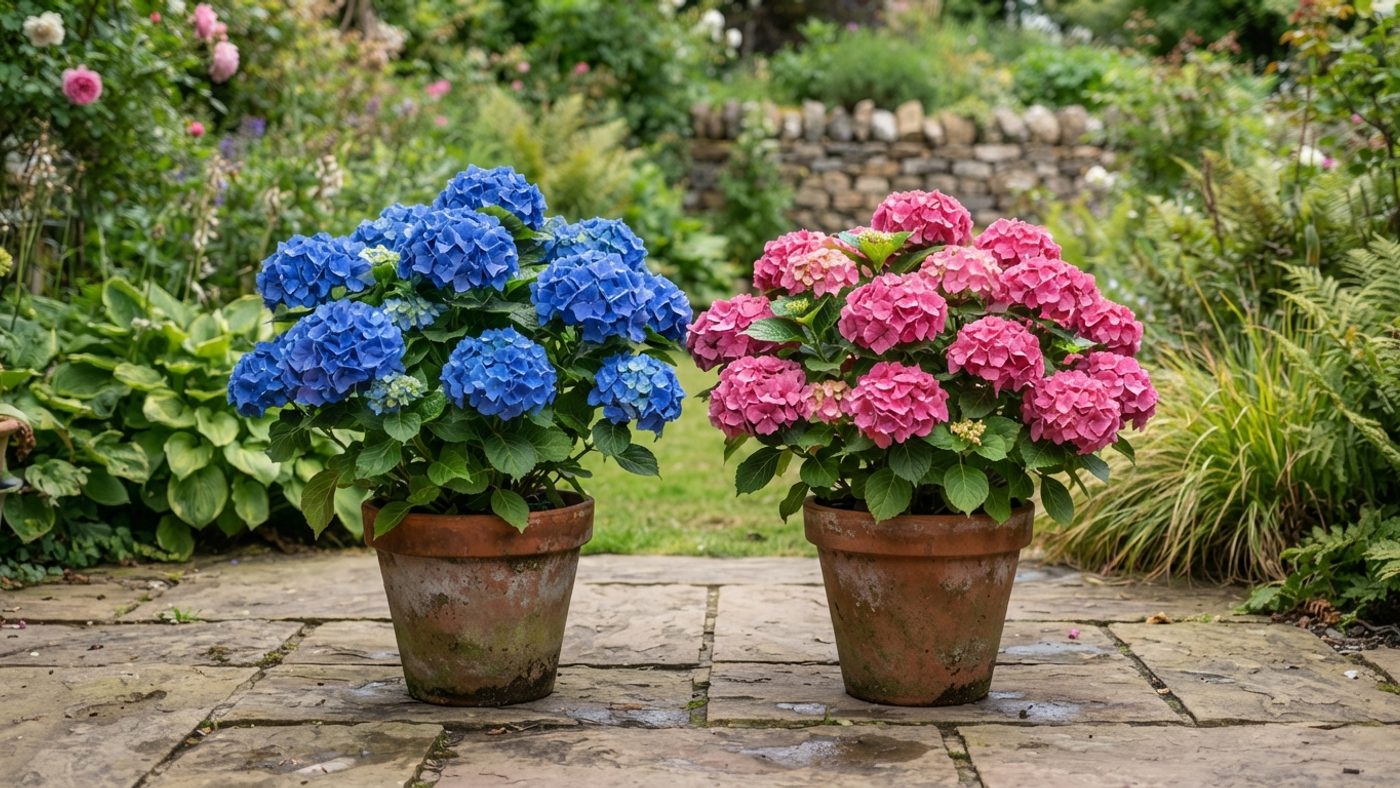
Because there's no surrounding native soil constantly leaching the container back toward a different resting pH, a containerised hydrangea holds its colour far more predictably than the same cultivar in open ground. One thing that still undermines it: hard tap water raises compost pH gradually over repeated watering, working against ericaceous compost's low pH over time. Water hardness varies by local supply rather than following a simple north-south pattern, so it's worth checking your own water provider's reported hardness rather than assuming either way. Rainwater from a water butt avoids the problem entirely and holds blue more reliably in a container than tap water does regardless of local water hardness. For anyone whose main goal is a guaranteed colour rather than working with whatever the open ground naturally favours, a container is the more reliable choice. It isn't maintenance-free forever, though: ericaceous compost's acidity fades over a year or two of watering and root activity even without hard water speeding it up, so a container plant still wants its pH checked periodically and the compost topped up or refreshed, not assumed fixed for good once potted.
The Scottish tilt: acid soil favours blue by default
Scotland's soils, taken as a whole, run more acidic and hold more organic matter than the rest of the UK. NatureScot states this directly, and it comes down largely to acidic parent rock such as granite in much of the country, high rainfall leaching calcium and magnesium out of the soil, and peaty, organic-rich ground that holds onto acidity rather than buffering it away.
That's the reverse of the classic problem in chalky parts of southern England, where alkaline soil makes pink the default and blue takes deliberate acidification to achieve.
There's real data behind how widespread that acidity is, from an SRUC survey of Scottish farm soil samples:
| Soil pH band | Share of sampled Scottish farm soils |
|---|---|
| Below pH 5.8 | Close to half |
| Above pH 6.2 | Around one in five |
Those are farmland samples rather than garden beds specifically, but they point to the same underlying geology and rainfall pattern that shapes garden soil too. The Farm Advisory Service's material on Scottish soil pH names the same driver: rainfall and drainage leaching bases out of the soil over time, requiring regular reapplication of lime just to hold a given pH rather than a one-off fix.
None of this is a guarantee for any individual garden, for the same reason covered above: soil pH varies enormously even within one plot, regardless of what the regional tendency suggests. The regional pattern explains why blue is common here without effort; it doesn't predict any one garden's result, and a home pH test on the actual bed is still the only way to know for certain.
Common questions
Why did my hydrangea change colour without me doing anything?
Most often this is a shift in soil aluminium availability that happened on its own, a new bed, added compost, nearby building work, lime leaching in from a path or wall, or the soil's pH simply settling to a different level than when the plant was first bought. A very common version of this: garden centres often grow mopheads in aluminium-dosed compost specifically to sell them blue, and that colour fades once the plant is in your own soil.
Can I use pennies, rusty nails, or coffee grounds to change hydrangea colour?
No, these are common garden myths. Pennies and rusty metal don't release aluminium in any form the plant can absorb, and coffee grounds have too small and inconsistent an effect on soil pH to reliably shift flower colour. Aluminium sulphate and garden lime are the two treatments actually documented to work.
How long does it take to change hydrangea flower colour?
Realistically a full growing season, and sometimes into a second season for an established plant. The soil pH number on a test kit can move within weeks, but the flower colour depends on the plant taking up aluminium (or losing access to it) through new root growth, which is gradual.
Why won't my hydrangea turn blue no matter what I do?
Two likely explanations: either the soil is too alkaline for aluminium sulphate alone to overcome (a container with ericaceous compost is the more reliable fix), or the cultivar is one of the white or fixed-colour types that can't change regardless of soil chemistry. Check which type is planted before assuming the treatment failed.
Is it true that Scottish gardens make blue hydrangeas easier?
As a general regional tendency, yes, see the Scottish tilt section above for the SRUC and NatureScot data behind it. It's not a guarantee for any one plot, though, so test your own bed rather than assume it.
Sources
4 sources, recorded with what each was used for
- RHS: How to grow shrubby hydrangeas — Growing Guide: pH bands for blue/mauve/pink, aluminium sulphate use, lime application rate for pink, container growing with ericaceous compost, and confirmation that white/red varieties don't change colour
- NatureScot: Scotland's soils: Statement that Scotland's soils tend to be more acidic and higher in organic matter than the rest of the UK
- SRUC: Acidic soils could be affecting production on many Scottish farms: Survey findings that close to half of sampled Scottish farm soils sat below pH 5.8, with around one in five above pH 6.2
- Farm Advisory Service Scotland: Understanding soil pH: Rainfall and leaching as drivers of ongoing soil acidification in Scotland, and the need for repeat liming rather than a one-off correction