
A back injury happens when load on the spine exceeds what the muscles, discs and joints supporting it can safely take at that moment. Three things drive that load up during gardening specifically: sustained flexion (bending forward and staying there), rotationMoving each crop family to different ground each year, on a multi-year cycle, so pests and diseases that build up in soil don't get a repeat host. Full definition → under load (twisting while carrying or lifting weight), and repetition (doing the same awkward movement dozens of times in one session without a break).
Why gardening puts your back at risk
None of this is unique to older or unfit gardeners. A joint study between Coventry University and the RHS used motion-capture technology, the kind normally used in film and medical research, to measure what digging actually does to the body, precisely because digging is such a common task across gardeners of every age and fitness level. It found that poor digging posture increases the load on the lower back by around 50%, and more than doubles the load through the shoulders, compared with good technique, and the joints under most strain are exactly the ones linked to higher long-term risk of osteoarthritis when repeatedly overloaded.
Ordinary gardening tasks concentrate all three risk factors at once. Weeding and planting put you in a stooped or kneeling position for long stretches. Digging combines forward bending with a loaded, often twisting, throw of the spade. Pruning at height adds overreach to the mix. And lifting a bag of compost or a full pot is, mechanically, no different from lifting any other heavy load badly, bend from the waist with a twist, and the spine takes the strain that the legs should have taken.
Wet, heavy ground, common in Scotland after rain, where clay soils are widespread, tends to add extra resistance to digging and lifting on top of the postural risk, meaning more force through the same joints for the same task.
Correct lifting technique
For anything heavy, compost bags, full pots, paving slabs, a loaded wheelbarrow, the same manual handling technique applies whether you're in a warehouse or a garden bed: your spine doesn't distinguish between a box and a bag of compost. The Health and Safety Executive (HSE) sets out the core steps:
- Plan the lift first. Know where the load is going before you pick it up, and clear the route.
- Get a stable base. Feet apart, one leg slightly forward, ready to adjust your footing as you lift.
- Bend knees and hips, not your back. HSE's own wording is "slight bending of the back, hips and knees at the start of the lift," not a full stoop, and not a deep squat either.
- Keep the load close to your waist for as long as possible, with the heaviest side nearest your body.
- Never twist while lifting. Keep shoulders facing the same way as your hips, and turn by moving your feet, not by rotating your spine under load.
- Look ahead, not down, once the load is secure, and move smoothly, no jerking or snatching.
- Put it down first, then slide it into position, rather than trying to place it precisely while still holding the weight.
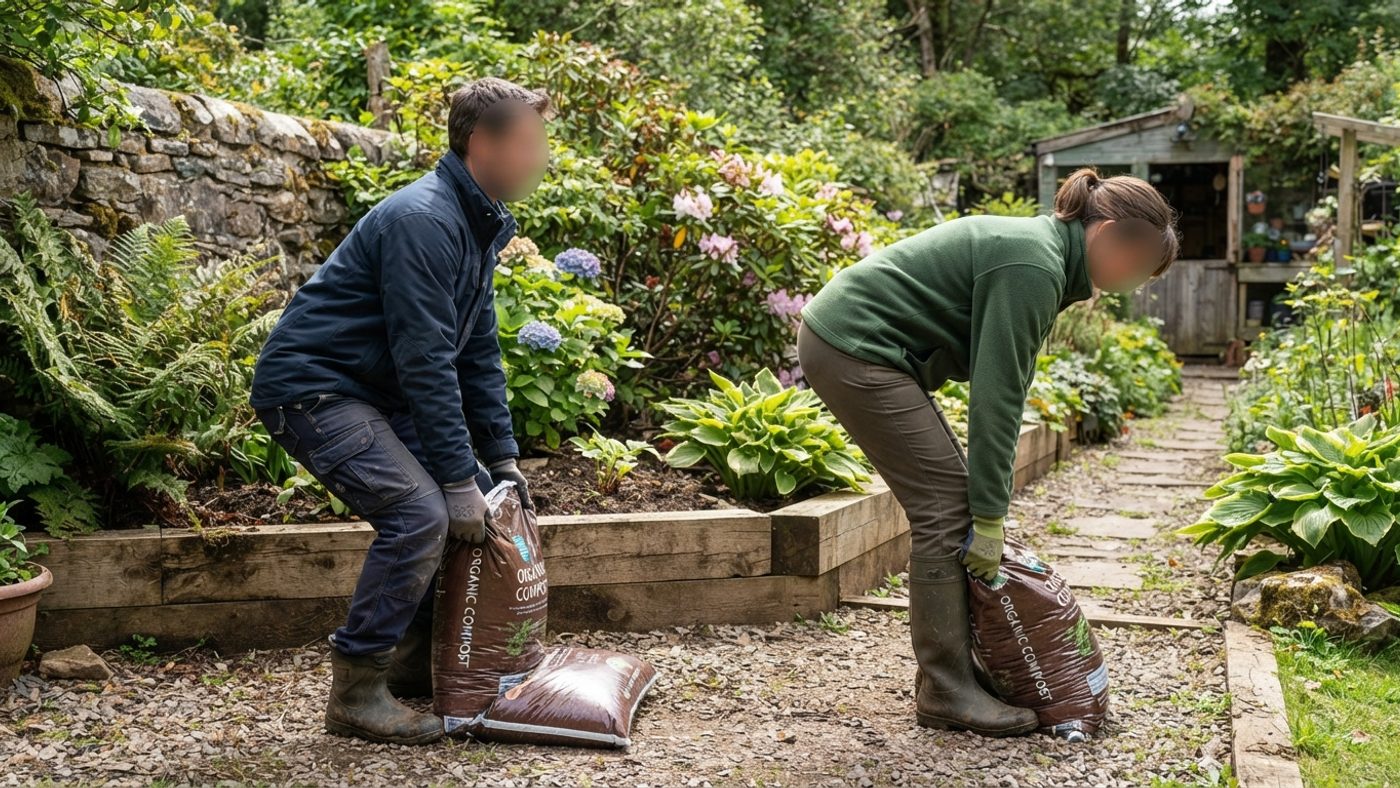
HSE is explicit that technique alone isn't the whole answer: good handling technique "is not a substitute for other steps you should take to reduce risk," such as using a handling aid, splitting the load, or getting a second person to share it, a full bag of compost or a heavy paving slab is a legitimate two-person lift, not something to prove a point about managing alone. A trolley or wheeled bin that removes a lift altogether beats even perfect lifting technique, worth remembering before you commit to carrying a bag of compost by hand.
Posture for the highest-risk tasks
Lifting technique covers one moment. Most gardening back strain actually comes from sustained posture over an extended task. Each of the tasks below carries a different loading pattern, so the fix is different too.
Digging
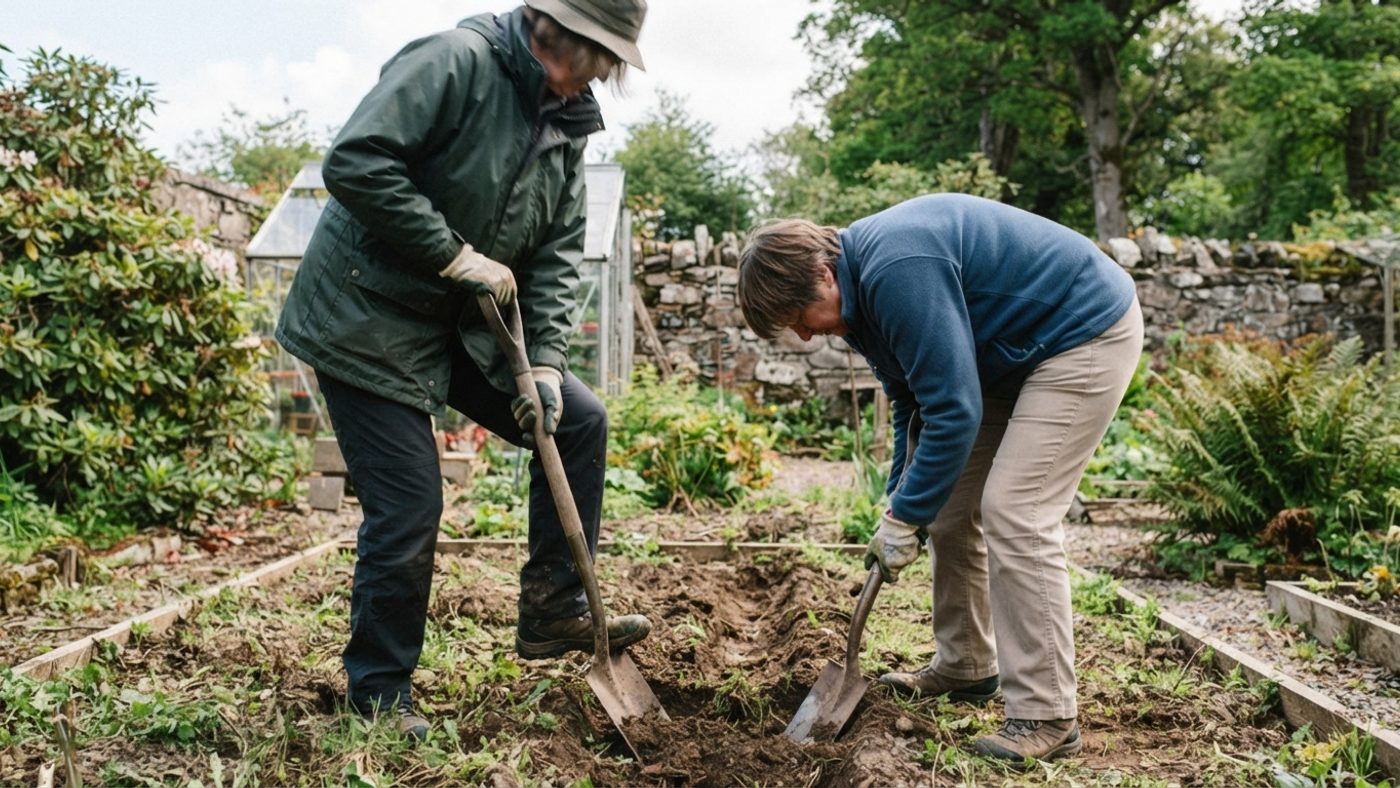
The Coventry University motion-capture study above found the dividingPropagating a clump-forming perennial by digging it up and splitting it into several smaller pieces, each with roots and shoots attached. Full definition → line between good and bad digging technique is simple: good technique uses minimal back bend and large knee bend, with a controlled, repetitive motion. Bad technique is characterised by large forward bending, overreaching with the arms, and inconsistent, jerky movement, and it's this pattern that drives the 50% increase in lumbar load. Practically, that means bending your knees to drive the spade in, keeping the motion rhythmic rather than snatched, and resisting the urge to reach further with your arms instead of repositioning your feet.
Weeding
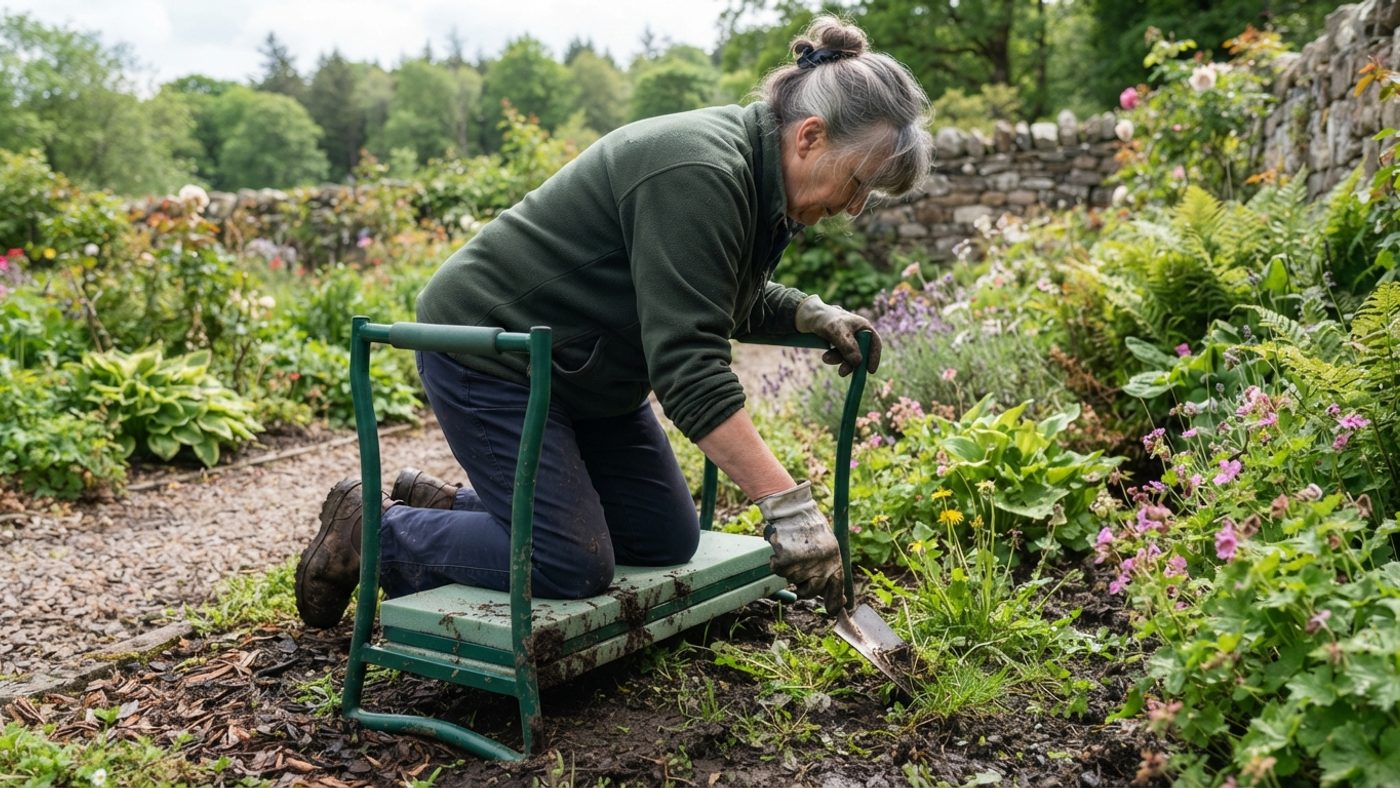
For large, established weeds, RHS guidance is to insert a spade or border fork to its full depth close to the base of the plant and lift out as much root as possible, rather than tugging repeatedly at the top growth, repeated tugging is exactly the kind of low-level repetitive strain that adds up over a session. For general hand weeding, working from a kneeling rather than a stooped position keeps the spine closer to neutral; a kneeler with handles (see equipment, below) makes both kneeling down and getting back up considerably easier on the back and knees.
Planting
Planting shares weeding's problem: it's a task done low to the ground, repeated many times in a row. The same principle applies, kneel rather than stoop where you can, and change position (kneeling, sitting on a low stool, standing to plant taller subjects) every so often rather than holding one posture for the whole bed.
Pruning at height
RHS guidance on pruning hedges is direct about two failure modes here: unstable footing, and overreaching. The advice is to use a sturdy tripod ladder, step ladder or platform rather than an ordinary ladder, since a tripod's adjustable legs cope better with uneven ground, and to avoid using powered tools above shoulder height, since that's where control and balance both start to go. For anything genuinely tall, RHS's own advice is blunt: tall hedges can be difficult and unsafe to tackle yourself, requiring specialist equipment, and hiring a contractor is the sensible option rather than improvising with a ladder that isn't rated for the job. Wear safety goggles and thick gloves for the pruning itself, and clear obstacles from the ground below before you start. Solid, gripped footwear matters here too, a lot of gardens and allotments have sloped or uneven ground, and losing your footing while on a ladder or reaching overhead is a separate injury risk on top of the strain itself.
Lifting compost bags and heavy pots
This is where the HSE technique above applies most directly, bend at the knees, keep the bag or pot tight against your body, and never twist to swing it into place. But the better fix, per HSE's own point that technique isn't a substitute for reducing the task itself, is to avoid the single heavy lift altogether: split a bulk bag into smaller loads, get a second pair of hands, or move it by trolley rather than by hand (see below).
Mowing and strimming
Pushing a mower is a repetitive, often stooped, forward-leaning task over a whole lawn, and a strimmer held out in front of the body for long stretches loads the shoulders and lower back in a similar way to overhead pruning. Both also come with a separate risk HSE covers under vibration at work: hand-arm vibration from powered tools, which can cause lasting numbness, tingling or reduced grip strength (hand-arm vibration syndrome) if exposure builds up over time. HSE's practical advice is to take regular breaks rather than running a powered tool continuously, keep blades sharp and tools well maintained so they cut efficiently rather than labouring, and keep your hands warm and dry, since cold hands are more vulnerable to vibration injury. For mowing specifically, an upright pushing stance, not leaning your weight over the handle, and a mower height and handle length that suit your own height reduce the stooping.
Equipment and adaptations that reduce strain
None of the following replace correct technique, but they change the task itself so there's less to get wrong.
- Kneelers with handles. RHS guidance recommends a kneeler seat with handles specifically because it protects the knees while also giving you something to push up on to stand, removing one of the more awkward unsupported movements in a weeding or planting session.
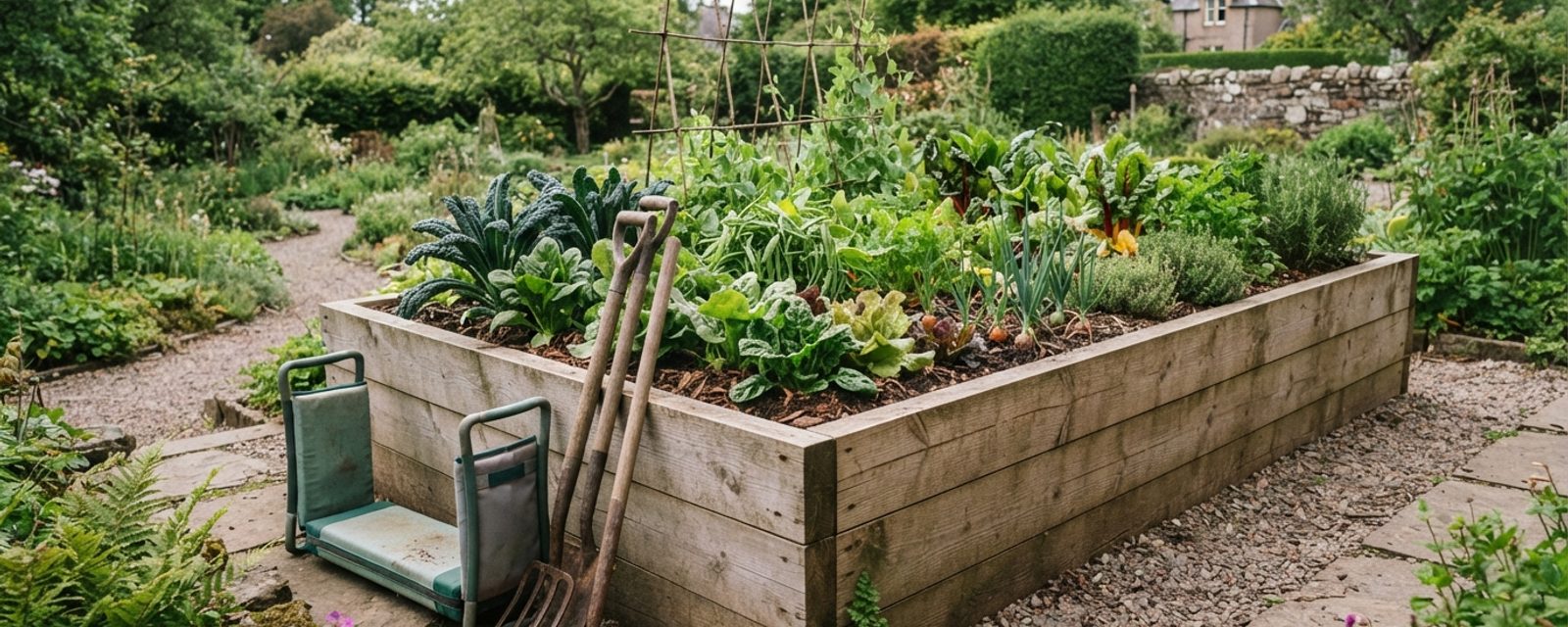
- Raised beds. RHS's own construction guidance notes raised beds are more accessible for gardeners with restricted mobility because they bring plants closer to eye level and cut the amount of bending needed. Recommended dimensions: no wider than about 1.5m (5ft), so you can reach the centre from either side without stepping onto the soil. Depth depends on what's growing, around 30cm is enough for shallow-rooting crops like salad leaves and strawberries, rising to 45cm or more for shrubs or small trees. Once built, a raised bed keeps removing low-level bending from that spot every season afterwards, rather than needing the fix repeated, and it's a genuinely useful answer to the wet, heavy clay ground common in much of Scotland, since you're filling it with a growing medium of your own choosing rather than digging and lifting through the ground as it is.
- Long-handled and lightweight tools. Long-reach tools reduce how far you have to bend or stretch to reach the ground or a raised target; lighter tool heads reduce the load your shoulders and back carry through a long session, worth taking seriously given the Coventry/RHS study above found shoulder load can more than double with poor form. A lighter tool with a padded, ergonomic grip is also worth seeking out if you already have joint pain or arthritis in the hands or shoulders, the same overload mechanism that strains a healthy back applies more readily to a joint that's already under strain.
- Wheeled seats and trolleys. For heavy pots, compost bags, or moving material any distance, a trolley or wheeled bin turns a lift-and-carry into a push, directly addressing HSE's point that changing the task beats relying on lifting technique alone. The same logic applies to a loaded wheelbarrow: push from a stable, upright stance rather than leaning your weight forward over the handles, and keep the load balanced over the wheel rather than piled toward the back, where it pulls on your arms and lower back with every step.
- Tripod ladders and platforms for height work. As above, RHS recommends these over a standard ladder for pruning, specifically because the adjustable legs give stable footing on uneven ground.
Gardening with a disability or a long-term mobility condition usually calls for more than the fixes above, a garden adapted properly around those needs, not just a few strain-reduction tweaks to an otherwise unchanged routine. Accessible gardening for disabilities → covers that fuller adaptation, from path surfaces and tool choice to funding routes specific to Scotland.
A sensible work pattern beats one long session
Good technique in a single lift only protects you for that lift. Over a whole afternoon, how you pace and vary the work matters just as much.
- Warm up before you start. Treat the first few minutes of a gardening session like light exercise rather than a standing start into digging, a short walk round the garden, some gentle arm circles and knee bends, is enough to get cold muscles moving before they're asked to do real work. This matters more on a cold, damp Scottish morning than on a warm one, since a stiff, unwarmed muscle takes more strain for the same movement than a warm one.
- Rotate tasks rather than finishing one job entirely. Alternate a stooped task (weeding) with a standing one (pruning, hedge trimming) so no single posture is held for hours at a stretch.
- Take breaks on a schedule, not just when it hurts. NHS inform's general back-care advice makes the same point for anyone managing back health day to day: it's better to spread activity through the day in small amounts than to do it all in one block, and to check in with your body regularly rather than pushing through discomfort.
- Change position, don't just pause. A break spent still kneeling isn't much of a break. Standing, stretching, or walking between tasks resets the posture your spine has been holding.
- Stop at the first sign of new pain, not once it's established. NHS inform advises stopping any activity that causes new pain or makes existing symptoms worse, rather than working through it.
High-risk tasks at a glance
| Task | Correct technique | Equipment that helps |
|---|---|---|
| Digging | Minimal back bend, large knee bend; controlled, rhythmic motion rather than jerky throws | Lightweight spade/fork; consider no-digA growing method that avoids turning the soil over, building fertility instead by adding organic matter on the surface. Full definition → methods to reduce how often deep digging is needed |
| Weeding | Kneel rather than stoop; for established weeds, insert tool to full depth at the base rather than repeatedly tugging top growth | Kneeler with handles; long-handled hand tools; raised beds to remove ground-level bending |
| Planting | Kneel or sit rather than stoop; vary posture through the session (kneeling/sitting/standing) | Kneeler; raised beds (max. ~1.5m wide so the centre is reachable without stepping on the soil) |
| Pruning at height | Avoid overreaching; keep powered tools below shoulder height; don't improvise with an unstable ladder | Sturdy tripod ladder or platform; long-handled loppers/pruning saw; hire a contractor for tall hedges/trees |
| Lifting compost bags/pots | Bend knees and hips (not the back), keep the load against your waist, never twist while carrying | Trolley or wheeled bin to avoid the lift entirely; split bulk bags into smaller loads; get a second person for genuinely heavy items |
| Mowing/strimming | Upright pushing stance, not leaning over the handle; take regular breaks from powered tools to limit vibration exposure | Mower/strimmer height matched to your own height; well-maintained, sharp blades; gloves to keep hands warm |
Common questions
What is the correct way to lift heavy bags of compost?
Bend your knees and hips rather than your back, get the bag close against your body before lifting, and keep your feet moving rather than twisting your spine to turn or set it down, standard HSE manual handling technique, and for a genuinely heavy bag, splitting it into smaller loads or getting a second person to help is a better option than lifting it solo.
Is digging bad for your back?
Digging isn't inherently harmful, but poor technique makes it high-risk: research led by Coventry University with the RHS found bad digging posture increases lower back load by around 50% and more than doubles shoulder load compared with good technique (minimal back bend, larger knee bend, controlled motion).
How can I make weeding and planting easier on my back?
Kneel rather than stoop wherever possible, use a kneeler with handles to protect your knees and help you stand back up, and consider raised beds, RHS guidance notes they reduce the amount of bending required by bringing the growing area closer to a comfortable working height.
How long can I safely garden in one session?
There's no fixed safe duration, but the general principle from NHS inform's back-care advice is to spread activity through the day rather than doing it all in one continuous block, rotate between different postures and tasks, and stop as soon as you notice new pain or worsening symptoms rather than working through it.
When should I see a doctor about back pain from gardening?
NHS inform advises seeing your GP if pain persists despite self-care, isn't affected by movement, or is worse at night, and most new back problems should improve within about six weeks with self-management, if it hasn't, it's a good idea to speak to a healthcare professional. Seek urgent help (GP in hours, or NHS 24 on 111 out of hours) for any loss of bladder or bowel control or numbness in the genital area, as these can indicate a rare but serious condition (cauda equina syndrome) needing immediate assessment.
A note on this guidance. This article covers general preventive and ergonomic advice for reducing back strain during ordinary gardening, it is not medical advice and cannot diagnose your specific pain. If you have persistent or severe back pain, or any of the warning symptoms listed above, contact your GP or a physiotherapist rather than relying on this guide.
Sources
8 sources, recorded with what each was used for
- NHS inform: Back problems: General back-care advice, activity pacing, and when to seek medical attention
- NHS inform: Exercises to help with back pain: Stretching/warm-up routine reference
- HSE: Manual handling at work — Good handling technique: Correct lifting technique steps
- HSE: Hand-arm vibration — How employers can protect workers: Vibration risk from powered tools (mowers, strimmers) and mitigation advice
- RHS: Digging techniques — what you should and shouldn't do: Coventry University/RHS motion-capture study findings on digging posture and back/shoulder load
- RHS: How to make a raised bed: Raised bed accessibility benefits and recommended dimensions
- RHS: Non-chemical weed control: Weed-removal technique to avoid repeated tugging strain
- RHS: Pruning hedges — expert tips: Safe ladder/platform use and overreach avoidance for pruning at height