
You fill the feeder on Sunday. By Wednesday morning it's empty, the ground beneath it is a mess of sunflower husks, and there's a grey squirrel doing an upside-down gymnastics routine on the very feeder the label promised was "squirrel-resistant." The blue tits and goldfinches you actually wanted to see have given up and gone next door. If this is a weekly ritual in your garden, you're not doing anything wrong, you're just up against an animal that is, by design, extremely good at this.
If you want to know how to feed and protect red squirrels specifically, that's covered separately. This piece is about the much more common problem: keeping grey squirrels off a standard garden bird feeder, and, in parts of Scotland where red squirrels still hang on, why getting that right matters for more than your seed budget.
Why grey squirrels are so good at this
Grey squirrels aren't lucky opportunists picking off the odd stray seed, they're a genuinely well-equipped raiding animal. The Scottish Wildlife Trust describes them as growing to around 30cm in body length plus a 20cm tail and roughly 600g in weight, which is enough mass to trigger anything short of a properly calibrated weight-sensitive mechanism, but still light enough for them to be confident climbers and jumpers. The Trust puts it plainly: they are "renowned for their agility, adept climbing and cunning," adding that they "can crack open birdfeeders and run along tight-rope washing lines to get at their nutty prize." That combination, balance, persistence, and a memory for where the food is, is exactly what makes a feeder that worked last month suddenly stop working once a squirrel has cracked it.
Their teeth are the other half of the problem. Squirrel incisors grow continuously and are used constantly for gnawing, and the RHS notes that squirrels "can quite easily bite through plastic," which is why it specifically recommends wire rather than plastic netting for anything meant to be squirrel-proof. A feeder port or hopper made of thin plastic isn't a long-term barrier, it's a snack with extra steps.
A workable fix has to out-engineer those specific strengths, not just make the feeder marginally more annoying to reach.
Feeder designs that actually work, and ones that don't
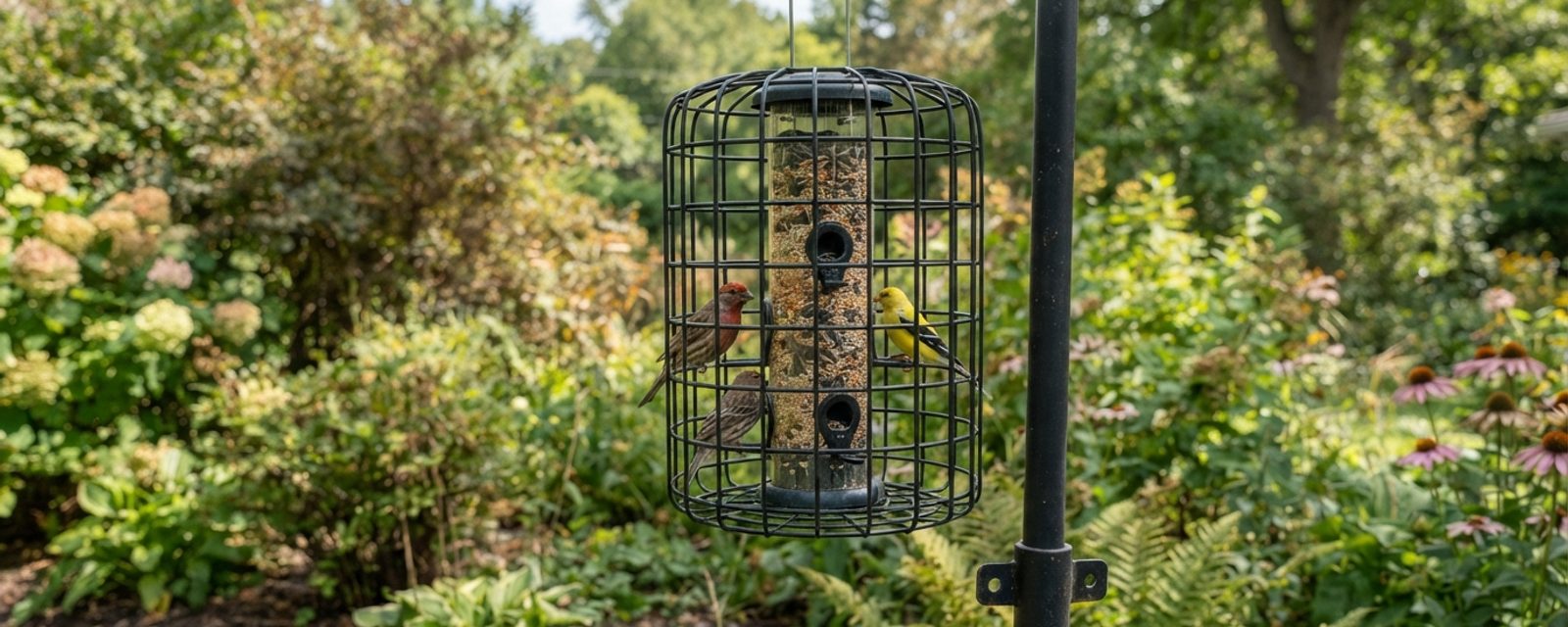
"Various designs of squirrel-proof bird feeders and tables are available from garden centres," per the RHS, usually built around "a stout wire cage that allows birds access while excluding squirrels," though "it may be found that birds also visit these feeders less frequently" once the cage goes on. The more effective a barrier is against squirrels, the more it can also put off the shyer garden birds, that's the real trade-off, not a fault in the product. In parts of Scotland where red squirrels are still around, that trade-off is worth accepting deliberately rather than discovering by accident: a feeder that actually excludes greys is doing more than protecting your seed, because it's also one less reason for a grey squirrel to linger somewhere it can spread disease to reds.
With that caveat in mind, here's how the main approaches compare:
| Design | How it works | Effectiveness against grey squirrels | Notes |
|---|---|---|---|
| Wire cage / "guardian" feeders | Outer wire cage keeps squirrels at arm’s length while small birds reach through the gaps | Generally effective, per RHS | May reduce visits from larger or shyer bird species |
| Weight-activated feeders | A perch or hatch closes or drops away under a squirrel’s weight | Effective in principle, provided the mechanism is set correctly for local bird weights | Needs calibration; set too sensitive and it excludes bigger birds too |
| Metal-cased feeders/ports | Metal housing instead of plastic, so gnawing can’t open new access holes | Addresses the specific chew-through weakness the RHS flags for plastic | Worth checking construction before buying, not just the marketing label |
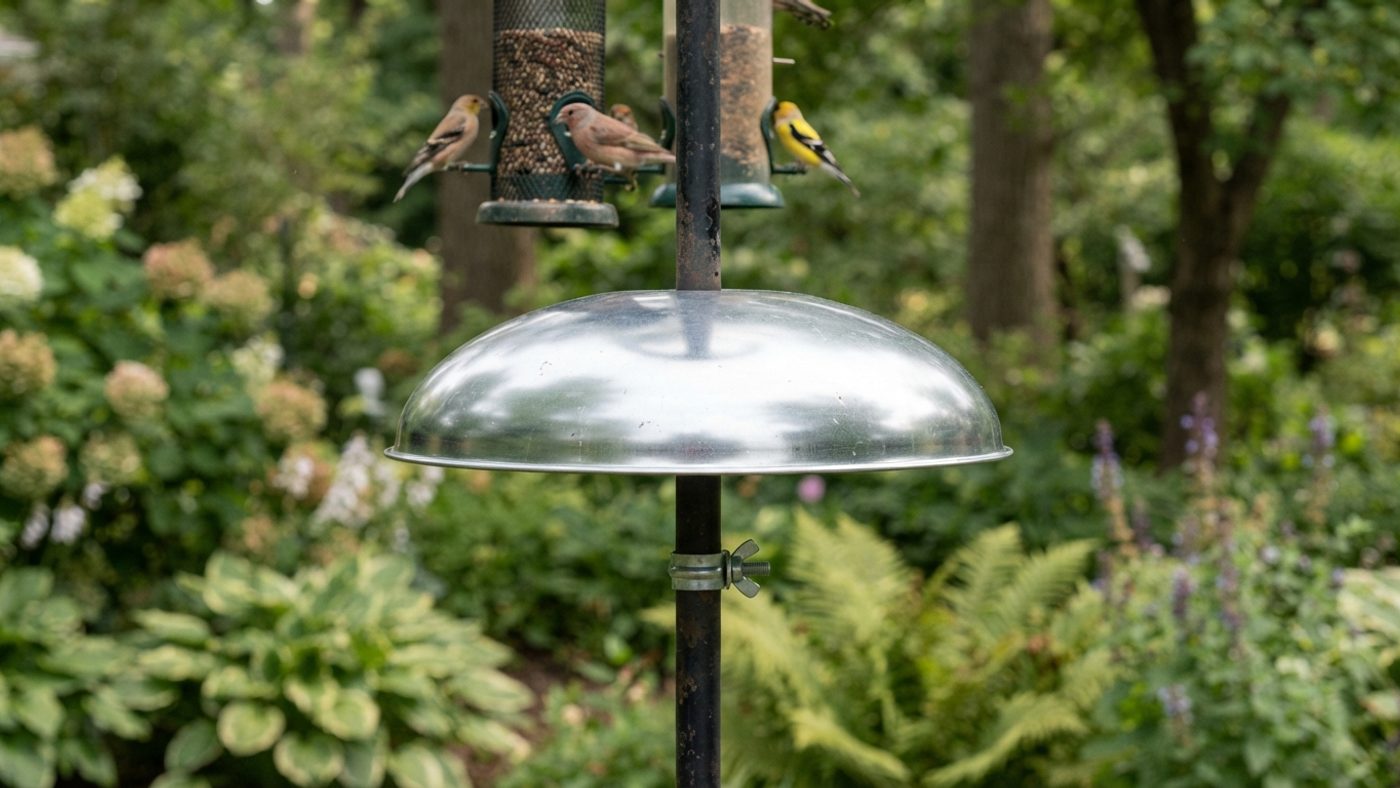
| Pole-mounted baffle (a cone or dome fitted onto the pole) | A smooth, angled surface below the feeder blocks a squirrel’s climbing route up the pole | Sound in principle: a squirrel can’t grip a smooth, steeply angled surface the way it grips a rough pole | Only works on a smooth metal pole; a wooden or rough-coated post gives enough grip to bypass it entirely |
| Repellent sprays and scaring devices | Taste or scent deterrents, ultrasonic gadgets | Likely short-term only | RHS is explicit that these "are likely to give no more than short-term protection" |
Physical barriers matched to the squirrel's actual method of attack, climbing a pole, squeezing through a gap, or chewing a hole, hold up much better than anything relying on the squirrel simply being put off by taste or noise. A squirrel that has already found a food source is a poor candidate for being scared away from it.
It's also worth dealing with what falls on the ground. Spilled seed and husks under a feeder are their own draw, giving a squirrel (and rats) an easy meal even from a feeder they can't get into directly. A seed tray or catcher fitted under the feeder, emptied regularly, closes off that secondary route.
One popular DIY trick worth a mention: smearing petroleum jelly on a pole to make it too slippery to climb. The RHS doesn't list it among its recommended methods, so treat it as an unproven extra rather than something to rely on in place of a proper baffle.
Placement matters as much as the feeder itself
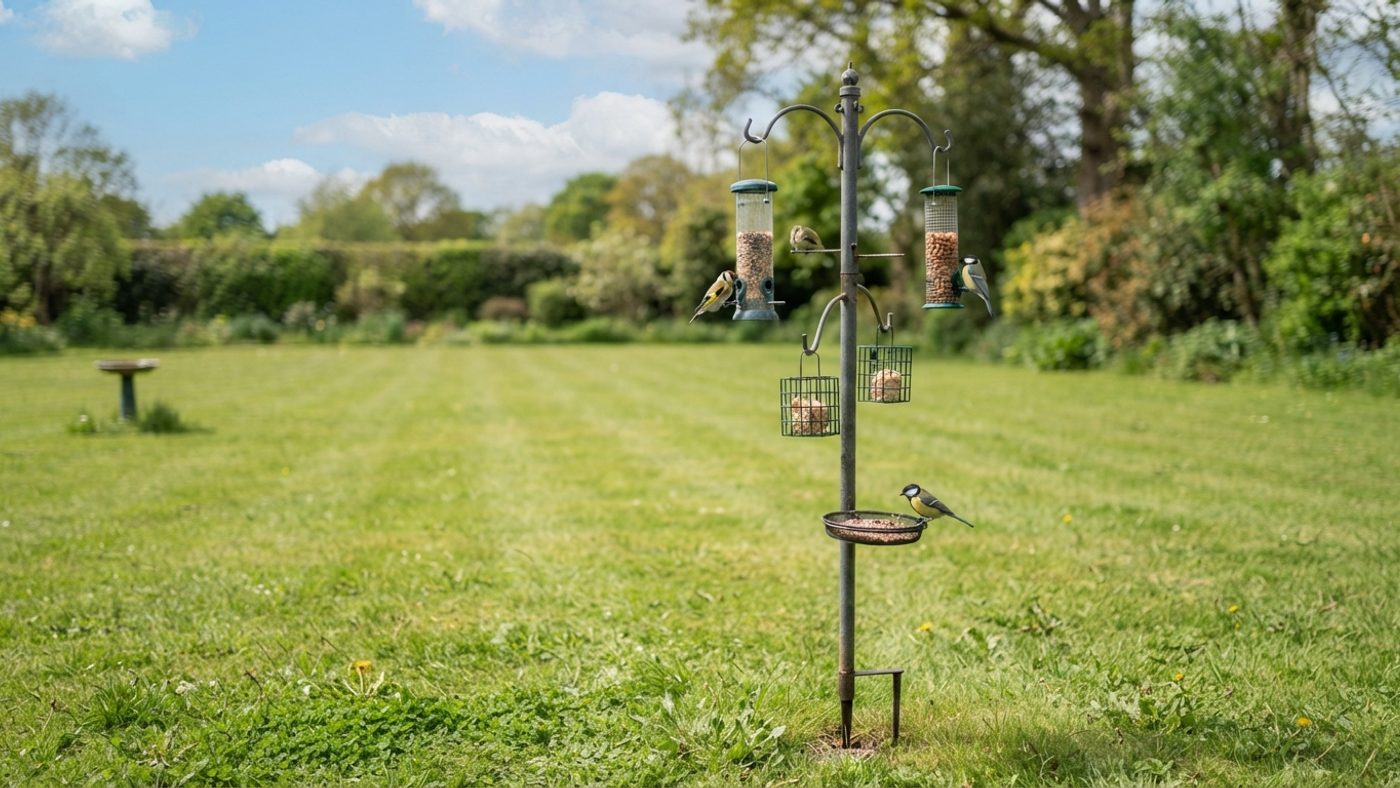
A well-designed feeder hung in the wrong place is still an easy target, because grey squirrels don't need to climb the feeder pole at all if they can launch themselves onto it from somewhere else. Gardeners' World's advice is straightforward on this point: keep feeders "away from any tree, fence or shrub that could be used as a jumping point," and note that positioning the feeder "at eye level, or a little above" tends to work better than very high or very low placement.
There's no single reliable figure for exactly how far a grey squirrel can jump, so the safer approach is to walk around the feeder location and honestly assess every possible springboard, fence tops, shed roofs, overhanging branches, even a wheelie bin, and either move the feeder further from all of them or move the springboard. A free-standing pole in open lawn, well clear of anything overhanging, combined with a properly fitted baffle on a smooth section of pole, addresses both the climbing and the jumping route at once. The same logic applies if your feeder hangs from a wall bracket or a tree branch rather than a pole: a squirrel that can reach the bracket by climbing the wall, or drop onto the feeder from the branch above it, doesn't need to solve the pole-climbing problem at all, so a bracket or branch mount needs the same clearance thinking as a freestanding pole, not less.
The conservation angle: why this matters more in some Scottish gardens than others
For most gardeners, an unguarded feeder is simply an expensive way to feed the local grey squirrel population instead of the birds. But in parts of Scotland, keeping greys off feeders is a genuine piece of conservation work, not just a matter of household seed budgets.
Grey squirrels carry squirrelpox virus without showing symptoms themselves, but the virus is generally fatal to red squirrels that catch it. NatureScot-published research states that grey squirrels "can carry the disease without showing symptoms," while "red squirrels exposed to the virus experience severe symptoms and high mortality rates." The first Scottish cases were recorded in 2005, "along the border with Cumbria," and the disease has been moving north with the grey squirrels that carry it ever since:
| Where | Squirrel situation, per NatureScot |
|---|---|
| Border with Cumbria (south Scotland) | Where the first Scottish squirrelpox cases were recorded, in 2005 |
| Central Lowlands | Established grey squirrel range, the main front the disease has spread through |
| Argyll, Tayside, Moray | Mixed — the northern edge of continuous grey squirrel range, but also areas NatureScot names as still having red squirrel populations |
| Aberdeenshire | Mixed — an isolated grey squirrel population sits alongside parts NatureScot names as red squirrel areas |
| Areas with only red squirrels (much of the Highlands, and parts of Tayside, Argyll, Moray and Aberdeenshire) | Virus is "unlikely to spread through" here, per NatureScot, as long as greys don’t get a foothold |
That last row is the key practical point for feeder-proofing: the disease risk to reds tracks where greys actually are, so a feeder that keeps greys from establishing or lingering in a red-squirrel area is doing real disease-prevention work, not just tidying up the garden.
The Scottish Wildlife Trust, which leads the Saving Scotland's Red Squirrels partnership project, is direct about the mechanism at stake: "Grey squirrels also carry Squirrelpox, a virus that is lethal to reds but not to greys." The project has run coordinated grey squirrel control across priority areas since 2009, including an effort to remove an isolated grey squirrel population near Aberdeen City, work to stop greys and the virus spreading further north from the Central Lowlands, and support for volunteer-led control in mixed-population areas of South Scotland, all aimed at giving red squirrels room to hold their ground or recover. The Trust also encourages the public to report squirrel sightings as part of that effort, red or grey, since sighting data is part of how the project tracks where control is needed.
What this means practically: if you garden in or near one of the areas where red squirrels are still present, the Highlands, or the specific parts of Aberdeenshire, Argyll, Tayside and Moray that NatureScot names as red-squirrel areas, or the islands, an unsecured bird feeder isn't neutral. Every grey squirrel it sustains is a grey squirrel with more reason to stay in an area where it's competing with, and potentially transmitting disease to, red squirrels. Squirrel-proofing your feeder in that context isn't just about protecting your bird food, it's a small, direct contribution to the same goal the regional control programmes are working towards. Even where you're confident you're in grey-only territory, a properly baffled feeder still means more of your seed goes to the birds it was bought for.
Bird Feeder and Bird Bath Hygiene → covers the other side of feeder upkeep: how dirty feeders spread disease, and the cleaning routine that actually prevents it.
Bringing it together
The combination that holds up best in practice is a feeder built to resist gnawing and squeezing (wire cages, metal fittings, or a correctly calibrated weight-activated hatch), fitted with a properly sized baffle on a smooth pole, sited well clear of every fence, shed roof, or branch that could serve as a launch pad, and kept clear of spilled seed underneath. Scent and taste repellents are worth trying only as an extra layer, not a primary defence, since even the RHS expects them to wear off in effectiveness. And if you're gardening somewhere red squirrels are still part of the local wildlife, treat a secured feeder as part of looking after them, not just as pest control.
Common questions
Do squirrel-proof bird feeders actually stop grey squirrels completely?
No, not completely or forever, but well-built cage feeders, correctly fitted pole baffles, and calibrated weight-activated feeders substantially reduce access. Even the RHS only claims these designs "exclude" squirrels while accepting that birds may also visit less often.
Should I fit a baffle above or below the feeder?
It depends on how the squirrels are getting to your feeder. A baffle below the feeder, on a smooth section of pole, blocks squirrels climbing up from the ground. If squirrels are jumping down onto the feeder from above, the barrier needs to address that route instead, which usually means moving the feeder further from overhanging branches rather than adding a baffle above it.
Is it worth using pepper or chilli-based squirrel repellents?
They may offer some short-term deterrence, but the RHS is explicit that "animal repellent substances and scaring devices are likely to give no more than short-term protection." Treat them as a supplement to physical barriers, not a substitute.
Does it matter if I’m not in a red squirrel area — can I just tolerate the greys?
That’s a personal choice for feeder maintenance and cost. But if you’re anywhere near the Highlands or one of the areas of Aberdeenshire, Argyll, Tayside or Moray where red squirrels persist, keeping greys off your feeders is more than a convenience, it reduces the local food supply propping up the species that carries squirrelpox and competes with reds for territory.
Can grey squirrels really bite through plastic feeders?
Yes — the RHS specifically warns that squirrels "can quite easily bite through plastic," which is why it recommends wire rather than plastic netting for permanent squirrel-proofing, and why metal-cased feeder components hold up better than thin plastic ones.
Sources
5 sources, recorded with what each was used for
- RHS: Grey squirrels: The bite-through-plastic warning, wire cage feeder description, and the repellent/scaring-device short-term-only caveat
- NatureScot: New squirrelpox research released today: The squirrelpox mechanism (carried asymptomatically by greys, fatal to reds), the 2005 first-recorded-case location, and the regional breakdown of where the virus can and can’t spread
- Scottish Wildlife Trust: Grey squirrel: Grey squirrel size, agility, and feeder-raiding behaviour
- Scottish Wildlife Trust: Saving Scotland's Red Squirrels project: The squirrelpox transmission mechanism and the coordinated grey squirrel control programme since 2009
- Gardeners' World: Best bird feeders: Feeder placement advice — clearance from jumping points, and eye-level siting