
A greenfinch is sitting hunched under your feeder, feathers fluffed out even though it isn't cold, doing nothing. It doesn't fly off as you approach. Look closer and its throat feathers might be matted and wet, as if it's been drooling, and it looks like it's struggling to swallow. If you've seen this, or you've found a dead finch or sparrow near your feeding station, you're most likely looking at a disease that spreads through the feeder or bath itself, and one that a weekly cleaning routine can prevent.
Trichomonosis and salmonellosis are the two diseases behind most of this, and they've reshaped how officially recommended garden feeding now looks: flat trays are out, weekly cleaning is non-negotiable, and both RSPB and RHS have changed their standing advice in the last few years because of what these diseases have done to finch numbers.
What trichomonosis actually is
Trichomonosis is caused by a parasite, Trichomonas gallinae, that lodges in a bird's throat and gullet, causing lesions that make it increasingly hard to swallow. Affected birds often look exactly like the greenfinch above: puffed up, lethargic, drooling, and regurgitating food they can't get down. Left untreated, it's usually fatal, generally through starvation or secondary infection rather than the parasite directly. The parasite isn't limited to finches: in pigeons and doves it causes the disease long known as canker, and a bird of prey that eats an infected bird can develop it too, known there as frounce.
The parasite spreads bird-to-bird in two main ways: through regurgitated food passed between a parent and chick, or a courting pair, which is why transmission spikes during the breeding season; and via food or water that a sick bird has recently fed from or drunk from and left contaminated with parasite-laden saliva. The one genuinely reassuring fact about T. gallinae is that it doesn't survive long once it's outside a bird's body, it's fragile in the open environment, which is exactly why a feeder cleaned regularly can break the transmission cycle so effectively. Since transmission spikes over spring and summer, a feeding station getting heavy traffic is worth cleaning twice a week through the breeding season, not just once, on top of the standard weekly minimum below.
Trichomonosis first turned up in British finches in 2005, and by summer 2006 birdwatchers were reporting a rapid, visible crash in greenfinch numbers, with the worst epidemics running through 2006 and 2007. The UK's greenfinch population has never recovered.
| Species | Decline | Period | What's driving it |
|---|---|---|---|
| Greenfinch | 66% | 1967–2024 (UK breeding population) | The 2006 trichomonosis outbreak accounts for most of this long-term fall |
| Greenfinch | 77% (4.3m → ~1m) | Since 2006 specifically | The trichomonosis outbreak itself |
| Chaffinch | Reduced adult survival | Since 2012 | Linked to trichomonosis, more marked in garden settings than rural ones |
Chaffinches have taken a hit too, driven by reduced adult survival linked to trichomonosis. Tellingly, the effect is measurably stronger in gardens with feeding stations than in the wider countryside, what the surveillance literature calls a "peri-domestic" effect. That's not a coincidence. It's a fairly direct indictment of the feeder as a disease-amplifying gathering point when it isn't kept clean.
What salmonellosis actually is, and why it behaves differently
Salmonellosis in garden birds is caused by Salmonella Typhimurium bacteria, and it spreads by a different route: mainly through droppings from an infected bird contaminating food or water that other birds then feed from. Affected birds appear similarly lethargic and fluffed-up, often with diarrhoea, and it can kill quickly.
The critical difference from trichomonosis is survival time in the environment. Where T. gallinae dies off quickly once outside a host, Salmonella bacteria can persist in soil, on feeders, and in dropping-contaminated ground for weeks to months. That single fact is why "I'll clean it when I next think of it" is a much riskier strategy for salmonellosis than it might seem, the bacteria isn't relying on birds visiting today to spread; it's happy to sit and wait for the next one.
Salmonellosis also carries a small human health dimension that trichomonosis doesn't: of the human salmonella cases recorded in England and Wales between 2000 and 2010, only about 0.2% were of the types linked to wild birds. No equivalent figure has been published for Scotland specifically, but there's no reason to expect the underlying mechanism, an infected bird's droppings reaching a person's hands or mouth, to behave differently north of the border; treat the England and Wales figure as a reasonable guide to how low the risk generally is, not zero. If you or a family member develop symptoms of salmonella infection after handling feeders or a sick bird, it's worth mentioning that possibility to a doctor. If a cat that hunts also falls ill around the same time you're seeing sick or dead birds in the garden, that's worth a call to a vet too.
Surveillance data shows salmonellosis incidents occurring across Scotland, with a distinct geographic split: finches are most commonly affected in northern Scotland, house sparrows in southern Scotland. A 13-year peer-reviewed study of garden bird salmonellosis in Scotland, covering 1995 to 2008, backs this up with sustained surveillance data specific to the country (Pennycott et al., 2010, Veterinary Record).
The cleaning protocol, in full
"Clean it regularly" isn't a protocol. Here's the one that RSPB, RHS, and Garden Wildlife Health converge on, in order.
- Empty out old or leftover food. Bin it, don't add it to a compost heap or scatter it elsewhere, since that just relocates the contamination.
- Dismantle the feeder or bath fully. Take feeders apart into their separate pieces rather than sponging over the outside.
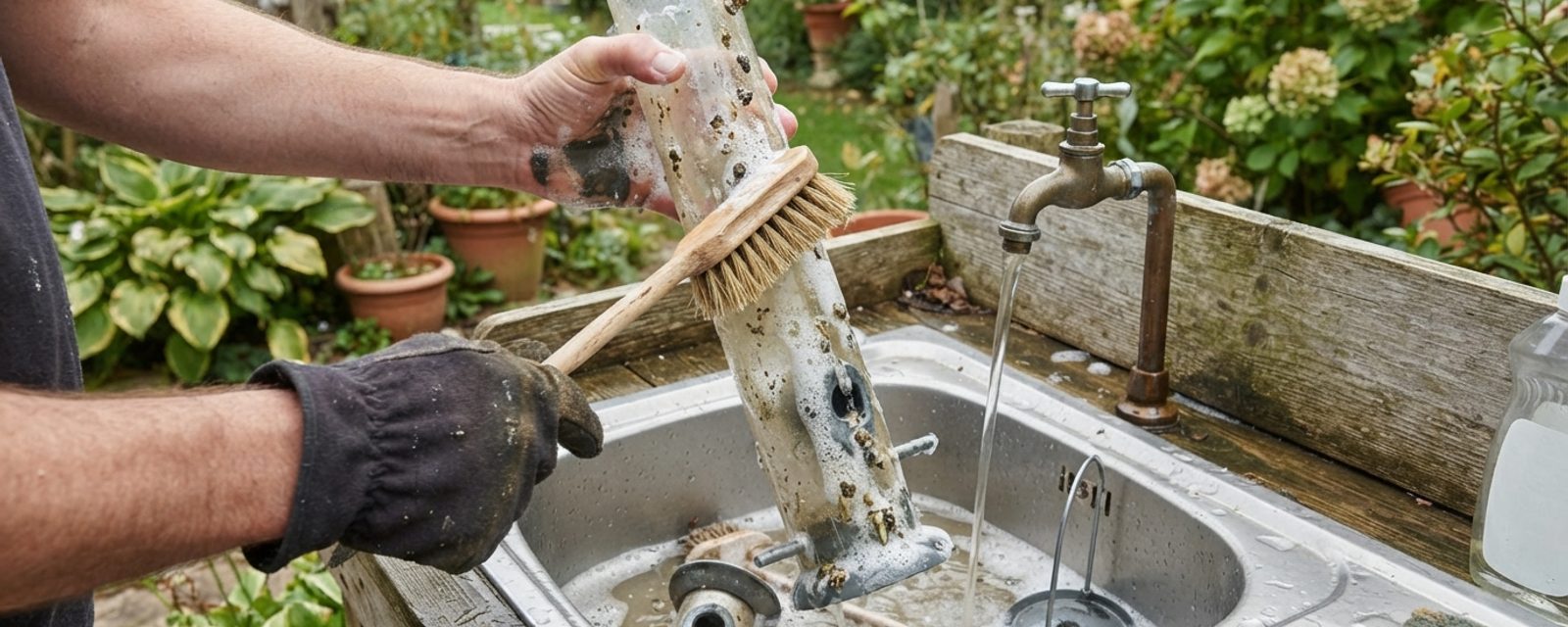
- Dampen the surfaces first, then scrub with hot water, ordinary washing-up liquid, and a long-handled brush kept solely for this job. Dampening before scrubbing matters: dry scrubbing crusted droppings can throw fine particles into the air, which you don't want to be breathing in.
- Rinse thoroughly.
- Disinfect with a mild (5%) household bleach solution, standard sodium hypochlorite bleach, or a proprietary bird-safe disinfectant such as Ark-Klens.
- Rinse again with clean water to remove all disinfectant residue.
- Dry completely outdoors before refilling or reassembling. Don't rush this step by bringing pieces inside to dry faster; a damp feeder put straight back into use undoes most of the benefit of cleaning it. In damp or overcast weather this can take longer than a single afternoon, a sheltered spot with good airflow gets pieces properly dry faster than a corner that never catches a breeze, and it's worth timing the job for a dry, breezy spell where you can.
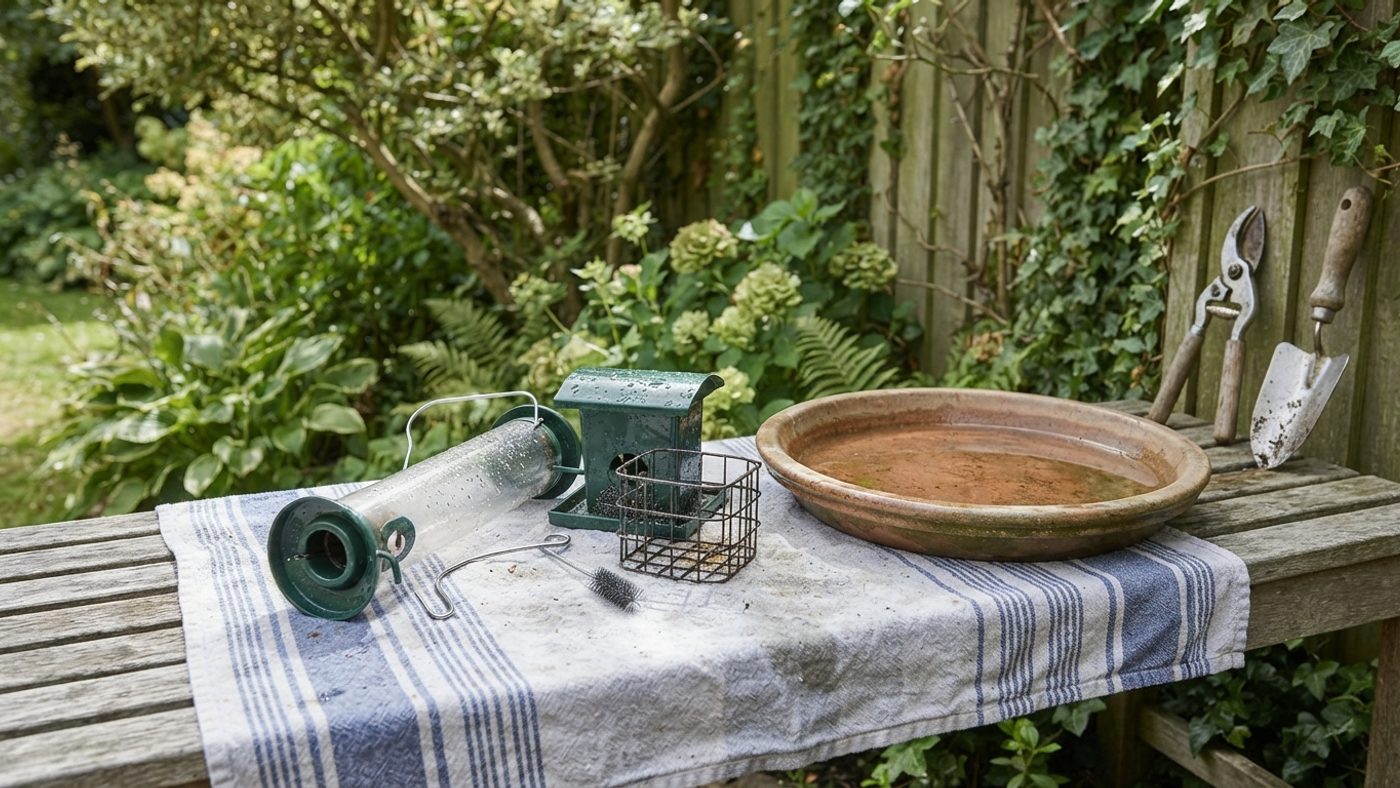
Keep a dedicated brush and a pair of gloves for this job and leave them outdoors permanently, never bring feeder-cleaning equipment into the house, and wash your hands and forearms thoroughly once you're done. Plastic and metal feeders disinfect more reliably than untreated wood, which absorbs moisture and residue into the grain rather than letting a rinse carry it away, worth bearing in mind when replacing an old feeder.
| What to clean | How often | Method | Drying |
|---|---|---|---|
| Seed and peanut feeders | Weekly (twice weekly in the breeding season if heavily used) | Dismantle, scrub with hot soapy water, disinfect (5% bleach or Ark-Klens), rinse | Dry fully outdoors before refilling |
| Bird baths — water | Daily | Empty and refill with fresh water | — |
| Bird baths — full clean | Weekly | Scrub and disinfect as above | Dry fully outdoors before reuse |
| Ground beneath feeders | Ongoing | Rake up spilt seed and droppings; rotate feeder position | — |
The same shared-dirty-feeder mechanism causes problems well beyond garden birds. Squirrelpox spreads between red and grey squirrels through shared feeding stations in a broadly similar way, an unrelated virus in unrelated animals, but the same underlying lesson that a feeder several species queue up at is a natural bottleneck for disease.
If you find a sick or dead bird
Act on the first sick bird you see, not just a dead one, by the time a bird has died at the feeder, others visiting the same spot have likely already been exposed. Stop feeding at that station. Garden Wildlife Health's guidance is to suspend feeding for a minimum of two to four weeks; RSPB's separate advice is to wait at least three weeks. Both are reasonable, so treat three to four weeks as the sensible default and lean longer if you can. Empty bird baths and leave them empty for the same period, until you stop seeing sick or dead birds around the garden.
When you do reintroduce food, do it gradually and keep watching for further casualties. If the problem comes back, extend the next pause much further, three to six months, rather than repeating the same short break and hoping for a different result.
Don't handle a sick or dead bird with bare hands. Use disposable gloves, or turn a plastic bag inside out over your hand to pick it up, then invert the bag around the bird. For disposal, official guidance is to double-bag the body, one leak-proof bag tied inside a second, and put it in with normal household waste in a lidded outside bin, or bury it at least 60cm deep away from any watercourse. Report what you've seen to Garden Wildlife Health at gardenwildlifehealth.org, their surveillance data is exactly what's built from reports like yours, and it's how the geographic patterns in Scotland were identified in the first place. If neighbours nearby also feed birds, it's worth telling them too, the same visiting birds are likely using both gardens, so one clean feeder next door doesn't isolate yours.
Bird flu (avian influenza) is a separate, more serious disease with its own official response guidance, which can include removing feeders entirely in affected areas, it isn't covered by the routine cleaning steps here, so check current local advice if you suspect it rather than treating a two-to-four-week pause as sufficient.
Feeder and bath design choices that cut disease risk
Flat feeding surfaces, bird tables, ground feeding, open window trays, are now the one thing RHS, RSPB, and Garden Wildlife Health all specifically advise against, following what RSPB describes as its own scientific review of the evidence. Flat surfaces are exactly where regurgitated or dropping-contaminated food pools and sits, giving both trichomonosis and salmonellosis their best chance to pass from one bird to the next. Tube feeders and hanging feeders that limit how much food any one bird can spread around are the safer option.
Beyond feeder shape, a handful of habits make a real difference. Use several feeding stations spread around the garden rather than one central point, so fewer birds and fewer species cluster in any single spot at once. Rotate feeder positions roughly weekly, per Garden Wildlife Health's suggestion, so droppings and spilt food don't accumulate on the same patch of ground. Fill with only 24 to 48 hours' worth of food at a time instead of topping up on top of older seed. Avoid siting feeders directly under roosts or dense tree cover where droppings from perched birds fall straight into the food below.
On timing, RHS recommends pausing seed and peanut feeders for summer, roughly May to October, offering only limited mealworms or fat balls in hanging cages during that window; RSPB instead centres its advice on peanuts and seed being most useful November to April, without calling for a hard summer stop. The shared principle behind both is reducing how much birds depend on a single artificial food source during the months wild food is plentiful anyway. Most gardeners feed year-round rather than following either seasonal pause exactly, and that's a reasonable middle ground too, provided the weekly clean and the design choices above are actually kept up, hygiene does more to cut disease risk than the calendar does.
Which species to attract and what to feed them is a separate question, covered on the garden birds page. And if grey squirrels are raiding the feeder before the birds get a look in, hygiene won't solve that particular problem, squirrel-proofing a bird feeder is a design fix in its own right.
Common questions
Can I use ordinary washing-up liquid, or do I need a specialist product?
Ordinary washing-up liquid and hot water is exactly what’s recommended for the scrubbing stage. The specialist step comes after: a mild 5% bleach solution or a proprietary bird-safe disinfectant like Ark-Klens for disinfecting, followed by a clean-water rinse. Soap alone removes grime but won’t reliably kill Salmonella sitting in the material of the feeder.
Is it safe to keep feeding birds at all if diseases like this exist?
Yes, and stopping isn’t what the evidence actually recommends. Both diseases predate garden feeding and would carry on regardless, and a well-fed bird going into a Scottish winter has a real survival advantage when natural food runs short. The RSPB’s own response to what trichomonosis did to greenfinch numbers wasn’t “stop feeding,” it was to change how feeding is done, which is the whole reason this article exists.
Why does bleach need rinsing off so thoroughly before birds use the feeder again?
Bleach residue left on a feeding surface can irritate or harm a bird that then feeds from it, and it can also taint food. The rinse-after-disinfecting step exists specifically to remove that residue before the feeder goes back into service, which is also why the dry-completely step matters, a still-damp feeder can mean diluted, incompletely rinsed residue is still present.
How do I know if a dead bird near my feeder died from disease rather than a cat or a window strike?
You often can’t tell by eye, and that’s fine, Garden Wildlife Health doesn’t need a confirmed diagnosis to log a useful report, just a description and location. If you saw the bird alive and unwell first, fluffed up, lethargic, drooling, or with diarrhoea, that’s a stronger indicator of disease than a bird found freshly dead with no prior symptoms observed.
Do bird baths need the same level of care as feeders, even though birds don’t eat from them?
Yes, arguably more. Bath water is drunk and bathed in by multiple birds a day, and droppings land in it directly. Daily water changes plus a full weekly scrub and disinfect, exactly as for feeders, is the standard advice, an unclean bath can spread salmonellosis just as readily as an unclean feeder.
Sources
9 sources, recorded with what each was used for
- RHS: Stop filling your feeders this summer to protect birds: Summer feeder-pause recommendation, flat-feeding-surface guidance
- RHS: Birds in your garden: General feeding/feeder-design context
- BTO: Trichomonosis: Disease mechanism, transmission routes, outbreak history (2005-2007)
- BTO: BirdFacts — Greenfinch: The 66% UK breeding greenfinch decline, 1967-2024
- RSPB: Top tips to help reduce disease in garden birds: Step-by-step cleaning protocol, Ark-Klens, three-week pause, feeder-design guidance
- Garden Wildlife Health: Trichomonosis in Garden Birds: Greenfinch population figures (4.3m to 1m), the peri-domestic effect, sick/dead bird protocol
- Garden Wildlife Health: Salmonellosis in Garden Birds: Transmission mechanism, environmental persistence, human health figure, Scotland surveillance finding
- Pennycott et al. (2010), Veterinary Record: Scotland-specific 1995-2008 peer-reviewed surveillance study of garden bird salmonellosis
- gov.wales: Remove and dispose of dead wild birds: Double-bagging and burial-depth guidance for disposing of a dead garden bird