
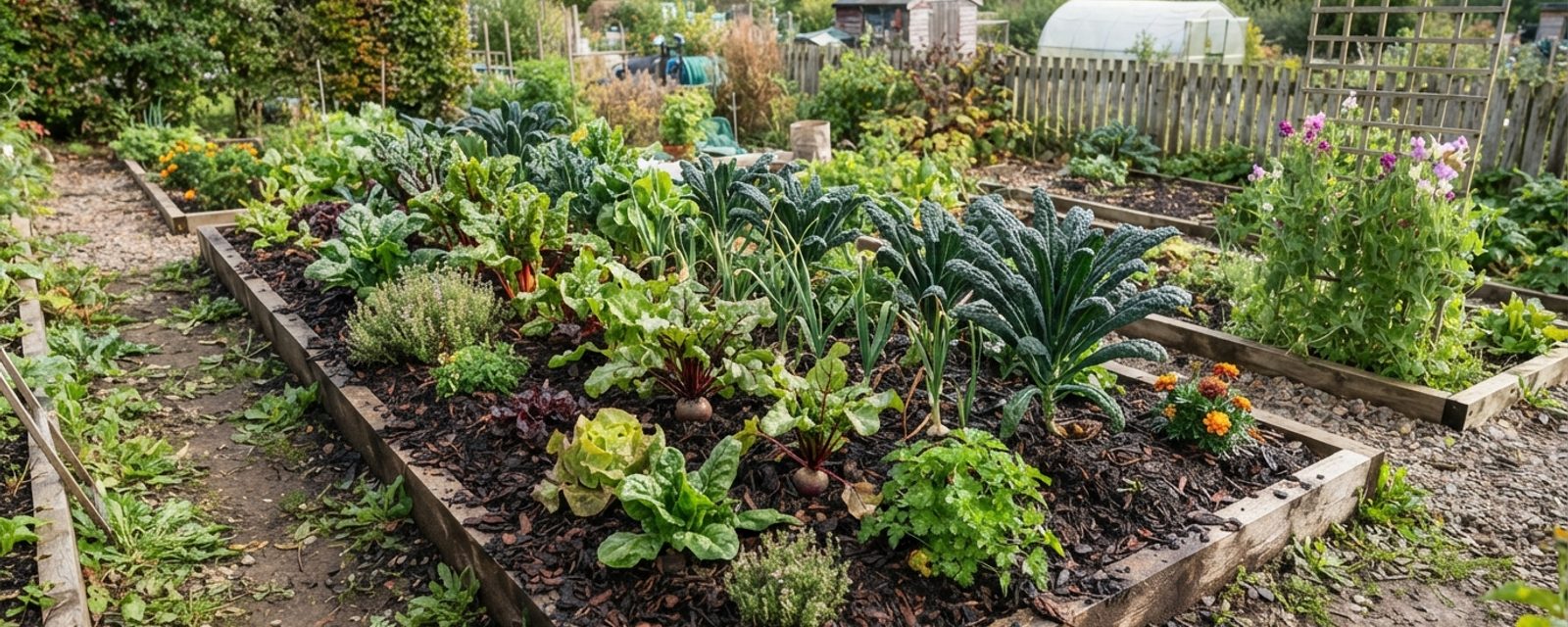
Every vegetable that reaches a supermarket shelf has already been refrigerated, packed, and driven, often for hundreds of miles, sometimes flown, before it ever reaches a trolley. A courgette picked from your own garden skips every one of those stages. It travels from soil to kitchen in the time it takes to walk there, needs no refrigerated haulage, and needs no plastic film to survive the journey. That's the actual mechanism behind why home-grown food tends to carry a lighter footprint than shop-bought, not a vague "growing things is good for the planet" feeling, but a genuine subtraction of transport fuel, cold storage energy, and packaging material from the chain between soil and plate.
It's not the whole story, though, and a good-faith look at carbon-friendly gardening in Scotland has to deal with the part that's less flattering: heating. Scotland's frost-free growing season runs shorter and cooler than most of England's, and a lot of the crops gardeners want to grow here (tomatoes, chillies, aubergines, cucumbers) need protection to fruit reliably. A greenhouse or polytunnel that's heated through a Scottish spring and autumn to keep frost off young plants is drawing on grid electricity or a fossil-fuelled heater for months longer than an equivalent structure further south would need. If that heat comes from an inefficient source, the emissions saved by cutting out a supermarket supply chain can be partly or wholly cancelled out by the emissions spent keeping the tunnel above freezing. There's no single verified figure for how the two balance out on a typical Scottish plot, it depends entirely on what's being heated, how, and for how long, and on where in Scotland the plot actually is, but the honest position is that unheated, well-timed, season-appropriate growing is close to a clean carbon win, while a heavily heated greenhouse running non-renewable power is a genuine trade-off worth thinking about rather than an automatic virtue.
A handful of everyday habits cut a garden's footprint further without much effort: leaving cut grass to break down straight back into the lawn rather than bagging it and binning it, regrowing certain vegetables from what would otherwise be kitchen scraps, and turning items already in the house or shed into planters, supports, or covers instead of buying new ones.
Scotland's climate policy and why gardens sit inside it
Scotland has a legal target of reaching net zero greenhouse gas emissions by 2045, five years ahead of the UK-wide target, with the Scottish Government's Climate Change Plan setting out the sector-by-sector policies meant to get there. Agriculture, land use, and food systems all sit inside that plan, alongside the Fourth Land Use Strategy and the National Good Food Nation Plan, which frames how Scotland grows, distributes, and thinks about its food supply.
Individual gardens are a rounding error against national emissions figures, but Scotland's environmental agencies treat garden-scale action as part of the same picture as large-scale land management, for two connected reasons: soil carbon and biodiversity.
| Programme | What it targets | Scale/date |
|---|---|---|
| Scotland's net zero target | All greenhouse gas emissions | Net zero by 2045 |
| NatureScot Peatland ACTION | Degraded peatland restoration | 66,000+ hectares restored since 2012; £250m committed to reach 250,000 hectares by 2030 |
| NatureScot Pollinator Strategy for Scotland | Wild bee, hoverfly and pollinator decline | 2017–2027 |
NatureScot's Peatland ACTION programme is the most visible example of the soil-carbon thread. It's a landscape-scale programme, not something a back garden can replicate, but the underlying principle behind it, that undisturbed, carbon-rich soil is worth protecting rather than disturbing, scales down to ordinary garden management directly: it's the same reasoning behind no-digA growing method that avoids turning the soil over, building fertility instead by adding organic matter on the surface. Full definition → growing (below), and it's also why buying peat-based compost cuts against the restoration effort just described, by creating demand for the same peat that programme is working to keep in the ground.
The other Scotland-specific thread is pollinators. NatureScot's Pollinator Strategy for Scotland was written because the country's wild bees, hoverflies, and other pollinating insects are in decline from habitat loss, land-use change, disease, pesticides, and climate change, and it explicitly names gardens, including window boxes, as part of the response, alongside farms, roadside verges, and public land. A pollinator-friendly garden isn't primarily a carbon-reduction measure, but it is a direct, named contribution to that strategy, not just generic "grow flowers for bees" advice.
Getting more from the season before reaching for a heater
Between "grow only what the outdoor Scottish season allows" and "heat a greenhouse all spring" sits a middle ground most gardens can use before either extreme. Cold frames, clochesA small, portable clear cover placed over an individual plant or short row to trap warmth and keep off wind, rain and pests. Full definition →, and horticultural fleeceA lightweight, breathable fabric laid or draped over plants to trap a little warmth and keep off frost, wind and some flying pests. Full definition → all trap the sun's own heat and slow down heat loss overnight, giving young plants a few extra degrees of frost protection with no energy input at all. Siting a greenhouse or polytunnel against a south-facing wall, and glazing or lining it well enough to hold onto the heat the sun puts in during the day, cuts down how much a heater has to do to keep it frost-free overnight, if one is used at all. A traditional hotbed, a deep pit or raised bed filled with fresh manure or grass clippings, topped with a layer of growing soil, generating gentle heat for weeks as the material below breaks down, is an old, entirely fuel-free way of giving young plants a warmer root run through spring, without any structure more complex than a bed and a fork to build it. Where a heater genuinely is needed, running it on a thermostat and timer rather than continuously, and only heating the space actually in use rather than a whole structure, keeps the energy spent proportional to what the plants need rather than what's convenient to set and forget. Seed catalogues label some varieties as bred for shorter, cooler seasons or early cropping, rather than for warmth and length of season, choosing one of those over a variety bred for a long, hot summer reduces how much protection a crop needs in the first place.
Soil: why not digging can matter more than what you plant
Undisturbed soil holds carbon. Digging, rotavating, or turning a bed exposes soil organisms and stored organic matter to oxygen, which speeds up the breakdown of that organic matter and releases carbon dioxide that would otherwise have stayed locked in the ground. No-dig growing works by leaving the soil structure intact and feeding it from above instead, laying mulchA layer of material spread over the soil around plants to suppress weeds, retain moisture, and improve soil structure as it breaks down. Full definition →, garden compost, or well-rotted manure on the surface and letting worms and soil organisms incorporate it downward, the way leaf litter builds soil in a woodland.
The practical method, as set out by Garden Organic, is straightforward for a new bed: cut back existing growth, cover the ground completely with cardboard or another light-excluding material to suppress what's underneath, then add a 15-20cm layer of mulch on top and leave it for six months to a year before planting, topping up with roughly 5cm of fresh mulch annually after that. Soil Association guidance makes the carbon case from the soil-biology side: digging disrupts the fungal networks that help feed plants and that can't tolerate exposure to air, so leaving the ground undisturbed keeps that underground ecosystem, and the carbon associated with it, intact. A green manureA fast-growing crop sown specifically to be dug back into the soil, adding organic matter and, with legumes, fixing nitrogen. Full definition →, a fast-growing cover crop such as field beans or clover, sown over an empty bed rather than leaving bare soil through autumn and winter, does a similar job between growing seasons: its roots hold the soil structure together, and digging it back in (or, in a no-dig bed, cutting it down and leaving it to break down on the surface) returns the nutrients and organic matter it built up.
Composting garden and kitchen waste at home keeps biodegradable material out of general waste, which matters because biodegradable waste sent to landfill breaks down without oxygen, buried under other rubbish, and that airless decomposition produces methane, a potent greenhouse gas, where composting in the open air mostly doesn't. Scotland has been phasing in a ban on sending biodegradable municipal waste to landfill specifically to cut those emissions, with full enforcement due from January 2028. Composting at home, at the scale an ordinary garden produces, doesn't require any permission or registration with SEPA, it's treated as an ordinary domestic activity, and it closes a nutrient loop in the garden instead of exporting waste and importing bagged fertiliser; anyone without the space for their own bin can usually route garden and food waste through a council green-bin collection instead, which composts it at scale rather than sending it to landfill. Materials, method, and choosing a peat-freeCompost made without peat, which is harvested from a slow-forming, carbon-storing wetland habitat that peat extraction damages. Full definition → bagged compost when one's still needed are covered in full in the peat-free compost guide.
Tools: petrol, electric, and hand-powered
Powered garden tools run on either mains electricity, battery, or petrol, and the choice has a direct emissions consequence. Petrol strimmers, mowers, and leaf blowers burn fuel inefficiently at small engine sizes compared with cars, and that inefficiency shows up as both carbon emissions and local air pollution in a way that's easy to overlook because the quantities involved per session feel small. Battery and mains-electric equivalents shift that consumption onto the electricity grid instead, and the Scottish Government's own energy statistics put renewable sources at 73.1% of Scotland's electricity generation in 2024, most of it from wind, so switching from petrol to electric garden equipment draws mainly on power that's already largely decarbonised. For anything that doesn't need power at all, a hand fork instead of a rotavator, secateurs instead of a powered hedge trimmer for light work, a push mower for a small lawn, skipping the motor entirely avoids the question altogether, and fits naturally with a no-dig approach that reduces how much soil disturbance a garden needs in the first place.
Water use
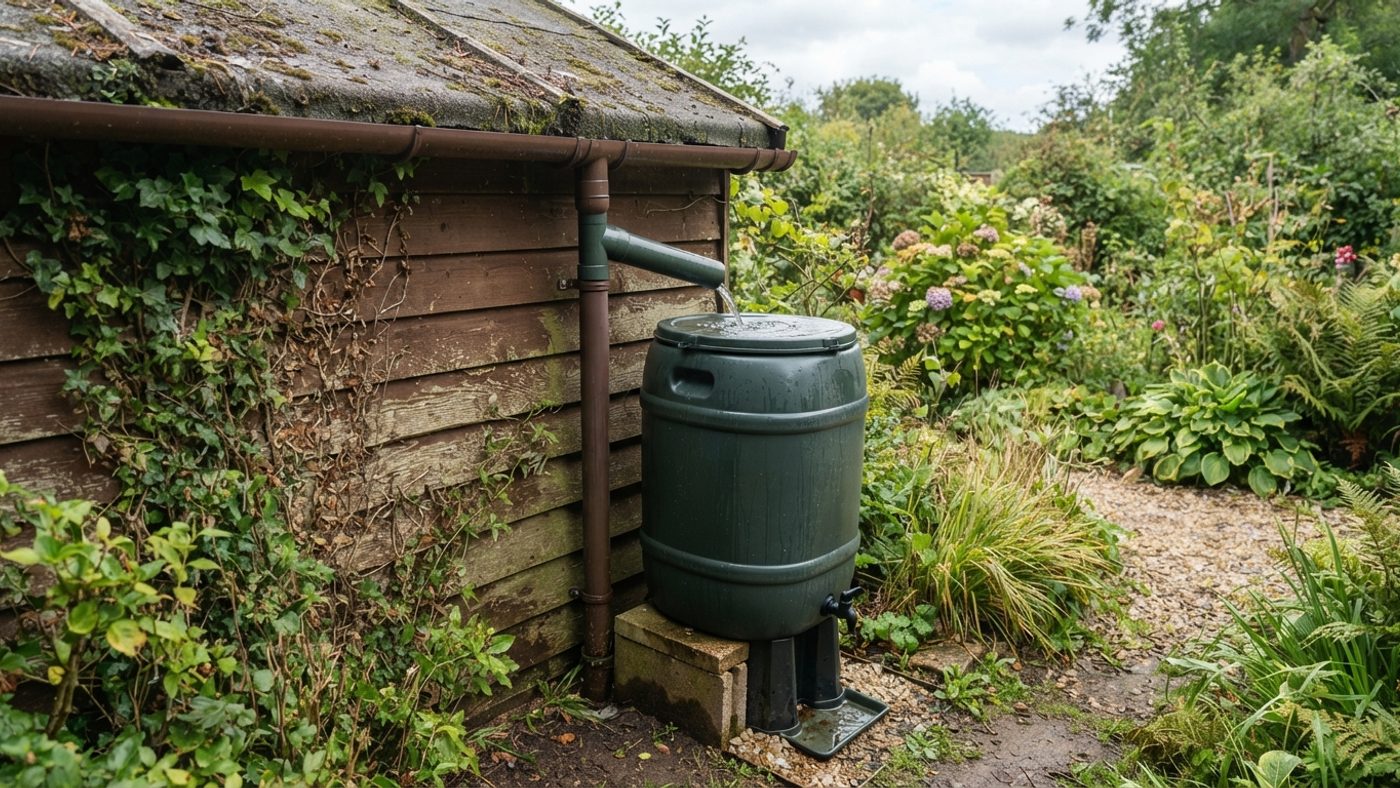
Mains water in Scotland is treated and pumped, both energy-intensive processes, so reducing how much of it a garden draws down has a real if modest energy consequence of its own, separate from the cost of the water itself. A water butt collecting rainwater from a shed, greenhouse, or house roof is the standard low-effort fix, and Scotland's generally high rainfall means one fills readily in most parts of the country; routing the overflow somewhere useful, a rain garden or border rather than straight onto a path, gets more use out of water that would otherwise just run off. A full water butt also pairs well with the no-dig approach above: soil that's been mulched rather than repeatedly dug tends to hold moisture better and needs watering less often, because an intact soil structure with organic matter worked in retains water more effectively than bare, disturbed ground. Watering in the early morning or evening rather than the heat of the day also reduces how much applied water is lost to evaporation before it reaches plant roots.
Plant choice: perennials, natives, and pollinators
What you plant carries its own carbon and biodiversity consequences, separate from how you manage the soil. Perennial plants, those that live for multiple years rather than being sown, grown, and cleared annually, need replanting far less often, which means fewer trips to a garden centre, less plastic plant-pot turnover, and less soil disturbance from repeated planting and clearing. Native and near-native plants tend to need less intervention once established (less supplementary watering, less feeding) because they're suited to the local climate and soil, and they support local insect life more effectively than many ornamental cultivarsA plant variety that arose or was bred under cultivation and is kept true by deliberate propagation, rather than a naturally occurring wild species. Full definition → bred primarily for flower size or colour.
Pollinator-friendly planting is where Scotland's national pollinator strategy and ordinary garden choice most directly overlap. NatureScot's guidance is not complicated: growing a range of flowering plants across the seasons, so there's something in bloom from early spring through to autumn, gives bees, hoverflies, and other pollinators a continuous food source rather than a single glut followed by a gap, and even a window box contributes to the same national picture the strategy is tracking. A garden that's planted with a spread of flowering times, rather than one dominated by a short, showy display, is doing double duty: less maintenance for the gardener, and a direct, named contribution to a national environmental strategy.
Materials and hardscaping: what you bring into the garden
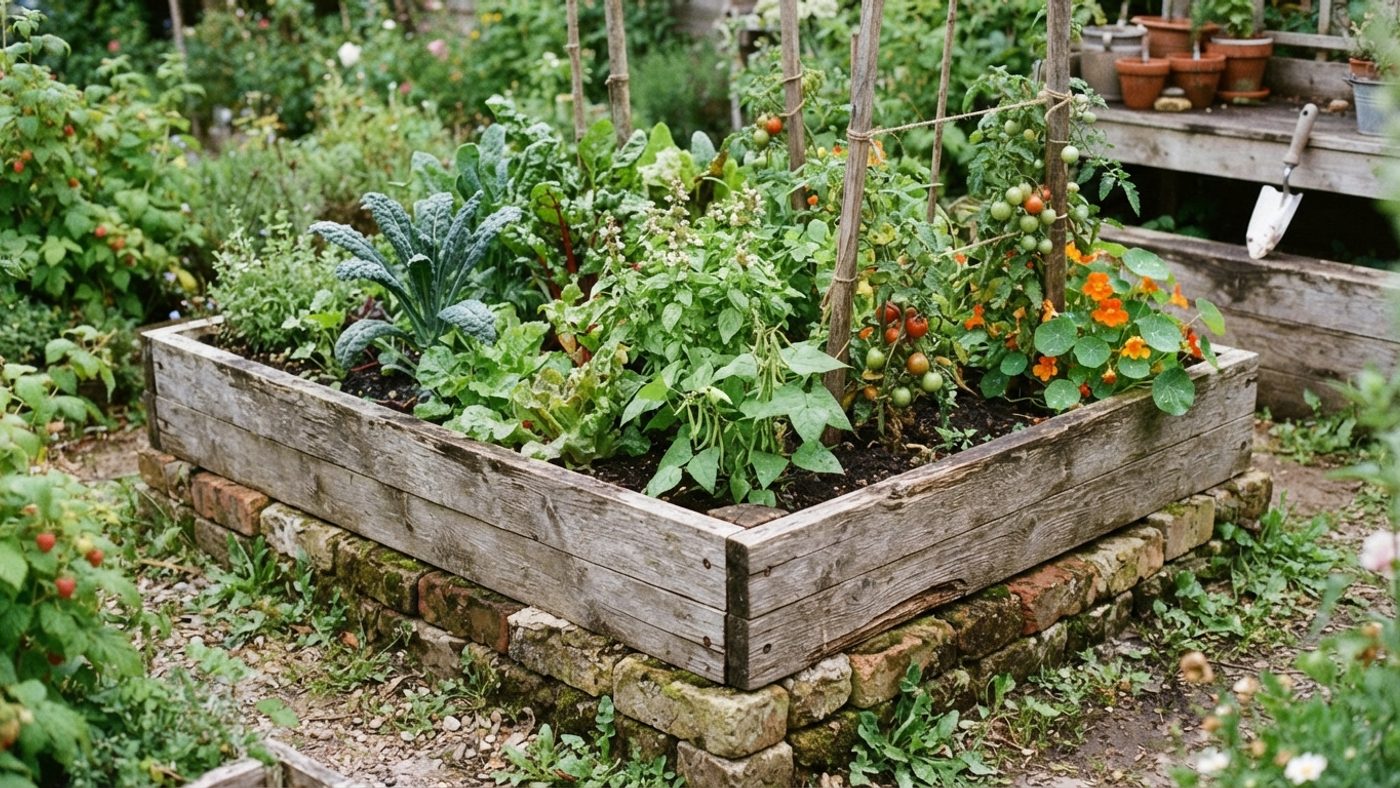
Compost, tools, and plants get most of the attention in carbon-conscious gardening advice, but the materials used to build a garden's hard structure, patios, raised beds, fencing, retaining walls, decorative gravel, carry their own "embodied carbon": the emissions already spent quarrying, manufacturing, and transporting a material before it's ever laid in a garden, on top of whatever happens on site. It's easy to overlook because it's a one-off purchase rather than a recurring habit, but the gap between options can be large: a paving slab or fence post cut, cured, and shipped new has a real manufacturing and transport footprint behind it, where a reclaimed slab or a second-hand fence panel carries essentially none, since it's already been made. Reclaimed timber, second-hand paving slabs, and stone sourced closer to home (reclaimed sandstone from demolition, Caithness flag rather than imported stone, home-grown FSC-certified softwood) reduce that footprint simply by avoiding new extraction, long-haul transport, and manufacture, and buying less new material in the first place, building a smaller raised bed, or repairing an existing path rather than replacing it, is the most direct way to cut this category of impact. Containers, timber offcuts, and other items already in the house or shed that would otherwise be discarded can substitute for newly bought materials in exactly this category, often at no cost at all.
Common questions
Does a no-dig bed make slugs worse?
A thick surface mulch does give slugs somewhere damp to shelter, which matters more in Scotland's generally wet, cool climate than it would somewhere drier. It's a real trade-off against no-dig's soil-carbon benefit rather than a reason to avoid the method: encouraging natural predators (birds, frogs, ground beetles, hedgehogs) by keeping a varied, not-too-tidy garden, and choosing nematodes over slug pellets where numbers do need controlling, keeps the pest control itself low-impact too.
Do I need permission from SEPA to compost at home?
No. Composting garden and kitchen waste at home is treated as an ordinary domestic activity connected to a private dwelling and doesn't require SEPA authorisation.
What's the single change that makes the biggest difference to a garden's carbon footprint?
There isn't one verified figure that ranks garden practices against each other, so it's more honest to say the practices reinforce one another: undisturbed, no-dig soil holds more carbon and needs less watering and weeding; composting keeps biodegradable waste (and the methane it produces in landfill) out of the waste stream; and choosing electric or hand tools over petrol ones cuts direct fuel emissions. None of them are dramatic alone, but they compound.
Are ornamental garden plants as useful for the environment as native ones?
Not necessarily. Many ornamental cultivars are bred for flower size, colour, or a long flowering display rather than for the amount of nectar or pollen they offer, and some produce little of either. A garden with a genuine spread of flowering times, including native and near-native plants, supports pollinators more consistently across the season than one dominated by a small number of showy but low-value varieties.
Does buying peat-based compost undo Scotland's peatland restoration work?
Not on its own, but it works against it. Peatland ACTION is actively restoring degraded Scottish peat bogs because intact peat is a major carbon store, while a bag of peat-based compost represents peat extracted from a bog elsewhere. Choosing a peat-free compost keeps that demand from growing.
Sources
10 sources, recorded with what each was used for
- gov.scot: Climate change — latest: Scotland's net zero 2045 target, the Climate Change Plan, and the Fourth Land Use Strategy/Good Food Nation Plan context
- NatureScot: Pollinator Strategy for Scotland: Confirming the existence and 2017–2027 scope of the strategy
- NatureScot: Helping Scotland's Pollinators: The aims of the strategy, pressures on pollinators, and its explicit inclusion of gardens and window boxes
- NatureScot: Peatland ACTION: The 66,000+ hectares restored since 2012 and the peatland-as-carbon-store framing
- NatureScot: Peatland ACTION — what we do: The £250 million commitment and the 250,000-hectare restoration target by 2030
- SEPA: Biodegradable municipal waste landfill ban: The landfill ban timeline (full effect from January 2028) and the methane mechanism
- Soil Association: No-dig gardening: The soil-biology rationale for no-dig (fungal network disruption, structure, moisture retention)
- Garden Organic: No-dig gardening: The practical no-dig method (mulch depth, timing) and its stated benefits
- gov.scot: Electricity Generation and Supply — Energy Statistics for Scotland, Q3 2025: The 73.1% renewable share of Scotland's 2024 electricity generation
- gov.scot: Renewable Electricity Generation — Energy Statistics for Scotland, Q4 2024: Wind's dominant share (30.1 TWh of 38.4 TWh) of Scotland's renewable generation in 2024