
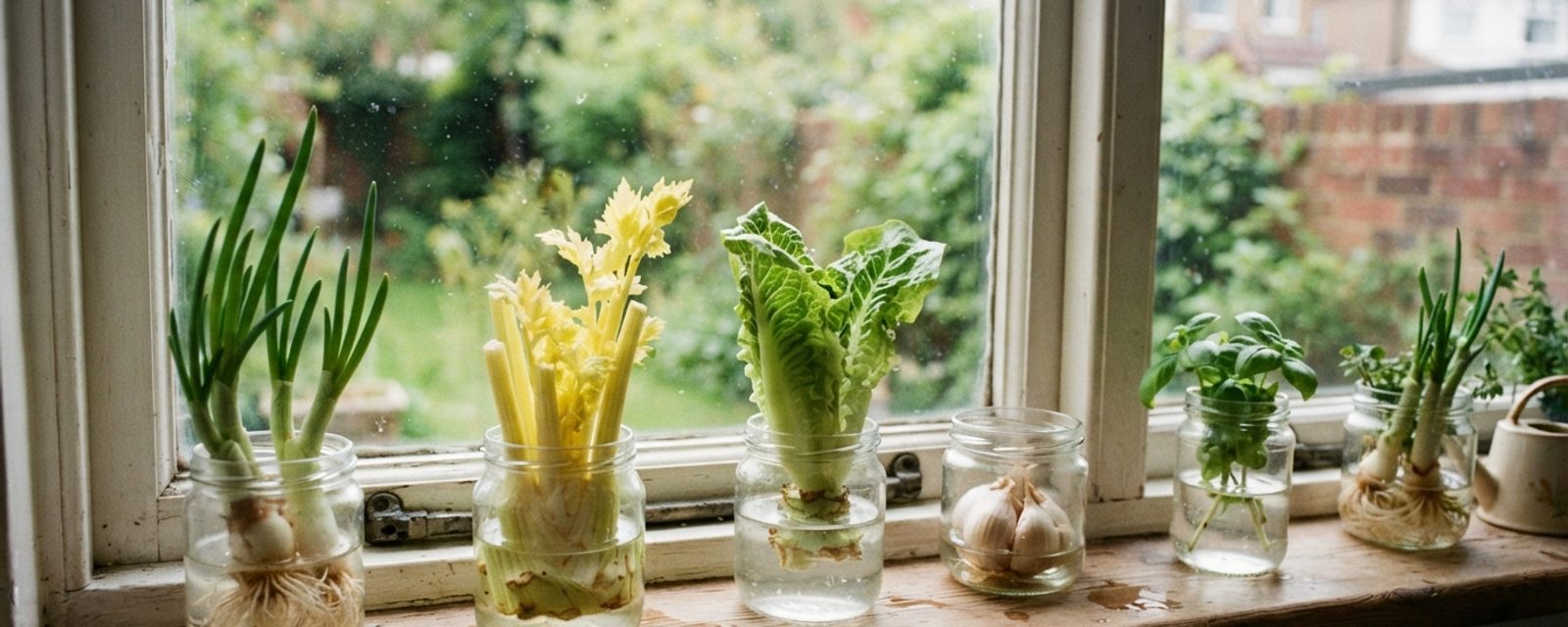
The spring onion root is already halfway into the food bin. So is the celery heel and the stump left after the last lettuce leaf comes off. That's the exact moment worth pausing at, because none of those three offcuts are rubbish yet, put in a jar of water on the windowsill instead of the bin, and they'll be doing something within days.
This isn't a substitute for growing vegetables properly from seed or sets. It's a way to squeeze a second short crop, or at least a fresh batch of leaves, out of something that was going in the compost caddy anyway. Some of the scraps below genuinely deliver. A few of the claims that circulate constantly online, regrowing a full new potato, a full onion bulb, or a fruiting avocado tree, from a kitchen scrap, don't hold up, and it's worth knowing that before three weeks are spent on a jar that was never going to produce much.
The scraps that genuinely work
Spring onions (green onions)
Save the white root end with roots still attached, about 2.5cm is enough, and stand it upright in a small glass with water covering the roots but not the cut top. New green shoots appear from the centre within about a week, and the same base can often be re-cut and re-grown a couple of times before it gives out. A healthy base stays firm and pale; if it turns soft, slimy, or starts to smell, it's spent, bin it and start a fresh one rather than trying to nurse it back.
This is regrowing leaves and stem, not the bulb the RHS describes for a proper crop: their guide to salad onions notes that a full harvest-ready plant, grown from seed, takes around two months to reach 15cm tall with a bulb 1-2.5cm across. A windowsill jar won't get there, what it produces is a milder, thinner stand-in for the green tops, useful in the same week rather than in two months' time. A leek's root end regrows the same way and behaves the same way: fresh green tops within a week, not a rebuilt leek.
Celery
Cut the base off about 5cm up from the root end, rinse it, and stand it in a shallow dish with water just covering the bottom, not the whole stalk. New pale stalks push up from the centre of the base within about a week; once roots have formed, the base can go into a pot of soil for a slightly larger, if still modest, second showing.
Celery is roughly 95% water and needs consistently moist soil throughout its growing season, according to the RHS, which is really why a regrown base stays small: a shallow dish can keep it alive and sprouting, but it can't replicate the sustained root run a full celery plant needs over a season sown indoors from mid-March. Treat the regrowth as a handful of stalks for a stock pot or a stir-fry, not a full head for braising. If the base is moved on into a pot of soil once it's rooted, keep it somewhere frost-free, celery has no hardiness to speak of and a cold snap will finish it off outright.
Lettuce (loose-leaf and Little Gem/Romaine types)
Keep the stem base after the leaves are cut away, sit it in a shallow dish of water with the cut side up and the base just submerged, and change the water every day or two. New leaves emerge from the centre within about a week to ten days.
The RHS's own guide to growing lettuce describes cutting a hearting lettuce down to a stump about 2.5cm tall as a recognised way to get "at least one, if not two, additional smaller harvests," and separately notes loose-leaf types can be snipped back to re-sprout as long as the weather isn't too hot or dry, indoors, on a windowsill through a Scottish winter, weak light is a far more likely obstacle than heat ever is. Garden Organic's guidance on quick-growing salad crops backs the same cut-and-come-again approach, recommending scissors over pulling whole leaves so the stem keeps producing.
Garlic
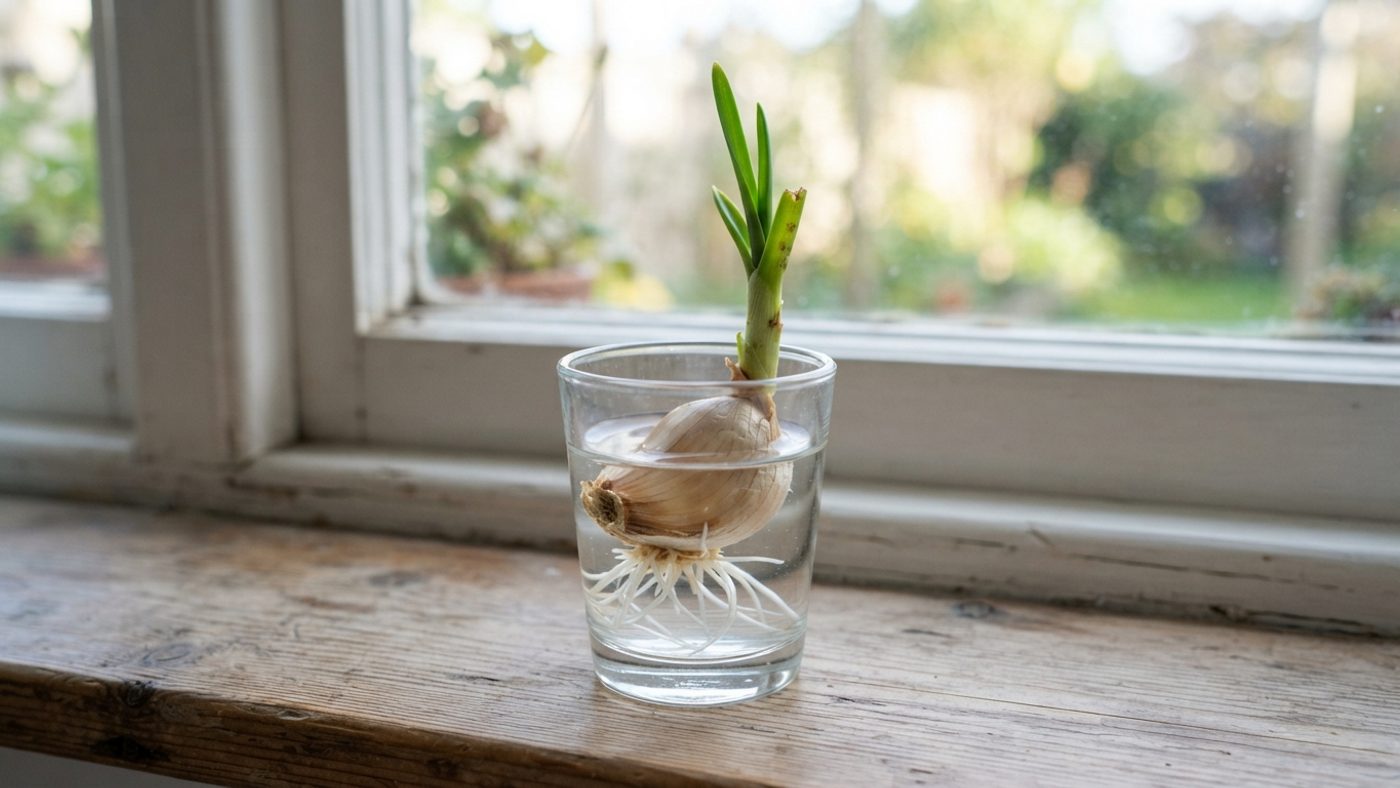
Two different things get lumped under "regrowing garlic," and they give very different results. A sprouted clove stood in a glass of water, or pushed into a pot of compost with just the tip showing, will send up a single green shoot within days. That shoot tastes like mild garlic and works as a stand-in for chives or spring onion tops in cooking, it will not turn into a bulb.
A sprouted clove planted properly in soil, flat end down, and left to grow through a full season can produce an actual new bulb, because this is genuinely how garlic is normally propagated, a single clove grown on becomes a new bulb of cloves, splitting into several cloves again as it swells underground. The RHS's growing guide describes exactly this planting method (cloves planted flat end down, pointed end up, 2.5cm deep) for cloves planted outdoors mid-autumn to early winter, over winter and into the following summer for harvest, and recommends buying named garlic varieties bred for the UK climate rather than planting supermarket bulbs, which are more likely to carry disease and may not be suited to growing on at all.
So: a windowsill glass gives leaves, not a bulb, in days. Soil and a full season can give a bulb, but a garden-centre clove is the safer bet than a supermarket one for that route.
The claims that overpromise
"Regrow a full potato from peelings"
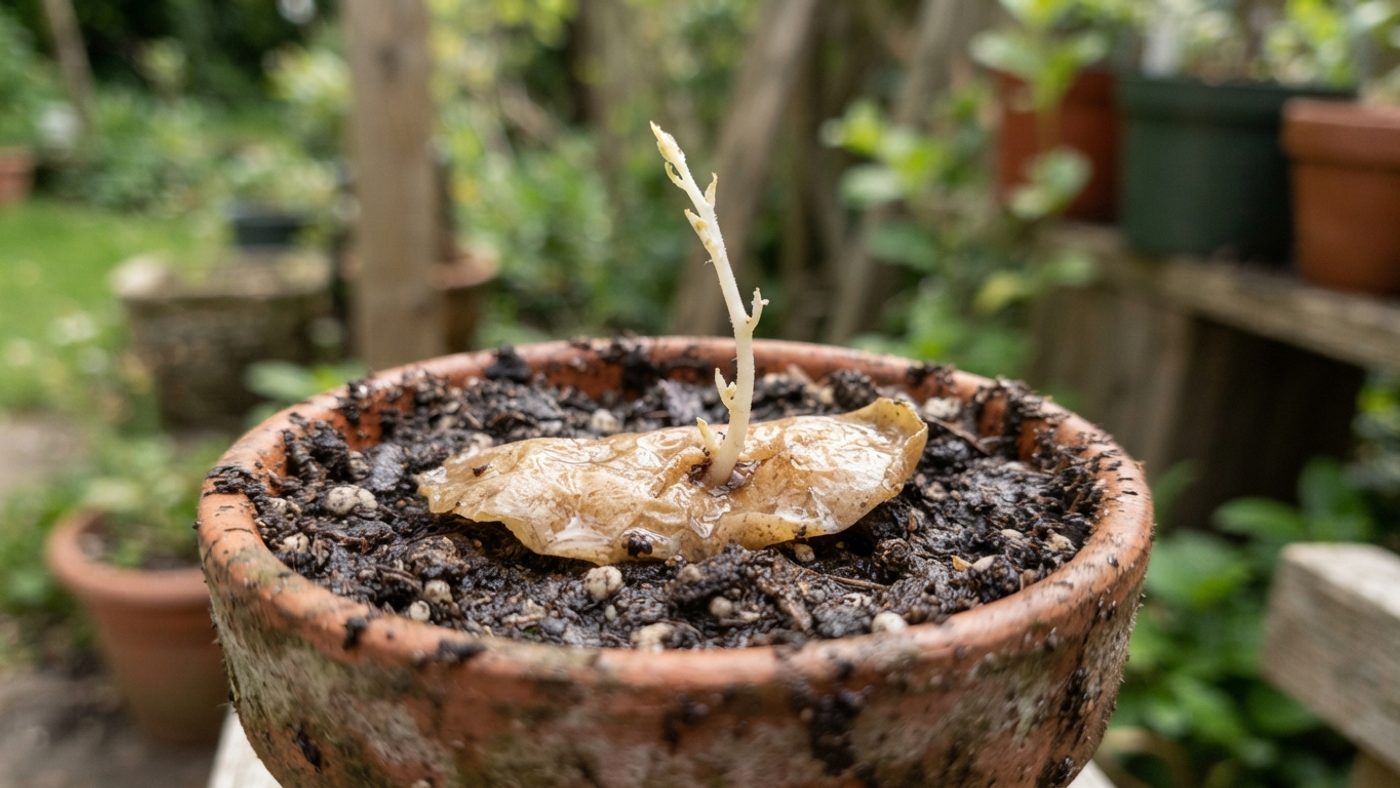
A peeling with an eye on it can sprout, that part is true, tubersA swollen underground stem or root a plant uses to store energy, which can also grow into a new plant, the classic example being a potato. Full definition → do this naturally, which is why forgotten potatoes in a cupboard start growing shoots. But a peeling is a sliver of skin with almost none of the stored starch a seed potato carries, and that stored reserve is what feeds the plant until it has enough leaf and root to feed itself. Which?'s guide to growing potatoes describes a from-scratch crop planted from proper seed potatoes in spring, maturing over a few months, a peeling might, with luck, produce a spindly shoot, but it is very unlikely to produce a worthwhile new potato at the other end.
"Regrow a full onion bulb from the root end"
The base of an onion, the flat disc of root tissue at the bottom, still attached when it's cut for cooking, will often sprout green shoots in water the same way a spring onion does. What it will not reliably do is swell back into a new storage bulb. Onions only start swelling into a bulb once day length and temperature reach the right combination over a full growing season, a threshold that applies the same way everywhere in the UK, not something Scotland's climate changes, which is exactly why the RHS's guide to growing onions is built entirely around starting from sets or seed each year, with no mention of regrowing a bulb from a kitchen scrap. Expect green shoots good for using like chives, not a new onion to slice.
"Grow an avocado tree from the stone"
An avocado stone suspended over water on cocktail sticks will often root and sprout, and it's a genuinely popular windowsill project, but it takes months to root at all, a tree grown this way from seed rather than graftedJoining a chosen fruiting variety onto a separate rootstock, so the tree grows the fruit of one plant on the roots of another. Full definition → can take a decade or more to flower if it ever does, and an avocado is nowhere near hardy enough to go outside in a Scottish garden at any stage. Worth doing as a houseplant curiosity, not as a food-producing project.
Quick reference
| Scrap | Method | First signs | Realistic result | Verdict |
|---|---|---|---|---|
| Spring onion root end | Root end in shallow water, roots submerged | About a week | Fresh green tops, milder than the original | Worth doing |
| Leek root end | Root end in shallow water, roots submerged | About a week | Fresh green tops, not a rebuilt leek | Worth doing |
| Celery base | Base in a shallow dish, water covering just the bottom | About a week | A handful of thin new stalks | Worth doing, in small amounts |
| Lettuce stem base | Cut stump in shallow water, changed regularly | 7-10 days | One or two smaller leaf harvests | Worth doing |
| Sprouted garlic clove (water) | Clove in a glass of water | A few days | Green garlic shoot, no bulb | Worth doing for the shoot only |
| Sprouted garlic clove (soil, full season) | Planted flat end down, grown through the season | Weeks to first growth, months to bulb | A genuine new bulb is possible | Worth doing, garden-centre clove preferred |
| Potato peeling | Peeling with an eye, in soil | Possible thin shoot | Rarely a worthwhile potato | Not worth relying on |
| Onion root end (for a new bulb) | Root end in water or soil | Green shoots appear | Shoots only, no new bulb | Not worth relying on for a bulb |
| Avocado stone | Suspended over water, then potted | Roots after weeks to months | A houseplant, rarely fruit | Curiosity only |
A note for flat and tenement kitchens
Everything on the "genuinely works" list above needs nothing but a jar, a windowsill, and a week or two, no allotment, raised bed, or even a balcony required, which is a real advantage for a tenement kitchen with no outdoor space at all. It doesn't need the long summer daylight a full potato or onion crop does, since sprouting from an already-formed base or clove is a much lower bar than bulbing from scratch, a spring onion or lettuce base will still put out new growth on a dim windowsill in a Scottish winter, just more slowly than in summer, and a south- or west-facing spot will get there faster than a north-facing one. Whatever doesn't regrow, garlic papers, the last inch of a celery base once it's spent, wilted outer lettuce leaves, is exactly the kind of scrap that suits a small kitchen compost caddy rather than the general waste bin. Beyond the windowsill jar itself, none of this technique is particularly Scotland-specific, the same jar of celery would do the same thing in London or Cardiff, but the no-outdoor-space, no-equipment nature of it makes it worth flagging for anyone gardening from a tenement flat, in the same spirit as composting in a flat with no garden.
Common questions
How long does it take for spring onions to regrow from scraps?
New green shoots usually appear within about a week of standing the root end in water; the tops are pickable within roughly two weeks, though they stay smaller and milder than a shop-bought bunch.
Can I get more than one regrowth from the same lettuce or celery base?
Lettuce stumps and celery bases will often push out a second, smaller batch of growth once the first is cut, though yields drop with each regrowth and most bases are spent by round two.
Is tap water fine, or does it need to be changed?
Plain tap water works. Change it every one to two days for celery and lettuce in particular — stagnant water encourages sliminess and smell well before any useful regrowth happens.
Can this be done with no garden at all, just a kitchen windowsill?
Yes — spring onion, celery, lettuce, and the water-glass garlic method all need nothing beyond a container, water, and a bit of daylight, which is why they suit a flat or tenement kitchen with no outdoor growing space.
How do I know if a scrap has gone off rather than just being slow?
A healthy base or clove stays firm and keeps its normal colour while it sprouts. Sliminess, a sour or rotten smell, or a soft, mushy texture mean it's spent — tip it in the compost caddy and start again with a fresh one rather than waiting to see if it recovers.
Does this work for leeks too?
Yes, the same way as spring onions: save the white root end with roots attached, stand it in water, and it will put up new green growth within about a week — a useful stand-in for the tops, though it won't rebuild into a full leek.
Sources
7 sources, recorded with what each was used for
- RHS: How to grow Salad Onions: Sowing times and harvest size/timing for spring onions, used to judge how a regrown scrap compares to a full crop
- RHS: How to grow Celery: Celery's water content, growing season, and moisture needs, used to explain why a regrown base stays small
- RHS: How to grow Lettuce: The RHS's own cut-and-come-again stump method, used as the basis for the lettuce verdict
- RHS: How to grow Garlic: Clove planting method, timing, and the caution against using supermarket bulbs
- RHS: How to grow Onions: Sets-versus-seed guidance, used to show a full bulb harvest is not built around regrowing scraps
- Garden Organic: Quick growing food: Windowsill container growing and the cut-and-come-again scissors technique for salad leaves
- Which?: The five easiest vegetables to grow: Potato-growing timeline and seed-potato basis for a proper crop, referenced in the potato-peeling verdict