
At dusk in a Scottish garden, a common pipistrelle drops out of the eaves and starts hunting, sending out calls too high for human ears and reading the echoes bouncing back off moths, midges and the odd mosquito, adjusting its flight path in real time to close in on each one. A single pipistrelle can take up to 3,000 midges and other tiny insects over the course of one night's foraging. For a gardener who has spent a summer evening being eaten alive on the patio, that fact alone is worth building a garden around.
Why bats matter in a garden
Every UK bat species is insectivorous, unlike some of their fruit-eating relatives elsewhere in the world. Moths, midges, mosquitoes, mayflies, caddis flies, lacewings and some beetles all end up on the menu, mostly taken on the wing using echolocation rather than sight.
Scotland has ten resident bat species, widespread across the mainland and absent only from Shetland and parts of Orkney. The common pipistrelle is the one most gardeners will actually see, often roosting in roof spaces and hunting low over gardens and around outdoor lighting at dusk. The soprano pipistrelle prefers wetland edges and hedgerows but turns up in suburban gardens and parks too. Brown long-eared bats are also frequent garden visitors, hunting more slowly and closer to foliage than the pipistrelles, gleaning moths and other insects directly off leaves rather than only catching them in open flight. Bat numbers have fallen over the past 50 years as roosting sites and insect-rich habitat have both become scarcer, and an ordinary garden with the right shelter, planting and water source helps reverse that locally, one midge-eating pipistrelle at a time.
Pesticides and insecticides cut straight against that: they strip out the moths, midges and other insects bats depend on, and can poison bats that eat contaminated prey afterwards. A garden that skips them keeps the insect-eating cycle above working in a gardener's favour, rather than starving it out.
Bat boxes: siting, height and the legal catch
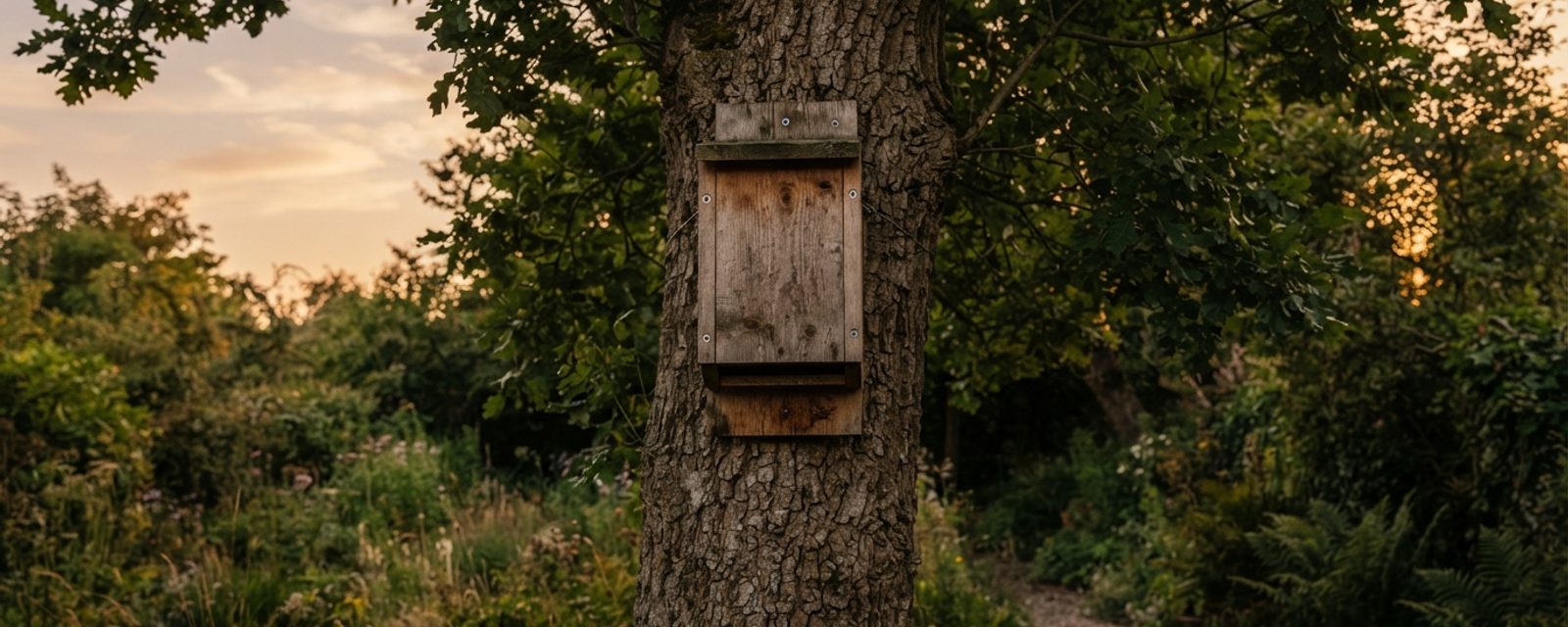
A bat box works like a highly specific bit of real estate: get the location wrong and it can sit empty for years. Most boxes are small enough to fit in one hand and can be bought ready-made or built from a simple untreated-timber design; the siting matters far more than the box itself.
| Factor | What to aim for |
|---|---|
| Height | At least 4 metres off the ground where you can install one safely, well clear of cats and other ground-level disturbance |
| Aspect | South, south-east or south-west facing, so the box gets sun for part of the day and warms up for roosting |
| Shelter | Sheltered from strong prevailing wind, not out on an exposed gable end |
| Light | Away from artificial light — street lighting, security lights and bright porch lights increase predation risk and put bats off using it |
| Navigation | Close to hedgerows, tree lines or other linear features bats use to find their way to and from the box |
| Material | Unplaned, untreated timber, or a commercially made box — never wood treated with preservatives |
Put up more than one box facing different directions if you can. Different aspects give bats a choice of temperatures through the season, and it also hedges against getting the single best spot wrong. Be patient: occupancy can take several months, sometimes years, even when a box is sited well, so an empty box in its first summer is not a failure.
Bats also shelter over winter in places a bat box doesn't replace: log piles, ivy-clad walls and trees, and undisturbed sheds or outbuildings all work as hibernation sites, worth leaving undisturbed alongside any box you put up, especially through the coldest months. Because most bat species hibernate over winter, that's also generally the lowest-risk time for hedge-cutting, ivy removal or tree work elsewhere in the garden, rather than during the spring-to-autumn months when bats are active and roosts are more likely to be in use.
Don't open a box to check on it once bats have moved in. It becomes a protected roost, and only a licensed bat worker may legally open one that's occupied. There's no need to clean a bat box out the way you would a bird box; leave it alone and let the bats manage it themselves.
Night-scented planting: feeding the moths bats hunt
The plants that work for bats aren't chosen for how they look, they're chosen for what they do after dark. Three traits make a plant genuinely useful for night-flying moths, and therefore for the bats that hunt them: pale or white colouring, which stays visible to insects navigating by starlight and moonlight long after darker colours disappear into the background; scent that is released or intensifies at night, when moths, not bees or hoverflies, are doing the pollinating and need a strong signal to find flowers in the dark; and tubular flower shapes, which suit the long, straw-like mouthparts moths use to reach nectar a shorter-tongued daytime insect couldn't access.
A planting scheme built around those three traits, run from early spring through to late autumn, gives moths, and the bats hunting them, a continuous food source across the whole active season, from when bats first emerge from hibernation to when they're building up fat reserves for winter.
| Plant | What makes it night-effective | Bloom season |
|---|---|---|
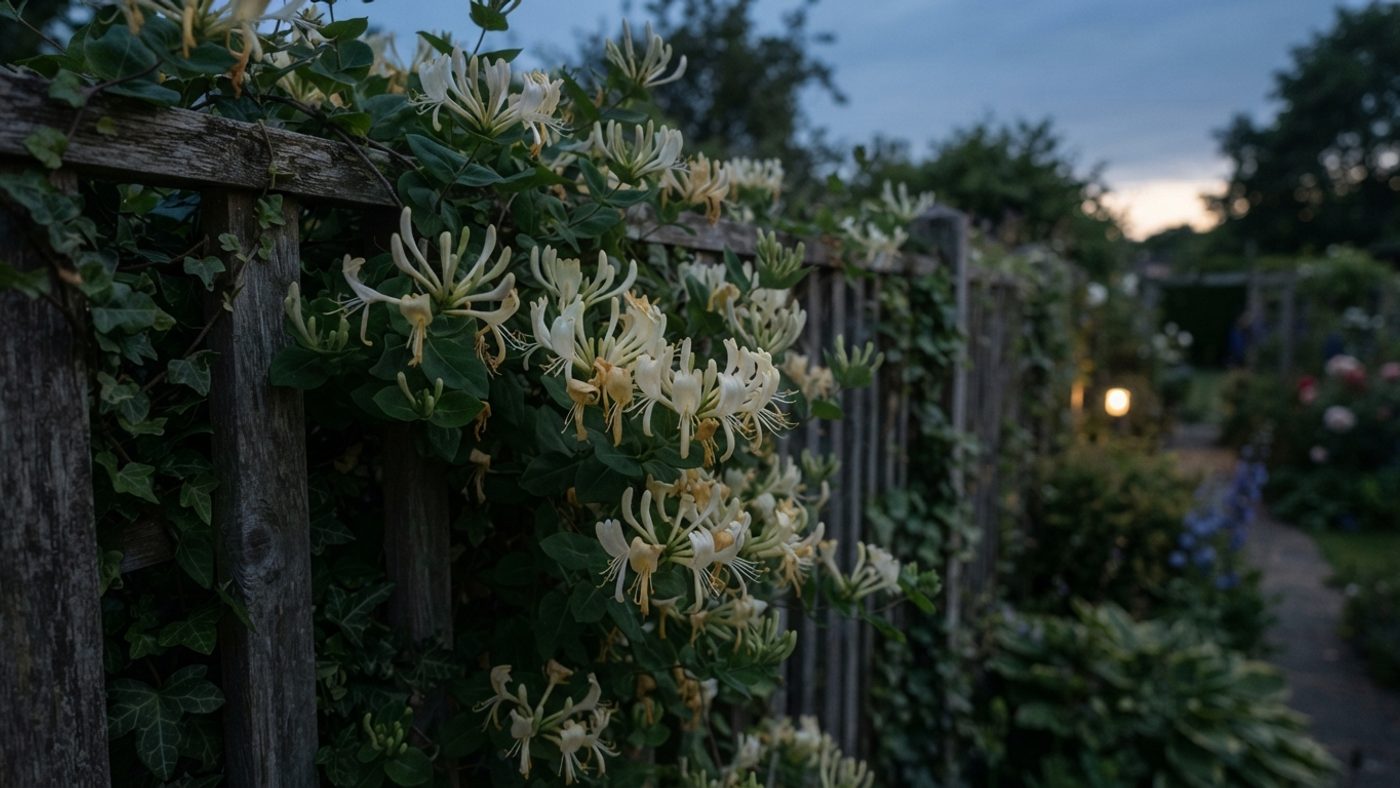
| Honeysuckle (Lonicera periclymenum) | Native climber whose fragrance strengthens noticeably after dark; tubular flowers suited to long moth mouthparts | Early summer–early autumn |
| Evening primrose (Oenothera biennis) | Pale yellow flowers that open in the evening; particularly associated with hawkmoth species | Summer–early autumn |
| Night-scented stock (Matthiola longipetala) | Unremarkable by day, releasing strong scent only once light fades | Summer |
| Tobacco plant (Nicotiana spp.) | Star-shaped, tubular white or pale blooms shaped precisely for moth feeding | Summer–first frosts |
Hemp agrimony is also worth including for the same reason: tall, pale flower heads that stay obvious to night-flying insects. For structure and reliability, native hedgerow species like hawthorn and elder are worth planting alongside these bedding and border plants rather than instead of them, since they extend the insect-feeding season further and do double duty as the navigation corridors bats need to find a garden at all. Varying flower height as well as species helps too, a mix of tall spires and low clumps gives moths, and by extension bats, more to work with than a single-height border.
Water features: a drinking and hunting ground
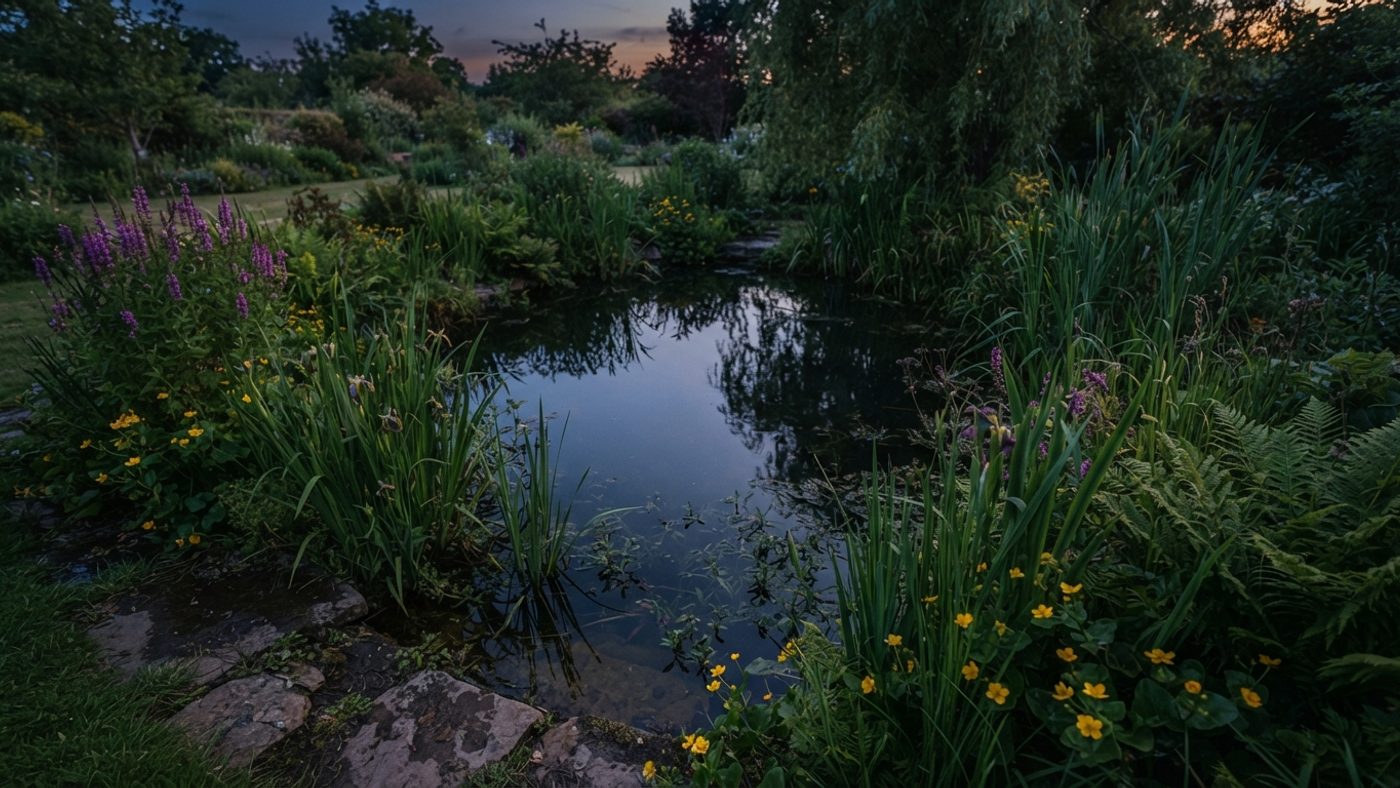
A pond does two separate jobs for bats. It's a water source they'll drink from in flight, skimming the surface without landing, and it's a hunting ground in its own right, because standing water breeds the midges and aquatic-larvae insects that are a favourite food of the pipistrelle. Daubenton's bat goes further and specialises in hunting low over water, sweeping just above the surface to take insects emerging from it; even a modest garden pond can pull this species in on a scale a border alone never will. You don't need anything elaborate, even a small water feature does the job, which matters if you're working with a balcony or a compact urban plot rather than a full garden.
A bat detector, a handheld device that converts echolocation calls into a range humans can hear, is a low-cost way to confirm bats are actually using a garden's pond or planting, rather than guessing from occasional silhouettes at dusk.
Lighting: the easiest thing to get wrong
Bright outdoor lighting works against everything above. Several UK bat species avoid lit areas altogether, so a security light or floodlit patio can push bats away from a pond, a border of night-scented planting, or a route they'd otherwise use to reach either. Where lighting is genuinely needed, the Bat Conservation Trust's advice is to keep it to the minimum necessary, aim it down and away from foraging routes and any known roost, and choose a warm-white bulb over a bright white or blue-white one, since cooler colour temperatures disturb bats more. None of this means a garden has to stay unlit, only that the planting and water features above do more good if the lighting around them isn't working against them.
Legal protection: what Scottish law actually says
In Scotland, bats are protected under the Conservation (Natural Habitats, &c.) Regulations 1994 (as amended), specifically Regulation 39. This is a different piece of legislation from the Wildlife and Countryside Act 1981, which covers other wildlife in Great Britain but does not apply to bats in Scotland. All ten bat species found in Scotland are classed as European protected species under these regulations, a legal category that goes well beyond the general protection most garden birds get, extending to the bat's roost and breeding site as well as the animal itself.
It's an offence to deliberately or recklessly capture, injure or kill a bat; to harass a bat or group of bats; to disturb a bat while it's occupying a roost, rearing young, migrating or hibernating; to obstruct access to a breeding site or resting place; or to damage or destroy a breeding site or resting place.
The nuance that catches people out: a roost is protected whether or not bats are in it at the time. The law protects the structure itself, a bat's resting or breeding place, not just the animal in residence. That means a roof space, tree cavity or gap behind cladding that bats use seasonally is still a protected roost during the months it's empty; you can't legally strip out a known bat roost in winter on the logic that no one's home right now.
What this doesn't mean: it doesn't mean every bat box needs a licence to put up, and it doesn't mean a bat flying through your garden at dusk triggers any legal obligation at all. The regulations are about disturbing, injuring or killing an actual bat, or damaging, destroying or blocking access to an actual roost; ordinary garden activity, birdwatching-style bat-spotting, and putting up an empty box are all outside their scope entirely.
If you find or suspect a bat roost
Bat droppings are easy to mistake for mouse droppings, and a gap behind cladding or a loft void isn't always obviously a roost until you're already working on it. If tree work, roof work or renovation turns up bats, droppings, or anything that looks like it could be a roost: pause the work immediately, without moving to another part of the building either, in case other roosts are present; don't disturb the bat or the roost further, and if a bat is exposed and can't safely be left alone or covered back over, contain it gently and call for advice rather than handling the situation yourself; and get advice before resuming, contacting NatureScot's Licensing Team for anything involving building or tree work that could affect a roost, or the Bat Conservation Trust's National Bat Helpline for general advice or an injured or grounded bat.
If you're not sure whether what you've found is actually bat droppings or a genuine roost, that uncertainty is exactly what the helplines below are for, you don't need to identify it yourself before calling. Acting responsibly the moment bats are found is what protects you here, you won't be in trouble for disturbing a roost you didn't know existed, provided you stop and seek advice as soon as you do. What isn't defensible is carrying on regardless, or resuming work simply because the bat flew off and is no longer visible: the roost is still protected even with no bat in sight, so the sensible move is to hold off until you've had advice.
NatureScot can license work that would otherwise be unlawful in some circumstances, covering cases like unavoidable building or tree work affecting a known roost, but that's a route arranged in advance through their Licensing Team, not something to assume applies retroactively after work has already disturbed a roost.
Who to contact: NatureScot's Bats in Houses helpline (01463 725 165, [email protected]) for bats in a home causing a public health or safety issue, with free bat-worker home visits available; NatureScot's Licensing Team (01463 725364, [email protected]) for building, renovation or tree work that could affect roosting bats; the Bat Conservation Trust's National Bat Helpline (0345 1300 228) for general advice or an injured or grounded bat; or the Scottish SPCA (0300 0999 999) as an alternative route for an injured or grounded bat.
Common questions
Do I need a licence to put up a bat box in my garden?
No. Putting up an empty box carries no legal requirement at all. The licensing point only applies later, and only if bats actually move in — an occupied box becomes a protected roost, and only a licensed bat worker may open one at that stage.
How long does it take for bats to use a bat box?
There’s no fixed timeline, and a box can sit unused for a season or two before anything moves in, so don’t take a quiet first summer as a sign the box was a wasted effort or badly placed. Putting up more than one box, at different heights and aspects, gives bats more than one option to discover and generally shortens the wait compared with pinning everything on a single box.
I think I have bats in my roof. Am I breaking the law by living there?
No. Simply having bats roosting in your home isn’t an offence, and you don’t need to do anything about their presence on its own. The law is triggered by actions that would disturb the bats or damage or destroy the roost, so the issue arises around building or renovation work, not around bats quietly living there. If bats in the house are causing a genuine public health or safety problem, NatureScot’s Bats in Houses helpline offers free home visits from a bat worker.
Can I trim or remove a tree if I think bats roost in it?
Not without checking first. Tree cavities, loose bark and dense ivy can all shelter roosting bats, and a roost in a tree is protected the same way as one in a building, whether or not bats are in it at the time you’re looking. Pause any planned work if you see signs of bats or find a cavity that looks suitable, and contact NatureScot’s Licensing Team before proceeding.
What plants actually attract bats to a garden, rather than just moths?
Nothing directly attracts a bat with scent or colour; bats are drawn by the promise of prey, not by the plant itself. The way to attract bats is to grow the pale, night-scented plants that draw moths, add a water feature for drinking and midge-hunting, and give bats somewhere to shelter with a well-sited box. Get the food and shelter right and the bats follow.
Sources
11 sources, recorded with what each was used for
- Bat Conservation Trust: Flight, food and echolocation: The up-to-3,000-insects-a-night figure for a common pipistrelle
- Bat Conservation Trust: Bat boxes, putting up your box: Box height, aspect, wind shelter, light avoidance, navigation-feature siting, occupancy timescale
- Bat Conservation Trust: Gardening for bats, bed and breakfast: Night-scented and pale-flower planting rationale
- Bat Conservation Trust: Gardening for bats, keep it dark: Lighting advice — minimising light near foraging routes and roosts, warm-white over cool-white bulbs
- Bat Conservation Trust: Bats and the law: Roost protection regardless of occupancy; confirmation the Wildlife and Countryside Act 1981 does not apply to bats in Scotland
- Bat Conservation Trust: I've found a bat during works: The pause/protect/seek-advice process for suspected roosts found during work
- Bat Conservation Trust: Maintaining your bat box: Confirmation that an occupied box requires a licensed bat worker to open, year-round
- NatureScot: Protected species — bats: Scotland's ten resident species, European protected species status, the offence list
- NatureScot: Bats, advice for homeowners: Bats in Houses helpline and Licensing Team contact details
- Legislation.gov.uk: Conservation (Natural Habitats, &c.) Regulations 1994, Regulation 39: Exact statutory offence wording for European protected species
- RHS: Bats in your garden: Bat diet, echolocation, and box aspect/siting