
You're standing in the garden centre with a climbing plant in your hands, and the label says "vigorous climber, full sun" and not much else. Is it going to wrap itself round a wire? Grip on with tendrils? Stick straight to the wall? Or just flop there until you tie it to something? Get this wrong before it goes in the ground and you end up either building a support the plant can't use, or watching a self-clinger you didn't need to build anything for slowly work its way into brickwork you'd rather it left alone. The plant's climbing mechanism, not its species name, is what should decide what you build first.
The ways a climber climbs
There are five distinct climbing mechanisms, and most named climbing plants fall clearly into one of them:
| Climbing type | How it climbs | What it needs | Examples |
|---|---|---|---|
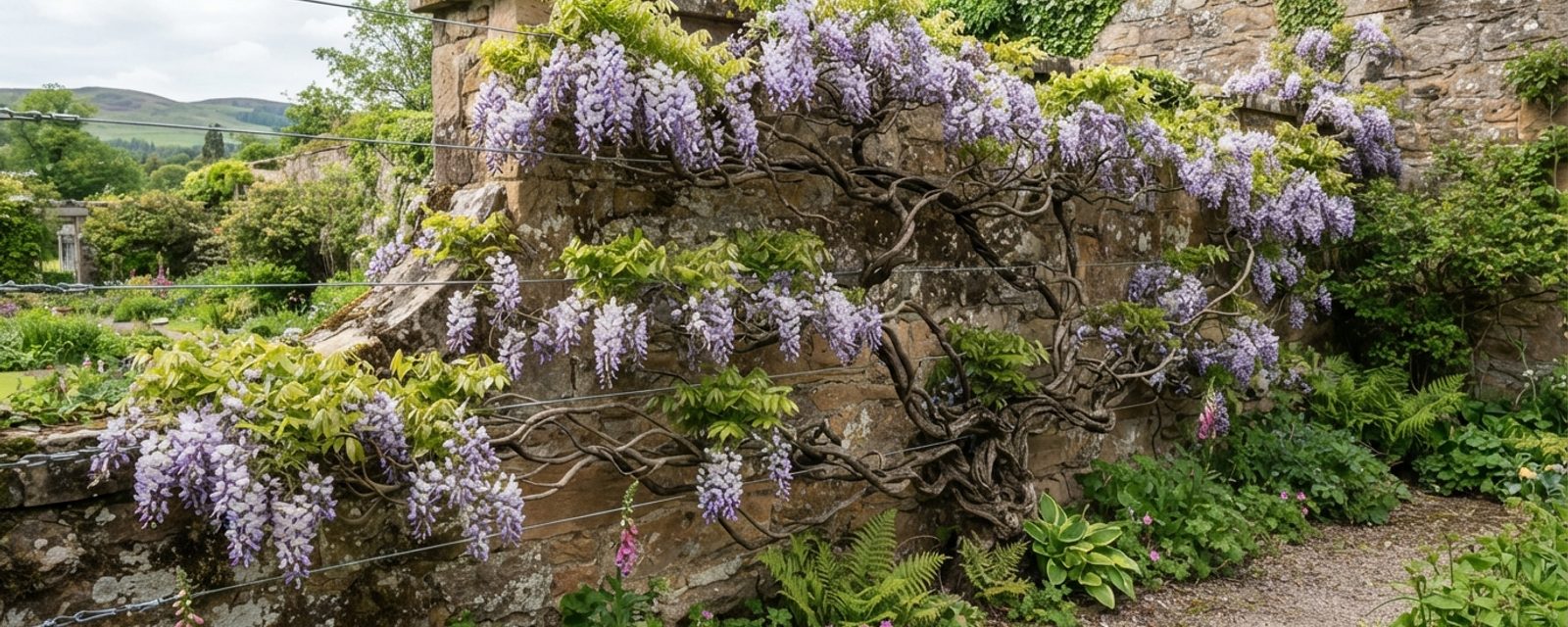
| Twining stems | The whole stem coils around a support | Something it can physically wrap around, wire, cane, or an obelisk strut. Not a flat wall. | Runner beans, honeysuckle, wisteria |
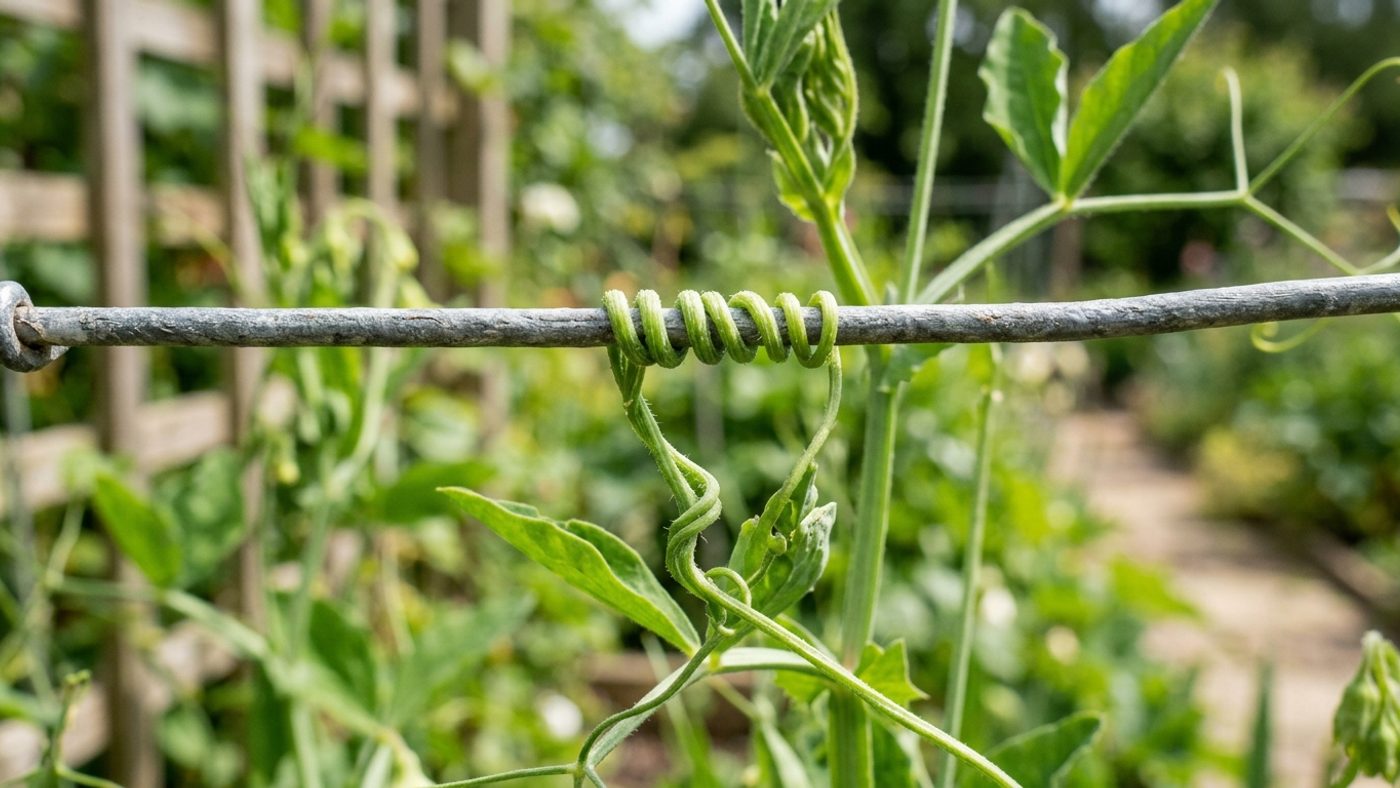
| Tendrils | Thin, coiling side-growths grip onto something narrow | A thin support the tendril can close around, wire, netting, or twiggy sticks | Sweet peas, grapes |
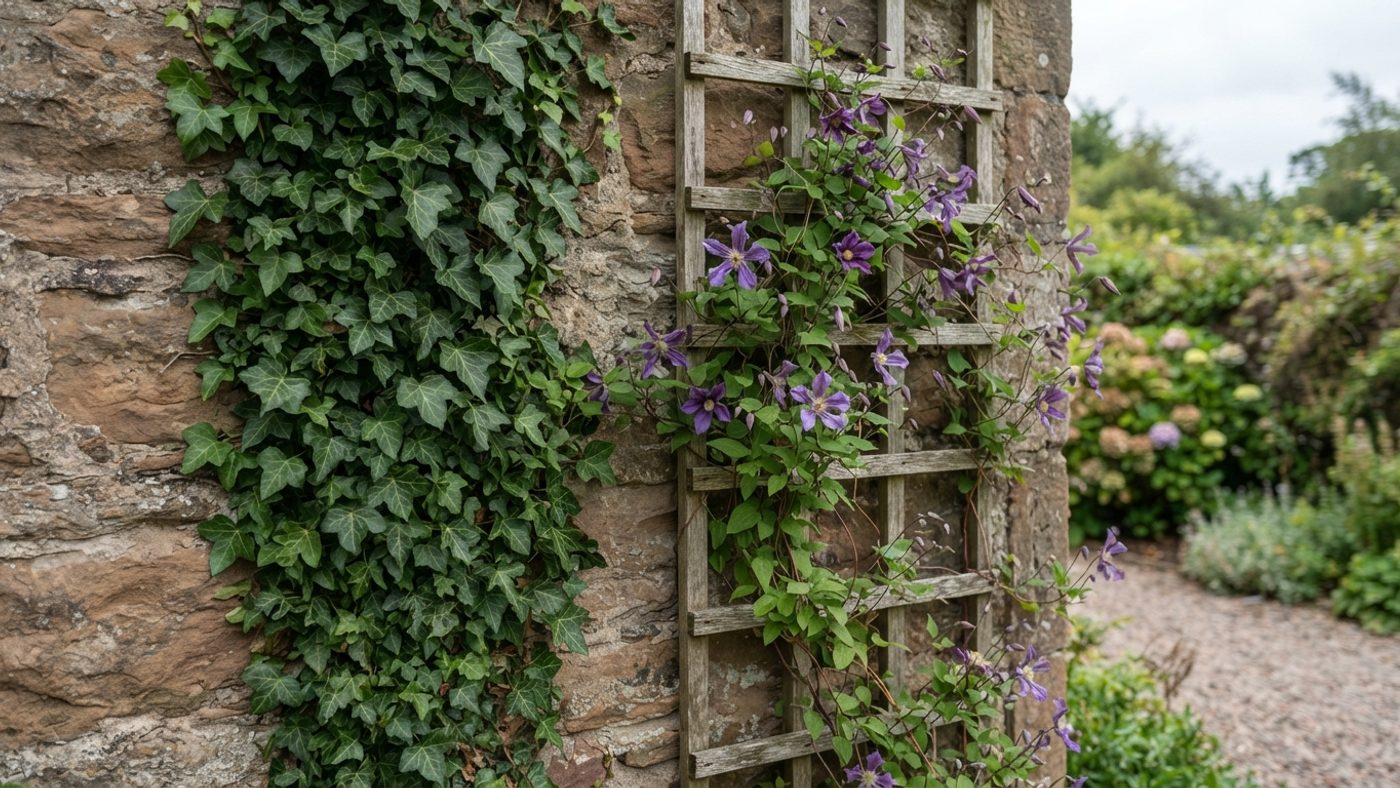
| Twining leaf-stalks | Leaf stalks (petioles), not the stem itself, wrap around a support | The same thin supports as tendril climbers, wire, netting, twiggy sticks | Clematis |
| Self-clinging | Aerial roots or sticky pads attach directly to a flat surface | Nothing. No support structure required at all | Ivy, climbing hydrangea |
| Scramblers | Long, often thorny stems that hook or lean but don't grip anything on their own | Wires or trellis, plus regular tying-in for the life of the plant | Climbing and rambling roses |
Clematis climbs by twining its leaf stalks readily around anything thin nearby, needing trellis or mesh it can get a stalk around rather than a solid panel. Even so, tying young growth in loosely with twine, in a figure-of-eight where the twine crosses between stem and support, helps spread the stems evenly across the support and keeps the display from bunching into a tangle at one point. A twiner put against a bare wall will simply flop, because there's nothing to wind around. A self-clinger given a trellis will ignore it and head straight for the brickwork next to it, because it was never going to use the trellis in the first place.
Building the right support
Install the support before the plant goes in, not after, trying to thread wires or trellis behind an established climber is far harder than doing it first.
Wires and vine eyes, for twiners and scramblers, need to stand clear of the wall and be spaced to suit what's growing on them:
| Fixing | Clearance from wall | Spacing | Notes |
|---|---|---|---|
| Wire and vine eyes | ~5cm | 30-45cm apart, lowest wire ~30cm above soil | Use 4mm galvanised or stainless wire for a heavy climber like wisteria; 2mm is enough for roses and honeysuckle |
| Wooden trellis | Same ~5cm, on battens | — | Keep the bottom edge 30cm above soil so it doesn’t rot where it meets damp ground |
Fixing into render or harling (the pebbledash-style textured render seen on many Scottish house walls) is a genuinely different job from fixing into bare stone or brick, and it's worth knowing which wall type you're dealing with before you start. Vine eyes made for hammering straight into a mortar joint have nothing solid to bite into on a rendered or harled surface, you need to fix through to the masonry behind, with a plug and screw rated for the wall's actual construction, not just for the render coat. On a harled wall, look for a mortar joint or a solid patch under the render to anchor into rather than drilling into the render itself, which can crack or flake away around the fixing over time.
Retrofitting an established climber that's already in the ground and growing the wrong way is harder than starting right, but not always a lost cause. For a twiner or tendril climber that's currently flopping with nothing to grip, wires or netting can usually still be worked in behind the existing growth a section at a time, redirecting stems onto it as you go rather than trying to thread the whole plant through in one go. A self-clinger already attached to a wall is a different matter, its aerial roots or pads are already in the surface, and pulling it off to fit a support behind it does more damage than leaving it to carry on self-clinging.
Obelisks and freestanding frames suit twiners and tendril climbers that need something three-dimensional to wrap around. A small obelisk can usually just be pushed into the soil; a larger one, or one that's going to be carrying a heavy, established plant, is better off anchored into a concrete footing rather than relying on soil alone. That's worth taking seriously in an exposed garden: a nominally small obelisk on an open plot, or anywhere exposed to Scotland's west-coast and upland wind, can still take a real gust load once it's covered in growth, and a proper footing is cheap insurance against having to re-set it later.
Bamboo-cane fans work well for training a young climber onto wires from planting: position three canes angled up toward the wires, tie the young stems and canes together with garden twine, remove weak growth as the framework fills in, and extend or remove the canes as permanent woody stems take over.
Planting distance from the wall matters regardless of support type, because a wall creates a rain shadow the plant's own foliage won't fix. Leave roughly 45cm between the plant and a solid wall or fence, or 20-30cm for a lighter support like a freestanding trellis panel, and angle the rootballThe mass of roots and the soil or compost clinging to them, as it comes out of a pot or out of the ground when a plant is lifted. Full definition → in toward the support rather than planting hard against it.
Aspect and hardiness still decide whether any of this works. A twiner like wisteria flowers best on a south- or west-facing wall, where it gets the warmth to ripen its wood, a bigger factor in Scotland's shorter, cooler summers than it would be further south, since there are fewer warm weeks available to do that ripening in. A self-clinger like climbing hydrangea does better on a north- or east-facing wall instead, and tolerates a sunnier spot too as long as the soil doesn't dry out in summer. Not every climber worth training is reliably hardy in a Scottish garden either, evergreen climbing hydrangea species need a sheltered spot, and last year's shoot tips can still be damaged by a hard frost even on an established plant. Building the right support is wasted effort on a plant sited or chosen wrong for the spot in the first place.
Wisteria outgrows most of the supports above: as a large, long-lived twiner it needs a genuinely permanent structure, wires or trellis built to carry decades of woody growth, not a seasonal cane, and sturdier ties than a lighter climber would need as its stems thicken. The full detail on how Scotland's shorter summer affects its flowering, and its two-stage summer/winter pruning cycle, is in the wisteria pruning guide.
Self-clinging climbers and older stone walls
Self-clinging climbers need no support at all, that's their whole appeal, but they attach by growing aerial roots or adhesive pads directly into the surface they're climbing, and that surface is a wall, not a piece of hardware you control.
Historic Environment Scotland's own guidance on biological growth on masonry names ivy specifically as one of the "higher plants" found on Scottish buildings, alongside grasses, bushes and trees, and is direct about what that category can do: "woody root growth can penetrate walls and dislodge stonework leading to structural damage." The same guide notes that fresh mortar is highly alkaline and that mortar generally stays more porous and alkaline than the stone around it for a long time afterward, which is part of why joints, not the stone face itself, are usually where a wall's biological growth, and root penetration, actually takes hold.
Fitting the wrong mortar to a traditional stone building is itself a documented cause of masonry decay: cement pointing incompatible with an older wall's original lime mortar is exactly the mismatch that damages it, quite separately from anything a climber's roots might do. Either risk points to the same practical takeaway: check what the wall was last pointed with and whether the joints are sound before letting a self-clinger loose on it, rather than assume an untouched wall is automatically fine.
Practically, that means treating "self-clinging climbers need no support" as true but incomplete. They need no trellis or wire, they still need a wall in good repair, and on an older stone building that's worth confirming before planting rather than after the growth is established and hard to remove without taking the pointing with it. It's also worth keeping any self-clinger, or a vigorous rambling rose for that matter, cut back well clear of gutters and roofline: growth that reaches the eaves ends up in the gutters and behind fascia boards, not just on the wall face, and that's a maintenance job worth doing from a ladder occasionally rather than leaving until it's a bigger one.
Tying in: the technique that stops stems getting damaged
Twiners, tendril climbers and self-clingers still need occasional guiding while they establish, and scramblers like climbing roses need it for the whole of their life, since they never grip a support unaided.
The basics: use soft garden twine rather than wire or anything rigid, wire can cut into a stem as it thickens with age, which is exactly the damage a tie is meant to prevent.
Tie loosely enough to allow room for growth, and place the tie just above a leaf node so it doesn't slip. For young, flexible growth a simple overhand knot around stem and support is enough; for heavier or older stems, and in a windy garden, use a figure-of-eight tie instead, loop the twine around the stem, cross the two ends, loop them around the support, and finish with a double knot. The crossed loop keeps the stem from rubbing directly against the support as it moves in the wind, which is the main thing that causes chafing damage over time. For heavy, woody climbers like an established rose or wisteria, fabric strips or rubber ties do the same job with a wider, softer contact surface.
Check ties as the plant grows through the season, a fast-growing climber can put on enough new length to need retying every week or two during its main summer growth spurt, and loosen or replace any tie that's starting to bite into a thickening stem before it cuts in properly. Natural jute or hemp twine rots faster in a consistently wet climate than in a drier one, so check ties made from it more often through a damp Scottish summer, or use a synthetic soft-tie tape instead for anything that needs to hold for more than a season.
Common questions
My climber has tendrils but the only support I’ve got is a solid wooden fence panel, will it climb it?
No. Tendrils need something thin enough to coil around, so a solid panel gives them nothing to grip. Fix netting or horizontal wires to the fence first, spaced closely enough for the tendrils to reach across, and the same plant that ignored the bare panel will climb readily.
Can I put trellis up for ivy so it climbs faster?
There’s no need, ivy is self-clinging and attaches directly to the wall surface with aerial roots, so trellis behind it does nothing. The one thing worth doing is checking the wall itself is in good repair first, since ivy’s roots go into whatever gaps or open joints are already there.
How do I know if my climber is a twiner or a scrambler if the label doesn’t say?
Watch the new growth for a season. A twiner’s shoot tips will actively wind themselves around anything narrow nearby within days; a scrambler’s stems just extend outward and flop unless you tie them to something. Roses are the classic scrambler, vigorous stems, no gripping mechanism of their own.
Is a figure-of-eight tie really necessary, or is a simple loop good enough?
A simple loop is fine for young, thin growth that isn’t going to thicken much before you retie it. Once a stem is heavier, or the spot is exposed to wind, the figure-of-eight is worth the extra few seconds: the crossed twine keeps the stem off the support directly, which is what stops it rubbing and scarring as it moves and thickens.
Do self-clinging climbers damage every kind of wall, or just old ones?
The stated risk, from Historic Environment Scotland’s own guidance, is about woody root growth getting into existing gaps or deteriorated joints and prising them further apart, not about aerial roots or pads attacking sound masonry on their own. That risk exists on any wall with poor pointing, old or new, but an older stone building is more likely to have joints that haven’t been checked or repointed recently, which is the condition that actually matters, so it’s worth checking rather than assuming.
Sources
7 sources, recorded with what each was used for
- RHS: Climbers - Training and Pruning: Support installation specs (wire clearance and spacing, wire gauge, trellis mounting), planting distance from walls to avoid rain shadow, obelisk anchoring, bamboo-cane fan training method
- RHS: How to Tie-in Climbers: The four climbing mechanisms, tying-in procedure, figure-of-eight knot technique, tie materials and the warning against wire ties
- RHS: How to Grow Climbing Hydrangeas: Recommended north/east aspect, tolerance of sunnier spots given moist soil, evergreen species needing shelter, frost damage to shoot tips
- RHS: How to Grow Clematis: Clematis’s leaf-stalk (petiole) twining mechanism, mesh/trellis clearance from the wall, figure-of-eight tying-in technique to spread stems evenly
- Gardeners’ World: How To Plant Climbers: Planting distance from walls, bridging canes for self-clinging climbers while they establish, tying stems in after planting
- Historic Environment Scotland: Biological Growth on Masonry - Identification & Understanding: The "higher plants" category naming ivy, the woody-root-penetration/structural-damage statement, mortar alkalinity/porosity notes
- Historic Environment Scotland: Lime and Cement in Traditional Mortars: Existence of dedicated guidance on lime-versus-cement mortar compatibility and its role in preventing masonry decay on traditional stone buildings