
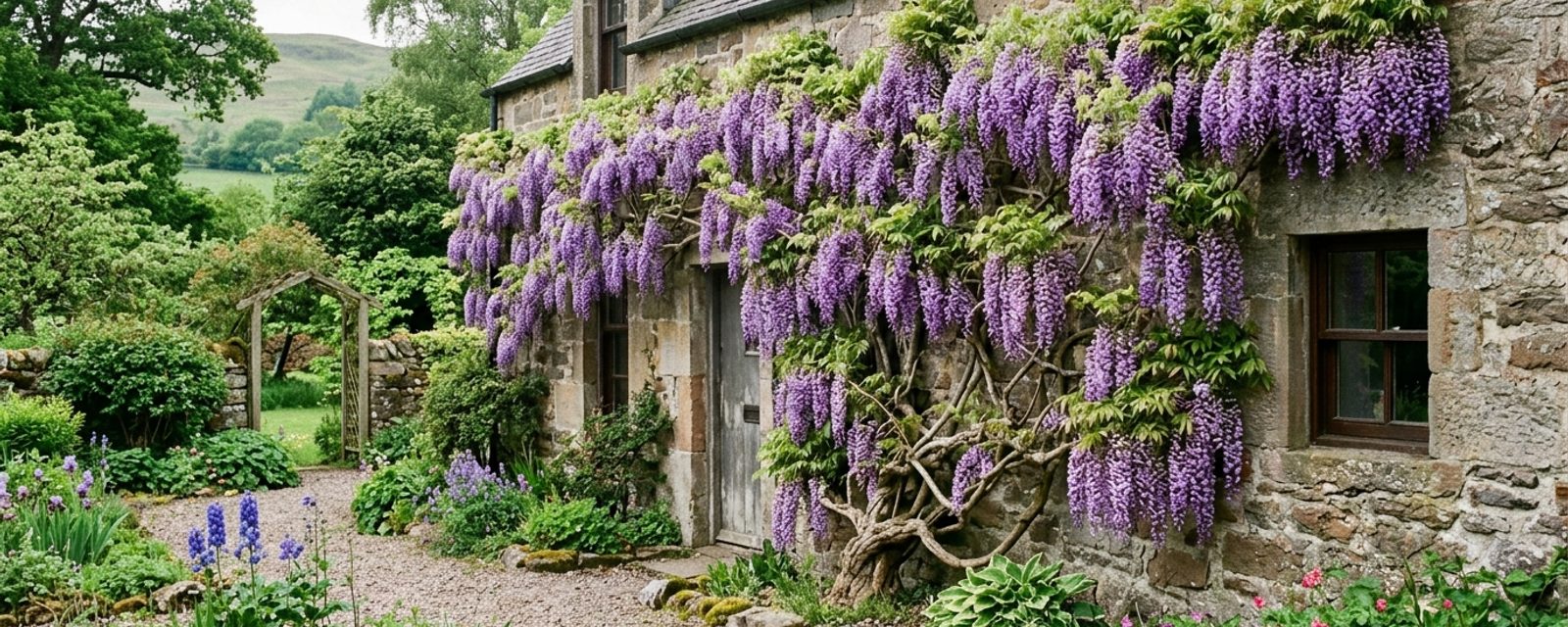
Wisteria gets pruned twice a year, not once, and the two cuts are doing genuinely different jobs. Miss the summer one and you're not just being untidy, you're skipping the step that turns this year's whippy growth into next year's flower buds in the first place. In Scotland that step has less to work with: a shorter, cooler summer gives new woodWhether a plant fruits on stems grown the previous year (young wood) or on older, established branches (old wood), which decides how it's pruned. Full definition → fewer warm weeks to ripen before the plant shuts down for winter, which is exactly the process the summer prune is meant to help along.
Two cuts, two different jobs
The summer prune, done in July or August, shortens the current season's whippy green shoots back to five or six leaves. Those shoots are easy to tell from older wood: they're thin, flexible and pale-barked, the fast, leafy growth the plant has put on since spring, quite different from the thicker, greyer, rigid wood below that's already flowered or carried previous years' growth.
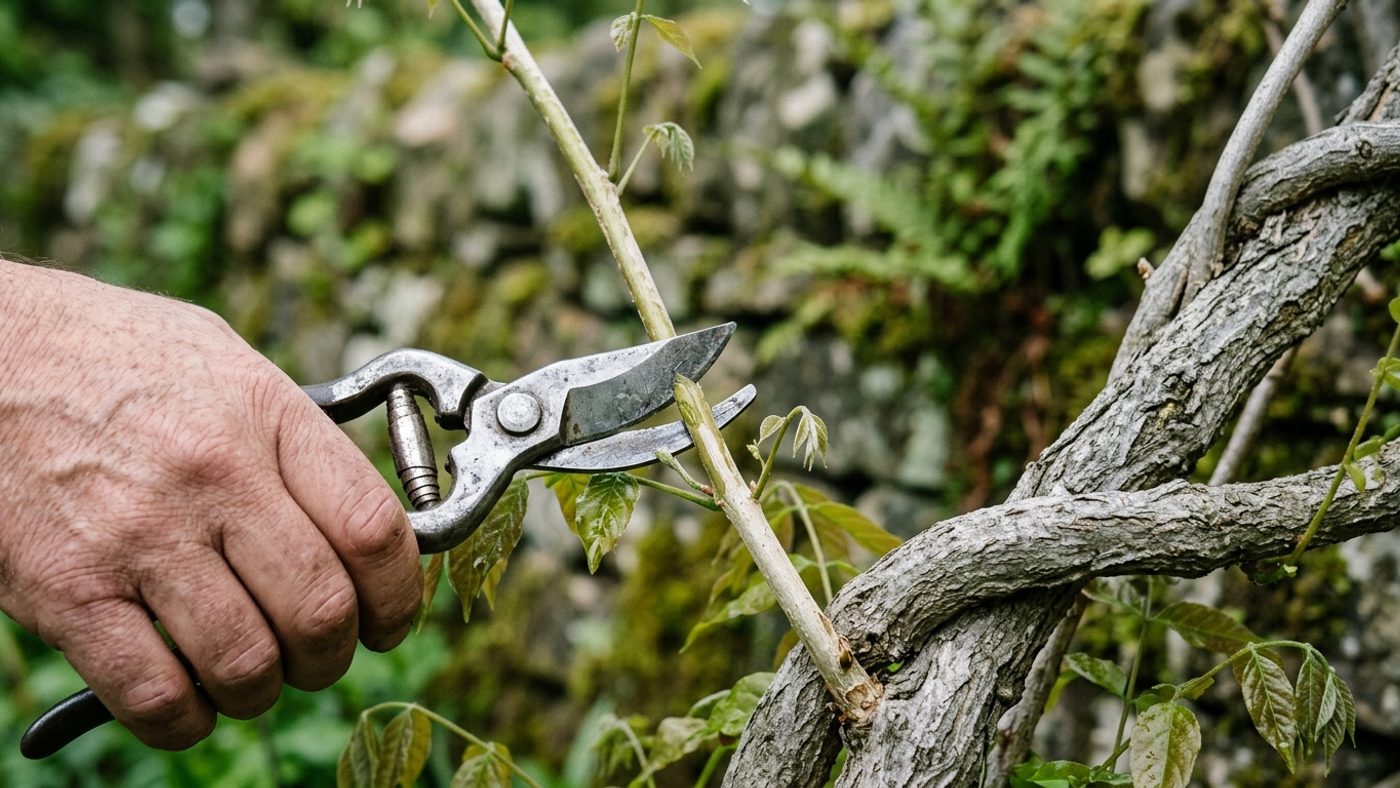
Cutting the young shoots back isn't tidiness: it lets more light and air reach the base of the young growth, which encourages the wood there to ripen and improves the odds of flower buds forming along it. The winter prune, done in January or February, goes back over those same shortened shoots and cuts them again, this time to two or three buds, roughly 2.5–5cm from the older wood. By then the plant is dormant and the framework is settled for the year, so the winter cut is about restricting vegetative vigour and making sure the coming flowers won't be hidden behind a mass of leafy growth.
| Stage | Timing | Cut back to | What it's for |
|---|---|---|---|
| Summer prune | July–August | 5–6 leaves on the current season's whippy shoots | Lets light and air reach the base of new growth, encouraging wood ripening and flower bud formation |
| Winter prune | January–February | 2–3 buds (2.5–5cm from older wood) on the same shortened shoots | Restricts vegetative vigour and keeps the coming flowers from being hidden by foliage |
Both cuts work on the same shoots in sequence, the winter prune isn't a separate structural job, it's finishing what the summer prune started. Skip the summer cut and rely on winter alone, and you're pruning a plant that's had all summer to put its energy into leafy extension growth instead of flower buds, the wood never got the light and air it needed to ripen, so there's less for the winter cut to work with regardless of how well that second cut is done.
Why a shorter Scottish summer changes what this pruning is doing
"Wood ripening" is the plant physically maturing that season's new growth, converting soft green growth into firmer, woodier stems capable of carrying flower buds, and it needs warmth and light to happen, over enough weeks to complete before the plant goes dormant. Some plants simply won't set flower buds without a genuinely warm stretch to ripen the wood, and wisteria is named specifically as one of them: it flowers best on a south- or west-facing wall, and in cool summers, or on north- and east-facing sites, it can struggle to flower at all. At Wisley, a hot summer was directly credited with unusually good wood ripening and a correspondingly heavy show of flower buds the following spring, the same mechanism working in the opposite direction from a cool one.
Scotland's summers run measurably cooler than England's, not just in isolated bad years.
| Summer | Region | Mean temperature | Comparison |
|---|---|---|---|
| 2025 (UK's warmest on record overall) | Western Scotland (warmest Scottish region) | 14.43°C | ~4°C below southeast/central-south England's 18.15°C |
| 2025 | Northern Scotland | 13.56°C | Lowest of any UK region that summer |
| 2024 (UK's coolest since 2015) | Scotland | 0.40°C below its own long-term average | England ran only 0.07°C below its own average the same summer |
Even in a record-warm UK summer, Scotland's warmest region still ran meaningfully cooler than England's, and in a cool UK summer Scotland cools further below its own average than England does. Either way, wisteria's wood is getting less accumulated warmth, over a shorter window, for the same ripening process the summer prune exists to support.
The July–August window itself is still right for a Scottish garden. What changes is how much weight two things carry alongside it. A south- or west-facing wall isn't just the generically better site everywhere: with less summer warmth on offer to begin with, choosing the warmest, most sheltered spot available does more of the work of getting the wood ripe. And it's worth expecting a genuinely lighter show of flower buds in some years, even from a well-pruned, well-sited plant, simply because that summer didn't deliver enough warm weeks to ripen the wood fully, that's a climate limit pruning technique can support but not fully overcome, and it's worth knowing that going in rather than assuming a thin flowering year means the pruning was done wrong.
Which wisteria, and what it needs to hold it up
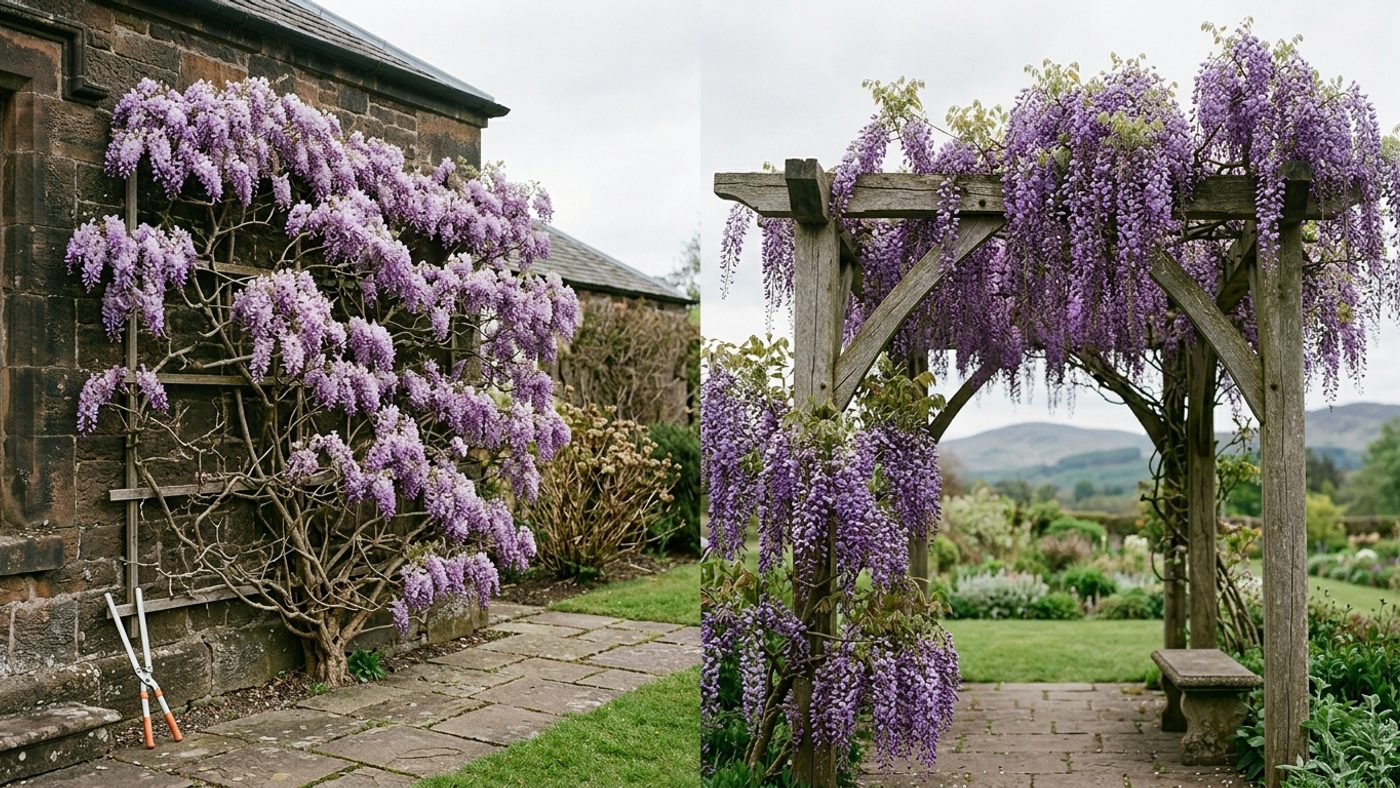
The two most widely grown wisterias behave slightly differently, and it's worth knowing which one you have before you start training it onto a support. Chinese wisteria (Wisteria sinensis) twines anticlockwise and flowers before its leaves emerge, giving a clean, uncluttered spring display best shown flat against a wall. Japanese wisteria (W. floribunda) carries the longest flower chains (racemes) of the genus, to 30cm or more, and looks best where those chains can hang free of foliage, a pergola or arch rather than a flat wall. A more compact option, W. frutescens 'Amethyst Falls', is rated H5The RHS's H1a–H7 scale for how much cold a plant can survive outdoors, H1a being tender indoor-only and H7 hardy anywhere in the UK. Full definition → by the RHS (on the RHS's nine-point hardiness scale, where a higher number means hardier; H5 is hardy in most places throughout the UK, one step below the H6 carried by Chinese and Japanese wisteria) and is small enough to grow in a container, worth knowing about if space, rather than climate, is the limiting factor.
Winter cold itself isn't the risk in Scotland for Chinese or Japanese wisteria: both are rated H6, hardy throughout the UK and northern Europe down to -20 to -15°C, well beyond anything a Scottish winter delivers. 'Amethyst Falls', at H5, carries a somewhat lower margin, though still hardy in most UK gardens. Either way, the real vulnerability in a Scottish garden sits with the flower buds, not with whether the plant itself survives winter.
Whichever type you're growing, plan for its final size from day one: wisteria is a large, long-lived climber that can reach over 10m in height and width at maturity, and the woody stems it builds up need genuinely strong support, sturdier ties than a lighter climber would need, run to a permanent structure such as wires or trellis against a wall, or a pergola or arch built to carry that weight for decades, not a temporary cane. It also wants well-drained, fertile soil to establish into, ground that sits wet through winter suits it poorly regardless of region. See training climbing plants for how wisteria's twining habit compares to other climbers, and the wire-and-vine-eye spacing a support like this needs.
To train a young plant as a standard, grow a single stem up a stout 1.2–1.5m stake, and once it reaches the top, remove the growing tip the following February to force sideshoots. From then on, shorten those sideshoots to 15–30cm each winter, building up a permanent branch framework the same way the summer/winter pruning cycle maintains an established plant.
Wisteria is also harmful if eaten, for people and pets alike, and it's worth wearing gloves when handling it, worth knowing if it's being trained over a pergola or arch used for sitting or eating under, or if there are children or pets in the garden.
Why your wisteria hasn't flowered yet
This is the question that sends most frustrated wisteria owners looking for answers, and pruning technique is only part of the story. A wisteria grown from seed can take up to twenty years to flower, and even then the results can disappoint, one of the strongest reasons to buy a named, graftedJoining a chosen fruiting variety onto a separate rootstock, so the tree grows the fruit of one plant on the roots of another. Full definition → cultivarA plant variety that arose or was bred under cultivation and is kept true by deliberate propagation, rather than a naturally occurring wild species. Full definition → rather than a seedling, since grafted plants flower far more reliably, though even they can sit for a year or two after planting while they establish roots before flowering starts. At Wisley, a particularly early-flowering cultivar took five years to produce its first bloom, not because of poor establishment but because repeated late-spring frosts damaged the flower buds in successive years before one finally survived through to opening.
Flower buds for next year's display actually form in late summer, roughly July to September, of the year before they open, which is exactly the same window the summer prune falls in and the same window wood-ripening happens in. Several separate things can go wrong with that same window, on top of a well-pruned plant:
| Cause | What's happening | What to do about it |
|---|---|---|
| Dry soil, July–September | The developing flower buds abort outright, with no visible sign until the following spring | Water through late summer, especially for a plant trained flat against a wall, where the wall itself creates a rain shadow even in a wet Scottish summer |
| Sharp spring frost | Buds already swelling can drop before opening, or open distorted | Site on a sheltered, south- or west-facing wall; watch the forecast into spring rather than assuming the risk has passed once winter's over |
| Deep shade | Wisteria flowers best in full sun; few or no flowers form in significant shade | Reposition or prune back overhanging growth that's shading the plant |
| Low potassium (poor, light or heavily-cropped soils) | Growth continues but flowering is held back | Apply sulphate of potash in spring, at 20g per square metre |
| A cool, short summer | Less accumulated warmth to ripen the wood the flower buds need to form on | Not something pruning alone fixes; site selection is the main lever available |
Heavy pruning, or pruning in early summer before the current season's growth has had a chance to extend and be cut back properly, disrupts flowering too, exactly why the two-stage July/August-then-January/February timing exists as a routine rather than a single flexible cut whenever there's time. A plant pruned correctly and consistently, on a sheltered, sunny wall, with even watering through late summer, is doing everything pruning technique can control. The years it can take a young wisteria to come into flower is real and separate from all of this, and not a sign anything's being done wrong.
Renovating an overgrown wisteria
An old, overgrown or neglected wisteria can be hard-pruned back into shape rather than removed: drastically shorten long, unproductive branches and remove older wood back to a strong lower branch or, in extreme cases, close to ground level, aiming to leave a skeleton framework of well-spaced main branches to build back from. Don't feed the plant the following spring, feeding after a hard renovation prune stimulates strong new vegetative growth at exactly the moment you want the plant redirecting its energy into recovery and flower buds instead.
Common questions
Why hasn't my wisteria flowered even though I've pruned it properly?
Pruning is only one factor. Seed-grown plants can take up to twenty years; even reliable grafted cultivars can sit for a year or two after planting. Shade, dry soil in late summer (when next year's buds are forming), a hard late-spring frost, or low potassium can all suppress flowering on a well-pruned plant, and Scotland's cooler summers mean the wood itself sometimes has less warmth to ripen with regardless of technique.
Can I skip the summer prune if I'm short on time and just do the winter one?
You can, the plant stays in shape either way, but expect fewer flowers: the winter cut alone doesn't do the light-and-air job the summer cut does.
How do I tell my wisteria's whippy new growth from its older wood?
New growth is thin, flexible and pale-barked, and it's what's grown since spring, often trailing loosely away from the support if not yet tied in. Older wood is thicker, greyer and rigid, and has already flowered or carried a previous year's growth. The summer prune only targets the new growth.
How do I know if my wisteria is a young plant still establishing, or a mature one that should be flowering by now?
A grafted cultivar more than four or five years old, sited in full sun on a south- or west-facing wall, pruned on the summer/winter cycle, and watered through late summer, should be flowering. If it isn't, work through the causes above, shade, dry late-summer soil, frost damage, or potassium, rather than assuming it just needs more time.
Sources
12 sources, recorded with what each was used for
- RHS: Wisteria Pruning Guide: Summer and winter pruning timing and technique, wood-ripening rationale, standard training, hard-pruning/renovation, no-feed-after-renovation advice
- RHS: Wisteria Frequently Asked Questions: Time to first flowering (seed vs grafted), flower-bud formation window, dry-soil bud abortion, spring frost damage, potassium/sulphate of potash advice
- RHS: Non-Flowering Woody Plants: Wood-ripening/heat requirement for flower bud set, wisteria named for best flowering on a south-facing wall, cool summers and north/east aspect linked to poor flowering
- RHS: How to Grow Wisteria: Recommended aspect, sun requirement, mature size, support structure needs
- RHS: How to Tie-in Climbers: Need for stronger ties on heavy woody climbers such as wisteria
- RHS: Wisteria sinensis 'Prolific': Chinese wisteria's anticlockwise twining habit and raceme length
- RHS: Wisteria sinensis: Toxicity note (harmful if eaten, people and pets; wear gloves when handling)
- RHS: Wisteria floribunda: Japanese wisteria's raceme length
- RHS: Wisteria frutescens 'Amethyst Falls': Hardiness rating and compact, container-suitable habit
- RHS: Wisteria Walk First Flowering (Wisley): Real example of years-to-first-flower, frost damage delaying flowering, a hot summer's effect on wood ripening and bud set
- Met Office: Summer 2025, A Regional Breakdown: Regional mean summer temperature figures, Scotland vs England comparison in a record-warm summer
- Met Office: UK Experiences Coolest Summer Since 2015: Scotland's summer temperature anomaly against England's in a cooler year, corroborating the regional gap across different summers