
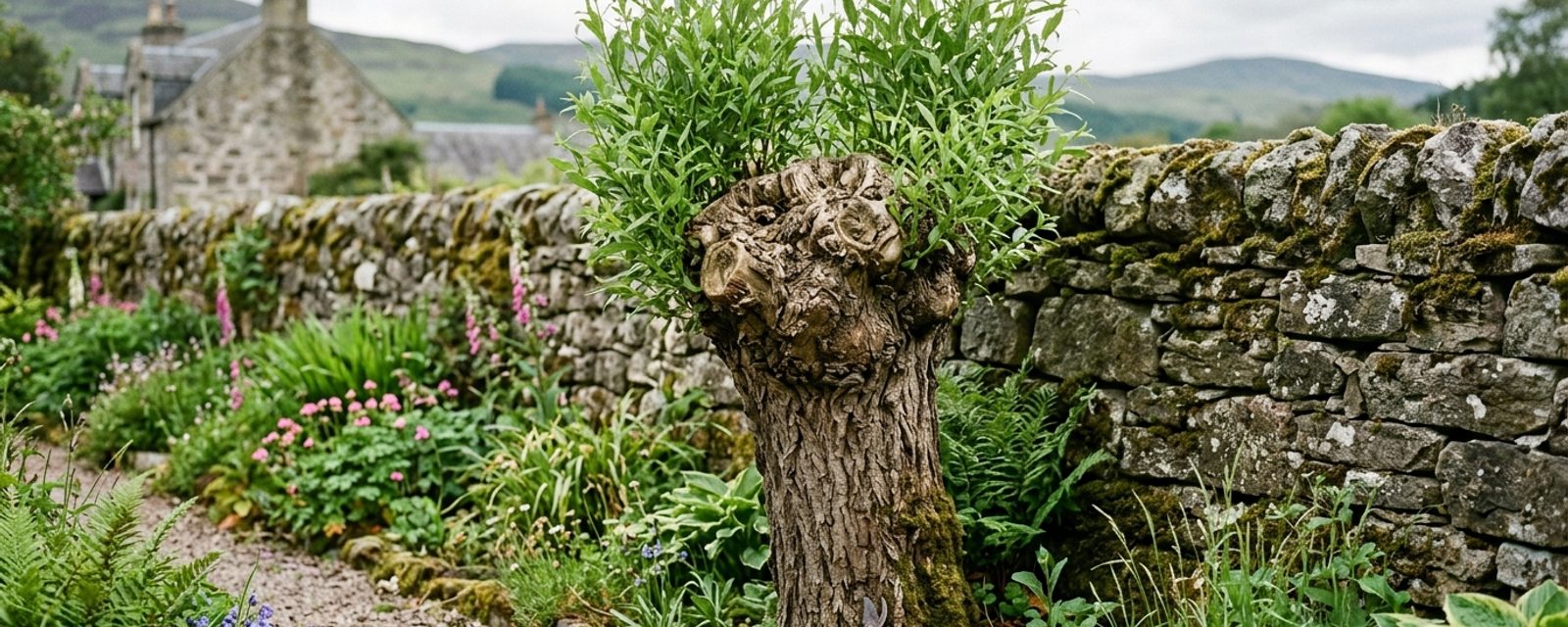
The safe week for this kind of cut is a moving target: late enough that the tree is still properly asleep, early enough that nothing's nesting in it yet, and every year that window sits in a slightly different place depending on how the winter's gone. Further south, gardeners are told to get the saw out "in late winter, before growth restarts" and treat that as fixed. In a lot of Scotland, growth restarts weeks later than that advice assumes, which sounds like it just buys more time, until the other end of the calendar, nesting birds, closes in from the opposite direction, and the window turns out to be narrower than it looks, not wider.
Pollarding and coppicing are both hard, structural cuts, nothing like routine pruning, done to a small number of specific plants for specific reasons, not general maintenance for every tree and shrub in the garden. Getting the technique right matters. Getting the timing right matters just as much, and it's the part general advice tends to gloss over with a season name instead of a real answer.
Two different jobs, not two names for the same thing
Both techniques cut a woody plant back hard and rely on it resprouting from below the cut, that's as far as the similarity goes. Where the cut is made, and why, are genuinely different.
Pollarding: a permanent framework above browsing height
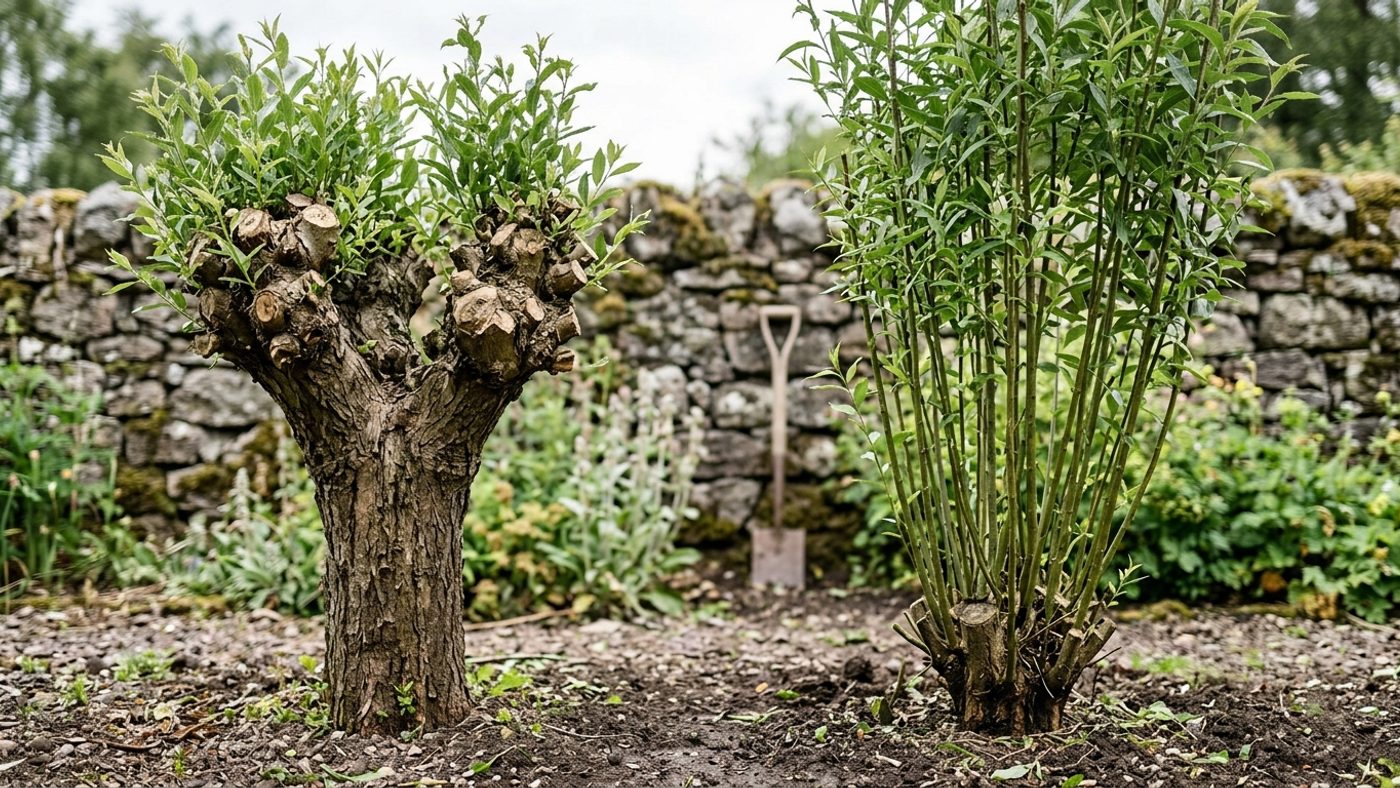
Pollarding keeps a tree or shrub smaller than it would grow naturally by repeatedly cutting new growth back to the same points on a permanent framework of branches, year after year. On a young shrub that framework might be around a metre up; on a tree, it's usually a trunk carrying three to five main branches, cut back hard to more or less the same spot each time. Over years of repeat cuts, each of those cut points swells into a knobbly "pollard head," and it's from that same permanent knuckle that new growth breaks each year, the framework itself never changes once it's established.
Ash, common lime, elm, elder, eucalyptus, London plane, mulberry, oak, box elder and tulip tree are the species regularly grown this way in gardens; willow, beech, hornbeam and holly are added to that list where pollarding is used on a larger, woodland scale. A few of the garden list, eucalyptus, mulberry and tulip tree, are also borderline for hardiness or reliable ripening in a colder Scottish garden regardless of cutting timing, worth checking against the specific site before committing a framework to one. Once a framework is established, pollarding is usually repeated annually to hold the size. Late winter to early spring is the standard timing, though maples specifically are better cut in summer, since a late-winter cut on Acer bleeds sap heavily; autumn is worth avoiding across the board, since fresh wounds are more exposed to decay fungi going into a wet season, a real consideration on the west coast and in the Highlands specifically, where autumn and winter rainfall runs well ahead of the drier east. A pollard that's been left unpruned for years shouldn't just have its size restored in one go, the branches produced from a neglected pollard head are often poorly attached and can fail in wind once they're carrying real weight again, a real risk on an exposed west-coast, island, or upland site where average wind loading is higher than in a sheltered lowland garden.
Coppicing: cutting back to the ground
Coppicing aims at a different outcome entirely: the whole plant is cut back to somewhere between 5 and 7.5cm above ground level (or back to the previous year's stubs, once the cut base, the "stool", is established), and it responds by throwing up a cluster of new stems from the base rather than regrowing a single trunk. It's the technique behind multi-stemmed shrubs, the vivid winter stem colour on dogwoods and willows grown for that purpose, oversized foliage on plants grown for leaf effect rather than flower, and rejuvenating a shrub that's become leggyDescribes a plant that's grown tall, thin and sparse rather than bushy, usually from too little light or not being pinched out. Full definition →, woody, or generally past its best.
Beech, dogwoods, elder, eucalyptus, hazel, hornbeam, lime, ornamental bramble, smoke bush, willow and yew are commonly grown this way in gardens; on a woodland scale the traditional coppice species list runs to oak, sweet chestnut, field maple, rowan and alder as well. February to March is the standard coppicing window; dogwoods and willows grown specifically for winter stem colour are usually left slightly later, into late March or mid-April, so the coloured stems stay on show for longer over winter. A large, well-established tree cut back this hard for the first time can take two growing seasons to regrow fully. Once a coppice stool is established it's usually vigorous enough to cut again within five to six years, in Scotland, that establishment period typically runs longer, so a young stool here is worth extra patience rather than cutting to the standard five-to-six-year timeline.
| Pollarding | Coppicing | |
|---|---|---|
| Cut point | Same permanent points on a framework, above ground | Ground level (5–7.5cm), or previous year's stubs |
| Regrowth habit | Dense foliage/branches at the cut points | Multiple new stems from the base |
| Typical purpose | Restrict size; keep new growth above browsing/grazing height | Rejuvenate; coloured winter stems, oversized leaves, multi-stem habit |
| Standard timing | Late winter–early spring (summer for maples) | February–March (into April for winter-stem dogwoods/willows) |
Scotland's dormant season doesn't end on the same date it does further south
"Dormant" isn't a fixed calendar block, it runs from leaf fall until the tree's buds break in spring. Bud burst itself isn't triggered by a date on the calendar; it happens once a tree has banked enough cold hours over winter and then enough warmth in spring, with day length playing a supporting role. Because winter cold and spring warmth don't arrive at the same time everywhere in the UK, bud burst doesn't happen on the same date everywhere either, and it varies enough, region to region, that a date fixed for one part of the country is a poor guide for another.
| Typical position | Rough bud-burst window |
|---|---|
| Southern England | Before end of March – into early April |
| Northern England | 1–2 weeks behind southern England |
| Northern Scotland | A further 1–2 weeks behind northern England again |
| Upland/high-altitude ground (either side of the border) | Later again, the same cold-hours-then-warmth mechanism, just starting from a colder base |
The gap is real enough to stack up: southern England can run roughly three weeks ahead of southern Scotland, and further again against the Highlands, though the exact figure depends heavily on species, early-bursting species that rely mostly on spring warmth can be under way before the end of March anywhere in the UK, while late-bursting species that need a longer chilling period hold off into mid-April or even mid-May regardless of location.
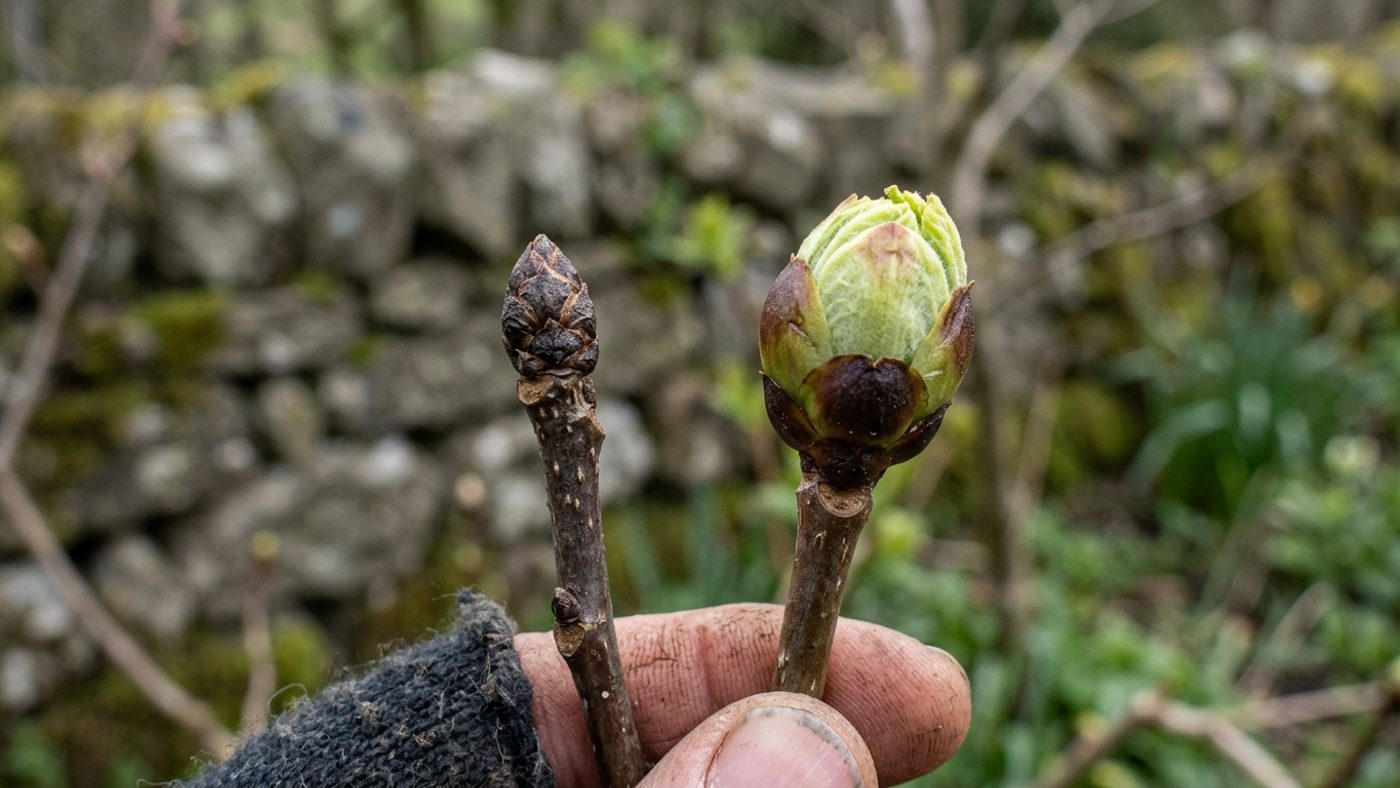
The practical upshot for pollarding and coppicing: a framework cut back "before growth restarts" in early March suits a milder, lower, more southerly garden, but can land weeks too early for the same job on an equivalent tree further north or at altitude, where the tree hasn't started moving yet. That matters more here than it would for a light prune, a whole pollard head or coppice stool cut hard while sap is already rising loses more to bleeding and stress than a smaller cut would. The most reliable check is the plant itself rather than a date: finish the cut before buds are visibly swelling and showing colour at the tip, whichever month that turns out to be in your own garden.
Frost timing follows a similar altitude-and-coastal pattern to bud burst, though the two aren't the same measurement and don't move in exact lockstep; this site's frost dates page has the fuller regional breakdown for anyone who wants it.
Nesting birds close the window from the other end
Every wild bird's nest is protected under the Wildlife and Countryside Act 1981 while it's in use or being built, it's an offence to intentionally or recklessly damage, destroy or take a nest or an egg during that period, and for certain vulnerable (Schedule 1) species, even disturbing a bird on or near an active nest is a separate offence. The Act itself doesn't name a fixed calendar season; it protects a nest whenever one is actually in use, and it's not an offence to cut back an old, long-vacated nest.
In practice, that turns into a season anyway. Scottish agri-environment rules that govern hedge management on land in support schemes set a fixed closed period for hedge trimming, 1 March to 31 August, aside from a road-safety exception, precisely because that's when a hedge or tree is realistically carrying active nests. That specific date range is a cross-compliance rule for supported land, not law for every private garden the way the Act itself is, but it lines up with the same practical guidance used across the rest of the UK: the safe hedge-cutting season runs October to February, with disturbance risk to nesting birds flagged across March to September as the reason. Treat early March to the end of August as the period to actively avoid on anything that might be holding a nest.
There's a legal defence if a nest, egg or young bird is disturbed unintentionally during otherwise lawful work that couldn't reasonably have been avoided, the offence requires the disturbance to be intentional or reckless, but that's a defence to be avoided needing, not a licence to skip checking. Guidance for developers recommends a pre-work check for active nests before anything gets cut in the March–September window, and rescheduling around any that are found, rather than relying on that defence after the fact. If hard cutting genuinely can't wait until outside the season, check thoroughly first.
Getting permission before getting the saw out
Timing isn't the only thing that can stop a pollard or coppice cut going ahead. A mature tree covered by a Tree Preservation Order needs the planning authority's consent before any cutting, lopping, topping or removal, under the Town and Country Planning (Scotland) Act 1997, unauthorised work on a protected tree carries a fine of up to £20,000 on summary conviction. Not every tree is protected this way, and a TPO isn't something a gardener can check just by looking at the tree, so it's worth a quick check with the local council's planning department before hard-cutting anything that looks mature or long-established, particularly in a conservation area, rather than assuming it's clear because nobody's ever mentioned it.
The same consent rules, plus the separate protections covering nesting birds and bat roosts, apply just as much to taking off a single large branch as they do to a full pollard or coppice, see removing large tree branches safely for the cutting technique and the honest line on when that job needs a professional arborist rather than a garden saw.
Where that leaves the calendar in practice
Put a number on it: from leaf fall (October–November) through to whenever buds on that specific plant start visibly swelling, for many lower, milder, coastal gardens that lands from February into March, but it can run into April or later at altitude or further north, while the nesting-season closed period stays fixed at 1 March–31 August wherever the garden is. That's the mechanism behind the opening of this article: bud burst sliding later doesn't buy extra room at the nesting end, so an upland or northerly cutting season can end up tighter rather than looser.
Dormant wood itself tolerates a hard cut without complaint; a cut made too early risks soft new growth exposed to a late frost, not the cut itself. A cut made too late risks disturbing an active nest, a legal issue as much as a horticultural one, and the one that should set the later boundary rather than "the tree still looks bare, so it must still be safe."
After the cut
New shoots from a coppice stool are soft and palatable, and browsing pressure from deer, rabbits, hares or livestock can undo a whole season's regrowth quickly; protecting the stool with fencing, or piling cut brash over it for the first couple of growing seasons, is standard practice on anything more than a token garden shrub. Pollards solve the same problem from the other direction, the whole point of cutting to a framework above head height is to put new growth out of easy reach of grazing animals in the first place, with roughly 1.2m generally enough to clear sheep and roe deer, and closer to 2m needed against cattle or red deer. Red deer occur across most of mainland Scotland, so a garden anywhere near open hill ground is worth erring toward the taller end of that range when choosing a pollard framework height, rather than the minimum.
Healthy prunings and coppice brash can go straight on the compost heap, get shredded for mulchA layer of material spread over the soil around plants to suppress weeds, retain moisture, and improve soil structure as it breaks down. Full definition →, or left as a loose habitat pile for invertebrates and small wildlife over winter, a genuine secondary use rather than just something to dispose of. Anything showing disease is worth burning or binning separately rather than composting, so it doesn't spread.
Common questions
Is pollarding bad for a tree?
Not on a tree pollarded from a young age on a regular annual cycle, it adapts to the pattern as permanent management. Starting to pollard a large, mature tree that's never been cut this way before is a different, higher-risk undertaking, and restoring an old, long-neglected pollard in one go, rather than over two or three seasons, is where structural problems tend to start.
Can I coppice any shrub?
No, it only works on species that resprout readily from a cut stool or stump, which rules out most conifers. Beech, dogwoods, elder, hazel, hornbeam, lime, willow and several others are genuinely suited to it; check a specific plant is one of them before cutting it hard to the ground.
Do I need permission before pollarding or coppicing a tree in my own garden?
Usually not, but check first if the tree is old, prominent, or in a conservation area, it may be covered by a Tree Preservation Order, and cutting a protected tree without consent from the local council can carry a substantial fine.
What happens if I find an active nest and hard cutting genuinely can't wait?
Stop and reschedule around it if at all possible; birds, eggs or young present makes proceeding an offence under the Wildlife and Countryside Act 1981. There's a narrow legal defence for genuinely unintentional, unavoidable disturbance during otherwise lawful work, but that's not the same as a green light, check before cutting, not after.
Sources
10 sources, recorded with what each was used for
- RHS: Pollarding — Pruning for Size Control: Species list, framework height, timing, cautions on neglected pollards
- RHS: Coppicing — A Guide to Regenerative Pruning: Cut height, species list, February–March (and later for winter-stem Cornus/willow) timing
- Woodland Trust: Types of Woodland Management: Coppicing/pollarding definitions, species, cycle lengths, browsing-height thresholds
- Woodland Trust: How to Plant and Maintain Hedges: October–February cutting season and the nesting-bird rationale
- Wildlife and Countryside Act 1981, Section 1: Legal protection for active nests, eggs and Schedule 1 species disturbance
- gov.scot: Wild Bird Habitat Duty Guidance: The 1 March–31 August hedge-trimming closed period under Scottish agri-environment cross-compliance rules
- NatureScot: Dealing with Construction and Birds: Wildlife and Countryside Act protection detail, pre-work nest-check and rescheduling guidance
- NatureScot: Deer: Red deer distribution across mainland Scotland
- gov.scot: Tree Preservation Orders (Planning Circular 1/2011): Consent requirements, penalties, legal basis
- BSBI: Bud Burst Phenology and Identification: Chilling/forcingCovering plants to exclude light and speed early, tender growth in the dark, most associated with rhubarb and sea kale in late winter. Full definition →/photoperiod mechanism, regional bud-burst lag figures