
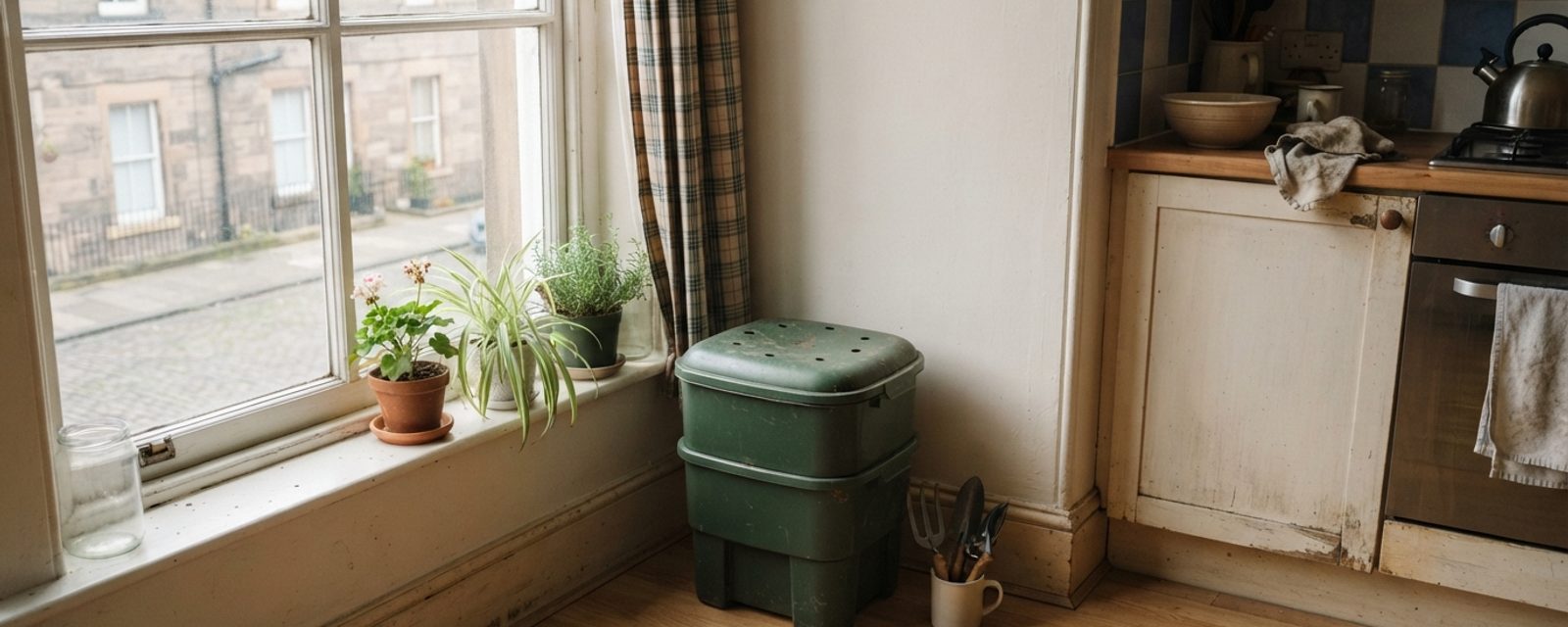
Standing in a flat kitchen with a bag of vegetable peelings in one hand, no garden through the door, there's often no clear idea what happens next. The peelings go in the general bin, get bagged with everything else, and end up in landfill or an incinerator. A few genuinely workable options exist instead, and which one fits depends mostly on outdoor space: some work with none at all, some need a balcony, and one needs nothing owned at all.
Why this matters more in Scotland specifically
Scotland's housing stock is unusually tenement- and flat-heavy. The Scottish House Condition Survey found that tenement flats, both the classic pre-1919 Edinburgh and Glasgow stone tenement and the newer post-1982 type, together make up 28% of urban dwellings in Scotland, the single most common dwelling type in Scottish towns and cities.
There's also a real practical fallback specific to Scotland worth knowing from the start: every Scottish council has had to provide every household a food waste caddy by law since 1 January 2016, under the Waste (Scotland) Regulations 2012. England only caught up recently:
| Food waste collection became mandatory | |
|---|---|
| Scotland (Waste (Scotland) Regulations 2012) | 1 January 2016 |
| England (Simpler Recycling reforms) | 31 March 2026 |
Both nations now guarantee it, but Scotland's version has been running, and its councils and processing infrastructure bedding in, for the better part of a decade longer.
The real options, compared
Four genuinely different approaches exist for someone with limited or no outdoor space, and they need genuinely different things from a home.
| Method | Outdoor space needed | Smell risk | Effort | What it accepts |
|---|---|---|---|---|
| Worm bin (wormery) | None — works indoors | Low if managed, real if neglected | Weekly feeding, occasional harvest | Raw veg, fruit (limited citrus), tea, coffee, eggshell, shredded card — no meat, dairy, fat |
| Bokashi | None — works indoors | Very low (sealed system); vinegary smell on opening | Daily layeringPropagating a new plant by pinning a low, flexible stem into the soil while still attached to the parent, so it roots before being cut free. Full definition →, needs a second stage | Almost everything, including cooked food, meat, dairy |
| Small tumbler composter | Balcony or shared yard | Low to moderate | Regular turning, feeding | Similar to garden composting — raw veg, garden waste, no meat/dairy/fat |
| Council food waste collection | None owned at all | None (waste leaves the home) | Almost none | Everything, including meat, dairy, cooked food |
The rest of this article covers each in enough depth to actually choose one, including smell and pest management, and what to do with finished compost if there's still no bed to dig it into.
Worm bins: the real indoor option
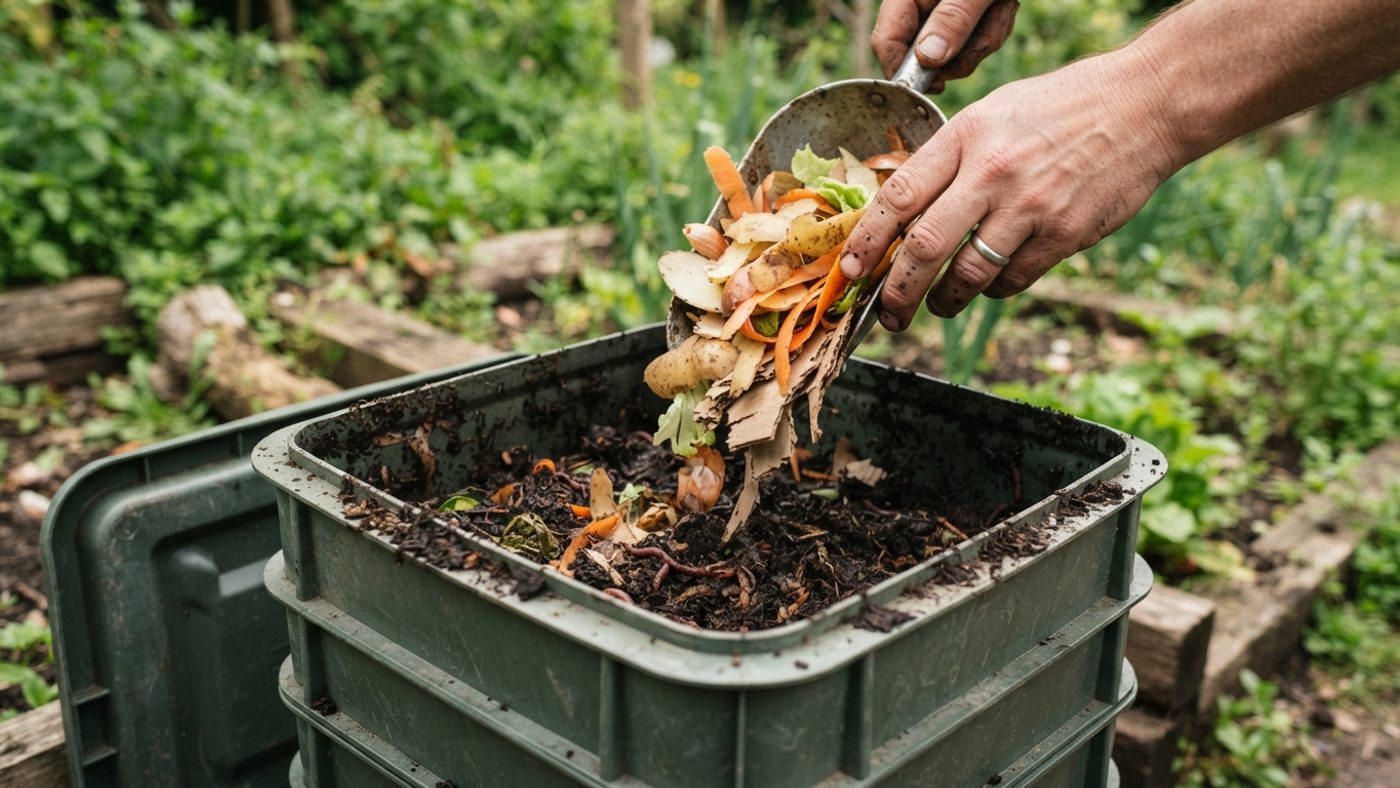
A wormery is the most complete answer to "I have no garden at all and want to actually compost something myself." It's a small, usually two-part container, a lower sump that collects a nutrient-rich liquid feed, and an upper composting layer where the worms live and work, and it's genuinely compact enough for a kitchen, a utility cupboard, or a sheltered balcony. The worms doing the work aren't ordinary garden earthworms, a wormery kit is bought complete with its starter population of composting specialists, brandling or tiger worms (Eisenia fetida or Dendrobaena veneta), adapted to a dense, food-rich environment rather than open soil, so nothing extra needs sourcing separately to get started. A basic kit is a modest one-off cost, well under the price of a garden compost bin, and lasts indefinitely with normal use.
Feeding is straightforward but has real limits. Raw vegetable peelings, most fruit (go easy on citrus, which is too acidic in quantity), tea bags, coffee grounds, eggshell, a little bread, and shredded paper or cardboard are all fine. Onions, shallots, leeks and garlic are best kept to small amounts or cooked first. Meat, fish, dairy, fat and grease are the firm no, not because the worms strictly can't handle traces of them, but because they're what actually attracts flies and rodents to an indoor bin, this is the one rule worth taking seriously if the bin lives in a kitchen.
| Most active | 18-25°C — close to a typical flat’s indoor temperature |
| Slows down | Below 10°C |
| Can kill the worm population | A genuinely hard, sustained frost, if the bin is left unheated |
| Time to harvestable compost | 8-12 months |
| Liquid feed, before use | Dilute 1 part liquid to 10 parts water — used undiluted, it’s strong enough to scorch plant roots |
A bin that has to sit somewhere unheated over a Scottish winter, an outdoor balcony or an unheated stair cupboard, is safer moved indoors, wrapped in extra insulation (an old duvet or bubble wrap around the bin), or fed much less and checked on rather than left alone through the coldest stretch.
Smell and pests in a wormery
A well-run wormery, fed correctly and not overloaded, has very little smell: worms process material fast enough that it doesn't sit around rotting. The two failure modes that do cause smell and fruit flies are predictable and fixable. First, overfeeding: adding more scraps than the worm population can process in a few days leaves food sitting on the surface, fermenting, and attracting fruit flies, the fix is feeding less and letting the population catch up, and burying new waste under the existing decomposed material or a layer of damp newspaper rather than leaving it exposed on top. Second, waterlogging: too much wet material without enough dry, carbon-rich bedding (shredded card, torn newspaper) turns the base anaerobic and genuinely smelly, the fix is more dry bedding and checking the drainage sump is doing its job. Chemical pest treatments aren't appropriate in a wormery since they'll harm the worms themselves; removing excess food and adjusting the feed rate solves almost every smell or fly complaint that comes up.
Bokashi: the brief version
Bokashi is the other genuinely indoor-compatible option, and it accepts things a wormery can't: cooked food, meat and dairy included, fermented rather than composted in the biological sense, using a bran inoculated with beneficial bacteria in a sealed, airtight bucket. The airtight seal is what makes it low-odour and pest-resistant even with meat and dairy inside, since nothing is exposed to air or to flies until the bucket is opened for its next stage. That next stage matters: bokashi produces a pre-compost that still needs burying in soil or finishing in a second system before it's usable, which is the part that trips up flat-dwellers who assume the bucket alone is the whole process. A starter kit is bought complete with the inoculated bran, so like a wormery, there's nothing extra to source before beginning. See bokashi composting for the full step-by-step process.
Tumbler composters: only with a balcony or shared outdoor space
A small enclosed tumbler, a sealed drum on a frame that's turned by hand to mix and aerate the contents, is a realistic option only once there's somewhere outdoors to actually put it: a balcony with room to spare, a shared drying green, a bit of shared tenement back court. It works much like an ordinary garden compost bin on a smaller scale, taking raw vegetable peelings and garden waste but not meat, dairy or fat, and needs regular turning and a reasonable green-to-brown material balance to work well.
Smell risk sits between a wormery and an open garden heap: enclosed and away from most pests, but capable of turning unpleasant if overloaded with wet kitchen scraps and too little dry material, the same failure mode that affects open piles. Rats are the real objection to any outdoor bin in a shared back court, more than smell on its own, an enclosed, sealed tumbler is a genuinely better choice than an open heap for exactly this reason, since there's no gap for a rat to get in and nest, but it still shouldn't hold meat, dairy or fat, which is what draws rodents to bins in the first place regardless of how sealed the container looks. Midges are a separate nuisance worth taking seriously in the west of Scotland specifically, where midges are a genuine summer problem: an outdoor bin left standing in damp, still air is exactly the kind of spot midges favour. It's more of a summer-evening irritant than a reason to avoid a tumbler outright, and it isn't specific to tumblers, but siting the bin somewhere with a bit of airflow rather than a still, sheltered corner cuts it down.
It isn't an indoor option in any sense, and anyone weighing it against a wormery or bokashi should treat "do I actually have outdoor access, even shared and small," as the deciding question, not "do I have a garden."
Council food waste collection: the guaranteed fallback
For anyone with genuinely no space of their own, no balcony, no shared yard, nowhere a bin or wormery could realistically sit, council collection is the one option that needs nothing owned at all, and in Scotland it's a legal entitlement, not just a widely available service. The Waste (Scotland) Regulations 2012 inserted a duty (now Section 45C(5) of the Environmental Protection Act 1990) requiring every Scottish waste collection authority to provide every household in its area, aside from a narrow rural exemption, a receptacle for separately collected food waste, in force since 1 January 2016.
It's also the only option on this list that takes meat, dairy, fat, cooked food and bones, everything a home wormery or tumbler has to refuse, which makes it a genuine complement even for someone running a wormery on the side rather than purely a fallback for people with nothing else.
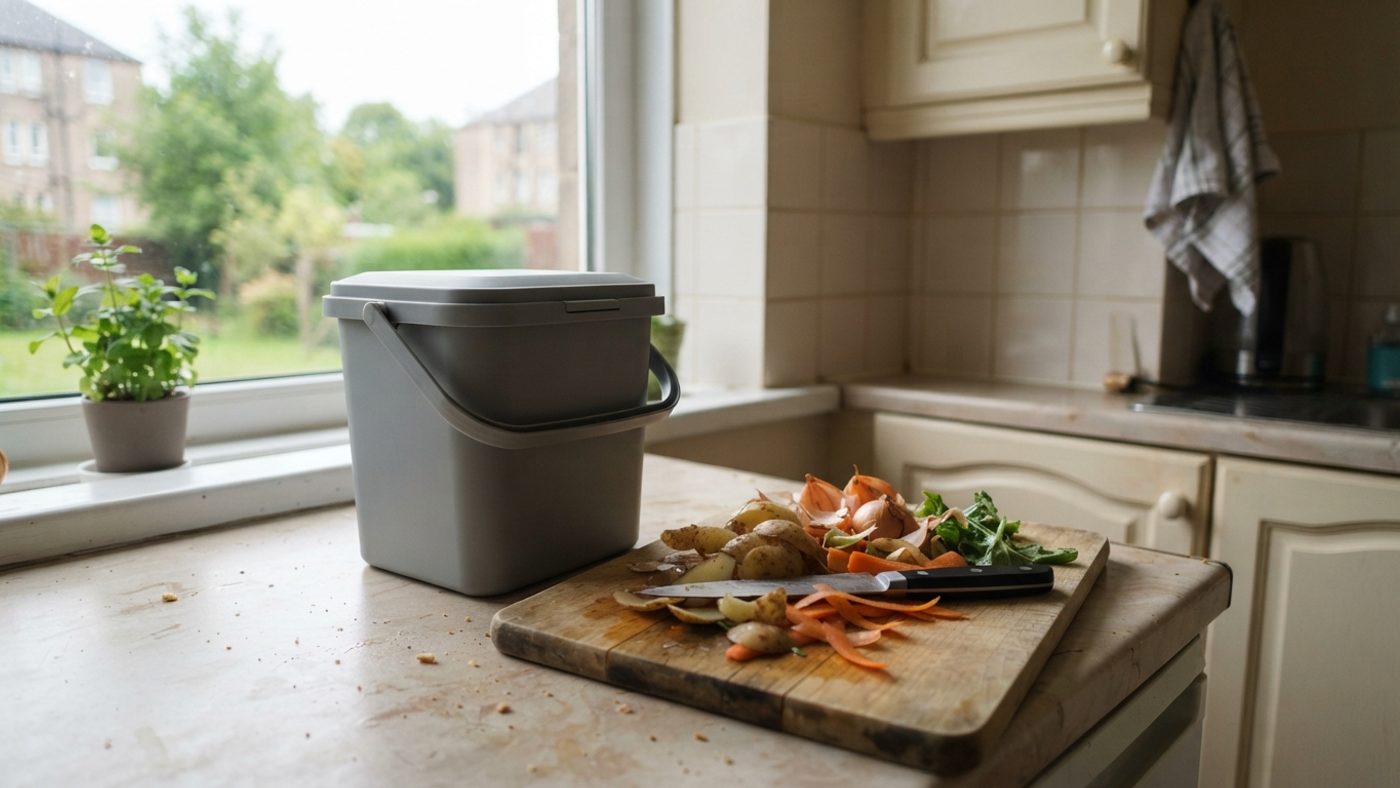
In Edinburgh, nearly every household gets a weekly food waste collection, either kerbside (an individual grey food bin or kitchen caddy at street level) or, for flats without individual bin access, a communal bin service, and the free kitchen caddy is available either way to collect scraps before transferring them out. Food needs to be bagged or wrapped before it goes in, for hygiene as much as for the staff handling thousands of bins a day, a compostable liner, an ordinary carrier bag, or a sheet of newspaper are all accepted, so it's worth checking a specific council's own page rather than assuming only one option works. Freezing scraps between collections, rather than leaving them in the caddy at room temperature, is the standard way to keep an infrequently-emptied indoor caddy from smelling or drawing flies over a warm week. From Edinburgh, food waste goes to the Biogen anaerobic digestion plant at Millerhill, which processes roughly 10,000 tonnes of Edinburgh's food waste a year, breaking it down without oxygen to produce biogas and a fertiliser by-product. Glasgow runs communal food waste bins and caddies for most tenement closes rather than individual kerbside collection, check the current Glasgow City Council page for the arrangement on a specific street, since the exact setup (bin hubs, on-street collection points) varies and has been changing.
Community composting and giving compost away
Community composting schemes collect garden and food waste from local households, often on a rota, shred and compost it centrally over several months, and typically sell or share the finished compost back to the people who contributed to it, a genuine option for someone who wants to contribute food or garden waste without running any system themselves. Coverage isn't universal, so it's worth actually searching for a named scheme near a specific address rather than assuming one exists: a city allotment association or community garden in Edinburgh or Glasgow is the most likely place to find one, and most publish contact details or a drop-off rota on their own website or noticeboard rather than requiring membership to take part. Allotment sites themselves are also worth trying directly for finished-compost donations even without a plot: waiting lists for an allotment plot in Edinburgh or Glasgow are typically long, so joining one purely to get a compost outlet isn't realistic, but most allotment associations will still take a donation of food or garden waste, or finished compost, from a non-member who asks.
For anyone who has made their own compost via a wormery, bokashi, or tumbler and has nowhere to dig it in, several real uses exist rather than it going to waste. It works well in container and balcony gardening, a wormery's finished compost and diluted liquid feed are both suited to pots rather than open beds anyway. Giving it away, to a neighbour with a garden, an allotment holder, or a community garden that will take donated compost, is a straightforward option most cities have some outlet for.
Common questions
Will a wormery smell in my kitchen?
Not if it’s fed correctly. The two things that actually cause smell, overfeeding and waterlogging from too little dry bedding, are both avoidable: feed roughly what the worms can process in a few days, bury new scraps rather than leaving them exposed, and keep a supply of shredded card or paper on hand to balance wet material. A wormery that’s smelling badly is a sign to feed less and add more dry bedding, not a sign the method doesn’t work indoors.
I don’t have a balcony or a garden. Is a wormery really my only home-composting option?
It’s one of two. Bokashi is the other genuinely indoor-compatible method, and it accepts cooked food, meat and dairy that a wormery can’t, though it needs a second finishing stage rather than producing usable compost directly from the bucket. Beyond those two, council food waste collection needs no space owned at all and is legally guaranteed to every Scottish household bar a narrow rural exemption.
What can’t go in a wormery that I could put in my council food waste caddy?
Meat, fish, dairy, fat and grease are the main things to keep out of a wormery, since they attract flies and pests in a way raw vegetable peelings don’t. All of those are accepted in Scottish council food waste collection, since it’s processed by anaerobic digestion at high volume rather than by a live worm population that needs protecting.
Is council food waste collection actually free in Scotland, or does it depend on the council?
The receptacle itself, a kitchen caddy and, where kerbside collection applies, an outdoor food bin, is provided free of charge as part of the statutory service every Scottish council has had to run since 1 January 2016 under the Waste (Scotland) Regulations 2012. The specific collection method (individual kerbside versus a shared communal bin) does vary by property type and council area, which is why it’s worth checking a specific council’s own page for tenement or flat-specific arrangements.
I’ve made compost from a wormery but have no garden. What do I actually do with it?
Use it in pots and containers on a balcony or windowsill, that’s exactly the scale a wormery’s output suits. Beyond that, giving it to a neighbour, an allotment holder, or a local community garden are all realistic outlets in most Scottish cities, and a community garden will often take a donation even from someone who isn’t a member if asked directly.
Sources
8 sources, recorded with what each was used for
- Scottish Government: Scottish House Condition Survey 2024, Key Findings — "Key Attributes of the Scottish Housing Stock": The 28% urban tenement-flat figure and the tenement-flat-as-most-common-urban-dwelling-type finding, plus the pre-1919 and post-1982 tenement stock breakdown
- legislation.gov.uk: The Waste (Scotland) Regulations 2012: The statutory duty (inserting Section 45C(5) into the Environmental Protection Act 1990) requiring Scottish waste collection authorities to provide every household a food waste receptacle from 1 January 2016, with the rural exemption
- GOV.UK: Simpler Recycling in England — policy update: The 31 March 2026 date on which weekly food waste collection became mandatory for households in England, for the Scotland/England timeline comparison
- The City of Edinburgh Council: Food waste prevention and recycling: Edinburgh's kerbside vs communal bin food waste service, free caddy provision, bagging requirement, and the Biogen Millerhill anaerobic digestion detail (roughly 10,000 tonnes/year processed)
- RHS: Worm Composting: Wormery structure (sump and composting layer), worm species used (Eisenia fetida, E. andreii, Dendrobaena veneta), what to feed and avoid, 18-25°C optimal temperature range and the below-10°C slowdown, 8-12 month harvest timeline, liquid feed dilution rate (1:10), and smell/fly prevention
- RHS: Composting: General RHS framing that worm composting is the recommended route for gardens too small for a conventional bin
- Garden Organic: Composting in your community: How community composting schemes operate (collection, shredding, communal composting, sale of finished compost back to contributors) and their suitability for people without their own garden
- Garden Organic: Different composting methods: The bokashi description (airtight fermentation bucket, broad material range including cooked food/meat/dairy, low odour from the sealed design) and general wormery framing