

You go out to trim the box balls, or you walk past the low hedge along the path, and something's off. A patch has gone from that dense, dark green to a dull rust-brown. Or there's a section that looks almost skeletal, stripped back to bare twigs in a way that wasn't there a fortnight ago. Or the whole hedge just looks tired, thinner than it used to be, without any one obvious mark on it.
Box (Buxus sempervirens) is under more pressure than almost any other hedging plant in a UK garden right now, and three genuinely different problems can produce a dying-looking hedge: a fungal disease, an invasive caterpillar, or plain stress and old age. They call for completely different responses, so working out which one you're looking at is the first job, before you cut anything or reach for a product.
The three causes, and how they actually differ
Box blight (the fungal disease)
Box blight is caused by two related fungi, Calonectria pseudonaviculata and the less common Calonectria henricotiae (both were formerly grouped under the name Cylindrocladium buxicola, a name you'll still see on older products and forum posts). The tell that separates blight from everything else is on the stems, not just the leaves: look for black streaking and dieback on young, green stems, thin, dark, elongated lines running along the stem itself, distinct from the stem's normal bark colour, rather than an all-over dark stem, alongside leaves that brown and drop. In damp weather you may also see white fungal spore masses on the undersides of leaves. Left to run, it produces the bare, straw-coloured patches that make a hedge or a piece of topiary look moth-eaten.
Blight thrives in warm, humid conditions with poor air circulation, and becomes most active during rainy periods. That's exactly what a tightly clipped box hedge or ball creates for itself: dense, still, shaded foliage that stays wet after rain far longer than open growth would. It spreads through water splash, on pruning tools, on hands, and via infected plant material moved from elsewhere in the garden or brought home from a nursery.
Box tree moth (the caterpillar pest)
Box tree moth (Cydalima perspectalis) isn't a disease at all, it's an invasive caterpillar, native to East Asia, that eats box foliage. The caterpillar grows up to 4cm long, with a greenish-yellow body marked with thick black and thin white stripes. The adult moth has a wingspan of around 4cm, usually white wings with a brown border, though all-brown or clear-winged forms also occur.
The giveaway signs are visual and physical, not a colour change in the leaves: fine silk webbing spun over the feeding area, small dark-green pellets of caterpillar droppings caught in that webbing, and pale, shell-like shed head capsules (tiny cast-off casings, left behind each time a caterpillar moults and grows) caught in the same webbing. A hedge under real attack can go from lightly nibbled to completely defoliated within a short space of active feeding, stripped back to bare stems while the plant itself, unlike with blight, is often still alive underneath.
The moth arrived in Britain as an adult in 2007, in Kent, with caterpillars found in gardens in the home counties by 2011 and the population established in and around London by 2014. There are at least two generations a year, with most of the feeding damage happening between March and October; the moth overwinters as small caterpillars sheltering inside webbed leaves.
Drought and general stress dieback
The third pattern has no black streaking and no webbing, caterpillars, or frass, it's a general yellowing, thinning, or dulling of the whole hedge or large sections of it. This is typically an old, tightly clipped hedge running out of steam: poor drainage, root competition from nearby trees or a wall, heat and drought stress in a dry spell, or simply age catching up with a plant that's been clipped hard for decades. It's the diagnosis by elimination, worth considering seriously once you've ruled out the specific tells of the other two.
How to tell them apart at a glance
| Box blight | Box tree moth | Drought/stress dieback | |
|---|---|---|---|
| What you see | Brown, dropping leaves; black streaks on young stems; white spore masses on leaf undersides in damp weather | Webbing over foliage, visible caterpillars, droppings, shed head capsules | General yellowing or thinning, no streaking, no webbing |
| Speed | Progressive over weeks, worse after rain | Can strip a hedge to bare stems within days to a couple of weeks during active feeding | Slow, over a season or more |
| What's underneath | Stems dead and blackened where streaked | Stems often still alive, just defoliated | Whole plant weakened rather than locally killed |
| Cause type | Fungal disease | Invasive insect pest | Growing-conditions problem |
| Spreads to neighbours? | Yes, via water splash, tools, and plant material | Yes, moths fly and lay eggs on nearby box | No, not contagious |
A hedge can, in principle, be dealing with more than one of these at once, especially an old, stressed hedge that's more vulnerable to blight taking hold once it's weakened.
Two other, usually harmless, look-alikes are worth ruling out before you settle on one of the three above. Box naturally turns bronze or orange in cold weather and greens back up again in spring, a normal seasonal response, not decline, so a whole hedge that's gone uniformly bronze over winter is very likely this rather than any of the three causes here, worth checking first given how much colder a Scottish winter runs than a southern English one. Box psyllid causes cupped, blistered new leaf tips in spring and is often mistaken for disease or moth damage by home gardeners, it's largely cosmetic and rarely worth treating.
Managing box blight
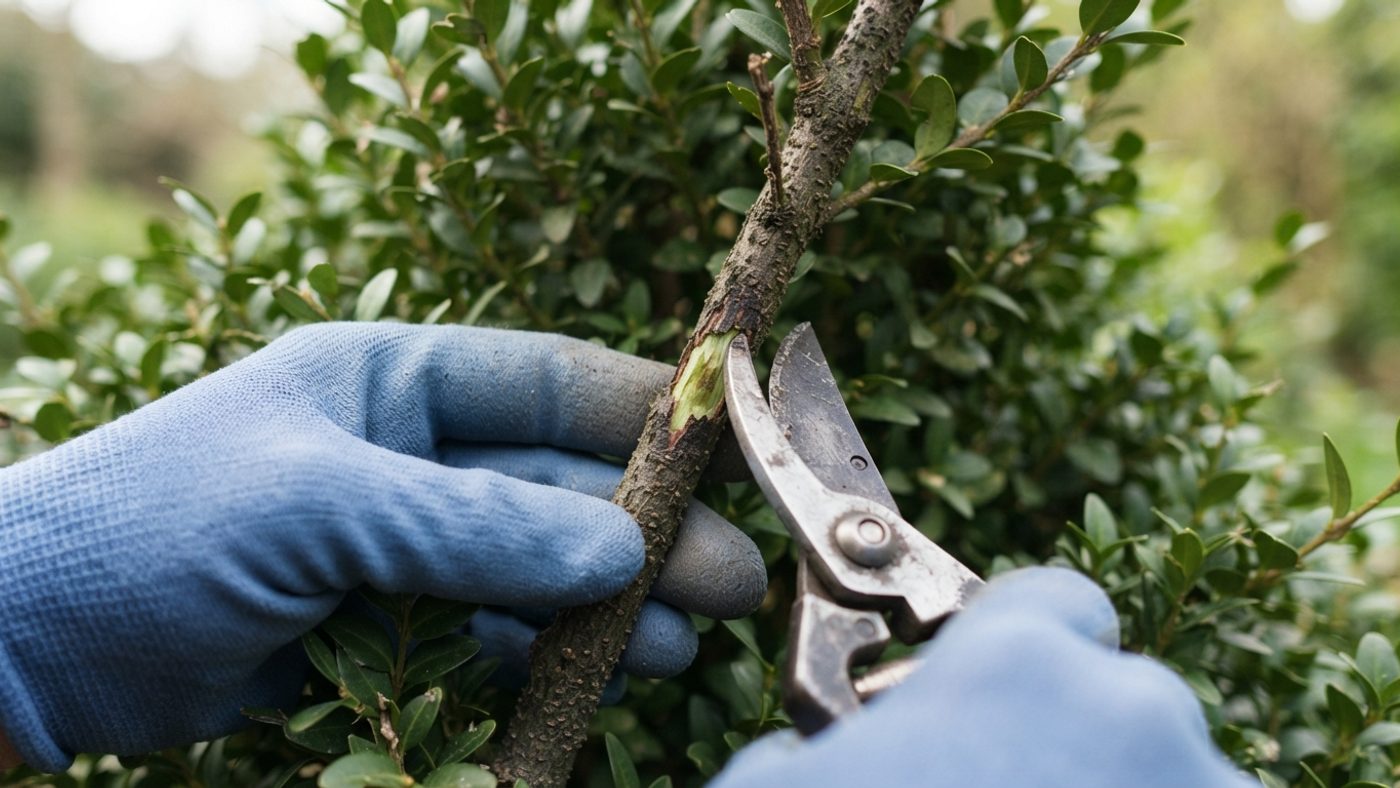
Once you're confident it's blight, the honest starting point is that badly infected box is often not worth trying to save. A hedge with a handful of streaked stems here and there, still mostly green, is worth fighting for. A hedge that's lost more than half its foliage, or where the same sections have come back infected two or three years running, usually isn't, since the fungus persists in fallen leaf debris and in the soil, so that hedge keeps reinfecting itself from the same patch of ground, year after year, a losing battle. Fungicides aren't the fix here either way.
Where the infection is caught early or is limited to a section or two, the management steps are all about working against the conditions blight needs:
- Open the hedge up. Reduce how often you clip, dense, frequently-trimmed growth is exactly the still, humid microclimateThe local growing conditions in one specific spot that differ, sometimes substantially, from the wider area's average climate. Full definition → blight favours.
- Water at the base, not overhead. Overhead watering or sprinklers splash spores around and keep foliage wet for longer.
- Prune only in dry weather, and disinfect secateurs and shears between cuts and between plants.
- Remove and destroy infected material rather than composting it, home composting doesn't reliably kill the fungus, so infected clippings and leaf litter should go to green waste collection or be burned/binned, not into your own compost heap.
- Quarantine any new box plant for around four weeks before planting it out, since infected nursery stock is a common way blight arrives in a garden in the first place.
- If you're replanting, resistant cultivarsA plant variety that arose or was bred under cultivation and is kept true by deliberate propagation, rather than a naturally occurring wild species. Full definition → such as 'Rococo', 'Faulkner', and 'National' are a more forgiving starting point than standard box.
Managing box tree moth
Because this is a pest rather than a disease, the response is inspection and physical/biological control rather than hygiene measures:
- Check hedges regularly through the growing season (roughly March to October) for early webbing or caterpillars, catching an infestation early makes every other option easier.
- Hand-pick caterpillars where the hedge is small enough to make this practical, it costs nothing and avoids any product entirely.
- Pheromone traps are a monitoring tool, they catch male moths and tell you when a new generation is active, rather than controlling the population on their own.
- Nematode-based biological control has some effect on the caterpillars, though nematodes can affect non-target insects too, so use with care and follow label instructions.
- Biological sprays based on the bacterium Bacillus thuringiensis are used for caterpillar control on ornamental hedging including box, check the product's label for the intended pest and setting before buying, since availability and home-garden suitability vary between products.
- Report a first sighting. If you're in an area where box tree moth isn't yet common, reporting it (the RHS runs a recording scheme for exactly this) helps track how far the pest has actually spread, which matters more in Scotland right now than in an already fully-established English county.
Managing drought and stress dieback
This is the most straightforward of the three to address, because there's no pathogen or pest to contain, just growing conditions to improve:
- Water deeply during dry spells, particularly for a hedge on free-drainingSoil that lets water pass through quickly rather than pooling, so roots aren't sitting in wet ground after rain. Full definition → soil or one that's still establishing.
- Feed in spring with a balanced fertiliser to support recovery, especially on a hedge that's been hard-clipped for years.
- Ease off the clipping regime. Very tight, frequent trimming stresses the plant over time and, as with blight, creates the dense, still conditions that make other problems worse, an occasional lighter touch benefits the plant on more than one front.
- Check the roots' growing conditions: compacted soil, competition from a nearby hedge or tree, or a spot that either waterlogs or dries out fast are all worth investigating if a hedge is declining without any of blight's or moth's specific signs.
The Scotland question: is box tree moth actually less of a risk here?
It's now considered a common resident, widely distributed across England, particularly the south-east, and present in Wales, Scotland, Ireland, and Northern Ireland, with England and the south-east specifically still carrying the bulk of the population. The moth is recorded as having first reached Scotland in 2018, over a decade after the initial English arrival, and current descriptions put its UK distribution as widespread in southern and central England but more scattered elsewhere, which includes Scotland.
So a Scottish gardener genuinely has a lower current baseline risk from this specific pest than a gardener in Kent or Surrey does. That's not a reason to stop checking, though. The pattern for this moth since 2007 has been one of continuous northward and westward spread, not containment, and a pest that reached Scotland eight years ago has had time to keep spreading since; "less established here so far" is where things stand now, not a guarantee of where they stay. Whether Scotland's colder winters slow the moth down directly isn't clear either way: it overwinters as small caterpillars sheltering inside webbed leaves rather than as eggs, and how well that survival strategy holds up against a harder frost than southern England typically sees is an open question.
The Scotland question: does our climate make blight better or worse?
Box blight needs warmth, humidity, and still air together, and Scotland's climate doesn't line up neatly on one side of that.
| Summer 2025 | Western Scotland | English Midlands / East Anglia / South-East |
|---|---|---|
| Average max. temperature | ~18°C | ~22-24°C |
| Rainfall | Well over triple | (baseline) |
That's a single summer, and it's western Scotland specifically: the east coast, from Fife up to Aberdeenshire, runs both drier and closer to English temperatures than the west does, so "Scotland" isn't one climate for this purpose. The general pattern still holds though: most of Scotland runs cooler than most of England, and the west runs distinctly wetter.
Those two factors pull in opposite directions for blight risk. Lower average temperatures work against a fungus that favours warmth, that's a point in Scotland's favour. Higher rainfall and humidity work in the fungus's favour, since it's most active in rainy periods, that's a point against, and more so in the wetter west than the drier east. No data settles which factor wins out for overall infection risk. The one thing that does hold regardless of region: the still, humid microclimate inside a densely clipped hedge forms whatever the climate outside it, so opening a hedge up and avoiding overhead watering cuts blight risk in any Scottish garden, cooler or drier regional averages don't excuse a badly ventilated hedge.
If it's beyond saving: alternatives to box
A hedge that's lost large sections to repeated blight, or one that's simply too old and thin to be worth nursing back, doesn't have to be replaced with more box. Ilex crenata (Japanese holly) is the most widely planted substitute, small-leaved, clippable, and superficially very box-like, but it's also the least successful of the common alternatives in practice: it particularly dislikes winter wet and hot, dry summers, and does best in cool, damp summers with well-drained, neutral to acidic soil. That description is closer to a Scottish growing season than an English one in the summer-heat respect, though Scotland's wetter winters, especially in the west, cut the other way against the "dislikes winter wet" part, so it's not a clean win either direction. Yew (Taxus baccata) is the alternative most often recommended by professional gardeners: it regrows well even when cut hard into old woodWhether a plant fruits on stems grown the previous year (young wood) or on older, established branches (old wood), which decides how it's pruned. Full definition →, tolerates most soils except waterlogged ground, and copes with sun or shade.
Common questions
Can a box hedge recover from blight, or should I just replace it?
It depends on how much of the hedge is affected and whether it keeps reinfecting from the same patch of ground. A hedge with a limited number of black-streaked, dying stems can sometimes be cut back hard, thinned for airflow, and nursed through, but a hedge that’s lost large sections repeatedly, or where infected debris has built up in the soil beneath it, is often not worth continuing to fight, since the fungus persists in that debris and soil.
Is box tree moth in Scotland yet, or am I safe?
It has reached Scotland, first recorded there in 2018, but current distribution data describes it as widespread mainly in southern and central England, with a more scattered presence elsewhere, including Scotland. That means lower current risk than further south, not zero risk, and the moth’s range has kept expanding since it first arrived in Britain in 2007, so it’s still worth checking your hedge through the growing season rather than assuming it won’t reach you.
My hedge just looks thin and tired, no black streaks, no caterpillars. What is it?
That points toward general stress rather than blight or moth, most often drought, poor drainage, root competition, or age in a hedge that’s been clipped hard for years. Improve watering in dry spells, feed in spring, and consider easing off how often you trim, dense, frequently-clipped growth is harder on the plant and also creates exactly the still, humid conditions blight prefers, so a lighter clipping regime helps on both fronts.
Can box blight and box tree moth affect the same hedge at the same time?
Yes, and it’s worth checking for both rather than stopping at the first diagnosis you confirm, particularly on a hedge that’s already stressed or thinning, since a weakened plant copes worse with a second problem on top of the first. Look at the stems for blight’s black streaking as well as the foliage for moth’s webbing, don’t assume one rules out the other.
Is it worth spraying pesticide as a precaution even before I see caterpillars?
No, spray only once you’ve confirmed active feeding, ideally when caterpillars are small, since biological products like Bacillus thuringiensis-based sprays work by being eaten and need caterpillars actively present and feeding to be effective. Regular visual inspection through the March-to-October feeding period, plus pheromone traps for early warning, is the better routine than spraying on a fixed schedule regardless of whether the pest is actually there.
Dealing with a different hedge problem? See conifer hedge browning and overgrown hedges and the law in Scotland.
Sources
5 sources, recorded with what each was used for
- RHS: Box Blight: Identification signs (black stem streaking, leaf drop, white spore masses), causal fungi names, conditions favouring spread (warm, humid, poor air circulation, rainy periods), spread mechanisms (water splash, tools, plant material), and management steps (reduced clipping, quarantine, dry-weather pruning, tool hygiene, disposal, resistant cultivars, avoiding fungicide)
- RHS: Box Tree Caterpillar: Caterpillar and moth appearance, signs of infestation (webbing, frass, shed head capsules), UK arrival and establishment timeline (2007 Kent arrival, 2011 home counties, 2014 London), current UK distribution statement, generations per year and feeding season, and management options (hand-picking, pheromone traps, nematode biological control)
- RHS: Box Alternatives - How to Choose: Ilex crenata's growing-condition preferences and its comparatively poor real-world performance as a box substitute, and yew's suitability as an alternative
- The Wildlife Trusts: Box Tree Moth: Current UK distribution description and the 2018 first-Scotland-record date
- Met Office: Summer 2025 - A Regional Breakdown: Comparative Scotland vs England summer 2025 average maximum temperature and rainfall figures, used as an illustration of the general cooler/wetter Scottish climate pattern relevant to blight's temperature-versus-humidity conditions