
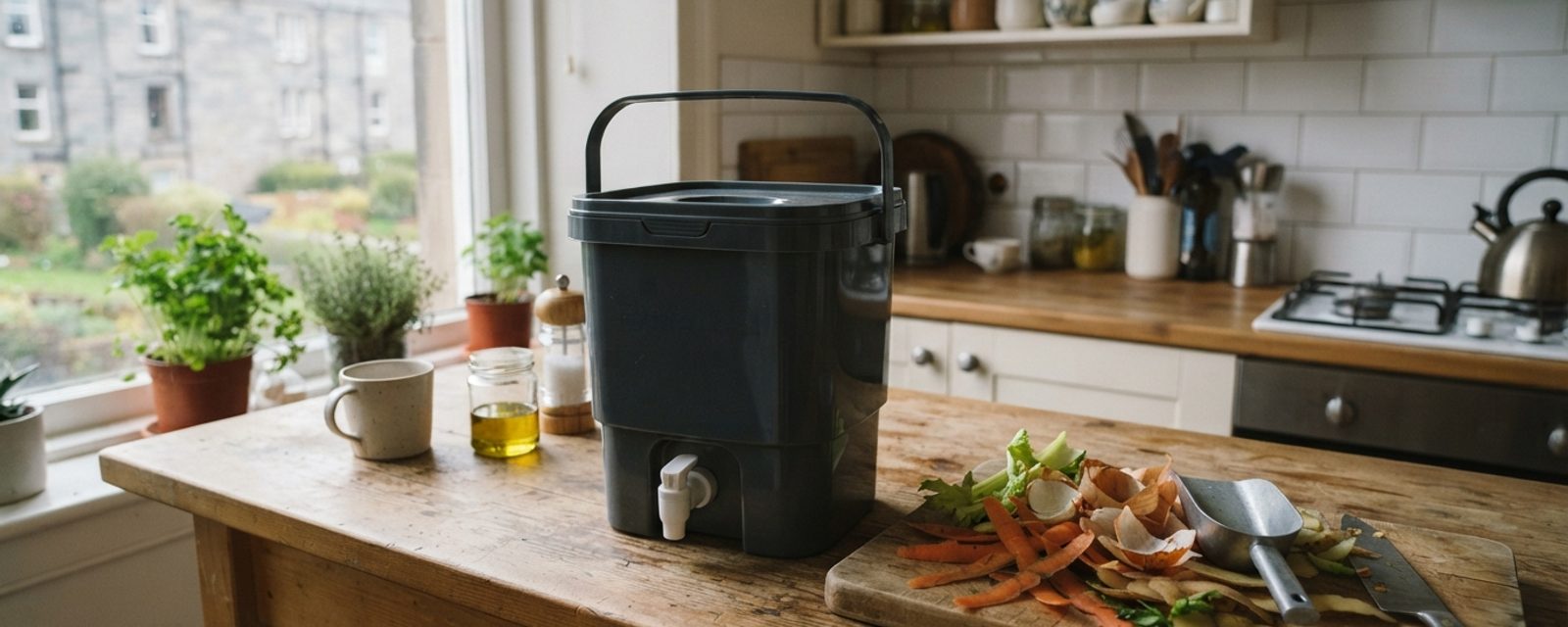
Inside a sealed bokashi bucket, nothing is rotting. Add a layer of kitchen scraps, sprinkle over a handful of bran laced with lactic acid bacteria and yeasts, press the air out, and clip the airtight lid back down, and what happens next is pickling, not decomposition. The same microbial family that turns cabbage into sauerkraut and milk into yoghurt goes to work on the food waste instead, souring it in an oxygen-free environment rather than breaking it down the way a compost heap does.
That's the whole trick behind bokashi, and it's why it can sit on a kitchen worktop or under a sink, take food that would never go near an ordinary compost bin, and produce no smell worth complaining about, right up until it needs a second, quite different step to actually finish the job.
What bokashi actually is
Bokashi is an anaerobic fermentation method, not a form of composting in the usual sense, carried out in a small airtight bucket, usually one of a matching pair, each fitted with a drainage tap. Food scraps go in layeredPropagating a new plant by pinning a low, flexible stem into the soil while still attached to the parent, so it roots before being cut free. Full definition → with "bokashi bran," a carrier such as wheat, rice husk or sawdust that's been inoculated with effective microorganisms, predominantly lactic acid bacteria and yeasts. Sealed away from air, those microbes ferment the waste rather than rotting it, which is the reason bokashi tolerates cooked food, meat, dairy and citrus that would cause problems in a cold compost heap or a wormery.
Fermentation pickles and preserves the waste, arresting the putrefying, smell-producing decay that happens when food waste is just left in a bin bag, but it doesn't turn that waste into compost by itself.
How it works, step by step
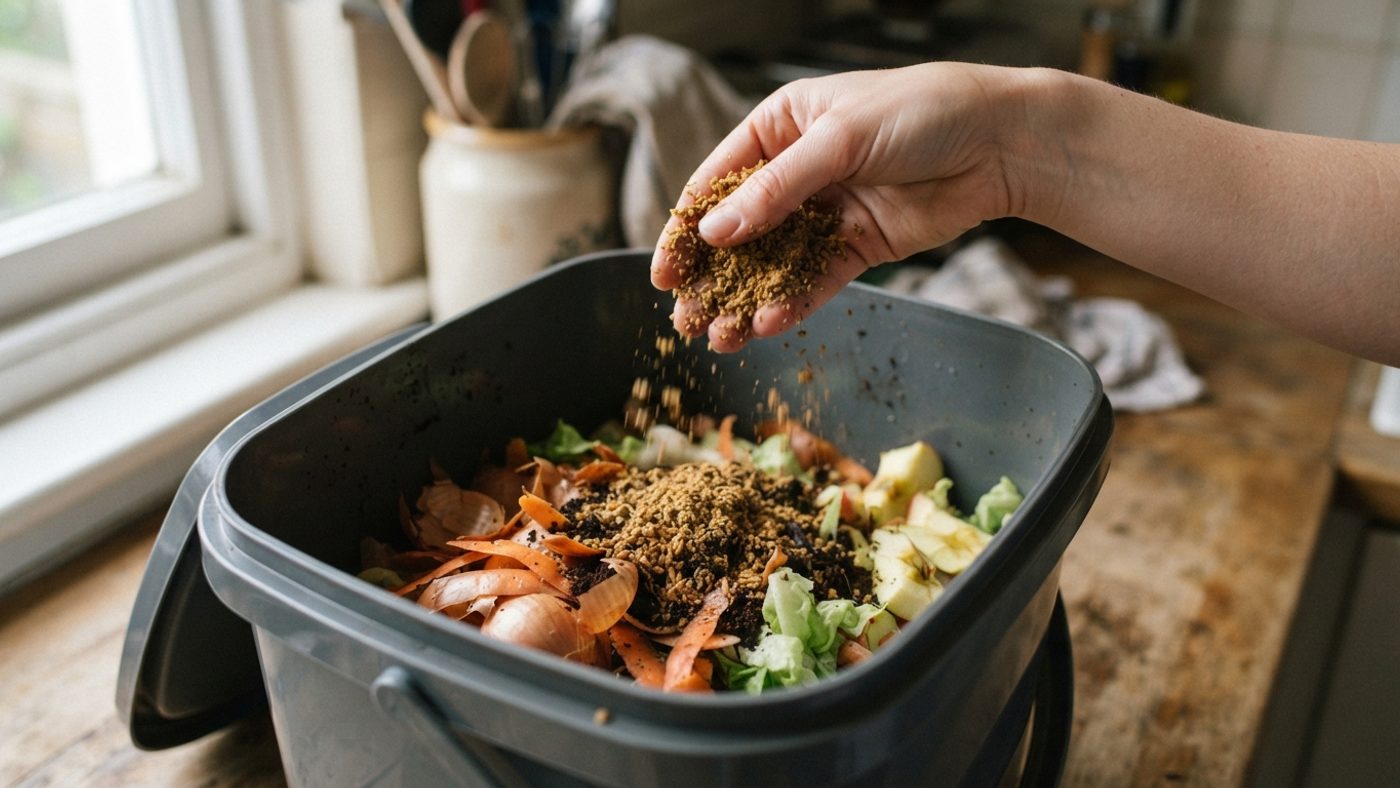
- Layer. Add food scraps in a thin layer, ideally cut into smaller pieces so more surface area contacts the bran, and sprinkle a handful of bran over roughly every 3-4cm of waste. Larger bones are best broken up first or left out, since they take a long time to break down; everything else, including meat, cheese and fat, is fair game.
- Press and seal. Push the contents down firmly to force out trapped air pockets, then seal the lid straight away. Air is the enemy of the process; opening the bin more than necessary slows fermentation and risks mould, and because the bin stays sealed between additions, it doesn't become the fruit-fly magnet an open kitchen caddy can turn into.
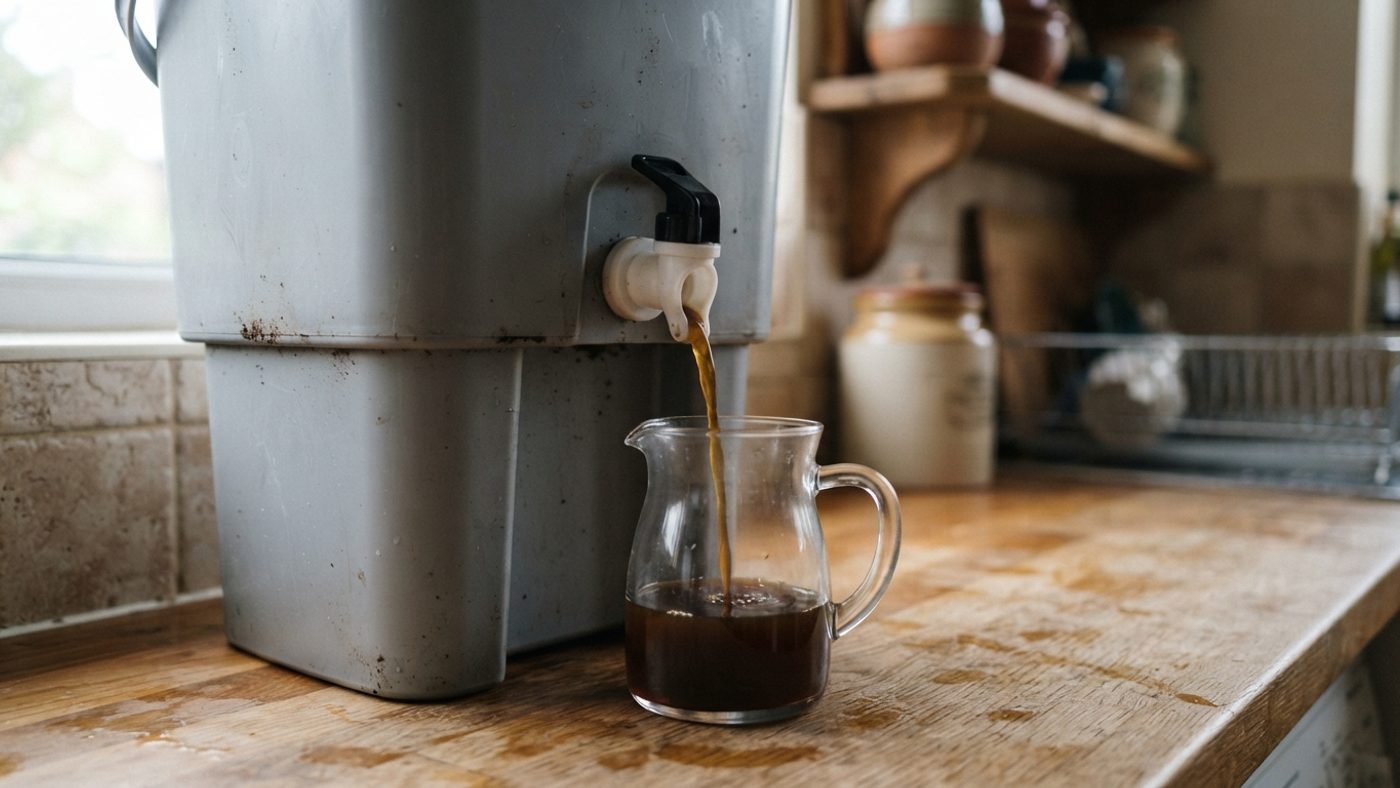
- Drain the liquid. Every couple of days, open the tap and drain off the liquid that collects at the bottom, this is "bokashi tea." Left sitting in the bucket, it can turn the whole batch sour and slimy rather than cleanly fermented.
- Repeat until full. Keep adding scraps and bran in the same way. A typical bucket takes roughly two weeks to fill with normal household food waste, though that varies with household size.
- Seal and ferment. Once full, stop adding waste, seal the lid properly, and leave it undisturbed for a further period of fermentation, around two weeks, sometimes stretching to 10-14 days, while a second bucket takes over the filling job. Keep the bin somewhere warm during this stage; fermentation, like any microbial process, runs slower in the cold, which is one real advantage of a method that lives indoors rather than in a garden bin exposed to a Scottish winter. Kept this way, a working batch should smell sweet-and-sour, closer to a takeaway or homebrew than to rubbish, and it's normal to see white mould appear on top, a genuine sign of successful fermentation, not a failure. Black or green mould is the opposite signal: that batch has rotted rather than fermented.
- Empty it out. Once fermentation is complete, the contents go either into an outdoor compost heap or bin, or straight into a trench dug in soil and covered back over. Bury it properly rather than leaving it near the surface, foxes and rats are both drawn to buried meat and dairy scraps if they can smell or dig them out, and a shared tenement back court is exactly the setting where a rat problem is worth taking seriously.
Genuinely different from, and useful alongside, ordinary composting
| Bokashi | Cold composting | |
|---|---|---|
| Process | Anaerobic fermentation (pickling) | Aerobic decomposition (rotting) |
| Space needed | A small bucket; indoors or a cupboard | An outdoor bin or heap |
| Accepts meat, dairy, cooked food, citrus | Yes | No |
| Odour if managed properly | Sweet-and-sour, not offensive | Can turn sour/slimy if it goes anaerobic from waterlogging |
| Time to the next stage | ~2 weeks to fill + ~2 weeks sealed fermentation | 4 months to 3+ years to finished compost |
| End result | Fermented, "pickled" waste — not yet compost | Finished, ready-to-use compost |
For anyone without a garden, that's the real appeal: a bokashi bucket needs no outdoor footprint at all, and it's one of the only home methods that will take meat and dairy scraps rather than routing them to landfill or general waste.
The catch: fermented bokashi isn't finished compost
What comes out of a bokashi bin after fermentation still looks largely like the food that went in, pickled, sour-smelling in the right way, structurally intact, because fermentation preserves rather than breaks down. Buried in soil or mixed into an active outdoor compost heap or bin, it then takes a further two to four weeks to actually decompose into something you'd recognise as compost or leaf-mould-like material.
The fermented waste is also genuinely acidic, smelling "acidic, and slightly sweet, like vinegar," which is why it's worth avoiding direct contact with plant roots straight away. That's worth taking seriously on ground that already leans acidic, common across much of Scotland, rather than assuming a few weeks buried anywhere will neutralise it on its own. Give it the two to four weeks buried or in a heap before planting into that spot, and be aware the ground itself can be frozen or waterlogged for weeks over a Scottish winter, which can delay burial regardless of how ready the fermented batch is, worth keeping a spare bucket or bin capacity in reserve for that stretch rather than assuming you can bury on demand year-round.
The liquid byproduct: bokashi tea
The liquid drained off every few days has two genuine uses. Heavily diluted with water, it works as a liquid plant feed, though how heavily varies by source, start weak and adjust rather than assuming a single fixed ratio:
| Source | Dilution for liquid feed |
|---|---|
| RHS | ~1:10 |
| Garden Organic | up to 1:100 |
Undiluted, it can also be poured neat down a sink or drain to help unblock it, on the strength of its acidity, a minor secondary use rather than the main point of running a bokashi bin, but a genuine one.
Downsides worth knowing before buying a kit
- Ongoing cost. A starter kit typically runs £30-£100, and the bran itself is a recurring expense, roughly £6 per kilogram, with an average household getting through about a kilogram every three months. Unlike a compost heap, bokashi isn't free to run indefinitely.
- It's a two-step process, not one. Buying a bokashi bin without a plan for the second stage, soil to bury into, or an outdoor heap to add the fermented waste to, means ending up with buckets of pickled scraps and nowhere to finish them.
- Genuinely limited value with zero outdoor access. If there's no soil to dig into and no outdoor compost bin to add the fermented waste to at all, not even a shared bit of ground, a large container bed, or a community plot, bokashi's main advantage over simply avoiding food waste in the first place shrinks considerably. It's built for people with limited space, not none.
Why this matters especially in Scotland
How many people actually have a garden to compost in changes how much bokashi's no-outdoor-space pitch matters, and Scotland's housing mix makes that a bigger question here than the UK average. In 2021, 21.7% of households in England and Wales lived in a flat, maisonette or apartment. At Scotland's 2022 census, 36.4% of Scottish households lived in flats, well above that England and Wales figure. The gap is sharper still in the cities: 56% of Edinburgh residents live in flats, and 73% of households in Glasgow do too. Having no soil and no outdoor bin of your own is the everyday reality for a large share of Scottish households, not a rare edge case.
Ordinary cold or hot composting assumes outdoor space, a bin or a heap sitting somewhere in a garden. Bokashi removes that requirement for the fermentation stage, which is the part that actually needs no space at all, a bucket under a sink or in a cupboard does the job regardless of what's outside the door. Somewhere to finish the fermented waste afterwards still matters, a shared bit of garden ground, a large container of soil, or a community growing plot all work, and it's worth checking what's available locally (a shared tenement garden, a nearby allotment or community growing space, see composting in a flat or small space for the other options) before starting, since bokashi only solves the space problem for the fermentation stage, not the finishing one. A second bucket also needs somewhere to live in a flat, a kitchen cupboard, a hall press, or a spot on a stair landing if it's shared and neighbours are on board, worth thinking through before buying a kit, particularly in a shared stair where storage space is already tight.
Common questions
Does bokashi actually smell, fermenting food waste indoors?
Done properly, sealed promptly after each addition, liquid drained regularly, it shouldn’t produce an offensive smell. A working batch has a sweet-and-sour, faintly alcoholic smell, closer to a takeaway container or homebrew than to rotting rubbish. A strong, rotten smell usually means air has gotten in, most often from not resealing the lid quickly enough or leaving drained liquid sitting too long.
What if the ground’s frozen or waterlogged when a batch is ready to bury?
That’s a genuine seasonal snag rather than a rare one over a Scottish winter. The fermented waste keeps fine sitting sealed in its bucket for a while longer than the two-week fermentation window strictly requires, since it’s already pickled rather than actively rotting, so there’s no need to force a burial the moment the timer’s up. It’s worth having a second bucket or some spare capacity ready for exactly this stretch, rather than assuming ground access on demand year-round.
How is this different from just putting food waste in an ordinary compost bin?
Ordinary cold or hot composting is aerobic decomposition, it needs air, and it excludes meat, dairy, cooked food and citrus because they attract pests and smell badly as they rot. Bokashi is anaerobic fermentation in a sealed bucket: it pickles rather than rots the waste, which is exactly why it can take those excluded foods and why it doesn’t need turning or airflow the way a heap does.
What can I do with the liquid that drains out of the bucket?
Diluted well with water, it works as a liquid feed for established plants, start on the weak side and adjust, since sources vary on exact strength. Undiluted, it can also be poured neat down a sink or drain to help keep it flowing.
Is bokashi worth the ongoing cost compared to just using a food waste caddy for council collection?
That depends on what you’re optimising for. A council food waste collection is free and needs no second finishing step, while bokashi costs roughly £6 per kilogram of bran (about a kilogram every three months for an average household) plus the initial kit price, and still needs somewhere to bury or compost the fermented output afterwards. Bokashi makes more sense where the goal is producing your own soil improver from kitchen waste rather than simply diverting it from landfill.
Sources
6 sources, recorded with what each was used for
- RHS: How to recycle food waste with bokashi: The bokashi bran/microbe description, the two-bucket system, layering and pressing method, draining the tea every couple of days, the roughly two-week fermentation period, "leave your bin somewhere warm" guidance, burying/adding to compost afterward, kit and bran costs (£30-£100 for a kit, ~£6/kg bran, ~1kg per three months), the 1:10 dilution ratio for liquid feed, and the drain-clearing use of undiluted tea
- Garden Organic: How to ferment food waste using the bokashi method: The anaerobic/fermentation explanation, the bran and inoculant description, the 10-14 day fermentation window kept somewhere warm, the acidic "vinegar-like" smell and the caution against direct plant-root contact, the full range of acceptable food waste, and the 1:100 dilution ratio for liquid feed
- Scotland's Census 2022 (National Records of Scotland): Housing at a glance: The national figure that 36.4% of Scottish households lived in flats
- City of Edinburgh Council: Census 2022 results: The figure that 56% of Edinburgh residents live in flats
- Understanding Glasgow (Glasgow Centre for Population Health): Housing overview: The figure that 73% of Glasgow households live in flats
- Office for National Statistics: Housing, England and Wales: Census 2021: The comparison figure that 21.7% of households in England and Wales lived in a flat, maisonette or apartment in 2021