
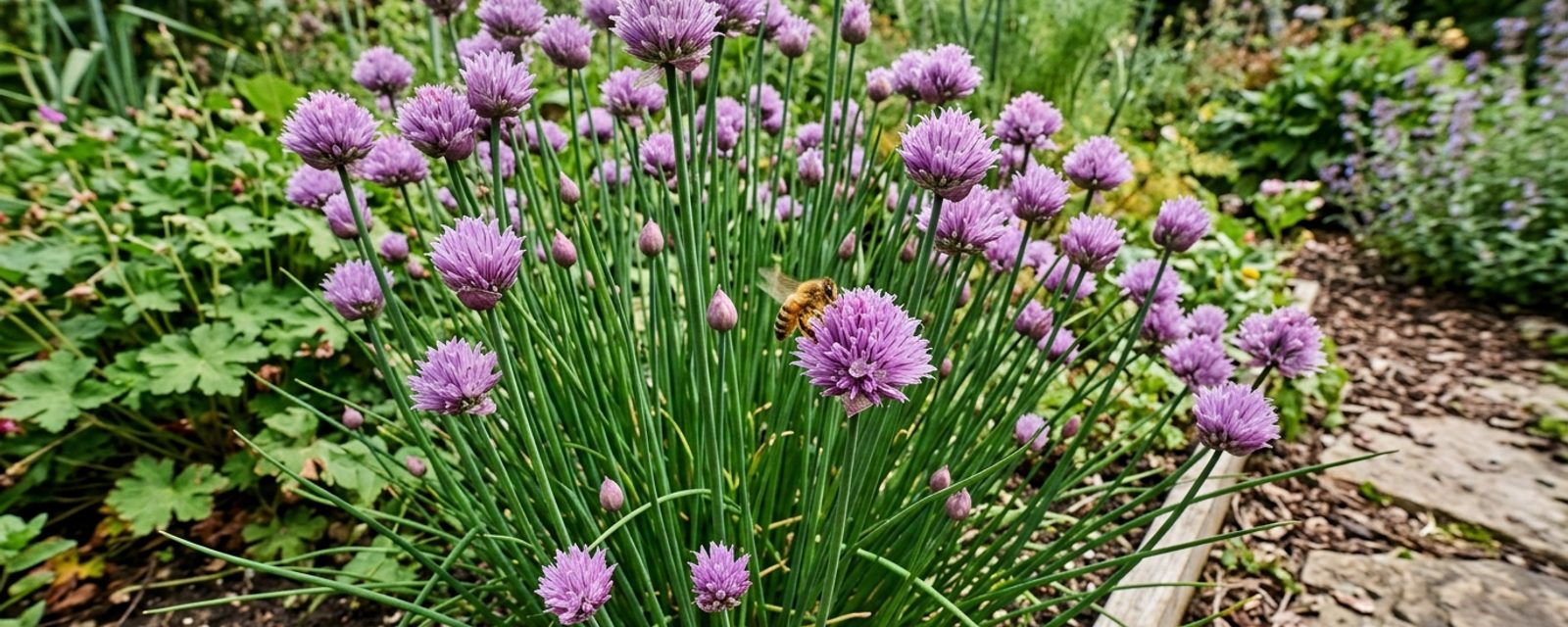
Allium schoenoprasum
Chives ask for almost nothing and give you something every month of the growing season: a clump planted once comes back every year, with fresh green snips ready as early as March.
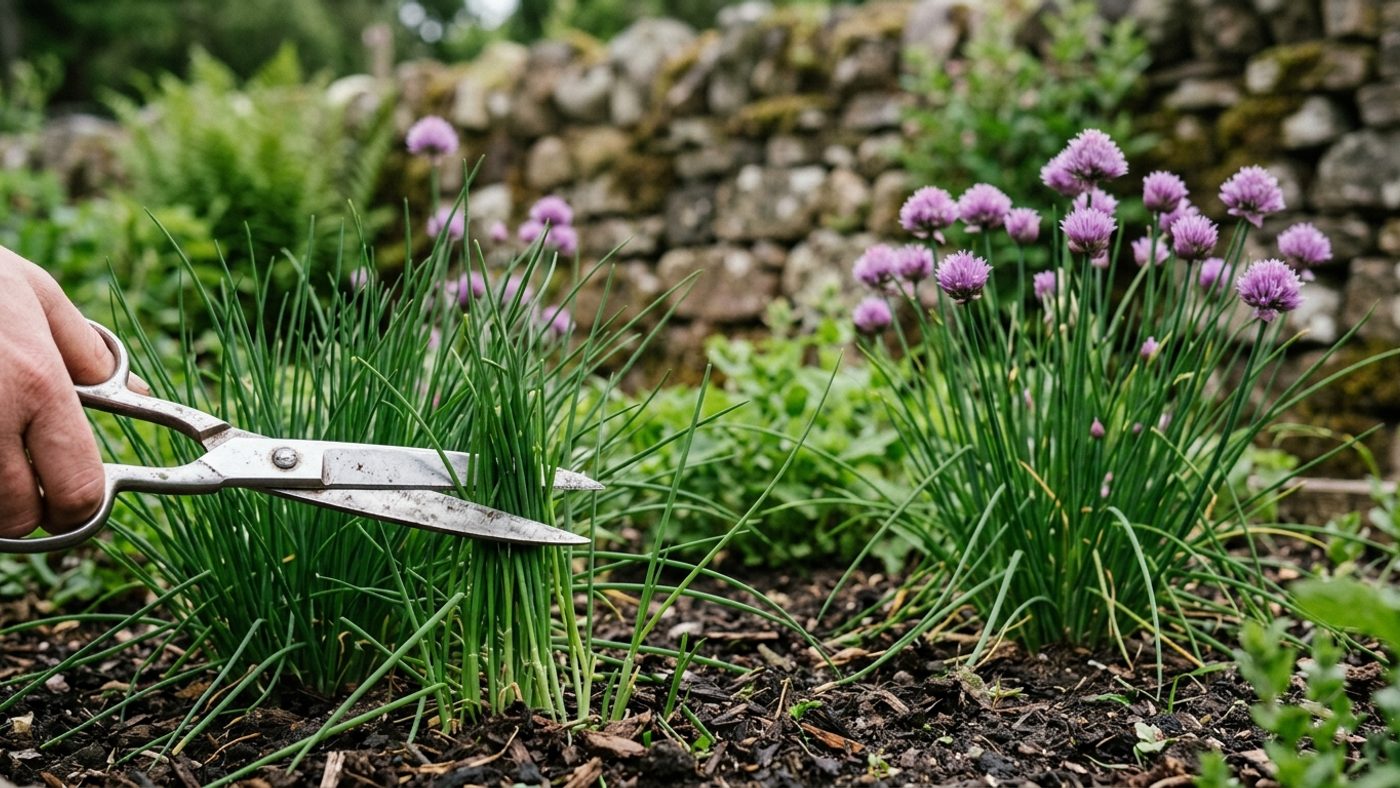
Cut the leaves 5cm from the base with scissors, never pulled, and they regrow within weeks. The purple flowers in early summer are edible, taste of mild onion, and make any salad look deliberate. A single clump by the kitchen door, or along the edge of a vegetable bed where their onion scent might confuse a carrot fly, is all the chive investment you will ever need to make.
Why chives suit Scotland
A Scottish summer, cool and damp, gives you lush tender leaves rather than tough woody ones, a genuine growing-condition advantage rather than mere tolerance. Chives are in the allium family, sharing a pest list with onions and leeks; a four to five year rotationMoving each crop family to different ground each year, on a multi-year cycle, so pests and diseases that build up in soil don't get a repeat host. Full definition → away from other alliums keeps soil-borne diseases from building up, though a single clump in a border is unlikely to attract serious trouble.
Varieties
Only two chives are grown for the kitchen, common and garlic, and neither holds AGMThe RHS's Award of Garden Merit: a UK-wide trials award for reliable performance, not a Scotland-specific recommendation. Full definition →. The standard kitchen chive is the one to grow.
★ Our pick for Scotland
Common chives
Allium schoenoprasum
The standard kitchen chive. Fine hollow leaves with a mild onion flavour. Purple globular flowers in early summer that are edible and excellent for pollinators.
Why this one: The standard kitchen chive, and the one virtually everyone means by "chives": mild onion flavour and the plant most worth having by the kitchen door. Garlic chives are the only real alternative, and they're a genuinely different plant with a different flavour, not an upgrade.
Also worth considering
Garlic chives
Allium tuberosum
Flat leaves, 40-50cm tall, white flowers. A garlic flavour rather than onion. Flowers later in summer.
Best Chive Varieties for Scotland → compares all named chive varieties head-to-head, with the practical detail that doesn't fit in a summary card.
Site and planting
Chives want sun or light shade and well-drained soil. They grow well in the ground, in raised beds, or in pots. A pot 20cm wide on a sunny windowsill gives you fresh chives through winter if you bring it indoors before the first frost.
Plant young plants in spring. Space them 15 to 20cm apart. Firm in and water well. You can also raise chives from seed, sown indoors in early spring or directly outdoors in spring. Sow thinly in small pots of peat-freeCompost made without peat, which is harvested from a slow-forming, carbon-storing wetland habitat that peat extraction damages. Full definition → seed compost and keep at room temperature. Seedlings are slow at first but quickly catch up. A seed-raised plant will be ready to harvest lightly in its first summer and fully from its second year onward.
Care through the season
Water young plants during dry spells while they establish. Once established, chives in the ground rarely need watering except in prolonged drought. Potted chives need regular water through the growing season.
Harvesting: cut the leaves about 5cm from the base with scissors. Never pull them. Harvest from late spring through autumn, cutting regularly to encourage fresh growth. The flavour is best before the plant flowers. After the purple flowers fade, cut the whole clump back to 5cm. A fresh flush of leaves will appear within two weeks.
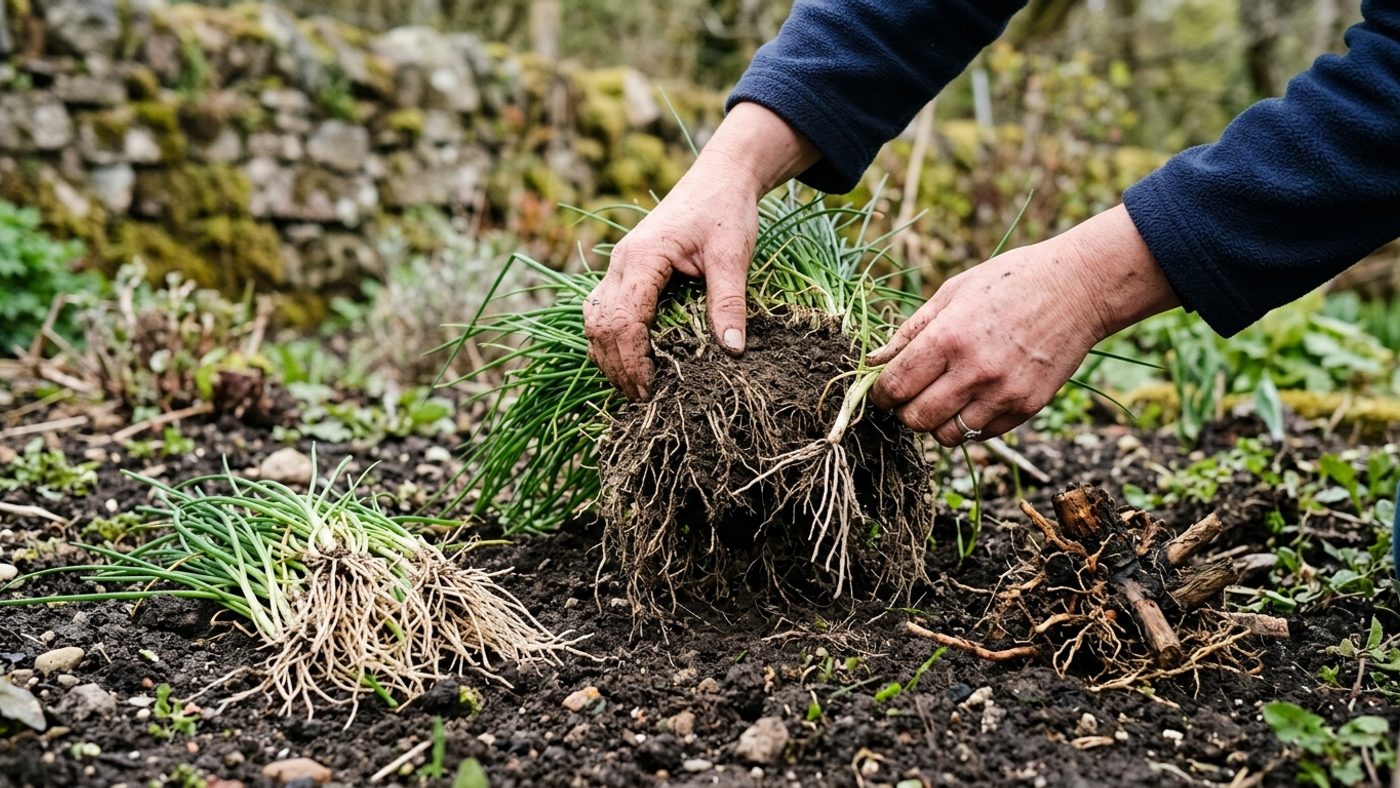
DividingPropagating a clump-forming perennial by digging it up and splitting it into several smaller pieces, each with roots and shoots attached. Full definition →: every three to four years in spring, dig up the clump and split it into several pieces. Replant the healthy outer sections and discard the woody centre. This renews the plant and gives you free new clumps for other spots in the garden.
Common problems
- Leek rust appears as orange spots on the leaves in wet summers. Cut affected leaves to the ground and bin them. The plant regrows. Good spacing and airflow reduce the risk.
- Clumps dying in the centre means the plant is overdue for division. Split it in spring and replant the healthy outer sections.
- Allium leaf miner larvae tunnel through the leaves, leaving white trails. Cover with insect-proof mesh in spring. Less common in Scotland than further south.
See more problems
- Onion downy mildew can affect chives too, worse in mild, humid weather. Good spacing and airflow reduce the risk.
- Onion white rot yellows and wilts the foliage and rots the roots, with white fungal growth at the base. There is no cure, and it persists in the soil for years, so lift and destroy affected clumps and avoid replanting alliums in the same ground.
Common questions
How do I harvest chives to keep them growing?
Cut leaves down to a couple of centimetres above the base rather than scalping them to the ground, and the clump regrows within weeks: do this two or three times through the season, then cut the whole clump back after flowering to refresh it. Full sourced breakdown: <a href="/tools/garden-myths/chives/">Chive Myths →</a>
Do chives survive a Scottish winter?
Yes. Chives are fully hardy perennials. The leaves die back in late autumn and the plant is invisible until spring, but the roots are alive underground. In March, green shoots will appear through the soil. A clump in the ground will survive winter after winter without protection. Chives in pots may benefit from being moved to a sheltered spot during the coldest spells.
Why are my chives getting thin and patchy?
Chives only need dividing every three to four years, not annually: dig up the clump in spring, split it, discard the woody centre and replant the healthy outer sections. Full sourced breakdown: <a href="/tools/garden-myths/chives/">Chive Myths →</a>
Are chive flowers edible?
Yes: the purple flowers are fully edible with a milder onion flavour than the leaves, and pulling them apart over a salad is a legitimate use of the plant rather than a waste of it. Full sourced breakdown: <a href="/tools/garden-myths/chives/">Chive Myths →</a>
Sources
3 sources, and what each was used for
- RHS: perennial habit, sowing and planting windows, 15-20cm spacing, division every 3-4 years, harvest window and indoor extension, named types
- Garden Organic: 0.5cm sowing depth, 10-20 day germinationA seed sprouting: breaking dormancy and putting out its first root and shoot, given the right warmth and moisture. Full definition →, 25cm final spacing, autumn division, cutting from 15cm tall while leaving 5cm of stem to regrow, and the edible pollinator-friendly flowers
- Teagasc: corroborates buying clumps and planting in early spring, and cutting leaves through summer as required