
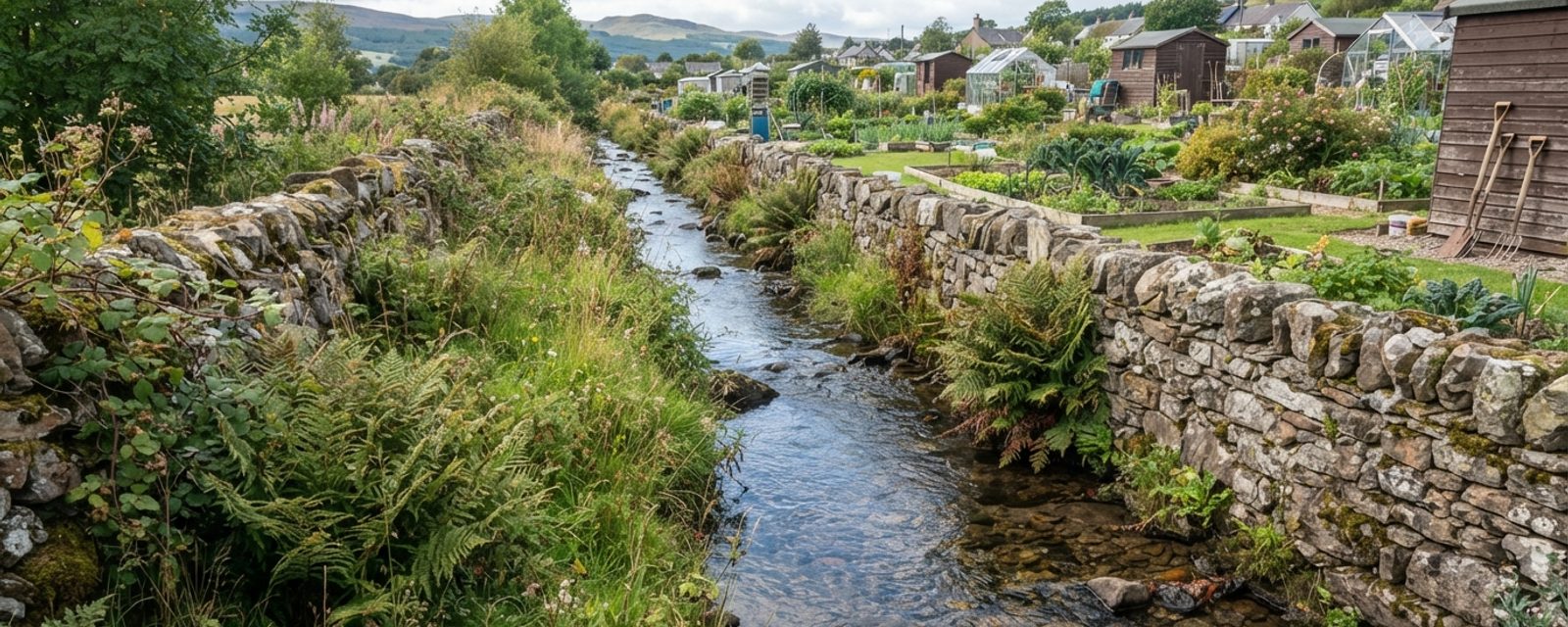
If your tap doesn't run back to a council pipe, if it draws from a borehole in the garden, a spring on the hill, or a shared tank fed by a burn, most of what gets written about hosepipe bans and drought restrictions simply doesn't apply to you: neither Scotland's nor England's restriction powers can reach a supply that was never connected to the mains.
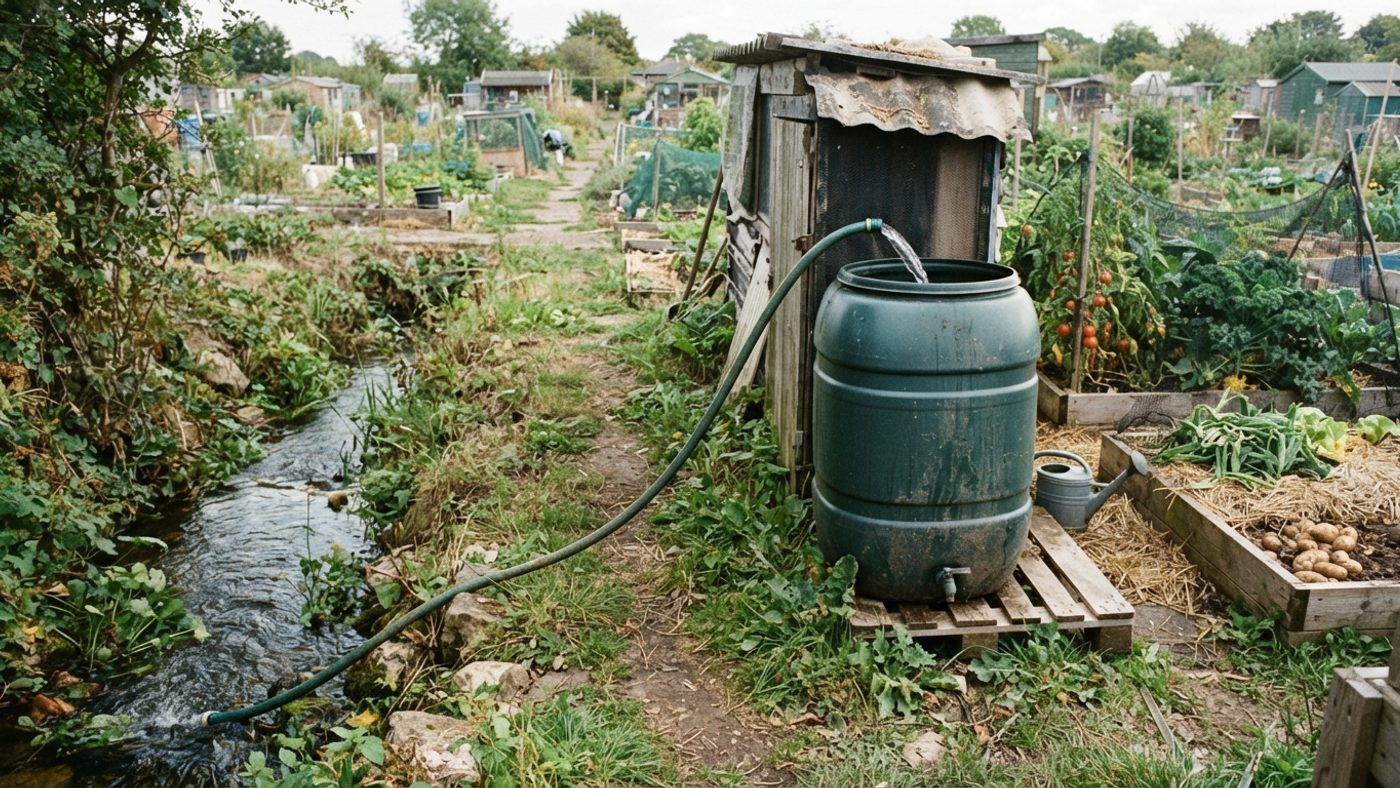
And if you're standing at the allotment eyeing the burn along the boundary, wondering whether you could just run a pipe down and fill a water butt from it, you're asking a different question again, not about restrictions on an existing supply, but about whether you're allowed to start a new one, which is a matter of SEPA abstraction rules rather than water-restriction law at all.
Both situations sit outside the mains water system, and both are commonly misunderstood, sometimes as "no rules apply at all," sometimes as "you probably need a licence for that." Neither is quite right.
Quick answer
A private water supply (used by around 3% of people in Scotland) is regulated by the local authority, not SEPA, and isn't reachable by either the English hosepipe-ban rules or Scotland's Water Shortage Order power, those only cover customers of a water company. Drawing new water from a burn, river, loch or groundwater to irrigate is a different matter and falls under SEPA's Environmental Authorisations (Scotland) Regulations 2018 (EASR), but almost every realistic garden or allotment watering volume falls into the tier that needs no application or registration at all. Filling a water butt from your own roof's rainwater isn't abstraction at all, and isn't covered by any of this.
Part 1: Private water supplies
What counts as a private water supply
A private water supply is any drinking-water supply that isn't provided by Scottish Water, a borehole, a spring, a well, or an intake from a loch or stream, typically feeding a single household, a small group of properties, or a rural business. Around 3% of Scotland's population relies on one, and DWQR notes many more people come across one temporarily, in a rural holiday cottage or similar. If your household water comes this way, your garden and greenhouse taps almost certainly draw from the same supply.
Who regulates it
Private supplies aren't left unregulated, they sit under a different regulatory structure from mains water, with different bodies doing different jobs.
Local authorities carry the day-to-day statutory duties. Under the Private Water Supplies (Scotland) Regulations 2006, each council must keep a register of the private water supplies in its area, has monitoring duties and powers over those supplies, and has a duty to provide information on request. Supplies are classified as Type A (a supply of 10m³ or more a day, or serving 50 or more people, or any supply used commercially or publicly, broadly, larger or commercial-scale supplies) or Type B (everything else, which in practice covers most single-household domestic supplies), with a separate risk-assessment regime for each. In practice, the local council's environmental health department is the point of contact for registering a supply, getting it risk-assessed, and arranging testing, and it's also the practical place to ask whether a registered private supply already exists near a burn or loch you're considering, since there's no single public map of private supplies to check yourself.
The Drinking Water Quality Regulator for Scotland (DWQR) sits above that, in an independent verification role. DWQR doesn't run supplies or regulate individual households directly, it checks that local authorities are meeting their statutory duties under the regulations and reports publicly on how well the system as a whole is working.
The regulatory framework itself runs through the Private Water Supplies (Scotland) Regulations 2006 and the Water Intended for Human Consumption (Private Supplies) (Scotland) Regulations 2017, which between them set the quality standards, risk-assessment requirements, and monitoring frequencies that apply depending on a supply's classification.
What owning or using a private supply actually involves
For a gardener or allotment holder on a private supply, the practical duties (per Scottish Government citizen guidance) are: registering the supply with the local authority, keeping the equipment maintained, treating the water so it's safe to use, and reporting problems when they arise. The same guidance is blunt about drought and storm planning specifically, it tells owners to plan in advance how they'll get water if their normal source is disrupted, rather than assuming one will always be available.
Does a hosepipe ban or Water Shortage Order affect you?
No, and it's worth being precise about why. Scottish Water can apply for a Water Shortage Order under Part 7 of the Water Resources (Scotland) Act 2013 during periods of low water availability, and a similar power exists in England under the Water Industry Act 1991. Both mechanisms regulate customers of a water undertaker, people whose water comes through the mains network. A private supply user isn't a customer of a water undertaker in the first place, so neither power reaches them, however severe the drought. Both mechanisms, plus SEPA's separate water-scarcity scale for licensed abstractors, are covered in full in the guide to hosepipe ban rules in Scotland.
That's a statement about legal restriction, not about water availability. A spring, borehole or stream-fed supply is a physical water source with its own limits, and in a dry summer it can run low or fail on its own terms, independent of anything a regulator does. The practical constraint facing a private-supply gardener in a drought isn't a legal one, it's whatever the source itself can physically deliver, which is exactly why forward planning for low-water periods is built into the official guidance on managing a private supply. Cutting overall demand helps regardless of supply type; the guides to general watering technique and hot-weather and heatwave watering cover that ground.
Using untreated water on food crops
One thing the drinking-water regulations don't settle for you: whether it's safe to water vegetables, salad or soft fruit directly from an untreated private source. Surface water (rivers, burns, lochs) carries a real contamination risk from wildlife, livestock, septic tanks and sewage overflow upstream, Food Standards Scotland names E. coli and Cryptosporidium specifically, with risk rising after rainfall as sediment and runoff disturb the water. Shallow boreholes and wells are less exposed but not immune, particularly with livestock nearby or after heavy rain. None of this is a legal barrier to using the water on a domestic plot, but it's a genuine food-safety consideration, not just a drinking-water one: avoid abstracting straight after flooding or heavy rain, and treat the risk as higher on leafy crops eaten raw than on anything cooked.
Part 2: Taking new water from a burn, river, loch or groundwater
A private supply and a new abstraction are not the same thing
Everything above concerns a household that already has a private supply serving the house, with the garden drawing from the same system. Running a hose or pipe directly into a burn, river, loch or borehole to water a garden or allotment, water that doesn't already come to you through any existing supply, is a new abstraction (taking water directly from the water environment), and it's regulated separately, by the Scottish Environment Protection Agency (SEPA), under environmental rather than drinking-water law.
The current framework: EASR
Water abstraction for irrigation in Scotland is authorised under the Environmental Authorisations (Scotland) Regulations 2018 (EASR), SSI 2018/219. Until November 2025, this activity sat under the Water Environment (Controlled Activities) (Scotland) Regulations 2011, widely known as "CAR." The Environmental Authorisations (Scotland) Amendment Regulations 2025 folded water activities into EASR from 1 November 2025, replacing CAR as SEPA's water-abstraction framework. Readers who've previously come across "CAR" are looking at the predecessor to the current rules; the volume thresholds themselves carried over unchanged into EASR, so what actually counts as low-risk or requiring registration hasn't moved.
The three tiers
| Volume abstracted | Authorisation needed | What's required |
|---|---|---|
| Under 10m³ (10,000 litres) per day | None | Comply with General Binding Rule two (GBR 2) directly, no application, no registration |
| 10m³ to 50m³ per day (inland surface water or groundwater) | Registration | One-off application to SEPA (form R-WAT-C1), current fee £198.55 |
| 50m³ per day or more | Full permit | Application to SEPA, with fees banded by volume |
A different, higher threshold applies to abstraction from the coast, which won't apply to inland garden and allotment irrigation.
What GBR 2 actually requires
For abstraction under 10m³ a day, no application or registration is needed at all, the activity is automatically authorised provided you comply with GBR 2's own conditions. Those conditions are: you must be able to demonstrate the abstraction stays under 10m³ a day, either through measuring equipment or through equipment that's simply incapable of drawing more; you must keep pipework, tanks and other equipment in good repair to minimise leakage; and the abstraction point must not be within 50 metres of an existing well, spring or borehole used for a water supply. That last condition exists for the same reason Part 1's local-authority risk assessments do: a new abstraction sunk too close to somebody else's private water supply can draw down or contaminate the very source that supply depends on.
Breaching GBR 2's conditions, or abstracting above 10m³ a day without registering, is an offence, this isn't a purely self-certified system with no real consequence for ignoring it, even at the low-volume end.
If a burn or loch you're considering has extra protections attached (a Site of Special Scientific Interest, a Special Area of Conservation, or a river with protected salmon or freshwater pearl mussel populations, for instance), additional requirements can apply beyond GBR 2's standard conditions. NatureScot's SiteLink tool lets you check whether a specific site carries one of these designations before you start.
What 10,000 litres a day actually means for a garden
For almost every realistic garden or allotment watering scenario, this isn't really a compliance question, it's reassurance. Ten cubic metres is 10,000 litres:
- A standard watering can (9–10 litres), around 1,000 full cans to reach the threshold
- A garden hose at a typical domestic flow rate, 8–11 hours of continuous running to reach the threshold
Hand-watering, a hose, or a sprinkler on a domestic garden or allotment plot, even generously used in a heatwave, sits nowhere near that. The registration tier (10–50m³) and permit tier (50m³+) exist for agricultural-scale irrigation, industrial use, and hydropower.
Does this exemption hold up during a drought?
Yes. SEPA's own significant water scarcity guidance is direct on this point: those abstracting up to 10m³ a day under GBR 2 "may continue to do so," and SEPA states it is "not considering suspending Registration level authorisations for abstractions of up to 50m³ per day" even in catchments at Significant Scarcity, the most severe level on its water-scarcity scale. Small-scale abstraction is treated as low-impact enough that it stays outside the restrictions aimed at larger agricultural and industrial abstractors during a dry summer. SEPA publishes a weekly status update for every Scottish catchment, so it's possible to check exactly where your own area sits before assuming either way.
Constructing a well or borehole for irrigation
If the plan involves sinking a new borehole or well specifically to abstract for irrigation, rather than connecting to an existing one, that construction itself is covered by its own General Binding Rule, separate from the abstraction GBR: boreholes and wells up to 200 metres deep, abstracting under 10m³ a day, are authorised under that GBR provided the construction prevents mixing of groundwaters of different chemical composition or from separate aquifers, isn't sited within 50 metres of an existing well without the owner's consent, and is properly backfilled or sealed when decommissioned. As with the abstraction GBR, no registration is required if the conditions are met.
England's threshold is a different number
The Environment Agency's licensing threshold in England is 20m³ per day, under the Water Resources Act 1991 as amended, not SEPA's 10m³ threshold in Scotland. The two are separate frameworks under separate regulators, so the English figure isn't a substitute for the Scottish one.
Common questions
Can I water my allotment from the burn that runs along the boundary?
Yes, in almost all cases without needing to do anything with SEPA first. Taking water this way is a new abstraction, but it's automatically authorised under GBR 2 as long as you: stay under 10,000 litres a day, keep equipment in good repair, and don't site the abstraction point within 50 metres of an existing well, spring or borehole used for water supply.
Do I need a licence to use an existing garden well or borehole?
If it's an existing private water supply already serving the house, it's regulated by the local authority under the Private Water Supplies (Scotland) Regulations 2006, not by a SEPA abstraction licence, registering it with the council's environmental health department is the relevant step. If instead you're constructing a new borehole or well specifically for irrigation, that construction is covered by its own General Binding Rule provided it's under 200 metres deep, abstracts under 10m³ a day, and meets the siting and construction conditions, again, no SEPA application needed if you meet them.
Does a hosepipe ban affect me if I'm on a private water supply?
No, neither the English hosepipe-ban power nor Scotland's Water Shortage Order can reach a private supply, since both only regulate customers of a water undertaker.
What happens if my borehole or spring runs low in a drought?
No law stops you using it, but a private supply is a genuinely limited physical resource that can run low on its own terms in a dry summer. That's a physical constraint, not a legal one, which is why planning ahead for a disrupted supply is part of the official guidance on managing a private supply.
Do the SEPA abstraction rules apply if I'm just using the tap water that already comes into my house from a private supply?
No, using an existing supply that already serves the house is governed by the private water supply rules (local authority regulation), not SEPA's abstraction rules. SEPA's thresholds and General Binding Rules apply specifically to taking new water directly from a river, burn, loch or groundwater that isn't already part of an existing supply.
Is "CAR" still the right term to use for Scotland's water abstraction rules?
Not any more. CAR (the Water Environment (Controlled Activities) (Scotland) Regulations 2011) was folded into the Environmental Authorisations (Scotland) Regulations 2018 (EASR) from 1 November 2025, which is now SEPA's water-abstraction framework. The volume thresholds themselves are unchanged from the old CAR regime, so anything using the 10m³/50m³ figures under "CAR" still holds; only the name of the framework has changed.
Sources
14 sources, recorded with what each was used for
- Drinking Water Quality Regulator for Scotland (DWQR): Private Water Supplies: The 3% population figure, the note that many more people encounter a private supply via rural holiday accommodation, and DWQR's independent verification role relative to local authorities
- mygov.scot: Private water supplies: Owner/user duties (registering, maintaining, treating, reporting), drought/emergency planning guidance, and local council environmental health as point of contact
- legislation.gov.uk: Private Water Supplies (Scotland) Regulations 2006: Local authority statutory duties, the Type A/Type B definitions, and risk assessment
- Food Standards Scotland: Water sources and storage (Fresh Produce Tool): The contamination risk of untreated surface water and shallow boreholes/wells on edible crops, and the recommendation to avoid abstracting during or immediately after flooding
- legislation.gov.uk: Environmental Authorisations (Scotland) Regulations 2018: The legal basis of the current EASR framework
- legislation.gov.uk: Environmental Authorisations (Scotland) Amendment Regulations 2025: The 1 November 2025 commencement date bringing water abstraction (formerly CAR) under EASR
- SEPA: EASR abstraction overview: The three-tier threshold structure
- SEPA: Abstraction from the water environment — less than 10m³ per day: GBR 2 conditions
- SEPA: Abstraction from inland waters from 10m³ to 50m³ per day: Registration process, form R-WAT-C1, and fee
- SEPA: Construction and operation of a borehole or well up to 200m deep and less than 10m³ water per day: Borehole/well construction General Binding Rule conditions
- SEPA: Significant water scarcity guidance: Confirmation that GBR-tier and Registration-tier abstraction are not suspended during Significant Water Scarcity
- SEPA: Water scarcity: Weekly catchment-level water-scarcity status reporting
- NatureScot: SiteLink: The tool for checking whether a specific watercourse carries an SSSI, SAC or other protected-area designation
- gov.uk / Environment Agency: Check if you need a licence to abstract water: The England comparison figure (20m³/day threshold) only