
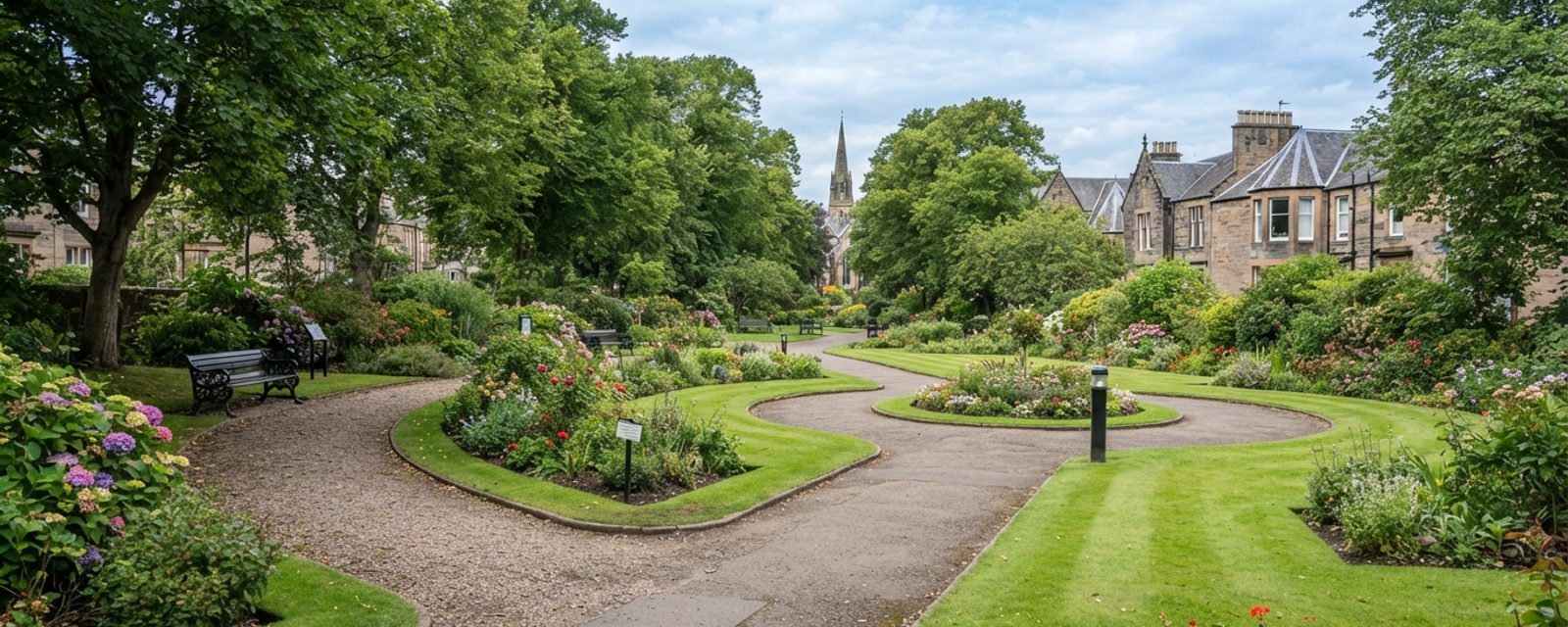
You've found the spot. A patch of scrubby green behind the primary school, or that flat, sunny corner of the town park that's been mown and ignored for a decade, exactly the kind of site a community garden or new allotment plot needs. You start asking the council who owns it, and a phrase comes back that nobody quite explains: "common good land." Not owned by the council in the ordinary sense, apparently, but not owned by anyone else either.
Quick answer
Common good land is property a Scottish council holds in trust for the community of a former burgh, not as an ordinary council asset, and that distinction has real legal teeth. Selling it, leasing it long-term, or changing its use triggers duties under the Local Government (Scotland) Act 1973 and Part 8 of the Community Empowerment (Scotland) Act 2015 that don't apply to normal council property, including public consultation and, in disputed cases, a court application. Every council is required to publish a register that tells you whether a given site has this status.
What common good land actually is
Common good property dates back to the medieval and early-modern burghs, roughly 200 self-governing Scottish towns (royal burghs like Edinburgh and Aberdeen, plus other burgh types with slightly different origins but the same basic status) that existed before local government reorganisation. Burghs acquired land, buildings, and other assets over centuries through royal charter, gift, bequest, or purchase, and held them not as the personal property of the town council but for the common good of the burgh's inhabitants, town squares, mercat crosses, harbours, parks, town halls, and odd parcels of ground that had simply belonged to the burgh since time out of mind.
When Scotland's burghs were abolished by local government reorganisation in 1975 (and again in 1996), their common good property didn't disappear or convert into ordinary council assets. It passed to the successor local authorities, but stayed legally separate. A modern council like City of Edinburgh, Glasgow City, or Aberdeen City can hold a piece of land as an ordinary corporate asset and hold a different piece of land as common good, and the two are governed by different rules even though the same council's name is on both titles.
How common good land differs from ordinary council land
Two statutes constrain what a council can do with common good property that don't apply to its ordinary estate.
The Local Government (Scotland) Act 1973, section 75, is the older backstop, and it turns on one key legal term: "alienate," which just means to sell, transfer, or otherwise permanently give up. Section 75 splits common good land into two categories. Where there's no real question about the council's right to alienate a piece of common good land, the council can sell or repurpose ("appropriate") it much like ordinary property. But where that right is genuinely in question, commonly because the land was gifted, bequeathed, or has been held for a specific purpose (a park, a recreation ground) for so long that it's treated as inalienable common good, the council can only dispose of it with the authority of, and subject to any conditions imposed by, the Court of Session or sheriff court.
This inalienable/alienable split is the real operative test, and it's not a paperwork formality: in Portobello Park Action Group Association v City of Edinburgh Council [2012] CSIH 69, the Court of Session's Inner House stopped Edinburgh's council building a new high school on Portobello Park, ruling that section 75 gave it no power to repurpose inalienable common good land at all, not even with a court's blessing, because an 1898 gift of the park came with an express condition that the ground be used exclusively as a public park. The council could only proceed once the Scottish Parliament passed a specific private Act, the City of Edinburgh Council (Portobello Park) Act 2014, deeming that one park alienable for that one purpose. That's the scale of legal weight this status can carry, and it's why checking a site's common good status matters before assuming a council can simply hand it over for a garden, just as much as before assuming it can sell it out from under one.
The Community Empowerment (Scotland) Act 2015, Part 8, added a layer of public process on top of this in 2018. It doesn't replace the 1973 Act's court-authorisation route; it adds transparency and consultation duties that apply regardless of whether court authorisation is also needed. Section 102 requires every council to establish and maintain a register of the property it holds as common good, and to publish that register online. Section 104 requires a council proposing to dispose of common good property, or change what it's used for, to publish details of the proposal and notify the relevant community councils and community bodies, inviting representations, then have regard to those representations before deciding. Neither the Act nor the guidance sets a fixed minimum number of weeks for that consultation, the duty is to publish and genuinely consider representations, not to run a process of any specific length. For a community group with its own timeline to worry about, a growing season, a funding deadline, a lease that needs signing before spring sowing, that open-endedness cuts against you: ask the council directly, early, what timetable it intends to run, rather than assuming a fixed number of weeks the way you might for a planning application.
| Provision | What it covers | Applies to common good land? |
|---|---|---|
| Local Government (Scotland) Act 1973, s.75 | Court authorisation for disposal where the council's right to alienate the land is in question | Yes — the primary mechanism, engaged when disposal rights are disputed |
| Community Empowerment (Scotland) Act 2015, Part 8 (ss.102–106) | Statutory common good register; publication and consultation before disposal or change of use | Yes — directly and specifically; this is the common good regime |
| Community Empowerment (Scotland) Act 2015, Part 5 (asset transfer requests) | Community bodies can request transfer, lease, or use rights over land/buildings owned or leased by a public authority | Treated the same as any other council land, no special common good rule |
| Community Empowerment (Scotland) Act 2015, Part 4 (amending the Land Reform (Scotland) Act 2003 community right to buy) | Registration of community interest in land and a right to buy when it comes up for sale | Treated the same as any other council land, no special common good rule |
Part 4 and Part 5 were built for the general run of council land, and neither singles out common good property for special treatment. A Part 4 or Part 5 request against a common good site runs on the same general rules as any other council land, but the council's separate common good duties, the register, the Part 8 consultation, and section 75 court authorisation where alienability is in doubt, still apply on top and don't go away just because a request has been made. The statute doesn't spell out how the two interact, so raise the overlap directly with the council or a solicitor for a specific site rather than assuming either route resolves it cleanly on its own.
Why this matters for gardeners specifically
Town parks, greens, and recreation grounds are among the most common categories of surviving common good property, because they were exactly the sort of amenity a burgh council would have set aside for its inhabitants centuries ago and never sold off. That means a meaningful share of the green space Scottish gardeners and community-growing groups look at as potential allotment or community garden sites, the disused bowling green, the corner of the public park, the old drying green behind the tenements, may carry common good status without anything on the ground indicating it.
The consequence cuts both ways. The same duty that protects the site from being quietly sold also applies to turning it into a permanent allotment or granting a community garden group a long lease, that too can count as a change of use or a disposal, and trigger the same publication-and-consultation process. Securing the land for growing may itself involve a formal proposal and a consultation window, not just an informal agreement with a parks officer.
A group already growing informally on common good land without a lease, an ad hoc arrangement with a parks team, say, has no special protection from that status alone; being common good constrains what the council can do with the land, it doesn't itself give an existing occupier any right to stay. If that's your situation, formalising the arrangement (a lease, a Part 5 asset transfer, or both) is worth pursuing precisely because it converts an informal understanding into something the council's own common good duties then have to work around.

Finding out if a site is common good
Common good status doesn't reliably announce itself on an ordinary title search, it's a status attached to how the council holds the land, not necessarily something flagged on the title sheet itself. The reliable way to check is the separate register section 102 of the 2015 Act requires every council to publish. Three examples, all live and searchable:
| Council | Register | Note |
|---|---|---|
| City of Edinburgh Council | Common Good Asset Register | edinburgh.gov.uk — underlying spreadsheet also available via the council's consultation hub |
| Glasgow City Council | Register of Common Good Property | glasgow.gov.uk — council reports holding around 22,000 title deeds in total; identifying every common good asset among them is an ongoing, multi-year review |
| Aberdeenshire Council | Common Good Asset Register | publications.aberdeenshire.gov.uk |
If your council isn't one of these, search "[council name] common good register", section 102 places the same publishing duty on every Scottish council, so an authority covering former royal burgh territory (Perth and Kinross, Stirling, Dundee, Fife, Angus, Inverclyde and others) should have an equivalent register somewhere, sometimes under headings like "common good property" or "common good asset register" on the council's land-and-property or committee-papers pages. Where a specific site doesn't appear on the published register at all, that's not necessarily conclusive, the registers are acknowledged works in progress in at least Glasgow's case, so it's worth asking the council's legal or property services team directly whether a specific parcel has ever been treated as common good, particularly for older sites whose title history goes back to a pre-1975 burgh.
Pursuing a garden or allotment site on common good land
The consultation and court-authorisation duties above are what protect a site from being sold or repurposed without a say. Actually securing one for growing is a separate, practical question, and it runs through the same general community- empowerment routes the 2015 Act gives for any council land, common good or not, covered in full in the guide to community right to buy and asset transfer: a Part 5 asset transfer request (asking to take on ownership, a lease, or management of the land) or, less commonly for a small urban site, registering a Part 4 community right to buy. There's no fee for making an asset transfer request itself, but a community body has to put together the request and a supporting case, and time and legal advice cost money in practice; for anything beyond a straightforward request, a solicitor or a body such as Development Trusts Association Scotland can help. Once a request is validated, the council has a statutory deadline of six months to issue its decision (longer only if both sides agree to extend it), and it must agree to the request unless it has reasonable grounds to refuse, a real but not indefinite timeline, so start early rather than assuming an answer within weeks. Where the site is also allotment ground, it separately falls under the Community Empowerment Act's food-growing provisions (Part 9), which govern statutory waiting lists and site management once it's allocated, common good status doesn't change that day-to-day allotment governance, it only governs how the site was disposed of, changed in use, or transferred to get there.
The practical starting point for any group is the same regardless of route: check the register, and if the site is listed, get a copy of any title conditions attached to it before assuming a straightforward lease or transfer is possible. If the ground turns out to be inalienable common good, held under a historic gift or bequest restricting it to a specific use, as at Portobello Park, a straightforward sale or long lease to your group may not be legally available to the council at all without either a court's authorisation or, in the most contested cases, an Act of the Scottish Parliament to permit it specifically. That's a real constraint to know about before investing time in a proposal, not necessarily a reason to give up on it: a shorter-term lease or management agreement, rather than outright ownership, doesn't require alienating the land at all, so it can be a realistic route even where a full transfer would need court authorisation or an Act of Parliament.
For the wider historical picture of how allotments and common land in Scotland ended up under such different tenure arrangements, see the history of allotments in Scotland, and for the statutory waiting-list and site-regulation rules that apply once a plot is allocated, see allotment rules in Scotland.
Common questions
Is common good land the same as council-owned land?
No. Common good land is owned by the local authority, but it's held for the common good of a former burgh's community rather than as an ordinary corporate asset, and its disposal or change of use is governed by extra statutory duties that don't apply to the council's general property.
Can a council just sell common good land if it wants to?
Not without following the section 104 publication-and-consultation process under the 2015 Act, and, where there's doubt about the council's right to alienate the land, without applying to the Court of Session or sheriff court for authorisation under section 75 of the 1973 Act.
Does common good land exist in England or Wales?
No. Common good is a distinctly Scottish legal category rooted in the burgh system; there's no equivalent status in English or Welsh local government law.
How do I find out if a specific park or plot is common good?
Check your local council's published common good register (required under section 102 of the 2015 Act), several, including Edinburgh, Glasgow and Aberdeenshire, publish theirs online, and if the site isn't listed, ask the council's property or legal team directly, since some registers are still being completed.
Can a community group take ownership of common good land for a garden or allotment?
Potentially, through the general community asset transfer request provisions in Part 5 or community right-to-buy registration in Part 4 of the 2015 Act, neither is written specifically for common good property, so any such request runs alongside, not instead of, the council's separate common good disposal duties.
Do allotments themselves ever count as common good land?
Some do, if the ground was historically part of a burgh's common good estate before being used as allotments. There's no blanket rule either way, so the only reliable way to check is against the specific council's common good register or by asking the council directly.
Sources
11 sources, recorded with what each was used for
- Local Government (Scotland) Act 1973, Section 75: The statutory disposal and court-authorisation mechanism for common good land
- Community Empowerment (Scotland) Act 2015, Part 8: Common good register and consultation duties, sections 102–106
- Community Empowerment (Scotland) Act 2015, Section 104: The publication and consultation duty before disposal or change of use
- Community Empowerment (Scotland) Act 2015, Part 5: Asset transfer request provisions; confirmed no specific rule for common good land
- Community Empowerment (Scotland) Act 2015, Part 4: Community right to buy provisions; confirmed no specific rule for common good land
- gov.scot: Community empowerment — common good property guidance for local authorities: Statutory guidance context and the historical origin of common good assets
- City of Edinburgh Council: Common Good Asset Register: A live, published example of a council common good register
- Glasgow City Council: Register of Common Good Property: A live, published example of a council common good register
- Aberdeenshire Council: Common Good Asset Register: A live, published example of a council common good register
- City of Edinburgh Council (Portobello Park) Act 2014, Explanatory Notes: The Portobello Park case background and why a specific Act of Parliament was needed
- gov.scot: Asset transfer under the Community Empowerment (Scotland) Act 2015 — guidance for relevant authorities: The six-month statutory decision-notice deadline and the "must agree unless reasonable grounds to refuse" standard