
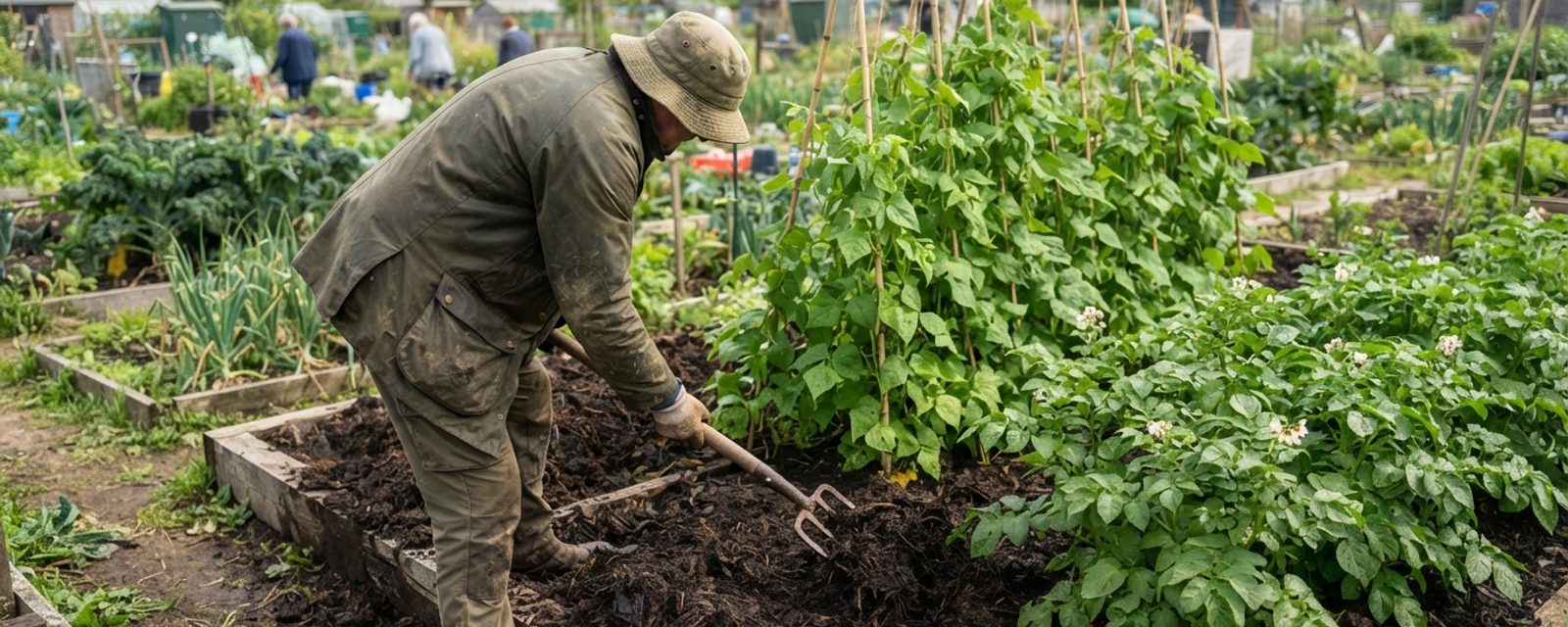
A few weeks after digging well-rotted manure into a new potato bed, the top growth stops looking like potato growth at all. The leaflets have narrowed into thin, curled fingers with a fern-like frill instead of a normal potato leaf's broad lobes. New shoots on the tomatoes in the next bed over are doing the same thing, twisted stems, cupped leaves, growing points that look pinched and stunted rather than opening out. Nothing was sprayed. The manure was well-rotted, dark, sweet-smelling, everything a book would tell you to look for. The plants are reacting as if they'd been hit with weedkiller, because they have been, just not by anyone in the garden.
The likely cause is aminopyralid, a herbicide sprayed onto pasture, hay meadows, and grassland to control broadleaf weeds like docks and thistles. It does something most gardeners don't expect from a weedkiller: it survives being eaten.
How a herbicide ends up in "clean" manure
Aminopyralid binds tightly to plant material. When livestock graze treated grass or eat hay cut from a treated field, the chemical passes through the animal's digestive system essentially unchanged and comes out in the dung. It has been through a cow or a horse and is still active.
It then survives the next stage too. Composting or "rotting down" a manure heap relies on heat and microbial breakdown of organic matter, and that process works perfectly well on the straw, dung, and bedding around it, the heap goes dark, crumbly, and sweet-smelling exactly as expected. Aminopyralid isn't touched by any of that. Its breakdown in soil depends on soil bacteria acting on it directly, a slow process measured in a year or more rather than the weeks or months a manure heap takes to rot down, so a heap can look and smell completely finished while the chemical inside it is still fully active. There is no way to tell by sight, smell, or texture whether a load of "good" manure is carrying it.
Aminopyralid belongs to a family of herbicides, including clopyralid and picloram, that all share this same trait of surviving digestion and composting intact.
Aminopyralid has been approved for UK grassland use since 2006. It was suspended in July 2008 after reports of exactly this kind of crop damage, then reauthorised in October 2009 under tighter conditions: treated grass can only be used for grazing, not cut for forage; only cattle and sheep may graze it, not horses; manure from treated fields is meant to stay on the farm it came from rather than being sold on; and anyone buying the product has to complete training first. Those conditions are meant to stop treated grass being cut and baled as hay rather than grazed, but they rely on compliance at the field level rather than any check that happens once manure or hay changes hands, so contamination from hay as well as grazing keeps turning up in practice. Beyond that gap, contamination still reaches gardens, manure changes hands informally, on a farm-to-allotment or farm-to-gardener basis that sits outside those conditions, and residues have also turned up in council green-waste compost and in bagged commercial composts made from grass clippings or manure, not just in muck bought directly from a farm or stable.
Symptoms, and what they can be confused with
The damage has a fairly distinctive look once you know what to check for, but it's easy to misread on a first pass:
- Curled and cupped leaves, often narrowed with a fern-like or feathery appearance
- Pale, narrow, distorted shoot tips, sometimes with twisted leaf stalks
- Prominent, parallel vein markings standing out against the leaf surface
- Stunted growth overall, with new growth affected more than old
Tomatoes, potatoes, beans, peas, and other legumes are particularly sensitive, along with chillies. Ornamentals including phlox, delphiniums, and roses can show the same symptoms if they're growing in or near contaminated material.
The pattern that separates this from other common problems is that new growth is distorted while the plant otherwise looks healthy and well fed, no yellowing pattern that spreads from old leaves upward (which points to a nutrient deficiency), no mottling or mosaic patterning across the leaf (a hallmark of viral disease), and no wilting confined to the first week or two after planting (ordinary transplant stress). Herbicide damage shows up as a specific distortion of shape, cupping, twisting, narrowing, concentrated in whatever is actively growing at the time contact happens, and it tends to affect every plant grown in the same batch of material rather than one plant here and there.
On a shared allotment site, that last point matters beyond one plot: a communal manure or compost heap contaminates every bed it's spread onto, not just the first one, so symptoms turning up on more than one plot fed from the same heap is itself a diagnostic clue, and worth flagging to whoever manages the site before more of it gets dug in elsewhere.
Test suspect manure before it goes anywhere near a bed
Because there's no way to eyeball a load of manure or a bag of compost and know it's clean, the only reliable check is to grow something sensitive in it first and watch how it comes up, a bioassay, meaning a test that uses a living plant's own reaction as the measuring instrument, rather than a lab test on the material itself. This is the standard bioassay:
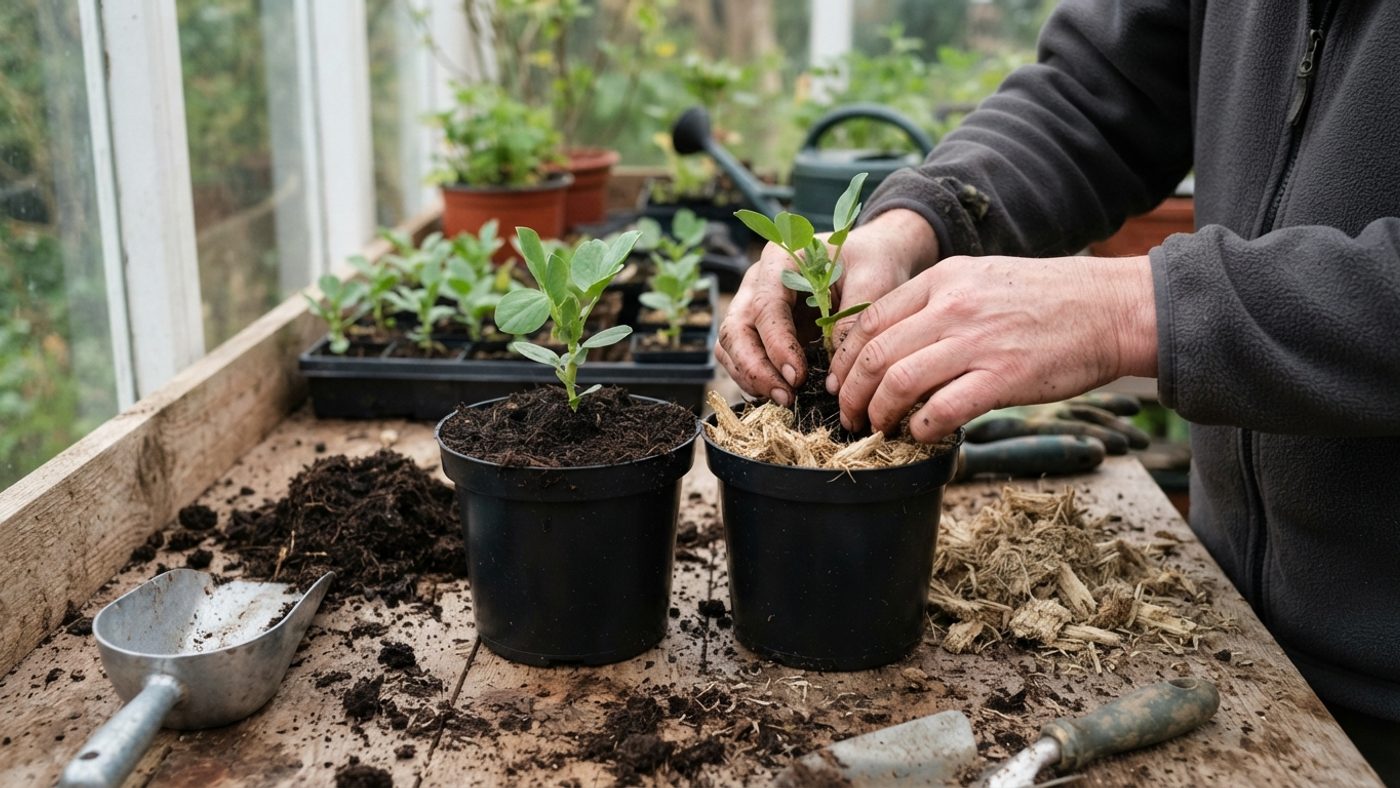
- Fill two pots with the suspect manure or compost, fresh and unused.
- Fill two more pots with ordinary garden soil or a different, known-clean growing medium as a control.
- Sow four broad bean seeds in each pot and water well.
- Stand the pots somewhere warm, a greenhouse, a propagator, or a bright windowsill indoors, since a cool spring or an unheated space slows germinationA seed sprouting: breaking dormancy and putting out its first root and shoot, given the right warmth and moisture. Full definition → enough to make the test harder to read, especially early in the season, keeping the compost lightly moist, and arrange them so drainage water from the suspect pots can't run into the control pots.
- Watch for three weeks.
If the beans in the suspect pots fail to come up, or emerge distorted, slow-growing, or fern-like compared with normal seedlings in the control pots, there are strong grounds to suspect aminopyralid or a related herbicide. As a further check, running the same test with radish seed alongside the beans is worth doing: radishes are unaffected by aminopyralid and clopyralid, so if the radishes also show damage, something other than herbicide residue is the more likely cause.
Straw bedding carries lower risk than hay or grass-based manure, since aminopyralid doesn't currently have approval for use on the cereal crops straw comes from, but this is a lower-risk category, not a guarantee, and it's still worth testing material intended for a food bed. Mixing a small amount of suspect material into a much larger volume of known-clean compost doesn't reliably make it safe either, the bioassay tests the mix you actually intend to use, so test at the dilution ratio a bed will really get, not the suspect material alone.
How long it lasts once it's in the ground
| Scenario | Typical persistence |
|---|---|
| Aminopyralid in manure generally | Over a year before residues break down |
| Manure that has been stacked | Two years or more |
| Guidance on replanting sensitive crops | Wait until the following growing season |
The practical result is that a single contaminated load can put a bed out of use for sensitive vegetables for a full season or longer, not just for a few weeks. Checking the region's actual growing-season length against that persistence window is worth doing before deciding whether to wait it out or work around the affected bed, losing a year matters more where the season either side of it is already short.
If you suspect a bed is already affected
Handle the material with the same basic precautions as any manure or soil amendment. Wear gloves when moving suspect manure or working an affected bed, wash your hands afterwards, and keep children and pets away from an open manure heap or a freshly dug bed until it's been worked in, ordinary manure hygiene, not a special aminopyralid precaution, but worth restating here since a bed under suspicion is exactly the kind of place a dog goes digging.
Remove any loose mulchA layer of material spread over the soil around plants to suppress weeds, retain moisture, and improve soil structure as it breaks down. Full definition → or manure still sitting on the surface immediately. Anything not yet fully incorporated into the soil is worth taking off site.
Rotovate or dig the soil repeatedly during warm weather to expose it to air and speed up the bacterial breakdown that eventually clears the residue, this helps the residue clear faster but doesn't make it instant, so it's worth doing alongside waiting out the season, not as a shortcut past it.
Hold off on replanting susceptible crops, tomatoes, potatoes, beans, peas, other legumes, and related vegetables, until the next growing season, and bioassay-test the bed itself with a pot of the actual soil before trusting it again.
Don't compost the damaged plants themselves. The same residue that stunted them is still in their tissue, and composting doesn't neutralise it any better the second time around, put affected plant material in general waste rather than the compost heap, so the problem doesn't spread into whatever that heap goes on to feed.
Report it. A 2019 wave of UK garden damage reports, prompted in part by wider press coverage of the issue, led Garden Organic, the Soil Association, and the Organic Growers Alliance to jointly raise the problem with the manufacturer, Corteva. Suspected incidents can be reported to Corteva (0800 689 8899, or by email with "Aminopyralid contamination" in the subject line) and to the Health and Safety Executive's Chemical Regulations DivisionPropagating a clump-forming perennial by digging it up and splitting it into several smaller pieces, each with roots and shoots attached. Full definition →, which reviews incident reports as part of monitoring the product's approval conditions.
If you're building a hotbed with fresh manure, the same risk applies before the manure ever gets near a food crop, see the guide to hotbed gardening in Scotland for sourcing manure safely and running a growth test ahead of committing a full hotbed's worth of material to a bed intended for food.
Common questions
Is there a lab test that can check a load of manure instead of the bean bioassay?
For a home gardener, no practical equivalent exists, the tests that can detect aminopyralid at the concentrations that damage plants are laboratory analyses aimed at commercial and regulatory use, not something offered as a routine consumer service. The bean bioassay is slower than a lab result would be, but it directly answers the question that matters for a food bed: whether the material, at the strength it’ll actually be used, damages a sensitive plant.
Is it safe to eat vegetables that show herbicide damage but still produce a crop?
Aminopyralid has low mammalian toxicity, and the concern with contaminated manure is crop damage and lost yield rather than a food-safety hazard in whatever the plant does manage to produce. That said, badly affected plants are often too stunted or distorted to crop reliably, and the more useful response is testing suspect material before planting rather than deciding what to do with an already-damaged crop.
Which vegetables are safest to grow if I’m not sure about my manure?
Grasses are naturally tolerant, aminopyralid is designed to spare grass while killing the broadleaf weeds growing among it, and cereals carry lower risk too, since the herbicide isn’t approved for use on the cereal crops straw comes from. Sensitive crops to avoid on unverified manure are tomatoes, potatoes, chillies, beans, peas, and other legumes. If you’re not confident in a load of manure, running the bean bioassay first is more reliable than picking crops by guesswork.
How is this different from ordinary transplant shock?
Transplant stress typically shows as wilting or slow establishment in the first week or two after planting, then resolves as the plant settles in. Herbicide damage instead shows up as a specific distortion of new growth, cupping, twisting, narrowing, fern-like leaflets, that continues or worsens over following weeks and tends to affect every plant grown in the same batch of soil or manure, not just one struggling transplant.
How do I find manure or compost I can actually trust?
There’s no supplier or label that guarantees a load is clear, since contamination traces back to what the animal ate or the grass was treated with, not to how the material was sold or bagged. Asking a stable, farm, or supplier directly whether they know the herbicide history behind their manure or compost is worth doing before taking a large quantity, but the bioassay is still the only way to actually confirm it before committing a full bed to it.
Sources
4 sources, recorded with what each was used for
- RHS: Weedkiller in Manure: What to Do: Persistence figures (over a year in manure, two years or more when stacked), affected crops, mechanism of transfer through livestock, straw/cereal approval status, general avoidance advice
- RHS: Weedkiller Damage: Recognise, Fix and Prevent: The step-by-step bean bioassay procedure, the radish cross-check, and foliar symptom descriptions (cupped/narrowed leaves, parallel veins, twisted stalks)
- Garden Organic: Worrying damage to plants from herbicide contamination in compost: The 2019 UK incident, the increase in reports following press coverage, and the joint engagement of Corteva by Garden Organic, the Soil Association, and the Organic Growers Alliance
- Health and Safety Executive: Issues associated with the use of farm yard manure containing aminopyralid residues: UK approval history (2006 approval, 2008 suspension, 2009 reauthorisation with restrictions), current use conditions, susceptible crop list, and the Corteva/CRD reporting process