
Hoverflies can't be bought. The way to get more in the garden is to create the right conditions, and here's how.
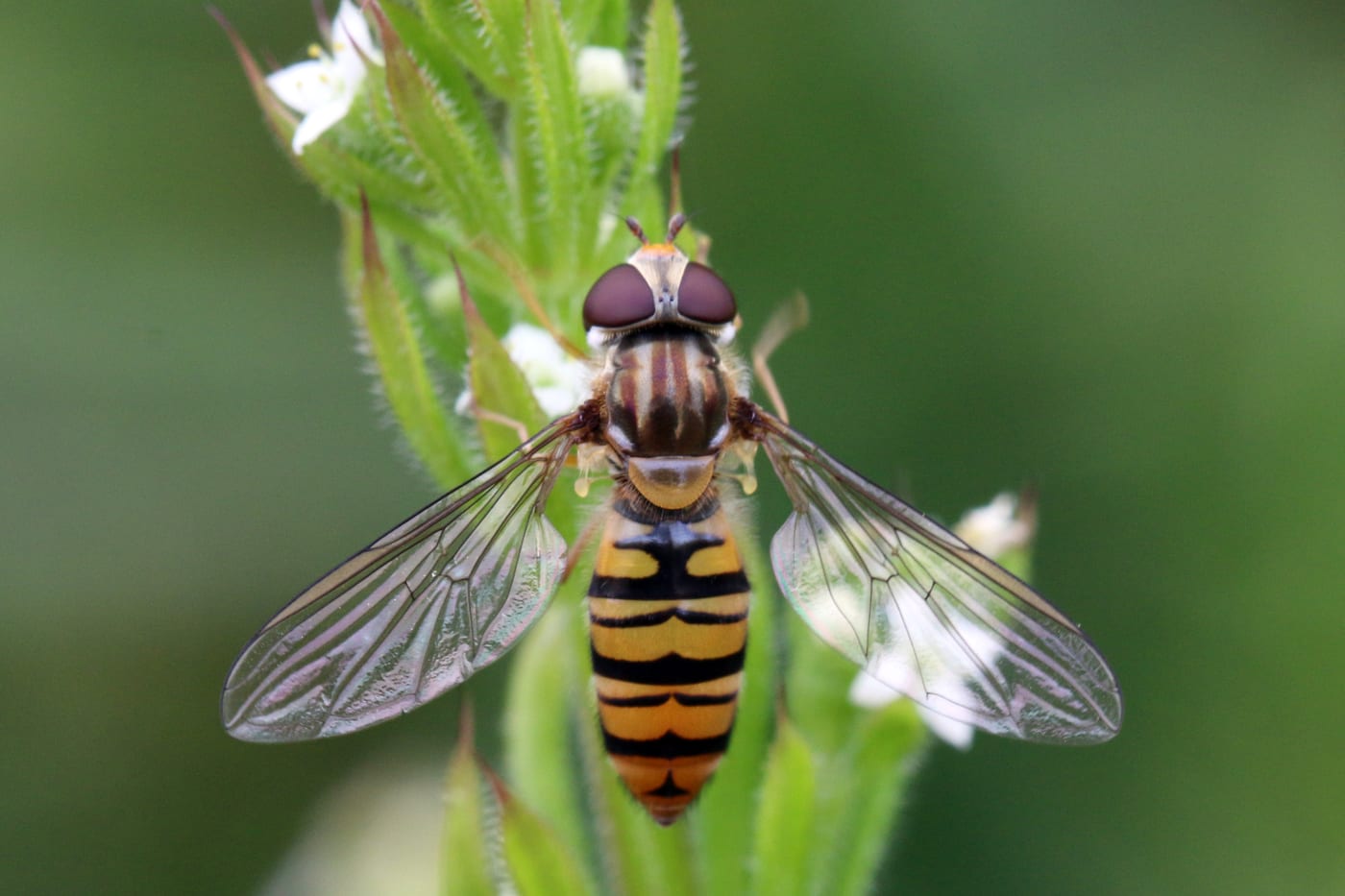
What does it look like?
Hoverflies are true flies, in the order Diptera and family Syrphidae; more than 280 of Britain's 6,000-plus fly species are hoverflies. They range from a few millimetres to 2cm long and have only one pair of wings, unlike bees and wasps, which have two. Many mimic wasps or bumblebees, with black-and-yellow stripes and bands, but hoverflies don't bite or sting. Larvae are legless maggots with no obvious head; some, including drone flies, grow a long breathing tube at the rear, earning them the name 'rat-tailed maggot.' The one pictured here, the marmalade hoverfly (Episyrphus balteatus), orange with alternating thick and thin black bands, is Britain's commonest and most familiar species, and the one most likely to turn up on a Scottish flower.
Life cycle
Females lay eggs singly or in small batches close to a food source for the larvae to find. Larvae pass through three stages, shedding their skin each time, before pupating in a pear-shaped pupa that ranges from whitish-brown to green. Depending on the species, adults either overwinter or live for only a few days.
Hoverflies do double duty: eating your aphids and pollinating your crops at the same time.
As a predator: RHS names hoverflies among aphid predators. Garden Organic separately recommends attracting them via diverse flowering plants.
As a pollinator: NatureScot treats hoverflies as key pollinators alongside bees, noting over 250 species in Britain and dedicating a leaflet to wasps and hoverflies.
How to encourage it
Pollinators need flowers producing lots of nectar for energy and pollen for protein. The key time for a garden to be in bloom for them is between March and October.
Hoverfly larvae have several different food sources depending on the species, and habitat can matter as much as planting: a log pile supports wood-feeding larvae, and a shallow water feature (a 'hoverfly lagoon') supports species whose larvae develop in water or wet debris. Tolerating some aphids on a few plants, rather than removing every one, also gives predatory larvae something to eat.
Avoid using insecticides where hoverflies are wanted; they don't discriminate between the aphids being targeted and the hoverflies (and other predators) that would otherwise deal with them.
Plant these near the crops that need help:
- Alyssum: grown near a crop, its nectar and pollen attract aphid predators including hoverflies.
- Phacelia (fiddleneck): lavender-blue summer flowers with pollen held on long filaments that's easy for hoverflies to reach; also usable as a green manure if dug in rather than left to flower.
- Ivy: flowers late, in autumn, when little else is in bloom, giving hoverflies a nectar source once most other flowers are over.
Alyssum is only reliably hardy in mild, sheltered parts of Scotland, so sow it in spring once frost risk has passed. Phacelia is hardier and can be sown in situ in spring or early autumn. Ivy is planted rather than grown from seed for this purpose, and its main value is timing rather than quantity: it flowers later than most garden plants, extending the nectar season into autumn.
Why this matters in Scotland
The marmalade hoverfly, the species pictured on this page, has 7,701 recorded sightings on NBN Atlas Scotland, the national biodiversity records database, as of 2026-08-04.
That's a genuinely well-established, everyday garden presence, not a rare or occasional visitor, and it fits with Wildlife Trusts' own note that the species is active in Britain right through the year, not just at the summer peak.
What it helps control
Whitefly, leafhoppers and scale insects are also on the menu for hoverfly larvae, not just aphids; about 40% of Britain's hoverfly species prey on aphids specifically. Other larvae feed on rotting wood or pond debris rather than on insects at all, which is why habitat, not just planting, matters for encouraging the group as a whole.
Frequently asked questions
Can I buy hoverflies?
Not usefully: hoverflies released into a garden with nothing to hold them there simply leave. Creating the right habitat and food source is what actually keeps a population around; see "How to encourage it" above.
How do I know if hoverflies are actually helping?
Watch the pest population, not the predator count: fewer aphids, glasshouse whitefly over a few weeks is the real sign, not how many hoverflies you can spot on a given day.
Do hoverflies only deal with the pests listed above?
No, also scale insects and leafhoppers, among other sap-sucking prey. The list above is what they're best known for, not the full extent of what they take.
When will I actually see hoverflies in the garden?
It depends on the stage in their life cycle — see "Life cycle" above for when they're active and what to expect through the year.
Sources
10 sources, recorded with what each was used for
- RHS: For Aphids: RHS names hoverflies among aphid predators.
- RHS: For Glasshouse Whitefly: RHS's dedicated hoverflies page: about 40% of Britain's hoverfly species prey on aphids as larvae, and larvae can also prey on other sap-sucking garden insects including whitefly, leafhoppers and scale insects. RHS's dedicated hoverflies page: identification (order Diptera, family Syrphidae, over 280 of Britain's 6,000+ fly species, size range, one pair of wings, wasp/bee mimicry, larva appearance), life cycle (eggs, three larval stages, pupa, variable overwintering), diet, and encouragement advice (plant list, avoiding insecticides, log piles and a 'hoverfly lagoon' for water-dependent larvae).
- Garden Organic: supports attracting hoverflies via diverse flowering plants as an evidence-based ecosystem approach
- NatureScot: NatureScot treats hoverflies as pollinators; over 250 species in Britain
- RHS: Alyssum's nectar and pollen attract predators of aphids.
- RHS: RHS's 'top plants for hoverflies' page: ivy's late, nectar-rich autumn flowers, and the 2022 finding that UK hoverfly distribution has declined 44% since 1980, with some species now on the IUCN Red List.
- RHS: Phacelia tanacetifolia is propagated by sowing seed in situ in spring or early autumn, and is rated H4: hardy through most of the UK, down to -10 to -5°C.
- RHS: Alyssum (Lobularia maritima) is propagated by sowing seed in situ in spring, and is rated H3: hardy in coastal and relatively mild parts of the UK, not reliably hardy everywhere.
- Wildlife Trusts: The marmalade hoverfly is Britain's most common and familiar hoverfly species, identified by its orange body with thick and thin black bands, and active in Britain right through the year.
- NBN Atlas Scotland: NBN Atlas Scotland's marmalade hoverfly species page recorded 7,701 sightings in Scotland as of 2026-08-04.