
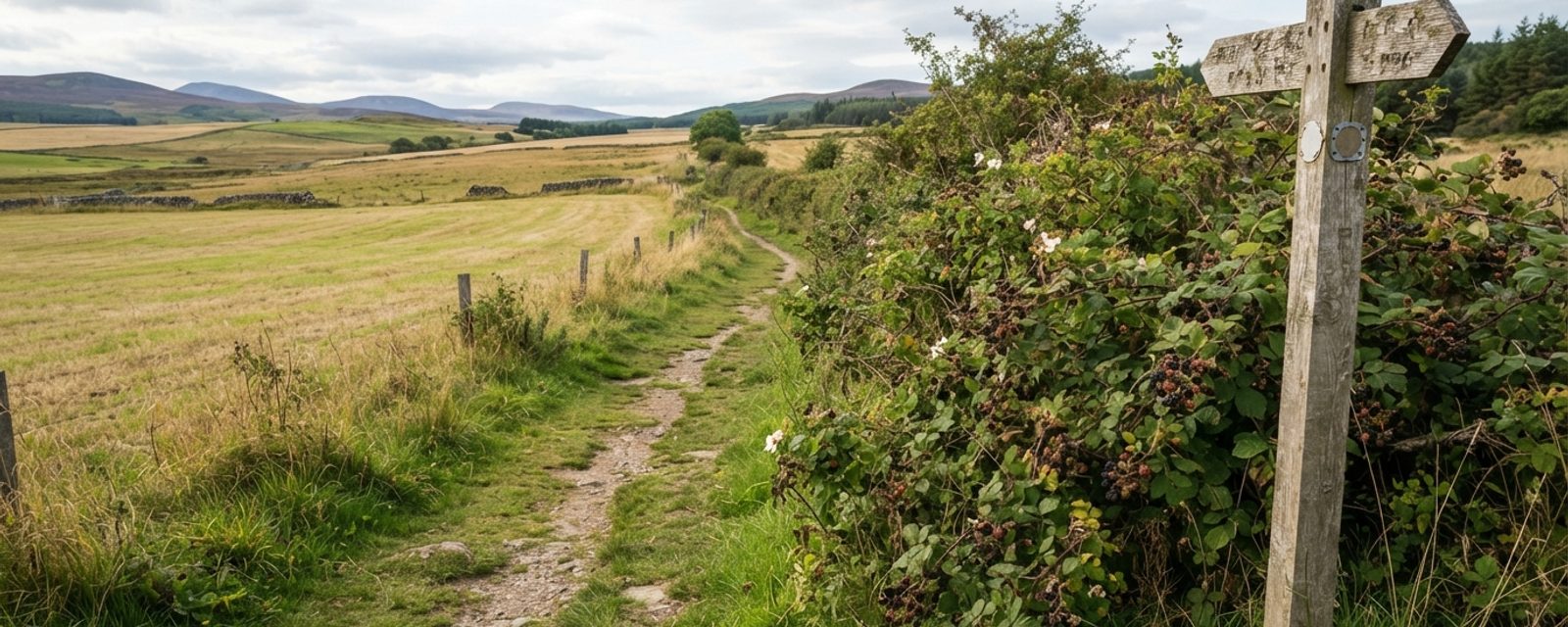
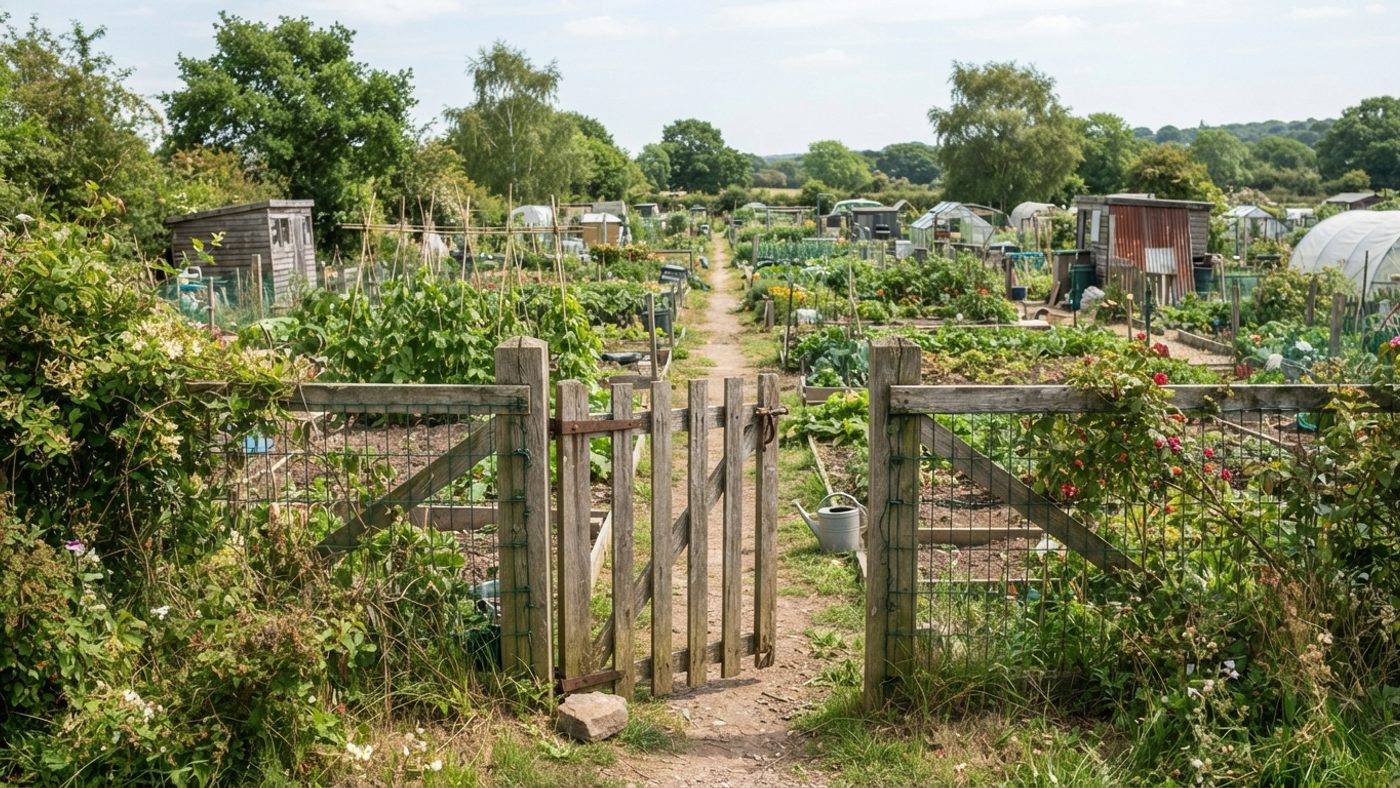
You're walking a core path along a field edge, and the hedgerow beside you is heavy with brambles or wild rosehips. Are you allowed to pick them? Or maybe you hold an allotment plot and have started wondering whether the site's shared paths count as public ground that anyone can walk through, right up to your fence line. Both questions come back to the same piece of legislation: Part 1 of the Land Reform (Scotland) Act 2003.
Quick answer
Scotland's access right covers most land and water for recreational purposes, exercised responsibly, but it specifically excludes private gardens, growing crops, and land close enough to a house to affect privacy. On a path you have a right to be on, picking a personal, non-commercial amount of wild fruit or fungi is allowed; digging up the plant it grew on is a separate offence under different legislation. Whether an allotment plot itself counts as excluded "garden" ground isn't stated anywhere in the law or the official guidance, so your site's actual tenancy agreement is what settles it in practice.
The statutory right, in plain terms
Section 1 of the Act gives everyone statutory access rights over land and inland water in Scotland, for recreational purposes, for crossing land, and for certain educational and commercial purposes that could otherwise be carried out non-commercially. These rights apply "above and below (as well as on) the surface of the land" and extend to all land except what is specifically excluded under Section 6.
It is not a right to do whatever you like wherever you like. Section 2 conditions the right on exercising it responsibly: you're presumed to be acting responsibly if you don't cause unreasonable interference with the rights of others, but that presumption fails if you're doing things the Act treats as incompatible with responsible access (hunting, shooting, fishing without a right to do so, improper vehicle use) or if you're ignoring the guidance in the Scottish Outdoor Access Code, which NatureScot maintains as the official interpretive guide to what "responsible" looks like in practice. That guidance also covers dogs and livestock directly: keep a dog under close control near farm animals, on a short lead around lambing fields and ground-nesting birds, and expect to be asked to keep clear of a field while livestock, especially cattle with calves, are in it, a real consideration on the same field-edge paths where hedgerow foraging happens.
What's excluded, and where private gardens fit
Section 6(1) lists the categories of land access rights don't apply to. The categories that matter most to a gardener or allotment-holder are:
| Excluded category | What it covers |
|---|---|
| Buildings, structures, works, fixed machinery | Land occupied by a building, or by a caravan, tent, or other place giving someone privacy or shelter |
| Curtilage and school land | The curtilage (land immediately around and forming part of the same plot as) non-residential buildings, plus school land used for school purposes |
| Land adjacent to houses | Land providing a reasonable measure of privacy to those in a house, or needed for their enjoyment of it |
| Private gardens | Land which is a garden, whether or not the house it belongs to also has a right of access over it |
| Sports and recreation land | Land developed or laid out as a sports or playing field, or for a particular recreational purpose |
| Growing crops | Land with crops that have been sown or are growing |
| Fee-charging land | Land where the public is required to pay for entry on 90 or more days a year |
The Access Code's own guidance on houses and gardens describes what actually marks land out as a "garden" for these purposes: a clear boundary (wall, fence, hedge, or a natural feature like a stream), a lawn or mown grass, flowerbeds and tended shrubs, paving and water features, sheds and glasshouses, and vegetable or fruit gardens attached to a house, often walled, sometimes some distance from it. Large estates with wider grounds, what the Code calls "policies", an old estate-management term for the designed, ornamental land around a big house, get a split treatment: the intensively managed area near the house is excluded as garden, but the wider, less-managed grassland and woodland beyond it remains open to access rights even if it's enclosed.
The growing-crops exclusion is temporary, not a permanent status for the field. Access rights don't apply while a crop is actually sown or growing, but once it's harvested, the ground reverts to being covered like any other field. That matters for anyone growing on a larger scale, a smallholding or market garden bordering a path: the exclusion tracks what's currently in the ground, not the field's use in general.
Does that exclusion cover an allotment plot?
The Act's private-garden exclusion is framed around land attached to a house, and the Access Code's description of what makes something a garden, boundary, mown grass, flowerbeds, shed, walled vegetable patch, describes a domestic garden physically connected to a dwelling. An allotment plot on a dedicated allotment site, held under a local-authority tenancy rather than as part of a house's curtilage (the legal term for the land immediately around and forming part of the same plot as a building), doesn't obviously match that description. Neither NatureScot's access guidance nor the Scottish Government's Part 9 Community Empowerment (Scotland) Act 2015 guidance for local authorities on allotments states directly whether a plot, or an allotment site as a whole, falls inside or outside the Section 6 garden exclusion.
The exclusion for land with "a building or other structure... or a caravan, tent or other place affording a person privacy or shelter" would plausibly cover a shed, polytunnel, or similarly enclosed structure on a plot, the same as it would anywhere else. Whether the cultivated plot itself, or the site's internal paths, count as excluded garden ground is a fact-specific question the law simply doesn't answer. In practice, the document that actually governs who can be on a specific site is usually the local authority's allotment tenancy agreement or the rules set by the allotment association, not the Land Reform Act directly, check that agreement for a definitive answer about your own site. That's also a separate question from whether you're entitled to be allocated a plot in the first place, which is a right created by the Community Empowerment (Scotland) Act 2015, not by access-rights legislation.
A committee-run site with a perimeter fence, gate, and signage restricting entry may be relying on the tenancy agreement and ordinary landholding control rather than any specific claim that the whole site is excluded garden land, the Act itself doesn't say which applies, so a fence alone doesn't prove the statutory basis either way. A fenced, cultivated individual plot with a shed or greenhouse has a reasonable case for being treated like the garden of a house even if the wider site's own status is unclear, and nobody has an automatic right to walk through your growing beds regardless of how the wider site is classified.
Foraging along a path you're walking under access rights
Access rights extend to almost all land and water, not just formally designated routes, but a "core path" is worth defining since it's the clearest example: local authorities are required to draw up a Core Paths Plan under the Act, a network of paths they've identified as giving the public reasonable access across their area. A core path is a good, signposted example of where you're clearly covered, but it isn't the boundary of the right, the field margin beside it is generally covered too. NatureScot's guidance on collecting wild food says that customary picking of wild fungi and berries for your own consumption isn't affected by the legislation. Personal, non-commercial foraging, often summarised in general UK foraging guidance as the "four Fs" (fruit, foliage, flowers and fungi), a convenient mnemonic rather than a Scotland-specific legal term, is generally compatible with responsible access.
What isn't covered: taking anything away for commercial purposes or for profit is specifically excluded from access rights, and commercial-scale collection needs the landowner's permission. The guidance also points foragers toward the Scottish Wild Mushroom Code for fungi-specific practice, worth following as more than a legal formality, since misidentifying an edible-looking fungus for a toxic look-alike is the real hazard in mushroom foraging, not the access-rights question.
A separate, older piece of legislation matters here too. Section 13 of the Wildlife and Countryside Act 1981 makes it an offence for anyone who isn't an authorised person to intentionally or recklessly uproot any wild plant not listed in Schedule 8 of the Act, a rule that exists independently of the 2003 access legislation and applies whether or not you're exercising access rights at the time. Plants listed in Schedule 8, rarer, specially protected species, carry stronger protection again: for those, the restriction covers picking and cutting as well as uprooting, removing any part of the plant without a licence is against the law. For common hedgerow fare like brambles and rosehips this rarely bites, but "I only picked it, I didn't dig it up" isn't a blanket defence if the plant turns out to be a Schedule 8 species. Some individual sites, National Nature Reserves, Forestry and Land Scotland land, and some country parks, also set their own byelaws that can further restrict or ban foraging on that specific site, on top of the general access-rights and 1981 Act position, local signage or the site manager's own guidance takes precedence where it applies. Sites of Special Scientific Interest (SSSIs) can carry their own additional restrictions on picking or disturbing protected plants too, separate from the Schedule 8 list, if a hedgerow or wood you're foraging in sits within an SSSI, check for posted notices before assuming the general rules are all that apply.
In practice: pick the rosehips or brambles from a hedgerow you're passing on a path you have a right to be on, but don't dig up the plant they're growing on without the landowner's permission.
Scotland versus England and Wales
Scotland's access right has no direct equivalent south of the border. England and Wales operate under the Countryside and Rights of Way Act 2000, which grants a right of access only over mapped "access land", land that is wholly or predominantly mountain, moor, heath, or down, plus registered common land and some dedicated or coastal land. Gardens, farmland, and most of the ordinary countryside are excluded outright, and the right doesn't extend to a general presumption of access to land and inland water the way Scotland's does. Scotland's Land Reform Act, by contrast, starts from a right over most land and water and works backward from a specific exclusions list, a meaningfully broader default than the English and Welsh model.
Common questions
Can I pick brambles or rosehips growing over a path on someone else’s land in Scotland?
Yes, if you're exercising access rights responsibly on land those rights apply to, and you're taking a personal, non-commercial amount for your own consumption.
Is it legal to forage mushrooms in Scotland for personal use?
Customary picking of wild fungi for your own consumption isn't affected by the access legislation, though it should be exercised responsibly and in line with the Scottish Wild Mushroom Code.
Can I sell foraged produce I picked while exercising access rights?
No. Taking anything away for commercial purposes or for profit falls outside access rights and needs the landowner’s permission.
Is it illegal to dig up a wild plant in Scotland?
Uprooting a wild plant not listed in Schedule 8 of the Wildlife and Countryside Act 1981 without being an authorised person, and doing so intentionally or recklessly, is a separate offence from anything in the access legislation. Schedule 8 species carry stronger protection still, covering picking and cutting as well as uprooting.
Does the public have a right to walk through my allotment site in Scotland?
There's no settled answer either way in the statute itself, so don't assume one. Whoever manages your site, the local authority or your allotment association, sets the practical rules on entry through the tenancy agreement, and that's the document worth checking rather than trying to reason it out from the Land Reform Act directly.
Is Scotland's right to roam the same as England's?
No. In Scotland you can walk a field margin or cross ordinary farmland responsibly without needing a mapped route or a public right of way. In England and Wales, that’s only lawful on land specifically mapped as open-access land, or on a formal public right of way — most ordinary countryside isn’t covered at all.
Sources
8 sources, recorded with what each was used for
- Land Reform (Scotland) Act 2003, Part 1: The general right of access (Section 1) and responsible exercise (Section 2)
- Land Reform (Scotland) Act 2003, Section 6: The full list of land excluded from access rights, including the private garden exclusion
- Scottish Outdoor Access Code: Houses and gardens: The practical description of what counts as a "garden" and how estate policies/grounds are treated
- Scottish Outdoor Access Code: Collecting wild food: Foraging guidance: personal versus commercial use
- Scottish Outdoor Access Code: Land Reform Act - Legal: Confirming the responsible-access framework referenced from the Act
- Wildlife and Countryside Act 1981, Section 13: The uprooting-wild-plants offence and Schedule 8 species protection
- Countryside and Rights of Way Act 2000, Part I: The England/Wales contrast on mapped open-access land
- Allotments: guidance for local authorities, Part 9 Community Empowerment (Scotland) Act 2015: The statutory framework for allotment tenancies and site management, which does not itself address public access rights