
Celery Leaf Spot is a common disease that affects celery in Scotland. Here is what it looks like, the conditions it needs, and the controls that actually work.
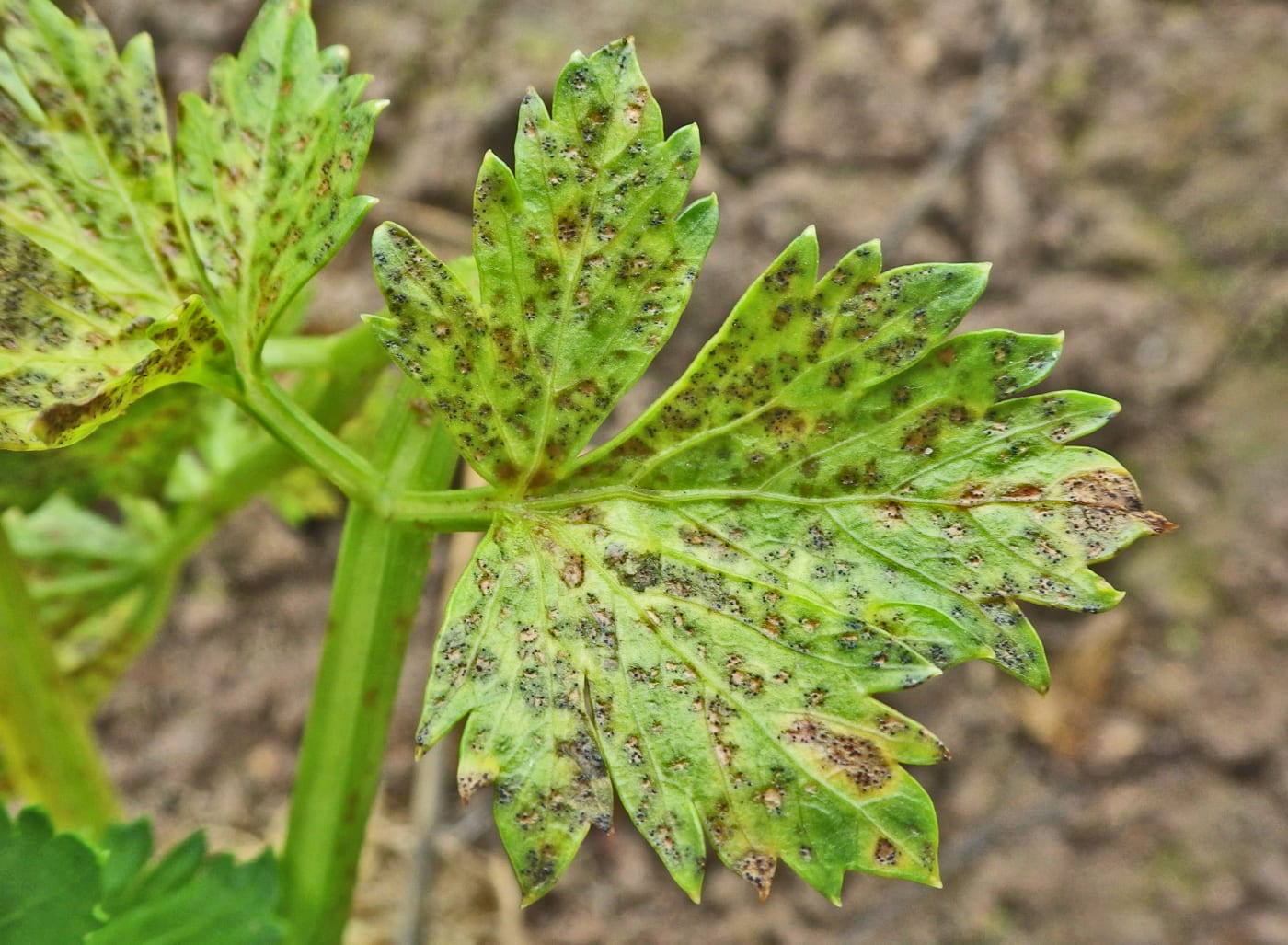
What does it look like?
Small, light yellow spots appear on the leaves and leaf stalks (petioles), gradually turning brown. The spots vary in shape and can merge into larger patches where the infection is heavy. Look closely and you can see minute black dots, called pycnidia, inside the spots: these are the fungus's own spore-producing structures, and they're the clearest way to tell this apart from other leaf discolouration.
What causes it
Pacific Northwest Extension calls this disease 'late blight', but the name is misleading: infections often start early in the season rather than late, particularly in cool, damp regions. The fungus spreads in water, and on tools, hands and workers moving through wet foliage, so working around plants while they're still wet from rain or dew spreads it further.
Symptoms
A seriously infected leaf dies outright rather than just looking marked, and the same spotting appears on the leaf stalks as on the leaves themselves.
Life cycle
The fungus overwinters on dead celery plant debris left in the ground or nearby. The main way it gets into a new planting is through infected seed, where it survives either on the seed coat or inside the seed itself; the fungus in the seed dies naturally within about two years, so older seed carries less risk than freshly infected seed. Once established, it spreads through the growing season via water, and on tools and hands moving between wet plants.
Why this matters in Scotland
The early-season infection pattern and the fungus's own preference for cool, damp conditions both point the same direction for a Scottish garden: this isn't a disease that needs a hot summer to get going, and a damp Scottish spring gives it exactly the start it needs.
Controls: what actually works
All the methods below are backed by real evidence, not just repeated folklore.
Remove any leaves with dry patches or spots as soon as you see them
Removing infected foliage cuts down the amount of actively spreading disease on the plant.
Rotate celery and celeriac together as one crop, avoiding the same ground for three to four years
Celery and celeriac carry the same risk since they're the same species, so avoid growing celery where either has grown in the past few years. A three-to-four-year gap before returning celery to the same ground is a specific figure worth aiming for.
Choose a resistant variety where leaf spot has been a recurring problem
'Granada' is the one named UK variety with resistance bred in. Varietal resistance is genuinely real: separate British Columbia trials over two growing seasons found 'Pilgrim', 'Tendercrisp' and 'T.U. 52-70 HK' resistant, 'Deacon' intermediate, and 'Bishop' and 'T.U. 52-70' susceptible, though those specific cultivarsA plant variety that arose or was bred under cultivation and is kept true by deliberate propagation, rather than a naturally occurring wild species. Full definition → aren't the ones typically sold in the UK.
Buy seed from a reputable supplier, and avoid working around wet plants
Since infected seed is the main way this disease gets into a new planting, and the fungus in seed dies out naturally within about two years, using properly sourced seed cuts off the main entry route. Once plants are growing, avoid working among them while foliage is wet, since that's how the fungus spreads between plants on hands and tools.
Water at the base of the plant rather than overhead, and space plants to give foliage room to dry
Since the fungus spreads in water and needs wet foliage to infect, avoiding overhead watering and giving plants enough space for air to move between them both work directly against the mechanism.
If saving your own seed, or buying seed of uncertain origin, treat it in hot water before sowing
Pacific Northwest Extension gives a specific protocol: treat one- to two-year-old seed in water at 118°F (about 48°C) for 30 minutes. This kills seed-borne infection without needing to discard otherwise good seed.
Frequently asked questions
What should I do first if I find celery leaf spot in my garden?
Start with remove any leaves with dry patches or spots as soon as you see them. After that, rotate celery and celeriac together as one crop, avoiding the same ground for three to four years. Work through the rest in order of how well-evidenced they are if the first two aren’t enough on their own.
Is there a spray that works?
No. There are no amateur chemical treatments available for celery leaf spot. The controls that work are cultural: the measures listed above.
How much of this advice is actually proven?
Every control listed above is evidence-based, not just repeated folklore. None of it is a guess.
Sources
2 sources, recorded with what each was used for
- RHS1: naming the disease, the celeriac cross-risk, the leaf-removal control, and 'Granada' as a named resistant variety
- Pacific Northwest Extension18: causal species, full identification and symptom detail, the seed-transmission and water/tool-spread mechanisms, specific rotationMoving each crop family to different ground each year, on a multi-year cycle, so pests and diseases that build up in soil don't get a repeat host. Full definition → length, and independent confirmation that varietal resistance is real