
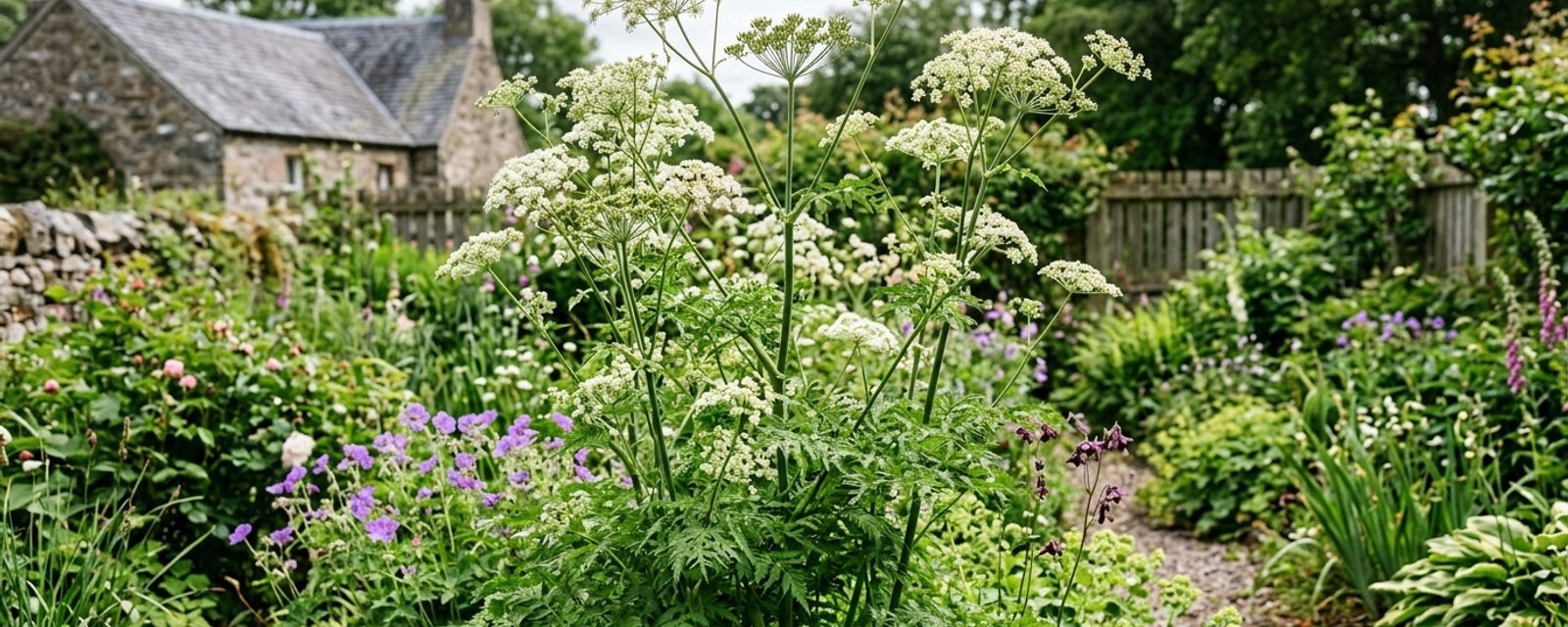
Myrrhis odorata
Sweet cicely isn't actually native to Scotland, despite a common reputation to the contrary, but it might as well be: genuinely naturalised here for centuries, with a real Gaelic name, Mirr, and over 12,000 recorded Scottish sightings.
This is a hardy, deciduous perennial grown for aniseed-flavoured leaves, dying back to the ground each winter and returning in spring, with an H5 hardiness ratingThe RHS's H1a–H7 scale for how much cold a plant can survive outdoors, H1a being tender indoor-only and H7 hardy anywhere in the UK. Full definition → meaning no winter protection is ever needed. The real thing to know before growing it is that it looks like several other members of the carrot family, some of them genuinely dangerous, so correct identification matters more here than the growing itself. It's an early flowerer too, worth knowing since it's among the first plants in the garden with much to offer pollinating and beneficial insects each year.
Planting
Propagate by seed or by divisionPropagating a clump-forming perennial by digging it up and splitting it into several smaller pieces, each with roots and shoots attached. Full definition →, in spring or autumn. Choose a site with moderately fertile, moist but well-drained soil; RHS lists partial shade specifically, while Gardener's World gives a wider tolerance running from full sun through partial shade. It tolerates acid, alkaline or neutral soil, so pH isn't a real constraint here. Give it real room: RHS puts a mature plant at 1-1.5m tall and 0.5-1m wide, Gardener's World a larger 2m by 1.5m.
Care
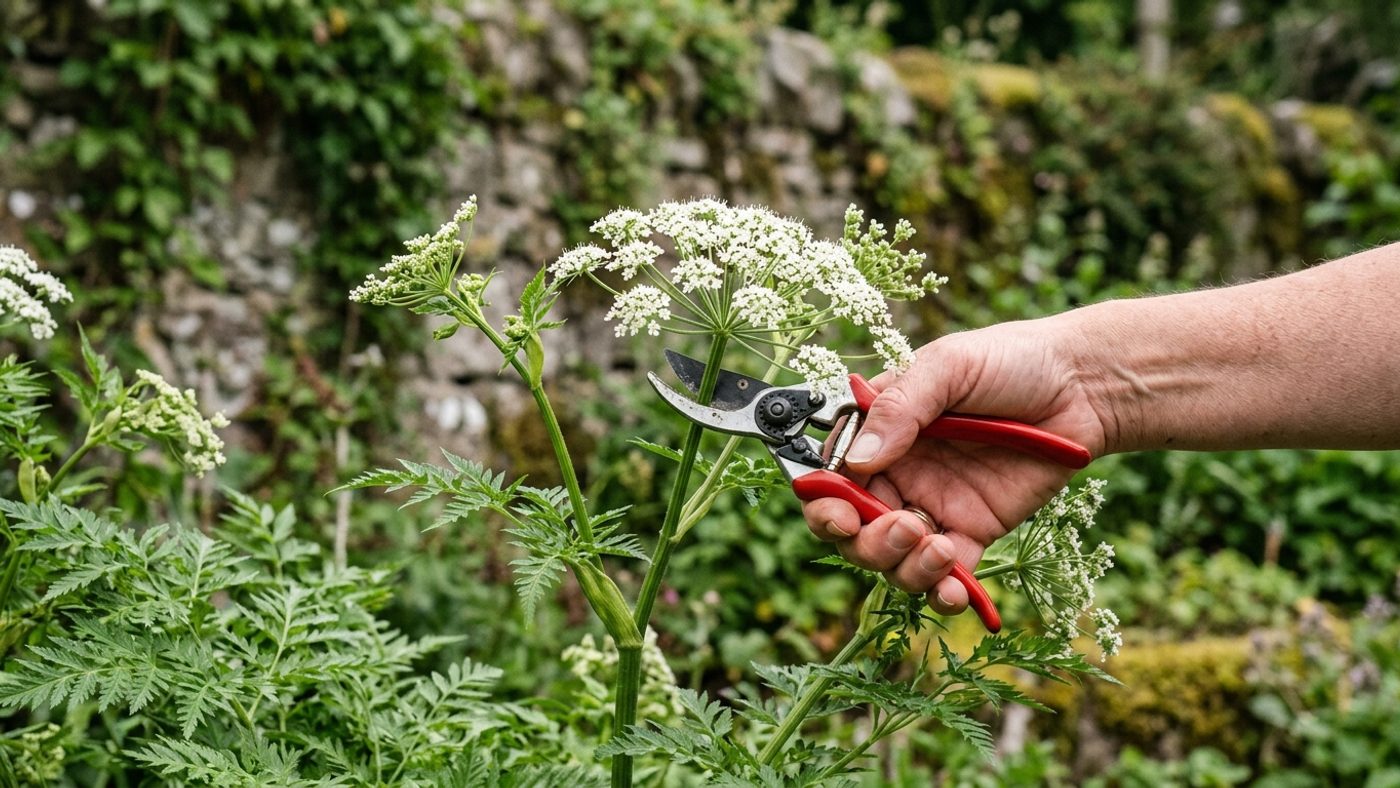
Once established, sweet cicely needs very little routine attention: no winter protection, and no chemical intervention for pests or disease, since it's rated generally free of both. Remove flower stalks as they develop, which improves leaf quality for cooking and also limits how much the plant seeds around if you'd rather it didn't spread.
Harvesting
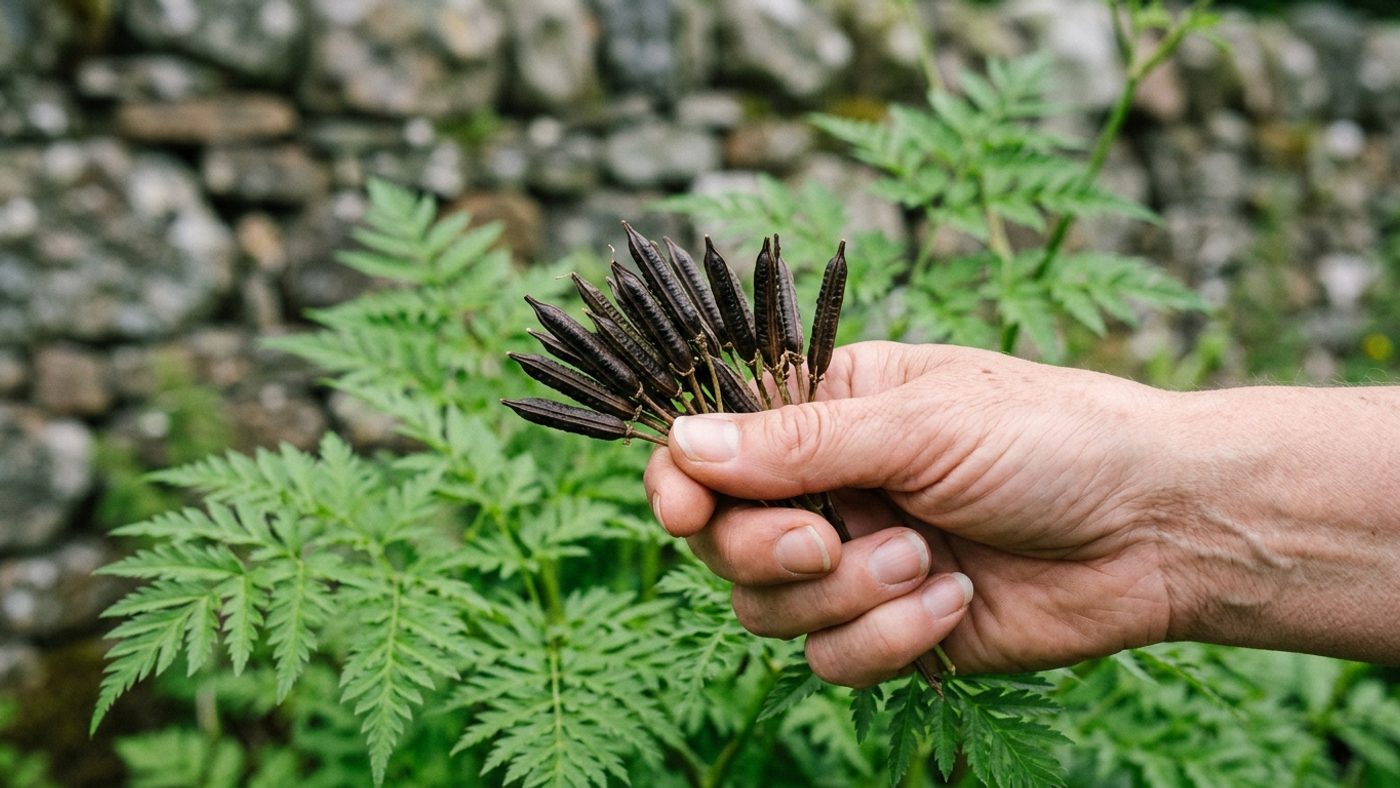
Pick leaves through spring and summer for their sweet, aniseed flavour, traditionally used to sweeten tart fruit like rhubarb or gooseberries, as well as in salads and with fish. Seeds can be gathered in summer once the flowers have set, with a stronger aniseed flavour than the leaves.
Common problems
The one genuine risk here isn't a pest or disease at all: correctly identifying the plant. Sweet cicely resembles several other members of the carrot family, including hemlock, which is deadly poisonous. Familiarity with umbellifers generally is essential before foraging any wild plant in this family; grown deliberately from known seed or a known plant in your own garden, this risk doesn't apply.
Common questions
Is sweet cicely actually native to Scotland?
No: both its official plant record and the national botanical recording body class it as introduced, not native to Britain or Ireland, with its true origin in central and southern Europe. Full sourced breakdown: <a href="/tools/garden-myths/sweet-cicely/">Sweet Cicely Myths →</a>
Is sweet cicely safe to grow and forage, given it looks like other umbellifers?
Not by leaf shape alone: leaf shape genuinely isn't reliable, even for experienced eyes, since sweet cicely can grow near deadly poison hemlock. Crush a leaf and check for a strong aniseed smell, and check the stem for hemlock's purple blotching, before harvesting anything you're unsure of. Full sourced breakdown: <a href="/tools/garden-myths/sweet-cicely/">Sweet Cicely Myths →</a>
Does sweet cicely need full sun or shade?
Sources genuinely differ. RHS lists it for partial shade specifically; Gardener's World gives a wider tolerance, full sun through partial shade. Either way it copes with some shade better than most Mediterranean herbs, which makes it a genuinely useful option for a spot that doesn't get all-day sun.
Will sweet cicely take over the garden?
It's a substantial plant either way: RHS gives 1-1.5m tall by 0.5-1m spread, Gardener's World a larger 2m by 1.5m. Removing flower stalks as they appear keeps leaf quality up and is also the practical way to stop it setting seed if you don't want it spreading beyond where you planted it.
Sources
4 sources, and what each was used for
- RHS: hardiness (H5), site/soil requirements and pH direction, size, native range (explicitly NOT native to GB/Ireland), propagation methods, flower-stalk removal for leaf quality, pest/disease-free rating
- gardenersworld.com: a genuinely different size figure (2m x 1.5m against RHS's 1-1.5m x 0.5-1m) and a wider sun tolerance (full sun through partial shade against RHS's partial-shade-only), both shown as real differences; corroborates spring/autumn propagation and flower-stalk removal; the traditional use sweetening tart fruit and its cottage-garden history
- scotland-species.nbnatlas.org: confirms non-native, established status and genuinely widespread Scottish naturalisation (12,479 Scottish records) — the real Scottish-specific angle for this crop's native-range question
- nature.scot: the Gaelic name (Mirr), traditional foraging/culinary use, and the genuine hemlock look-alike safety warning — a real Scottish cultural and safety angle neither RHS nor Gardener's World gives